A passport application can feel deceptively simple: submit your documents, pay the fee, and wait. The problem is that the official “processing time” does not necessarily tell you when the passport will actually arrive at your door.
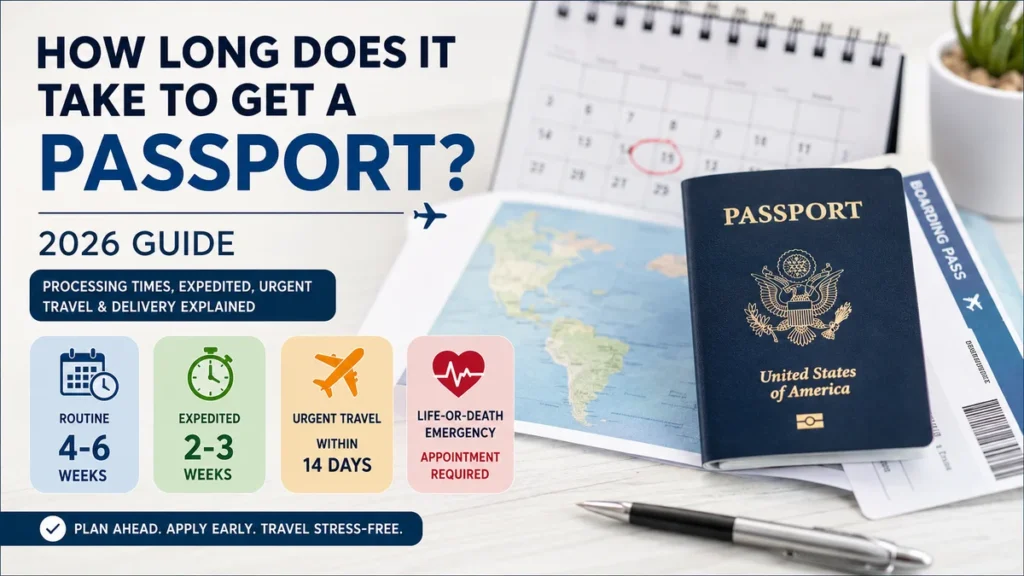
So, how long does it take to get a passport in the United States in 2026? According to the U.S. Department of State, routine passport processing currently takes 4–6 weeks, while expedited processing takes 2–3 weeks. These estimates do not include mailing time, which can add up to two weeks before processing and another two weeks afterward.
Quick answer: A U.S. passport currently takes 4–6 weeks for routine processing or 2–3 weeks with expedited service. However, the Department of State says mailing can take up to two weeks in each direction, so your total door-to-door timeline may be longer than the official processing estimate.
How Long Does It Take to Get a Passport in 2026?
The time required depends mainly on the service you select and how quickly your application and completed passport move through the mail.
Here is a practical overview based on current U.S. Department of State guidance:
| Service | Government Processing Time | Additional Considerations |
|---|---|---|
| Routine service | 4–6 weeks | Mailing time is additional |
| Expedited service | 2–3 weeks | Additional $60 expedite fee |
| Urgent travel | Appointment required | International travel within 14 calendar days |
| Life-or-death emergency | Appointment required | Must meet emergency eligibility requirements |
The most common mistake is treating the 4–6 week routine estimate as a guaranteed door-to-door delivery window. It isn’t.
The State Department specifically separates processing time from mailing time. Your application can take up to two weeks to reach a passport agency or center, and the finished passport can take up to another two weeks to reach you after it is mailed.
That means you should apply well before an international trip rather than counting backward exactly six weeks from your departure date.
Passport Processing Time vs. Total Delivery Time
Understanding this distinction makes passport planning much easier.
Processing time
Processing begins when your application reaches a passport agency or processing center.
For routine service, the current processing estimate is:
4–6 weeks
For expedited service, it is:
2–3 weeks
These estimates represent the government’s processing period rather than the complete time between submitting an application and holding your passport.
Mailing your application
If your application needs to be mailed, the Department of State advises allowing up to two weeks for it to arrive.
Your application may arrive much sooner, but you should not build travel plans around the fastest possible scenario.
Receiving your new passport
Once processing is complete and your passport has been printed and mailed, standard delivery can take up to another two weeks.
Faster return delivery is available for eligible passport books. The Department of State currently offers a paid 1–3 day delivery option. Passport cards are handled differently and are sent through First Class Mail.
What does that mean in practice?
For routine service, a conservative timeline can look like this:
- Application travels to processing facility — up to 2 weeks.
- Government processes application — 4–6 weeks.
- Passport travels back to applicant — up to 2 weeks.
The outer planning window can therefore reach approximately 8–10 weeks when the maximum mailing allowances are included.
That doesn’t mean every routine application takes 10 weeks. Many arrive sooner. It simply explains why travelers should distinguish the published processing estimate from their total potential wait.
Quick Takeaway: If your trip is eight weeks away, don’t assume a 4–6 week processing estimate automatically gives you plenty of time. Mailing, application problems, and seasonal demand can reduce that buffer.
How Long Does Expedited Passport Processing Take?
If routine service is too slow, expedited processing can significantly reduce the government processing period.
Current expedited passport processing takes approximately 2–3 weeks, compared with 4–6 weeks for routine applications. The expedited service fee is an additional $60.
Again, those 2–3 weeks do not automatically include all mailing time.
For example, an applicant might choose expedited processing but use slower delivery methods. That can reduce some of the time saved by paying for faster government processing.
If timing matters, consider the entire journey:
- Delivery of the application
- Passport agency processing
- Return delivery of the passport
The State Department recommends considering faster delivery options when you need your passport quickly.
Is expedited service guaranteed to take two weeks?
No.
The published range is an estimate, not a promise that every application will be completed exactly two weeks after submission.
Application problems can also interrupt normal processing. A missing signature, unacceptable passport photo, incorrect fee, missing previous passport, or incomplete form may result in the government requesting additional information.
Responding quickly to such requests can help prevent an avoidable delay.
How Long Does It Take to Get a Passport for the First Time?
A first-time adult passport application generally follows the same published government processing windows:
- Routine: 4–6 weeks
- Expedited: 2–3 weeks
The process itself differs from a standard renewal, however.
First-time applicants generally need to apply in person at an authorized passport acceptance facility. These facilities can include participating post offices, libraries, and local government offices. The State Department also holds passport acceptance fairs in some locations.
This creates another timeline people sometimes overlook: appointment availability.
If the nearest acceptance facility cannot see you immediately, the days you spend waiting for an appointment occur before your application enters the official processing system.
For that reason, someone asking “how long will my first passport take?” should consider:
appointment wait + application transit + processing + return delivery
rather than processing time alone.
How Long Does a Passport Renewal Take?
Routine passport renewals currently follow the same 4–6 week processing estimate, while expedited renewals take approximately 2–3 weeks.
Eligible applicants may have different submission options.
Renewal by mail
Applicants who meet the requirements for Form DS-82 can renew by mail. Where the application is sent depends partly on where the applicant lives and whether routine or expedited service is requested.
The State Department recommends using a trackable mailing method when submitting passport documents.
Online passport renewal
Eligible U.S. citizens can also renew their passports online using routine service.
Online renewal removes the need to physically mail the initial renewal application and old passport, but applicants should still rely on the government’s current processing guidance rather than assuming an online submission means instant or dramatically faster approval.
The right submission method depends on your eligibility and travel timeline.
What If You Need a Passport in Less Than 2–3 Weeks?
A normal mailed expedited application may not be appropriate when international travel is approaching quickly.
The Department of State directs travelers with urgent international travel to seek an appointment at a passport agency or center.
For urgent travel, you generally need to be within 14 calendar days of your international travel date when attending your appointment. If a foreign visa is also required, the appointment window can extend to 28 days before travel.
You will need proof of international travel.
Appointments can be limited, so an urgent travel option should not be treated as a substitute for applying early.
Can you get a passport the same day?
Same-day or very rapid issuance may be possible in qualifying urgent circumstances at a passport agency, but it should not be assumed or treated as guaranteed.
How quickly the agency can handle the application depends on the travel circumstances, documentation, eligibility, and appointment availability.
If your departure is several weeks away, expedited service is generally the more appropriate route.
What Is a Life-or-Death Emergency Passport Appointment?
The Department of State maintains a separate process for qualifying life-or-death emergencies.
You may qualify when you need to travel internationally within 14 days because an immediate family member outside the United States:
- Has died
- Is dying
- Is in hospice care
- Has a life-threatening illness
- Has a life-threatening injury
Documentation is required, and you need an appointment at a passport agency or center.
This service is specifically intended for genuine emergencies and is different from simply needing a passport quickly for an upcoming vacation.
What Can Make a Passport Take Longer?
Even when the Department of State is operating within its published processing window, individual applications can be delayed.
1. An unacceptable passport photo
Passport photos must meet government requirements. A poor-quality, incorrectly sized, digitally altered, or otherwise unacceptable photo can create problems with an application.
2. Missing signatures or dates
An unsigned application is a common preventable problem.
Before submitting your paperwork, review every required signature and date field carefully.
3. Incorrect or missing fees
Passport fees vary based on factors such as age, application type, passport book or card selection, and optional services.
Incorrect payment can prevent an application from moving forward normally.
4. Missing supporting documents
Depending on the application, required documents may include evidence of U.S. citizenship, identification, a previous passport, or other supporting records.
For mail renewals, the State Department lists missing previous passports among the issues that may cause applicants to receive a request for corrected or additional information.
5. Requests for additional information
If Passport Services needs more information, it can send you a letter or email.
Respond as quickly as possible. The State Department warns that applications can take longer when additional information is required.
6. Seasonal demand
Passport demand isn’t constant throughout the year.
The Department of State says its busiest period generally runs from late winter through summer. It identifies October through December as a less busy period and encourages travelers to plan ahead.
A smart approach is to renew before you have a trip that makes the deadline stressful.
Does a Child’s Passport Take Longer?
The government’s published routine and expedited processing windows apply broadly, but applying for a child involves additional requirements.
Children under age 16 receive passports that are generally valid for five years, and these passports cannot simply be renewed using the adult renewal process. A new application is required.
Because additional documentation and parental consent requirements can apply, preparation becomes especially important.
A missing consent document or identification issue can turn an otherwise straightforward application into a delayed one.
Families should also remember that passports submitted together are not necessarily returned together. The Department of State says family members or friends who apply on the same day may receive their passports on different dates.
When Does the Passport Processing Clock Start?
This question causes a surprising amount of confusion.
The processing clock does not necessarily start when you put your application in the mail.
Government processing time refers to the period during which a passport agency or center reviews the application. The State Department says an application may take up to two weeks to reach the agency or center before that processing period begins.
Imagine mailing your application on August 1.
If it spends several days traveling and moving through intake before entering processing, August 1 should not be treated as day one of the official 4–6 week processing estimate.
This distinction matters when calculating whether your passport is likely to arrive before a trip.
How Can You Check Your Passport Application Status?
After applying, you don’t have to simply wait without information.
The Department of State sends application status updates to the email address provided with the application. Applicants can also use the Online Passport Status System to check progress.
Common stages can tell you whether the application has entered processing or whether further action may be required.
If your status initially appears unavailable, don’t immediately assume something is wrong. For mailed renewals, for example, an application can still be moving through the intake process before a passport agency begins processing it.
Once your passport is mailed, tracking information can provide a much more useful estimate of its actual arrival.
Can You Speed Up a Passport After You’ve Already Applied?
Sometimes travel plans change after an application has already been submitted.
In that situation, you may still have options.
The State Department advises applicants whose travel circumstances change to contact Passport Services. Depending on the situation, you may be able to upgrade the application to expedited processing or add faster 1–3 day delivery for an eligible passport book.
Don’t submit a second passport application simply because the first one appears slow unless the Department of State specifically instructs you to do so.
Instead, check your application status first and follow official instructions.
How Long After Approval Does a Passport Take to Arrive?
Once processing is complete, the passport still needs to reach you.
The State Department advises allowing up to two weeks to receive a completed passport after it is mailed under standard delivery conditions.
Passport books are sent using a trackable delivery service, while passport cards are sent via First Class Mail.
Your supporting documents may arrive separately.
This often surprises first-time applicants. Your birth certificate, previous passport, naturalization certificate, or other original supporting documents do not necessarily arrive in the same envelope as your new passport.
The Department of State says supporting documents may arrive up to four weeks after the passport book or card.
So receiving your passport without your birth certificate or old passport does not automatically mean those documents have been lost.
What Should You Do If Your Passport Doesn’t Arrive?
Start by checking your application status and available tracking information.
If the Department of State shows that your new passport was mailed but you have waited more than two weeks without receiving it, Passport Services instructs applicants to report the issue. You may be asked to complete Form DS-86, a statement declaring that the issued passport was not received.
There is a deadline associated with this process. The Department of State says Form DS-86 must be completed within 120 days of the passport’s issuance date. After that point, you may have to reapply and pay the applicable fees again.
Keep tracking records and application information available until both your passport and important supporting documents have arrived.
When Should You Apply Before International Travel?
The safest answer is simple: as early as reasonably possible.
Don’t calculate your application date using only the minimum processing estimate.
Instead, account for:
- Time needed to get an acceptance appointment
- Initial mailing or delivery
- Government processing
- Possible requests for additional documents
- Return delivery
- Time needed for visas, if applicable
- Unexpected travel changes
For example, someone traveling in ten weeks has considerably more flexibility than someone waiting until five weeks before departure.
The State Department also advises travelers to consider the total time required to obtain the passport when booking travel because mailing is not included in published processing estimates.
Quick Takeaway: Treat the official processing time as one part of your passport timeline—not your complete travel-planning deadline.
Routine vs. Expedited Passport: Which Timeline Makes Sense?
Your travel date should determine how much buffer you need.
| Your Situation | Option to Consider |
| No upcoming travel | Routine processing |
| Travel is several weeks away but timing is tight | Expedited processing |
| International travel is less than 2–3 weeks away | Urgent travel appointment |
| Qualifying family emergency abroad | Life-or-death emergency appointment |
The exact choice depends on when you’re traveling and whether you already have an application in progress.
Paying for expedited service isn’t always necessary. If you have several months before your trip, routine processing provides plenty of planning room in normal circumstances.
On the other hand, saving the expedite fee isn’t worthwhile if doing so leaves almost no margin before a non-refundable international departure.
How to Avoid Unnecessary Passport Delays
You cannot control every part of passport processing, but you can reduce many preventable delays.
Before submitting an application:
- Use the correct application form. First-time applications and eligible renewals follow different procedures.
- Check every required signature and date. Small omissions can create major delays.
- Use a compliant passport photo. Don’t assume any ID-style photograph will qualify.
- Include all required supporting documents. Review the official checklist for your application type.
- Verify your payment. Make sure the amount and payment method are correct.
- Use trackable delivery when appropriate. Keep the mailing receipt and tracking details.
- Watch your email after applying. Respond quickly if Passport Services requests additional information.
- Track your application. Don’t wait until the week before departure to discover a problem.
- Build in extra time. Processing estimates can change as application demand changes.
The last point matters because passport processing times are not permanent. The State Department says they can change due to increased demand and other factors.
How Long Does It Take to Get a Passport? Final Timeline
For anyone still wondering how long does it take to get a passport, the current 2026 answer is straightforward: routine U.S. passport processing takes 4–6 weeks, while expedited processing takes 2–3 weeks for an additional $60.
But processing time isn’t the same as total waiting time.
Your application may take up to two weeks to reach Passport Services, and your completed passport may take up to another two weeks to reach you. Urgent travelers may qualify for an appointment at a passport agency when international departure is approaching, while qualifying life-or-death emergencies have a separate appointment process.
The practical rule is to avoid planning around the shortest possible timeline. Apply early, submit complete and accurate documents, monitor your application status, and leave enough room for mailing or unexpected delays before committing your passport to a fixed international departure date.