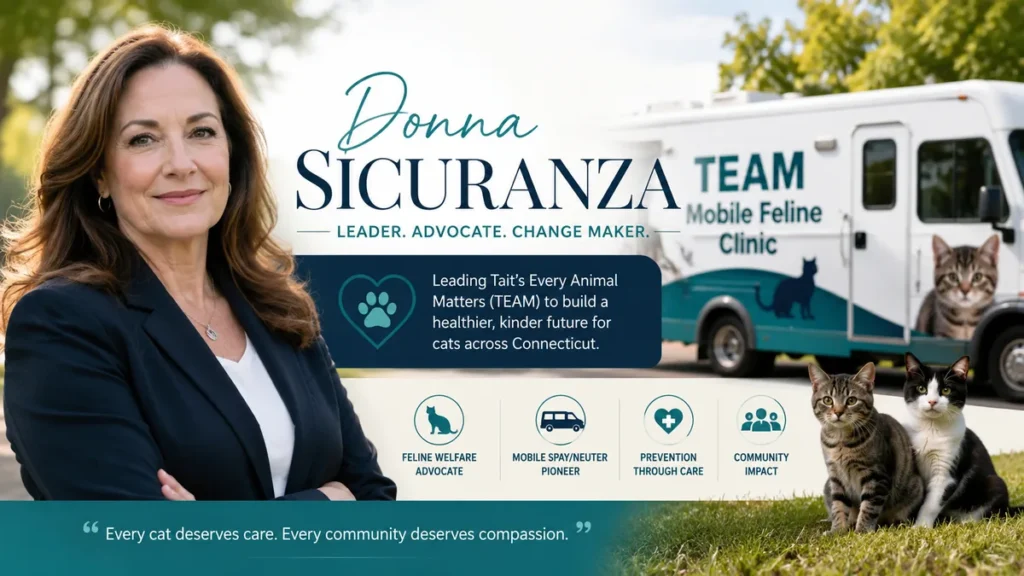
Donna Sicuranza is not a conventional celebrity. Her public reputation comes from decades of work in animal welfare, nonprofit leadership, communications, and expanding access to veterinary services for cats in Connecticut. She is most closely associated with Tait’s Every Animal Matters (TEAM) and its mobile feline spay, neuter, and vaccination program.
Searching her name can be surprisingly confusing. Several people named Donna Sicuranza appear in public records, while some newer biography sites mix details belonging to different individuals. The clearest documented professional record connects Donna Sicuranza—also identified in some sources as Donna Sicuranza Marconi—with TEAM in Westbrook, Connecticut.
Quick answer: Donna Sicuranza is an American nonprofit executive and animal-welfare advocate known for her leadership at Tait’s Every Animal Matters. She helped establish TEAM’s mobile feline spay/neuter program in 1997, an initiative designed to make sterilization and preventive veterinary care more affordable and accessible to Connecticut cat owners and caretakers.
Who Is Donna Sicuranza?
Donna Sicuranza is best known through her long association with Tait’s Every Animal Matters, commonly shortened to TEAM, a nonprofit organization headquartered in Westbrook, Connecticut.
Her professional profile identifies her with TEAM and places her in Westbrook. Public professional information also connects her educational background with Fairfield University and Trinity College in Hartford.
Her role should not be confused with that of a veterinarian. Sicuranza’s documented contribution is primarily in organizational leadership, communications, outreach, and the development and operation of TEAM’s mission. Veterinary procedures aboard the mobile clinic are performed by licensed veterinary professionals.
That distinction matters because her contribution to animal welfare is largely about building and sustaining a system that allows veterinary professionals to reach animals that might otherwise go without affordable care.
Donna Sicuranza and Tait’s Every Animal Matters
The central chapter in Donna Sicuranza’s professional story is TEAM.
The organization grew out of an earlier animal-adoption effort established by veterinarian Dr. John A. Caltabiano. According to a Connecticut Magazine account, a bequest from the estate of animal lover Vernon A. Tait allowed Caltabiano to revive the nonprofit under the name that became Tait’s Every Animal Matters.
The organization needed to determine where it could have the greatest impact.
Calls from members of the public repeatedly raised the same problem: unwanted kittens, growing populations of unsterilized cats, feral colonies, and communities struggling to manage feline overpopulation.
Sicuranza, who was working in journalism and public relations at the time, described the apparent scale of unwanted litters when discussing TEAM’s early development. That problem helped shape the nonprofit’s eventual focus on affordable feline sterilization.
Rather than building its entire model around expecting cat owners to travel to a permanent veterinary facility, TEAM took veterinary services into communities.
That idea became the TEAM Mobile Feline Spay/Neuter Clinic.
How Donna Sicuranza Helped Launch the Mobile Clinic
In 1997, Dr. John Caltabiano and Donna Sicuranza worked together to put Connecticut’s first mobile feline spay/neuter clinic on the road.
An official TEAM newsletter later described the clinic as Connecticut’s first mobile spay/neuter and vaccination clinic specifically serving cats and credited Caltabiano and Sicuranza with establishing it to make these services more affordable and accessible.
The concept was practical.
Instead of asking every pet owner or feral-cat caretaker to solve transportation and accessibility problems independently, the clinic could travel between communities.
The mobile model was particularly useful for people caring for multiple cats, residents living farther from affordable veterinary services, and those managing community or feral cats.
By July 2001, contemporary reporting described TEAM as Connecticut’s first and only mobile cat clinic and reported that the program had already sterilized more than 40,000 cats since beginning in March 1997.
That early figure demonstrates how quickly the model moved beyond an experimental project.
Why Spaying and Neutering Became TEAM’s Main Mission
Feline overpopulation is not simply a matter of having too many cats.
When domestic cats reproduce without control, communities can face growing numbers of unwanted kittens, abandoned animals, crowded shelters, and unmanaged feral colonies.
TEAM’s strategy attacks the problem before another litter is born.
Spaying female cats and neutering males reduces reproduction, while pairing sterilization with vaccination and basic preventive care can improve the broader health of the population being served.
This was particularly important for feral and community cats.
In a 2001 report, Sicuranza discussed TEAM’s preference for treating and returning feral cats rather than relying on euthanasia as the primary response to established colonies. The clinic was already treating substantial numbers of feral animals at that time.
This philosophy helped turn TEAM into more than a mobile surgery service. Its work became part of a wider effort to manage cat populations through preventive intervention.
Donna Sicuranza’s Career Before Animal Welfare Leadership
Sicuranza did not begin her professional life as a veterinary professional.
Her background was in language and communications.
Her professional profile lists studies at Fairfield University and Trinity College-Hartford, with Trinity attendance shown from 1989 to 1992.
Public professional records also describe a career as a freelance writer, editor, and public relations specialist before her long-term leadership at TEAM.
At first glance, journalism and animal welfare may appear unrelated.
In nonprofit management, however, communication is fundamental.
An organization needs to explain its mission clearly, maintain relationships with donors, work with communities, coordinate volunteers, communicate with the media, educate the public, and make complicated issues understandable.
A background in writing and public relations therefore provided skills that could transfer naturally into nonprofit leadership.
For Sicuranza, communications experience became part of the infrastructure behind an organization trying to change how Connecticut communities addressed feline overpopulation.
Working With Dr. John A. Caltabiano
Dr. John Caltabiano was an important figure in both TEAM’s development and Donna Sicuranza’s life.
Historical reporting credits Caltabiano and Sicuranza with partnering to launch the mobile clinic in 1997.
Caltabiano was an experienced veterinarian with an interest in mobile veterinary medicine. A Connecticut Department of Agriculture publication noted that he had established a Mobile Veterinary Medical Clinic in 1980 and later launched the TEAM Mobile Feline Unit while serving as president of Tait’s Every Animal Matters.
Their relationship was personal as well as professional.
Following Caltabiano’s death in 2009, published records identified Sicuranza as his longtime partner. The Connecticut Department of Agriculture stated that she would continue his work at TEAM and with FeralStat, another project connected with his efforts to address feral-cat overpopulation.
The continuation of TEAM after the loss of one of its central founders illustrates an important part of Sicuranza’s leadership: maintaining an established mission across decades rather than allowing it to disappear with its founder.
How the TEAM Mobile Feline Clinic Works
TEAM’s mobile model brings feline veterinary services to different Connecticut communities instead of operating solely from a traditional stationary clinic.
Historically, its service package has combined several forms of care around sterilization.
For example, reporting from 2001 described a package that included an examination, spay or neuter surgery, rabies and other vaccinations, nail trimming, and treatment for ear mites. A licensed veterinarian performed the medical services, with cats generally returning home the same day.
Prices and specific services have naturally changed over the decades, so historical fees should not be treated as current prices.
The underlying model, however, has remained recognizable: make essential feline care easier to reach and more affordable than it might otherwise be for some caretakers.
Why a Mobile Veterinary Clinic Matters
A mobile clinic solves several practical problems at once.
It can:
- bring services closer to communities;
- reduce transportation barriers;
- support owners with limited access to affordable veterinary care;
- serve domestic as well as feral cats;
- work with people managing community-cat populations;
- combine sterilization with vaccination and preventive treatment; and
- reach multiple areas without requiring permanent clinics in every location.
This is one reason TEAM’s longevity matters as much as any single statistic.
A program that operates for decades can influence generations of cats rather than addressing one temporary surge in population.
The Scale of TEAM’s Impact
One of the clearest ways to understand the organization’s growth is to compare historical milestones.
In 2001, TEAM had reportedly sterilized more than 40,000 cats since the mobile program began in 1997.
By the time of Dr. Caltabiano’s death in 2009, published records reported that TEAM had sterilized more than 128,000 cats.
More recent accounts citing TEAM’s figures report that the total has surpassed 225,000 cats receiving sterilization and vaccination services since the clinic’s launch.
Those numbers represent more than individual veterinary procedures.
Every successful sterilization also prevents potential future litters. Over many years, that cumulative effect can make population-management programs substantially more meaningful than their raw procedure counts suggest.
What Makes Donna Sicuranza’s Work Noteworthy?
Sicuranza’s story is unusual because it does not fit the standard internet-biography formula.
There is no need to manufacture celebrity status, wealth estimates, or dramatic personal details to explain why her work matters.
Her public significance is easier to understand through three areas.
Long-Term Commitment
TEAM’s mobile clinic dates to 1997.
Sustaining a nonprofit program over that length of time requires more than a good original idea. Funding, public awareness, staffing, veterinary partnerships, scheduling, changing costs, equipment, community relationships, and organizational continuity all have to be managed.
Accessible Veterinary Care
TEAM’s approach recognized that a service is not truly accessible merely because it exists.
Location and affordability matter.
Bringing veterinary services into communities reduces one of the barriers that can prevent owners and caretakers from sterilizing their cats.
Prevention Instead of Crisis Management
The organization focuses heavily on preventing uncontrolled reproduction rather than dealing only with its consequences.
That is a different way of thinking about animal welfare.
Sheltering, adoption, and rescue remain important, but reducing the number of unwanted litters addresses the problem earlier.
Donna Sicuranza and Feral Cat Welfare
Feral cats present a particularly difficult animal-welfare challenge.
Unlike ordinary household pets, they may have limited or no socialization with humans. Capturing them, transporting them, and arranging veterinary treatment can therefore require a different approach.
TEAM’s historical work included feral cats alongside domestic pets.
As early as 2001, reporting indicated that roughly one-third of the cats treated by the program came from feral colonies. Sicuranza publicly advocated an approach involving trapping, treating, and returning feral cats rather than simply killing them as a population-control measure.
This places her work within the broader philosophy commonly associated with humane community-cat population management.
It also helps explain why mobile veterinary services are particularly relevant: the people caring for colonies may need affordable access to sterilization on a scale that differs substantially from the needs of a household with one pet.
Is Donna Sicuranza Also Known as Donna Sicuranza Marconi?
Recent online sources identify the TEAM executive as Donna Sicuranza Marconi, while older professional and organizational materials commonly use Donna Sicuranza or Donna J. Sicuranza.
Readers researching her should therefore be aware of the name variation.
More importantly, they should avoid combining her biography with information about unrelated people who happen to share the Sicuranza surname.
The Donna Sicuranza Identity Confusion Explained
One major problem with search results for Donna Sicuranza is that they can refer to more than one individual.
A particularly important distinction involves Donna Marie Sicuranza, a New York woman whose obituary appears prominently in search results.
Donna Marie Sicuranza was born on March 24, 1942, worked at Walker Studios and later the Bank of New York in Bronxville, married Angelo Sicuranza, and died on March 10, 2017, at age 74.
Those details should not automatically be attached to the Connecticut animal-welfare executive.
The TEAM-associated Donna J. Sicuranza appears independently in Connecticut records. For example, a 2011 obituary for Robert Sicuranza identifies his daughter Donna J. Sicuranza as a Westbrook resident.
Similarly, Dr. John Caltabiano’s 2009 obituary identifies his longtime partner as Donna Sicuranza of Westbrook.
These records make it especially important for biography writers to verify identities instead of copying details from other pages simply because the names match.
What Is Publicly Known About Donna Sicuranza’s Personal Life?
Much less is reliably documented about Sicuranza’s private life than about her professional activities.
That is normal for someone whose public profile comes from nonprofit work rather than entertainment or politics.
One personal relationship is supported by credible historical documentation: veterinarian Dr. John Caltabiano was described as her longtime partner when he died in 2009.
Beyond information supported by credible records, claims about her marriage, children, net worth, exact age, celebrity relationships, or other private matters should be treated cautiously.
A lack of public information is not a gap that needs to be filled with speculation.
Is Donna Sicuranza a Veterinarian?
No reliable source reviewed for this profile identifies Donna Sicuranza as a veterinarian.
She is associated with TEAM through executive leadership, communications, organizational development, and animal-welfare advocacy.
TEAM’s veterinary procedures are performed by veterinary professionals.
This difference is worth emphasizing because nonprofit animal welfare involves many roles beyond practicing veterinary medicine. Building funding, community partnerships, public awareness, scheduling systems, educational outreach, and accessible service delivery can determine whether veterinarians are ultimately able to help thousands of animals.
Why Donna Sicuranza’s Story Still Matters
Animal welfare often receives attention through dramatic individual rescue stories.
Donna Sicuranza’s career highlights another side of the field: infrastructure.
A mobile clinic may not generate the same emotional reaction as rescuing one animal from immediate danger, but a sustained sterilization and vaccination program can influence animal welfare at population scale.
The history of TEAM illustrates this clearly.
What began as an attempt to respond to Connecticut’s unwanted-cat problem developed into a long-running mobile veterinary program. Contemporary reporting documented more than 40,000 sterilizations by 2001, while later records showed the total passing 128,000 and eventually exceeding 225,000 cats.
Behind those numbers is a simple principle: preventing unwanted litters can reduce suffering before it occurs.
That principle has remained at the center of the organization with which Sicuranza has spent much of her professional career.
Donna Sicuranza’s Lasting Contribution to Animal Welfare
Donna Sicuranza is best understood through documented work rather than internet speculation.
Her career moved from writing, editing, and public relations into sustained nonprofit leadership. Working with Dr. John A. Caltabiano, she helped establish TEAM’s mobile feline spay/neuter clinic in 1997 and supported a model designed around affordability, accessibility, vaccination, sterilization, and humane management of domestic and feral cats.
Decades later, the program’s scale provides the strongest measure of that work.
For readers searching donna sicuranza, the most useful distinction is also the simplest: she is the Connecticut animal-welfare and nonprofit professional associated with Tait’s Every Animal Matters, and her documented story should not be mixed with biographies of unrelated people sharing the same name.
Her public legacy is ultimately less about personal fame and more about a practical idea sustained over decades—bring affordable veterinary care closer to the animals and people who need it.