You may genuinely care about someone yet feel uncomfortable when they get emotionally close. Perhaps you withdraw during disagreements, struggle to express affection, or feel overwhelmed when a partner needs reassurance. These patterns can be confusing, especially when you want meaningful relationships but also feel a powerful need for independence.
A therapist for avoidant attachment can help you understand these reactions without treating your need for personal space as a problem.
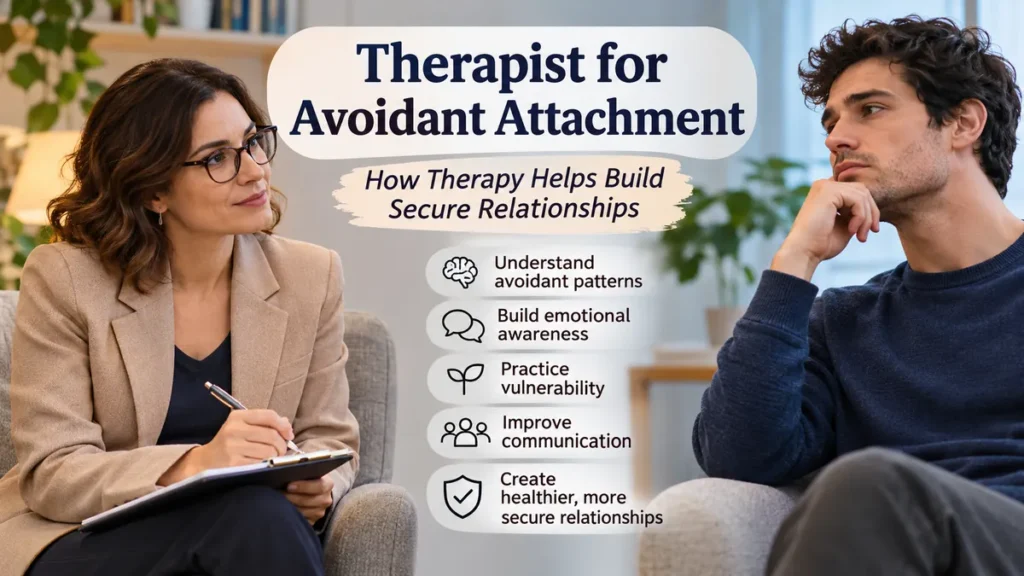
A therapist for avoidant attachment is a licensed mental health professional who helps people recognize patterns of emotional distancing, difficulty trusting others, and discomfort with vulnerability. Through approaches such as attachment-focused psychotherapy, cognitive behavioral therapy, and emotion-focused work, therapy can support healthier communication, emotional awareness, and more secure relationships.
Avoidant attachment is not a permanent personality trait or a mental health diagnosis. It describes a pattern of relating to others that can change through self-awareness, supportive relationships, and therapeutic work.
What Is Avoidant Attachment?
Avoidant attachment is an insecure attachment pattern characterized by discomfort with emotional dependence, a strong preference for self-reliance, and a tendency to create distance when relationships become emotionally demanding.
Attachment theory originated with psychiatrist and psychoanalyst John Bowlby and was expanded through developmental research by psychologist Mary Ainsworth. Their work helped explain how early relationships can influence expectations about emotional availability, safety, and closeness.
Adult attachment research subsequently explored how these patterns appear in romantic relationships, friendships, and other important interpersonal connections.
Understanding dismissive-avoidant attachment
People with a dismissive-avoidant attachment pattern often value autonomy and may minimize their need for emotional support.
Common characteristics include:
- Feeling uncomfortable when someone becomes emotionally dependent on them.
- Preferring to solve personal problems without assistance.
- Withdrawing during emotionally intense conversations.
- Finding it difficult to identify or express vulnerable feelings.
- Feeling trapped when a relationship requires frequent reassurance.
- Downplaying the importance of emotional intimacy.
These behaviors do not necessarily indicate a lack of love, empathy, or commitment.
For some individuals, emotional distance functions as a protective response to situations that feel overwhelming or unsafe.
Avoidant attachment vs. fearful-avoidant attachment
Although both patterns can involve withdrawal, their underlying experiences may differ.
| Characteristic | Dismissive-avoidant | Fearful-avoidant |
|---|---|---|
| Emotional closeness | Often minimizes its importance | Desires closeness but may fear it |
| Independence | Strong preference | May alternate between independence and dependence |
| Conflict response | Often withdraws or disengages | May alternate between pursuing and withdrawing |
| Trust | Difficulty relying on others | Fear of rejection or betrayal |
| Common concern | Losing autonomy | Being hurt or abandoned |
Fearful-avoidant attachment is sometimes discussed alongside disorganized attachment, although these terms originate from different research contexts and should not always be treated as interchangeable.
Attachment patterns also exist along dimensions rather than fitting everyone into fixed categories.
Signs You May Benefit From a Therapist for Avoidant Attachment
Not everyone who values independence needs therapy. Personal boundaries, privacy, and time alone are normal parts of healthy relationships.
Therapy becomes particularly relevant when emotional distancing repeatedly causes distress, relationship difficulties, or problems communicating important needs.
You pull away when relationships become serious
A relationship may feel comfortable during its early stages, but increasing intimacy can trigger discomfort.
You might begin focusing on a partner’s imperfections, questioning the relationship, or seeking additional time apart.
Sometimes these reactions reflect genuine incompatibility. In other situations, they may represent an automatic response to vulnerability.
A therapist can help distinguish between the two.
You struggle to express emotional needs
People with avoidant tendencies sometimes learn to manage difficult feelings privately.
You may find yourself saying:
- “I’m fine” when you are upset.
- “I don’t need anyone” when support might help.
- “It’s not a big deal” when something genuinely hurts.
- “I just need space” without explaining what happened.
The difficulty is not necessarily an absence of emotion. It may involve limited practice recognizing, tolerating, or communicating emotional experiences.
You shut down during conflict
Relationship disagreements can activate defensive responses.
Some people become quiet, emotionally numb, distracted, or physically distant during arguments.
This reaction is sometimes described as emotional shutdown or withdrawal.
A therapist can help identify the warning signs and develop strategies for remaining engaged without becoming overwhelmed.
You feel uncomfortable receiving affection
Compliments, reassurance, or expressions of love may create unexpected discomfort.
You might appreciate affection intellectually while struggling to respond emotionally.
Therapy can explore whether these reactions reflect past experiences, expectations about dependence, or other relationship concerns.
Your relationships follow repeating patterns
Perhaps several relationships have ended because partners felt emotionally disconnected.
You may notice recurring cycles of closeness, withdrawal, conflict, and reconciliation.
When similar difficulties appear across different relationships, examining your own patterns may provide useful insight.
How Does a Therapist for Avoidant Attachment Help?
A therapist does more than encourage someone to become emotionally open.
Effective psychotherapy involves understanding the purpose of protective behaviors, identifying situations that trigger them, and developing alternative responses that respect both emotional needs and personal boundaries.
1. Identifying attachment triggers
The first step often involves recognizing when avoidance becomes activated.
Common triggers include:
- A partner requesting emotional reassurance.
- Conversations about commitment.
- Feeling criticized or misunderstood.
- Disagreements involving vulnerability.
- Receiving unexpected emotional attention.
- Feeling pressured to share personal experiences.
A therapist may help you examine what happened before you withdrew, what you felt physically, and what thoughts accompanied the reaction.
For example, a partner asking to discuss the future might trigger the thought, “I’m going to lose my freedom.”
Recognizing that interpretation creates room to consider other possibilities.
2. Exploring earlier relationship experiences
Attachment-focused therapy may examine childhood relationships, family communication, and important adult experiences.
Some people grew up in environments where emotional needs were dismissed, independence was strongly rewarded, or caregivers were inconsistently available.
Others developed avoidance after painful romantic relationships, betrayal, or repeated interpersonal disappointment.
However, avoidant attachment does not prove that someone experienced childhood trauma or inadequate parenting.
Attachment develops through multiple interacting influences, and no single childhood explanation applies to everyone.
3. Building emotional awareness
Emotional awareness involves recognizing feelings before they become overwhelming.
A therapist might help someone distinguish between irritation, disappointment, fear, embarrassment, sadness, and emotional exhaustion.
This matters because different emotions call for different responses.
Someone who interprets vulnerability as irritation may withdraw when what they actually need is reassurance or a clearer boundary.
4. Practicing vulnerability gradually
Healthy vulnerability does not mean sharing every private thought or abandoning personal boundaries.
It means developing the ability to communicate meaningful experiences when doing so supports trust and connection.
A therapist may encourage small, manageable exercises such as acknowledging disappointment, asking for support, or explaining why a conversation feels difficult.
The pace should remain collaborative rather than forced.
5. Developing healthier conflict responses
Avoidant attachment can become particularly noticeable during disagreements.
Therapy may focus on learning to request a break without abruptly ending communication.
For example:
“I want to understand what you’re saying, but I’m feeling overwhelmed. Can we take 20 minutes and continue this conversation afterward?”
This approach protects emotional regulation while preserving the relationship.
6. Strengthening the therapeutic relationship
The relationship between therapist and client can itself provide opportunities to explore trust, autonomy, and emotional closeness.
A 2024 study published in the Journal of Consulting and Clinical Psychology investigated how clients’ attachment patterns related to their developing sense of security with therapists and their comfort with emotional closeness or independence during treatment. PubMed
This does not mean therapists replace personal relationships. Rather, a consistent professional relationship can offer a structured environment for practicing new interpersonal experiences.
Which Therapy Is Best for Avoidant Attachment?
There is no universally established single best therapy specifically for avoidant attachment.
The appropriate approach depends on individual symptoms, relationship history, treatment goals, and any accompanying mental health concerns.
Several psychotherapy approaches may be relevant.
| Therapy approach | Main focus | Potential benefit |
|---|---|---|
| Attachment-based therapy | Relationship expectations and attachment patterns | Understanding emotional distancing |
| Cognitive behavioral therapy (CBT) | Thoughts, behaviors, and coping responses | Challenging unhelpful beliefs |
| Emotionally focused therapy (EFT) | Emotional connection and interaction cycles | Improving relationship communication |
| Psychodynamic psychotherapy | Recurring emotional and relational patterns | Exploring underlying defenses |
| Schema therapy | Long-standing beliefs and coping styles | Addressing entrenched relationship patterns |
| Acceptance and commitment therapy (ACT) | Psychological flexibility and personal values | Responding to discomfort without automatic withdrawal |
These approaches have different evidence bases. Their inclusion does not mean each has been proven equally effective for avoidant attachment specifically.
Attachment-based therapy
Attachment-based psychotherapy explores expectations about closeness, emotional safety, trust, and dependence.
A therapist may examine how earlier experiences influence present-day interpretations of relationships.
For instance, someone who believes that relying on others inevitably leads to disappointment might gradually explore whether that expectation applies to every relationship.
The aim is not to eliminate independence but to make emotional connection feel less threatening.
Cognitive behavioral therapy
Cognitive behavioral therapy examines relationships between thoughts, emotions, and behaviors.
A person with avoidant tendencies might experience an automatic belief such as:
“If I tell my partner how I feel, they will use it against me.”
CBT can help evaluate the evidence for that belief and develop more flexible interpretations.
Behavioral exercises may involve practicing direct communication or testing whether asking for reasonable support actually produces the feared outcome.
CBT has substantial evidence for various mental health conditions, but research specifically establishing it as the superior treatment for avoidant attachment is limited.
Emotionally focused therapy
Emotionally focused therapy is particularly associated with couples therapy and the work of psychologist Sue Johnson.
It examines negative interaction cycles that can develop between partners.
For example, one partner may seek reassurance while the other withdraws. The first partner then becomes more distressed, prompting further withdrawal.
Therapy helps both partners recognize the cycle rather than treating each other as the problem.
EFT may be useful when attachment-related difficulties are occurring within a romantic relationship.
Psychodynamic therapy
Psychodynamic psychotherapy explores recurring emotional patterns, unconscious defenses, and the influence of earlier relationships.
A person may gradually recognize that emotional detachment once served a protective purpose but now interferes with desired relationships.
The therapeutic process can involve noticing similar reactions within the therapy relationship itself.
Schema therapy
Schema therapy focuses on enduring beliefs and coping responses that may develop through significant experiences.
Relevant schemas can involve emotional deprivation, mistrust, abandonment, or excessive self-reliance.
A therapist helps identify how these beliefs influence present-day behavior and works toward more flexible coping strategies.
Acceptance and commitment therapy
ACT emphasizes accepting difficult internal experiences while acting consistently with personal values.
Someone may value emotional intimacy but experience anxiety when sharing vulnerable feelings.
ACT-based exercises can help the person acknowledge discomfort without automatically allowing it to determine their behavior.
How to Find the Right Therapist for Avoidant Attachment
Choosing a therapist involves more than finding someone who mentions attachment styles on a professional profile.
Qualifications, relevant experience, treatment methods, and the quality of the therapeutic relationship all matter.
The American Psychological Association recommends considering professional credentials, relevant clinical experience, treatment approaches, and personal comfort when selecting a therapist. https://www.apa.org
Look for appropriate professional qualifications
Depending on your country, qualified psychotherapy providers may include:
- Licensed clinical psychologists.
- Licensed professional counselors.
- Licensed clinical social workers.
- Licensed marriage and family therapists.
- Psychiatrists with psychotherapy training.
- Other appropriately registered mental health professionals.
Professional titles and licensing requirements vary by jurisdiction.
A therapist should be authorized to practice where they provide services, including when delivering online therapy.
Ask about attachment-related experience
A professional does not necessarily need the exact title “attachment therapist” to provide relevant treatment.
More useful questions include:
- What experience do you have working with avoidant attachment patterns?
- How do you approach emotional withdrawal and difficulties with vulnerability?
- Which therapeutic methods do you typically use?
- How do you help clients who find emotional conversations overwhelming?
- How do you measure progress?
- What happens if I feel uncomfortable or need to slow the pace of treatment?
Their answers should be understandable and respectful of your individual circumstances.
Pay attention to the therapeutic relationship
People with avoidant tendencies may initially find therapy uncomfortable because the process involves discussing personal experiences with someone unfamiliar.
A suitable therapist should respect boundaries while gently helping you examine patterns that interfere with your goals.
Research has identified an association between attachment insecurity and the quality of the therapeutic alliance. A 2024 meta-analysis found small negative associations between attachment avoidance and clients’ ratings of the working relationship with their therapists. Taylor & Francis Online
This reinforces the importance of discussing discomfort openly rather than automatically interpreting it as treatment failure.
Consider online vs. in-person therapy
Both formats may provide access to qualified professionals.
| Factor | Online therapy | In-person therapy |
|---|---|---|
| Convenience | Often easier to schedule | Requires travel |
| Privacy | Depends on your environment and platform | Usually provided in a dedicated clinical setting |
| Accessibility | May expand provider options | Limited by local availability |
| Communication | Video, audio, or other supported formats | Face-to-face interaction |
| Suitability | Depends on needs and clinician assessment | Depends on needs and clinician assessment |
The National Institute of Mental Health emphasizes checking a therapist’s credentials, experience, treatment approach, and whether you feel comfortable working together. National Institute of Mental Health (NIMH)
Neither format is automatically better for every person with avoidant attachment.
What Happens During Therapy for Avoidant Attachment?
The process varies depending on the clinician and therapeutic approach.
However, treatment commonly includes assessment, collaborative goal setting, emotional exploration, skills practice, and periodic reviews of progress.
The first session
An initial appointment often focuses on understanding your concerns.
A therapist may ask about:
- Current relationships and recurring difficulties.
- Family background and important life experiences.
- Emotional reactions during conflict.
- Previous experiences with therapy.
- Mental health symptoms and relevant medical history.
- Personal goals and expectations.
You do not have to disclose every sensitive experience immediately.
A qualified clinician should explain confidentiality, its legal limits, and how treatment decisions are made.
Early sessions: recognizing patterns
Initial sessions may explore specific situations in which emotional withdrawal occurs.
Consider this hypothetical example:
Alex enjoys spending time with a romantic partner but becomes distant whenever the partner asks about long-term commitment.
Instead of assuming Alex fears commitment, a therapist explores the thoughts, feelings, and circumstances surrounding these reactions.
Alex eventually notices a recurring fear of losing personal freedom.
That discovery becomes a starting point for developing a more balanced response.
Middle sessions: practicing different responses
Therapy may then focus on applying new skills in everyday situations.
Exercises could include:
- Naming emotions before withdrawing.
- Expressing one specific need.
- Recognizing unhelpful assumptions.
- Communicating boundaries clearly.
- Practicing active listening.
- Returning to conversations after agreed breaks.
The therapist and client can discuss what worked, what felt difficult, and which adjustments may help.
Later sessions: maintaining progress
As treatment develops, attention may shift toward maintaining changes across different relationships.
Progress might involve noticing triggers earlier, recovering more quickly after conflict, or feeling more comfortable asking for support.
The goal is greater flexibility, not constant emotional openness.
Can Avoidant Attachment Change Through Therapy?
Yes. Attachment-related expectations and behaviors can change, although the process varies between individuals.
Attachment styles are not immutable identities.
A person who previously relied heavily on emotional withdrawal may learn to tolerate closeness, communicate needs, and maintain relationships without feeling that independence is threatened.
Research supports the possibility of changes in attachment security during psychotherapy.
A meta-analysis of 36 studies involving 3,158 patients found that improvements in attachment security during treatment may coincide with better psychotherapy outcomes. The researchers also suggested that some clients with lower initial attachment security may benefit from therapy that addresses interpersonal relationships. Wiley Online Library
However, these findings do not establish a guaranteed outcome or a specific timeline for changing avoidant attachment.
What does becoming securely attached look like?
Secure attachment does not mean becoming dependent on others or eliminating the need for solitude.
It generally involves being able to balance connection and autonomy.
Possible signs of improvement include:
- Feeling more comfortable discussing emotions.
- Asking for support when appropriate.
- Maintaining personal boundaries without abrupt withdrawal.
- Responding to conflict with greater flexibility.
- Trusting others while recognizing realistic risks.
- Feeling less threatened by healthy interdependence.
A securely functioning relationship allows both partners to have individual identities and emotional needs.
How long does attachment therapy take?
There is no standardized number of sessions required to change avoidant attachment patterns.
Duration depends on factors such as the complexity of the difficulties, treatment goals, accompanying symptoms, and the therapeutic approach.
Some people focus on a specific communication difficulty through relatively brief therapy. Others may benefit from longer-term work addressing deeply established relationship patterns.
Rather than expecting a fixed timeline, discuss measurable goals with your therapist and review progress periodically.
How to Work on Avoidant Attachment Between Therapy Sessions
Therapy is one part of the change process. Everyday relationships also provide opportunities to practice emotional awareness and healthier communication.
The following exercises are educational strategies, not substitutes for individualized mental health treatment.
Recognize the urge to withdraw
When you notice yourself becoming distant, consider three questions:
- What happened immediately before I wanted to pull away?
- What emotion or physical sensation am I experiencing?
- Do I genuinely need space, or am I trying to escape discomfort?
The purpose is observation, not self-criticism.
Practice naming one emotion
If identifying feelings is difficult, begin with simple descriptions.
Instead of automatically saying “I’m fine,” try:
“I’m frustrated because I felt misunderstood.”
Or:
“I’m nervous about this conversation, and I need a little time to think.”
Specific emotional language can make communication clearer.
Use boundaries rather than disappearing
Healthy independence includes communicating when you need time alone.
A clear boundary might sound like:
“I need some quiet time this evening, but I’d like to talk tomorrow.”
This communicates both autonomy and continued interest in the relationship.
By contrast, repeatedly disappearing without explanation can create uncertainty and undermine trust.
Challenge assumptions about dependence
Notice beliefs such as:
- Depending on someone makes me weak.
- Sharing emotions always leads to rejection.
- A close relationship means losing independence.
- Asking for reassurance is embarrassing.
Consider whether these beliefs describe universal truths or expectations shaped by particular experiences.
You do not have to replace them with unrealistic optimism. The goal is a more accurate and flexible perspective.
Develop tolerance for manageable vulnerability
Start with situations that feel relatively safe.
You might share a small disappointment, acknowledge appreciation, or ask a trusted person for minor assistance.
Pay attention to the outcome rather than assuming vulnerability will always produce discomfort or rejection.
If an interaction feels unsafe or coercive, maintaining distance may be the appropriate response.
Keep a relationship reflection journal
A brief journal can help identify patterns over time.
| Situation | Automatic reaction | Possible emotion | Alternative response |
|---|---|---|---|
| Partner requests reassurance | Withdraw | Pressure or anxiety | Ask what reassurance would help |
| Friend offers support | Decline immediately | Discomfort | Consider accepting specific help |
| Disagreement begins | Become silent | Fear or frustration | Request a timed break |
| Relationship becomes closer | Question everything | Vulnerability | Examine the actual concern |
The journal should help you understand your experiences, not force every behavior into an attachment label.
Therapist for Avoidant Attachment in Romantic Relationships
Romantic relationships often make attachment patterns especially noticeable because they involve emotional closeness, uncertainty, and mutual dependence.
A therapist may work with one partner individually or with both partners together.
The anxious-avoidant relationship cycle
One commonly discussed pattern involves a partner who seeks reassurance and another who responds by withdrawing.
For example:
- One partner feels disconnected and requests more communication.
- The other experiences the request as pressure.
- The second partner withdraws.
- The first becomes increasingly worried and seeks additional reassurance.
- Both partners feel misunderstood.
This is sometimes called the anxious-avoidant cycle or pursuer-distancer pattern.
It is not exclusive to particular attachment styles, and it does not mean either partner is responsible for every relationship difficulty.
Therapy can help partners understand how their reactions influence each other.
Can couples therapy help avoidant attachment?
Couples therapy may be appropriate when both partners want to improve communication, trust, and emotional connection.
Emotionally focused couples therapy, for example, may help partners identify the emotional experiences underlying their interaction patterns.
Individual therapy may be preferable when someone wants to understand their personal reactions privately or when their partner does not wish to participate.
In situations involving intimidation, coercive control, or abuse, standard couples therapy may be inappropriate. An individual assessment and safety-focused support should come first.
How to support a partner with avoidant tendencies
Supporting someone does not mean ignoring your own emotional needs.
Helpful approaches can include communicating requests clearly, respecting reasonable boundaries, and avoiding assumptions about another person’s intentions.
For example, instead of saying, “You never care about my feelings,” try explaining a specific experience:
“When we stop talking after an argument, I feel uncertain. Could we agree on when to continue the conversation?”
The other partner remains responsible for their own behavior and willingness to participate.
Attachment terminology should not be used to excuse persistent disrespect, dishonesty, or harmful treatment.
Common Misconceptions About Avoidant Attachment Therapy
Misunderstandings about attachment styles can create unnecessary shame or unrealistic expectations.
“Avoidant people cannot love deeply”
Avoidant attachment does not mean someone is incapable of affection, empathy, or commitment.
Emotional expression and emotional experience are not identical.
Someone may care deeply while finding certain forms of closeness uncomfortable.
“Therapy will make me dependent on other people”
Healthy therapy should support autonomy and informed personal choices.
The goal is to develop flexibility in relationships, including the ability to rely on others when appropriate without sacrificing independence.
“Every avoidant person has childhood trauma”
Early relationships can influence attachment, but avoidant tendencies do not establish that trauma occurred.
Adult experiences, temperament, relationship contexts, and other factors may also contribute.
A therapist should explore individual history without imposing a predetermined explanation.
“Attachment styles are permanent”
Attachment patterns can be relatively stable, but they are not fixed for life.
Experiences within relationships and psychotherapy may influence how people understand and respond to emotional closeness.
“Avoidant attachment is the same as avoidant personality disorder”
These are different concepts.
Avoidant attachment describes a pattern of relating to close others.
Avoidant personality disorder is a recognized mental health condition involving a broader, persistent pattern of social inhibition, feelings of inadequacy, and sensitivity to negative evaluation.
The two should not be treated as interchangeable.
Likewise, dismissive-avoidant attachment is not the same as avoidant personality disorder or a diagnosis of social anxiety disorder.
A qualified clinician can assess whether symptoms reflect an attachment-related difficulty, another mental health concern, or a combination of factors.
When Should You Seek Professional Support?
Consider speaking with a licensed mental health professional when relationship patterns cause ongoing distress or interfere with important parts of your life.
Examples include repeatedly ending relationships despite wanting closeness, experiencing intense discomfort during ordinary emotional conversations, or struggling to maintain meaningful connections.
Professional support may also be valuable when emotional withdrawal occurs alongside depression, anxiety, trauma-related symptoms, or significant interpersonal conflict.
The National Institute of Mental Health explains that psychotherapy can help people identify and change troubling emotions, thoughts, and behaviors. Treatment should be tailored to the person’s needs and circumstances. National Institute of Mental Health (NIMH)
You do not need to identify with a particular attachment category before seeking help.
A therapist can begin with the difficulties you are actually experiencing rather than requiring you to fit a label.
Final Thoughts: Finding a Therapist for Avoidant Attachment
Working with a therapist for avoidant attachment can help you better understand emotional withdrawal, difficulty trusting others, and discomfort with vulnerability.
The purpose of therapy is not to change your personality or eliminate independence. It is to help you develop more choices in how you respond to closeness, conflict, and emotional needs.
Attachment-focused psychotherapy, CBT, emotionally focused approaches, and other treatments may provide useful tools depending on your circumstances.
Progress often begins with recognizing a familiar reaction and responding differently, even in a small way.
If emotional distancing is repeatedly affecting your relationships or well-being, a licensed therapist with experience in interpersonal and attachment-related concerns can help you explore those patterns and develop a treatment plan suited to your goals.