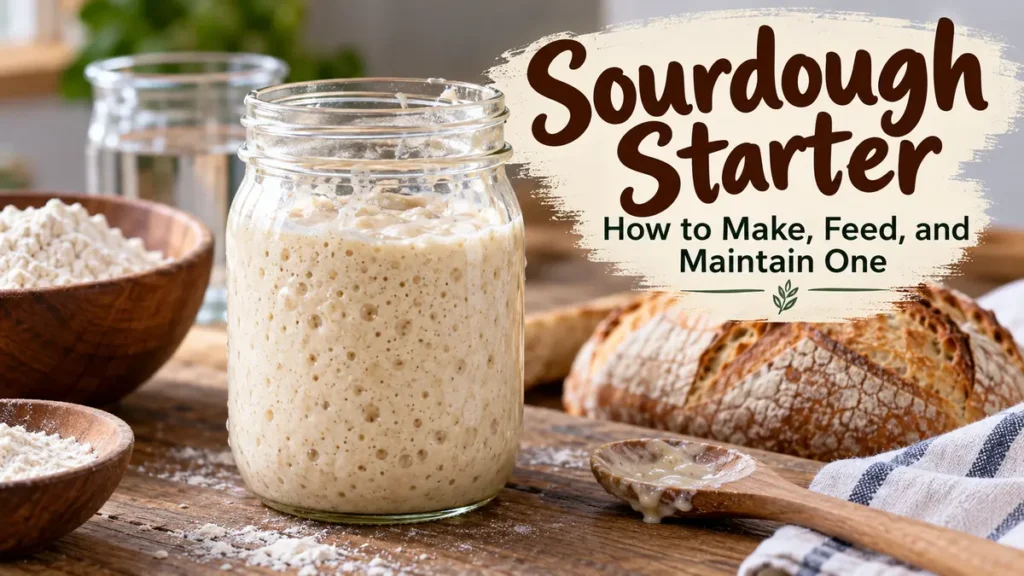
A jar of flour and water can become the engine behind naturally leavened bread. The surprising part is that you do not need commercial yeast to get it started.
A sourdough starter is a fermented culture of flour and water containing yeasts and lactic acid bacteria. With regular feedings of fresh flour and water, the culture becomes active enough to ferment bread dough, producing carbon dioxide for rise while contributing the characteristic aroma, acidity, and flavor associated with sourdough. The Perfect Loaf
Making one is simple, but it is not instant. Some starters become vigorous within about five to seven days, while others need considerably longer. Temperature, flour, feeding routine, and the developing microbial community all affect the timeline. The better approach is to judge your starter by its behavior rather than by the calendar. King Arthur Baking
What Is a Sourdough Starter?
A sourdough starter is a living fermented mixture used to initiate fermentation in bread dough. Unlike bread made with packaged baker’s yeast alone, traditional sourdough relies on microorganisms maintained in the starter.
Two groups are especially important:
- Yeasts, which help produce carbon dioxide and leaven the dough.
- Lactic acid bacteria, which produce organic acids and contribute flavor, acidity, and fermentation characteristics.
The exact microbial population varies from starter to starter and is influenced by flour, temperature, feeding practices, hydration, and other environmental conditions. Common sourdough cultures contain multiple species rather than one universal “sourdough yeast.” The Perfect Loaf
Think of a starter as a small fermentation ecosystem rather than simply wet flour.
You repeatedly give that ecosystem fresh flour and water. As the microorganisms metabolize nutrients in the flour, the mixture develops bubbles, expands, changes aroma, and eventually reaches a point where it can reliably ferment bread dough.
Starter vs. levain: are they the same?
The terms sometimes get used interchangeably, but there is a useful distinction.
Your starter is the culture you maintain over time. A levain is typically a portion of that culture built specifically for a particular batch of bread. A baker can adjust the levain’s flour, hydration, quantity, or fermentation schedule without changing the permanent starter.
This approach also means you do not need to keep a huge jar of starter just because your bread recipe needs a large amount.
What You Need to Make a Sourdough Starter
The ingredient list could hardly be shorter:
| Item | Purpose |
|---|---|
| Flour | Provides food and microorganisms for the culture |
| Water | Hydrates the flour and creates the fermentation environment |
| Glass or food-safe container | Holds the starter |
| Digital kitchen scale | Makes feeding ratios consistent |
| Spoon or spatula | Mixing and scraping the container |
| Loose-fitting lid | Protects the starter without sealing it completely airtight |
A digital scale is particularly useful. Starter volume changes dramatically as it fills with gas and then collapses, making cups and spoons less consistent than measurements by weight. King Arthur Baking likewise recommends weighing ingredients for better accuracy. King Arthur Baking
What Is the Best Flour for a Sourdough Starter?
You can establish a starter with several types of flour, but whole-grain flour is particularly useful at the beginning.
Whole wheat and whole rye flour contain more of the grain than refined white flour and are commonly used to encourage early fermentation. King Arthur Baking’s current starter method begins with whole wheat or pumpernickel flour before switching to unbleached all-purpose flour for regular feedings. King Arthur Baking
The Perfect Loaf similarly favors a mixture containing whole-grain rye when establishing a new culture. The Perfect Loaf
Practical options include:
- whole wheat flour
- whole rye flour
- unbleached all-purpose flour
- bread flour
- mixtures of whole-grain and white flour
You do not have to keep buying specialty flour forever. Once a starter is established, unbleached all-purpose or bread flour can work perfectly well for routine maintenance.
Can you switch flour later?
Yes.
A starter established with rye or whole wheat does not have to remain a rye or whole-wheat starter permanently. Bakers routinely change feeding flour once the culture is established.
Changes can temporarily alter fermentation speed, consistency, aroma, and feeding needs, so make the switch and watch how your starter responds rather than assuming its old schedule will remain perfect.
What Water Should You Use?
Ordinary drinking-quality water works in many kitchens.
The temperature matters because fermentation accelerates in warmer conditions and slows as the environment becomes cooler. King Arthur recommends adjusting water temperature to the environment: cooler water in a warm house and lukewarm water when conditions are cool. King Arthur Baking
Avoid very hot water. You are maintaining living microorganisms, not cooking the flour.
If your tap water works well, there is no automatic need to buy bottled water. If you consistently struggle with a starter and suspect heavily treated tap water, trying filtered water is a reasonable troubleshooting step.
How to Make a Sourdough Starter From Scratch
There are many successful starter schedules. Some use once-daily feedings initially; others move to twice-daily refreshments as activity increases. The following method uses equal weights of starter, water, and flour once regular feeding begins, keeping the quantities small enough to reduce waste.
Day 1: Combine flour and water
Mix:
50 g whole wheat or whole rye flour
50 g water
Stir thoroughly until no pockets of dry flour remain.
Place the mixture in a clean container and cover it with a lid that prevents drying without creating a tightly sealed environment.
Leave it at room temperature for approximately 24 hours.
Marking the initial level with a rubber band or piece of tape makes subsequent growth much easier to see.
Day 2: Begin feeding
You might see bubbles already.
You also might see almost nothing.
Both can happen during the early stages.
Keep:
50 g starter
Then add:
50 g water
50 g unbleached all-purpose or bread flour
Mix thoroughly, cover, mark the new level, and leave it for another 24 hours.
This is a 1:1:1 feeding ratio by weight: one part starter, one part water, and one part flour.
Day 3: Watch for fermentation
By this point, you may notice:
- bubbles along the sides
- expansion
- a fruity or fermented aroma
- changes in texture
- rising followed by falling
If activity is developing, begin feeding roughly every 12 hours.
Each time, retain 50 g starter and feed it 50 g water plus 50 g flour.
King Arthur’s current starter recipe follows this twice-daily schedule beginning around day three and continues it as the culture gains strength. King Arthur Baking
Days 4 and 5: Keep the routine consistent
Continue the same feeding process.
Do not panic if activity seems weaker than it did earlier.
One of the most confusing experiences for beginners is seeing spectacular growth very early and assuming the starter is finished. Then the activity suddenly slows.
Early activity does not necessarily mean that a mature, stable starter has developed. Keep feeding consistently and allow the microbial community time to establish itself.
Day 6 and beyond: Judge performance, not age
Some starters are vigorous by now; others are not.
Continue regular feedings until your starter repeatedly rises strongly after being fed.
A useful benchmark is a starter that approximately doubles within 6 to 8 hours after feeding, contains abundant bubbles, and has a pleasantly acidic aroma. King Arthur uses this doubling behavior as a key sign that a starter is active and ready for baking. King Arthur Baking
Do not throw away a healthy-looking starter simply because it did not become powerful on day seven.
Depending on conditions, developing a strong culture can take a week, two weeks, or occasionally longer. The Clever Carrot
Sourdough Starter Feeding Ratios Explained
Starter feeding becomes much easier once you understand ratios.
A ratio such as:
1:1:1
means equal weights of:
starter : flour : water
For example:
20 g starter + 20 g flour + 20 g water
or:
50 g starter + 50 g flour + 50 g water.
Both are 1:1:1.
A 1:2:2 feeding might be:
20 g starter + 40 g flour + 40 g water.
A 1:5:5 feeding might be:
10 g starter + 50 g flour + 50 g water.
There is no single feeding ratio that every baker must use. Higher ratios provide more fresh food relative to the amount of mature starter and generally extend the fermentation cycle.
The Perfect Loaf, for example, describes maintaining a strong culture with a 1:5:5 ratio and twice-daily feeding, demonstrating why feeding ratios should be understood as tools rather than rigid universal rules. The Perfect Loaf
What does 100% hydration mean?
Hydration describes the amount of water relative to flour by weight.
If you feed:
50 g flour + 50 g water
the newly added flour and water are at 100% hydration because their weights are equal.
A 100% hydration starter is popular because the arithmetic is simple and it works well for many sourdough recipes.
Why Do You Have to Discard Sourdough Starter?
Discarding seems wasteful until you do the math.
Suppose you kept everything and fed a 1:1:1 ratio.
You might have:
100 g starter → 300 g after feeding
300 g → 900 g
900 g → 2,700 g
2,700 g → 8,100 g
Your starter would quickly consume kilograms of flour.
Discarding keeps the culture at a manageable size while allowing you to supply enough fresh food relative to the existing microorganisms. It also helps prevent the culture from becoming excessively acidic.
The Perfect Loaf specifically notes that regular discard prevents the starter from becoming extremely large and overly acidic. The Perfect Loaf
You don’t have to waste the discard
Once you have an established starter, discard can become an ingredient.
It can be incorporated into recipes such as:
- pancakes
- waffles
- crackers
- pizza dough
- muffins
- flatbreads
- biscuits
- pretzels
King Arthur also recommends using discard in recipes rather than automatically throwing it away. King Arthur Baking
During the earliest days of creating a brand-new culture, however, simply discarding the excess is the straightforward option.
How to Tell When a Sourdough Starter Is Ready
Do not use one bubble, one dramatic rise, or a specific number of days as your only test.
A dependable starter demonstrates a repeatable fermentation pattern.
Look for several signs together.
| Sign | What you want to see |
|---|---|
| Rise | Roughly doubles after feeding |
| Timing | Strong rise within about 6–8 hours under suitable conditions |
| Bubbles | Visible throughout the culture |
| Aroma | Pleasantly tangy, fermented, fruity, or yeasty |
| Pattern | Rises, peaks, then gradually falls |
| Reliability | Repeats this behavior across feedings |
A starter at or near peak fermentation often has a rounded or slightly domed top, plenty of internal bubbles, and obvious expansion above its post-feeding level.
Eventually the food supply diminishes. The starter stops climbing and begins falling.
That cycle is normal:
feed → ferment → rise → peak → fall → feed again
Learning to recognize it is more valuable than memorizing a clock time.
Does the Float Test Tell You When Starter Is Ready?
The float test involves dropping a small amount of starter into water. Gas-filled starter may float, and some baking guides use this as a quick indication of activity. The Clever Carrot
But it should not be your only readiness test.
A starter can behave differently depending on flour, hydration, handling, and where it is in its fermentation cycle. A stronger practical benchmark is whether it consistently rises predictably after feeding.
Track its height instead.
A rubber band around the jar immediately after feeding gives you an easy visual reference.
How Often Should You Feed a Sourdough Starter?
Your feeding schedule depends primarily on how you store and use it.
If you keep it at room temperature
Regular bakers often keep starter on the counter.
King Arthur’s current maintenance method recommends approximately one feeding every 24 hours for its 1:1:1 room-temperature routine, while other maintenance systems use approximately 12-hour intervals. The appropriate frequency depends on temperature and feeding ratio as well as starter activity. King Arthur Baking
The important principle is to feed often enough that the starter does not remain severely depleted for long periods.
If you keep it in the refrigerator
For occasional baking, refrigeration is much easier.
A common routine is:
- Keep a small amount of starter.
- Feed it.
- Allow fermentation to begin.
- Refrigerate it.
- Refresh it approximately weekly.
King Arthur recommends roughly weekly feeding for refrigerated starter. King Arthur Baking
Before baking, take it out and give it room-temperature feedings until it again rises strongly and predictably.
Room Temperature vs. Refrigerator Storage
| Storage method | Best for | Typical feeding approach |
|---|---|---|
| Room temperature | Frequent bakers | Daily or more frequently depending on ratio and temperature |
| Refrigerator | Occasional bakers | About weekly |
| Room temperature before baking | Reviving refrigerated starter | Repeated feeds until reliably active |
Refrigeration does not eliminate fermentation. It slows it.
That makes cold storage extremely convenient for someone who bakes once every week or two rather than every day.
Temperature Makes a Huge Difference
Many apparent starter problems are really temperature problems.
Fermentation slows in a cool kitchen. Put the same healthy culture somewhere warmer and it can behave very differently.
The Perfect Loaf describes around 80°F (26°C) as a useful environment when establishing its starter method, while The Clever Carrot recommends approximately 70–75°F (21–24°C) for its beginner schedule. These differences demonstrate that there is no magical single temperature; warmer conditions generally accelerate fermentation within a reasonable range. The Perfect Loaf
If your starter seems sluggish during winter, consider finding a comfortably warm location rather than endlessly adding extra flour.
Suitable spots might include a temperature-controlled proofing box or another reliably warm area of the kitchen.
Avoid excessive heat. Warmer does not mean hotter is always better.
Understanding the Rise, Peak, and Fall Cycle
A newly fed starter begins relatively dense.
As fermentation progresses, gases become trapped in the flour-and-water matrix. The starter expands and bubbles become visible against the jar.
Eventually it reaches its maximum height: the peak.
Afterward, the structure can no longer retain the gas as effectively, available food has diminished, and the starter begins falling.
This falling does not mean your culture died.
It means you missed the peak.
A line of residue above the starter’s current level is often evidence that it rose while you were away and subsequently collapsed.
This is why marking the jar immediately after feeding is so helpful.
Common Sourdough Starter Problems
My starter isn’t rising
First check temperature.
A starter sitting in a cold room can ferment much more slowly than expected.
Then check:
- feeding ratio
- feeding frequency
- flour
- water
- consistency
- whether it actually rose and fell while you weren’t watching
If you are creating a new starter, time may simply be the missing ingredient.
A starter that has not become vigorous after seven days is not automatically a failed starter. King Arthur explicitly recommends continuing regular feedings when a young culture needs longer to establish itself. King Arthur Baking
My starter rose on day two and then stopped
This is a classic beginner concern.
Early dramatic activity is not proof that the stable microbial culture you need for bread has fully developed. Continue your feeding schedule rather than immediately changing everything.
Consistency usually works better than reacting to every unusual day.
My starter smells sour
A tangy or acidic smell is expected.
Depending on its age and feeding cycle, you might notice aromas that remind you of yogurt, fruit, vinegar, yeast, or other fermented foods.
The aroma changes as fermentation progresses.
A starter that smells particularly sharp may simply be hungry and ready for fresh flour.
There is liquid on top
Liquid can sometimes accumulate on a neglected or refrigerated starter.
King Arthur notes that liquid on refrigerated starter can be drained off or stirred back in before feeding. King Arthur Baking
Treat it as a signal to evaluate your feeding schedule.
My starter is too runny
Consistency changes as a starter ferments.
Immediately after a 100% hydration feeding, it may be relatively thick. As acids and enzymes act on the mixture, it can become looser.
A runny starter at the end of its fermentation cycle therefore does not necessarily mean you measured incorrectly.
Use weight measurements before making major adjustments.
My starter isn’t bubbling much
Look at more than the surface.
Bubbles against the side of the jar can reveal fermentation that is less obvious from above.
Whole-grain and white-flour starters can also look different. What matters most is repeatable expansion and fermentation.
When Should You Throw Away a Sourdough Starter?
A sluggish starter and a contaminated starter are different problems.
Slow fermentation can often be corrected through feeding, warmth, and time.
Visible mold or clearly abnormal colored growth is different. When contamination is apparent, the safest practical approach is to discard the culture, thoroughly clean the equipment, and start again rather than trying to preserve a questionable starter.
Keep the jar sides reasonably clean so that dried residue does not make changes difficult to evaluate.
How to Strengthen a Weak Sourdough Starter
If an established starter has become sluggish, simplify your routine.
- Keep a small portion of the existing starter.
- Feed it fresh flour and water at a consistent ratio.
- Keep it at a comfortably warm room temperature.
- Mark its starting level.
- Observe how long it takes to peak.
- Feed consistently over several cycles.
- Bake only after strong rising behavior returns.
For refrigerated starter, King Arthur recommends repeated room-temperature feedings until it can double or triple within approximately six to eight hours before baking. King Arthur Baking
Whole-grain flour can also be useful when trying to encourage activity. King Arthur notes that whole wheat and rye are commonly useful because they are less processed and provide additional nutrients for fermentation. King Arthur Baking
How Much Starter Should You Keep?
Probably less than you think.
Maintaining hundreds of grams every day wastes flour unless you constantly need large amounts.
A small starter works on the same principles as a large one.
For example:
20 g starter
20 g water
20 g flour
produces 60 g total starter at a 1:1:1 ratio.
King Arthur even provides a small-starter maintenance method built around just 20 g of retained starter. King Arthur Baking
When you plan to bake, increase the quantity through one or more feedings.
Suppose your bread recipe requires 100 g of ripe starter and you want some left for future baking. You can build enough ahead of time rather than maintaining that quantity all week.
This “keep small, build when needed” approach saves substantial flour.
How to Prepare Refrigerated Starter for Baking
Imagine your starter has spent a week in the refrigerator and you want to make bread.
Take it out and inspect it.
Then:
- Retain a small amount.
- Feed it fresh flour and water.
- Leave it at room temperature.
- Wait for clear expansion.
- Repeat the feeding if necessary.
- Use it when its rise becomes strong and predictable.
A healthy culture that was recently refrigerated may rebound quickly. One neglected for considerably longer can require several feeding cycles.
Do not judge readiness simply because the starter has reached room temperature. What you need is fermentation strength.
What Is Sourdough Discard?
Sourdough discard is the portion removed before feeding your maintained culture.
It is not a separate species of starter.
Removing some starter lets you feed the remainder at the desired ratio without creating an ever-growing quantity.
Discard from an established starter can provide fermented flavor in many recipes even when it is not being relied upon as the primary leavening agent.
This distinction matters:
Active starter is typically fed, vigorous, and used for fermentation.
Discard is the excess removed during maintenance and may no longer be at peak activity.
Recipes designed specifically for discard account for that difference.
Mistakes That Commonly Cause Starter Trouble
Measuring inconsistently
A cup of flour and a cup of water do not weigh the same.
If a formula is designed around equal weights, replacing them with equal volumes changes the hydration dramatically.
Use a digital scale whenever possible.
Feeding by the clock without watching the starter
Schedules are useful, but fermentation is biological.
Your starter does not know that a recipe says “12 hours.”
Watch how fast it peaks in your actual kitchen.
Keeping too much starter
A giant jar means giant feedings.
Reduce the amount you maintain and build more only when you need it.
Changing multiple variables at once
A beginner sees slow growth and changes the flour, water, temperature, ratio, jar, and feeding frequency simultaneously.
Then there is no way to know what helped.
Make controlled adjustments.
Assuming more frequent feeding is always better
Feeding a weak new culture again before it has had enough time to ferment can repeatedly dilute its developing microbial population.
Follow a sensible starter-building schedule and use activity as your guide.
Expecting every starter to follow the same timeline
One guide may produce an active starter in five days, another in seven, while your kitchen may require longer.
King Arthur’s current method says a starter can be ready around day five if it meets the appropriate activity benchmarks, whereas The Clever Carrot notes that a strong culture can take two weeks or more. These are not necessarily contradictions; fermentation conditions differ. King Arthur Baking
The behavior of the starter matters more than its birthday.
A Simple Long-Term Sourdough Starter Routine
Once the starter is established, sourdough becomes much less complicated.
If you bake frequently, maintain it at room temperature with a feeding schedule matched to your ratio, temperature, and baking routine.
If you bake occasionally, refrigerate it and refresh it roughly weekly. Before your next bread day, bring a portion back to room temperature and feed it until it is reliably vigorous again. King Arthur Baking
You can also maintain a very small culture to reduce flour use and build the quantity required before baking.
The core process never really changes:
keep → feed → ferment → use → repeat
Once you understand that rhythm, you no longer need to treat sourdough as a fragile kitchen experiment.
Final Thoughts on Sourdough Starter
A successful sourdough starter does not require exotic ingredients or complicated equipment. Flour, water, a container, a scale, reasonable warmth, and consistent feeding are enough to establish a culture capable of leavening bread.
Focus on observable signs rather than an exact calendar: bubbles throughout the mixture, predictable expansion, a pleasant fermented aroma, and—most importantly—a reliable rise after feeding. Once the starter can repeatedly double within roughly six to eight hours under suitable conditions, you have a far better indication of baking readiness than simply counting how many days have passed. King Arthur Baking
From there, maintenance becomes a routine rather than a project. Keep the culture small, feed according to how frequently you bake, refrigerate it when you need a break, and build up the amount before baking. A well-maintained starter can remain the foundation of your sourdough baking for years.