Some images are appreciated for their beauty. Others carry a meaning that goes far beyond color, composition, or resolution. radha krishna images belong to the second category.
Radha and Krishna have been represented for centuries through devotional paintings, temple art, sculpture, manuscripts, prints, and, more recently, digital artwork. Today, people encounter their imagery as HD wallpapers, mobile backgrounds, profile pictures, festival greetings, framed art, and devotional pictures. Current image collections show especially strong interest in wallpapers, DP images, Vrindavan scenes, romantic devotional artwork, and high-resolution pictures. Wallpapers.com
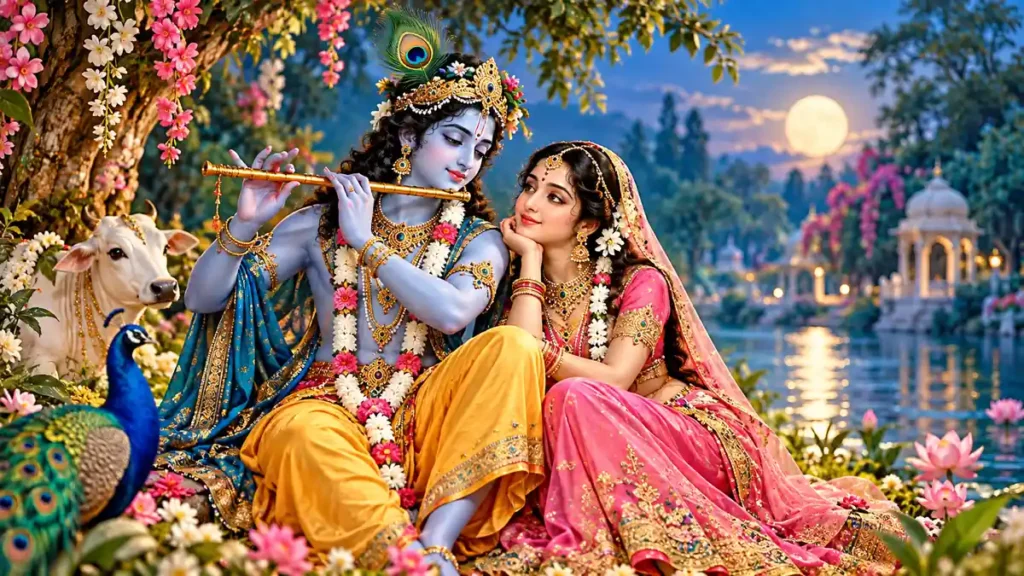
radha krishna images are devotional representations of Radha and Lord Krishna, commonly associated with divine love, bhakti, joy, longing, and spiritual devotion. They often depict Krishna playing the bansuri beside Radha in Vrindavan, surrounded by peacock feathers, flowers, cows, lotuses, the Yamuna River, or other elements connected with Krishna tradition. PhysicsFundamentalsGuide
Understanding these details can turn an attractive picture into something much more meaningful.
What Do radha krishna images Represent?
At first glance, a Radha Krishna picture may appear to portray two beautifully dressed figures standing together. Within devotional traditions, however, their relationship carries much deeper significance.
Radha is closely associated with complete loving devotion toward Krishna. Krishna represents the Divine toward whom that devotion is directed. Their relationship is therefore frequently understood through bhakti, the path of loving devotion to God, rather than simply as an ordinary human romance. Dev Aastha
This explains why themes of love and devotion are so closely connected in Radha Krishna art.
A picture showing Radha quietly listening while Krishna plays his flute can communicate ideas such as:
- devotion and surrender;
- spiritual longing;
- harmony between the devotee and Divine;
- unconditional love;
- inner joy and peace;
- beauty and grace.
Some Vaishnava theological traditions describe Radha in relation to Krishna’s hladini shakti, or divine bliss-giving potency. Interpretations vary among Hindu traditions, so individual symbols should not automatically be treated as having one universally fixed theological meaning. PhysicsFundamentalsGuide
That distinction matters when interpreting religious artwork respectfully.
Symbols Commonly Seen in radha krishna images
The most beautiful Radha Krishna pictures often tell their story through small visual details.
An artist does not necessarily need to explain the scene with words. A flute, peacock feather, lotus, cow, forest, or river can immediately connect the artwork with familiar Krishna traditions.
| Symbol or Setting | Common Association |
|---|---|
| Krishna’s flute or bansuri | Divine attraction and Krishna’s call |
| Peacock feather | Krishna’s recognizable iconography, beauty and grace |
| Radha beside Krishna | Devotional love and companionship |
| Vrindavan | Sacred landscape associated with Krishna’s youthful pastimes |
| Yamuna River | Sacred geography connected with Krishna traditions |
| Lotus | Purity and spiritual beauty |
| Flower garlands | Worship, celebration and devotion |
| Cows | Krishna’s cowherd identity as Govinda or Gopala |
| Jhula or swing | Festive Radha-Krishna imagery |
| Forest landscape | Pastoral atmosphere associated with Vrindavan |
| Moonlight | Poetic and contemplative devotional setting |
Several of these elements repeatedly appear in modern and traditional collections of Radha Krishna artwork. PhysicsFundamentalsGuide
Krishna’s Flute or Bansuri
The bansuri is among the most recognizable symbols associated with Krishna.
In devotional interpretation, the sound of Krishna’s flute is sometimes understood as a spiritual call drawing the devotee toward the Divine.
Artistically, it also produces one of the classic Radha Krishna compositions: Krishna holding or playing the flute while Radha stands beside him.
The surrounding landscape may include flowering trees, peacocks, cows, lotuses, or a riverbank.
Peacock Feather
A peacock feather in Krishna’s crown instantly identifies him in many paintings and illustrations.
It is so strongly associated with Krishna’s visual identity that even minimalist digital artwork may retain the feather when many other traditional details are removed.
Peacock imagery also complements the rich blues, greens, and golds frequently used in devotional paintings.
Radha
Radha’s presence gives these images their distinctive devotional character.
Her pose, expression, and relationship to Krishna may communicate affection, longing, peaceful companionship, or complete devotion.
Some artwork depicts Radha looking toward Krishna as he plays the flute. Other pictures show both figures standing together, sitting beneath a tree, walking through a garden, or sharing a flower-covered swing.
Vrindavan
Vrindavan is one of the most important places associated with Krishna’s youthful pastimes.
This is why so many Radha Krishna wallpapers use pastoral rather than royal backgrounds. Forests, flowering trees, cows, peacocks, riverbanks, and gardens create a visual connection with the sacred landscape.
A Vrindavan scene can therefore add narrative meaning to an image rather than serving merely as decoration.
Yamuna River
The Yamuna is another recurring element.
Artists may show Radha and Krishna beside calm water, underneath trees, or surrounded by lotuses. The river helps establish the sacred geography connected with Krishna traditions.
In modern digital artwork, the Yamuna may be represented less literally as a peaceful blue river running through a lush landscape.
Lotus Flowers and Garlands
Lotuses have long been associated with spiritual beauty and purity in Indian religious art.
Flower garlands add another devotional layer because flowers are closely connected with worship and celebration.
They also make Radha Krishna HD images visually striking without changing the central devotional subject.
Popular Types of Radha Krishna Images
Search results now contain everything from historical artwork to modern AI-generated illustrations. Pixabay alone currently indexes hundreds of images under Radha-Krishna searches, while dedicated wallpaper galleries contain more than a thousand pictures. Wallpapers.com
Choosing the right style depends largely on where the image will be displayed.
Traditional Radha Krishna Paintings
Traditional paintings usually contain richer symbolism and more elaborate detail.
You may see:
- ornate clothing and jewelry;
- Krishna’s flute and peacock-feather crown;
- Radha in traditional dress;
- flowering Vrindavan landscapes;
- cows and peacocks;
- temple-inspired ornamentation;
- lotus-filled rivers or ponds.
These images work particularly well when someone wants devotional art rather than a simple digital background.
Historical representations can also reveal how Radha-Krishna iconography developed across different artistic traditions and periods.
Radha Krishna HD Images
HD pictures are designed primarily for modern screens.
Higher resolution matters because small details such as jewelry, facial expressions, flowers, feathers, and clothing can lose clarity when an image is enlarged.
For a desktop monitor, television, or large digital display, choose an image whose dimensions are at least as large as the screen area where it will appear.
Do not assume that a file labeled “HD” is genuinely high quality. Check the actual pixel dimensions.
Radha Krishna 4K Wallpapers
A 4K wallpaper generally refers to an image intended for displays around 3840 × 2160 pixels.
The additional resolution is useful on large monitors and televisions, particularly when the original artwork contains fine details.
Resolution alone does not make a good wallpaper, though.
A detailed picture can become distracting when desktop icons sit over important areas. Images with some open space around Radha and Krishna often work better as functional desktop backgrounds.
Radha Krishna Mobile Wallpapers
Phone wallpapers need a different composition.
Desktop images are normally horizontal, while smartphone screens are vertical. Simply cropping a wide painting can accidentally remove Radha, Krishna’s flute, a crown, or another important part of the composition.
A portrait-oriented image is usually a better choice.
Also consider where your phone displays its clock and notifications. A relatively uncluttered upper section keeps both the artwork and screen information visible.
Radha Krishna DP and Profile Pictures
Radha Krishna DP images are widely used for WhatsApp and other social profiles, and current image galleries specifically organize pictures around this use. CuteImage.in – Photos & Wallpapers!
Profile pictures have one practical limitation: they are displayed very small.
A large landscape containing tiny figures may look beautiful at full size but become almost unrecognizable inside a circular profile icon.
For a DP, choose:
- a close composition;
- clearly visible faces or silhouettes;
- strong separation between subject and background;
- minimal tiny details;
- enough space for circular cropping.
Always preview the picture as a circle before uploading it.
Radha Krishna Love Images
Many people search specifically for Radha Krishna love images.
The word “love” deserves context here. In devotional traditions, Radha and Krishna are frequently interpreted through divine love and bhakti, rather than merely through modern ideas of romantic relationships. Dev Aastha
Artwork in this category often uses flowers, moonlight, soft landscapes, swings, gardens, or Radha standing close to Krishna while he plays his flute.
Temple and Murti Photos
Not every Radha Krishna image is a painting.
Photographs of decorated murtis in temples are another major category. These images may show elaborate clothing, jewelry, crowns, garlands, flowers, and festival decorations.
Unlike illustrations, they document actual devotional displays and can provide a stronger sense of darshan for some viewers.
Minimalist Radha Krishna Art
Minimalist images strip the composition down to a few recognizable features.
An artist might use only:
- Krishna’s flute;
- a peacock feather;
- two silhouettes;
- a simple Radha-Krishna outline;
- a lotus;
- a limited background.
These pictures work particularly well as modern wallpapers because they leave plenty of negative space.
How to Choose Beautiful radha krishna images
The “best” picture depends on its purpose.
A detailed traditional painting that looks excellent in a frame may be inconvenient as a phone lock screen. Likewise, a minimalist mobile wallpaper might feel too plain when printed as large wall art.
Start With the Intended Use
Decide where the image will appear before downloading it.
| Purpose | What Usually Works Best |
|---|---|
| Phone lock screen | Vertical portrait composition |
| WhatsApp DP | Close, simple composition |
| Desktop wallpaper | Wide landscape image |
| 4K display | High-resolution landscape |
| Framed print | High-resolution traditional art |
| Festival greeting | Bright devotional composition with text space |
| Prayer space | Respectful traditional or temple imagery |
| Social post | Square or adaptable composition |
This one decision eliminates many unsuitable options immediately.
Check Resolution
A small image stretched across a large screen becomes blurry.
For digital use, match the source image to the approximate resolution of the display. For printing, you generally need considerably more pixel information than you would for a small social-media profile picture.
If the source offers multiple download sizes, choose the larger original rather than enlarging a tiny file afterward.
Look at Composition
Resolution receives a lot of attention, but composition often matters more.
Ask:
- Are Radha and Krishna clearly visible?
- Is Krishna’s flute being cropped?
- Does the background overpower the central figures?
- Will phone notifications cover their faces?
- Will circular cropping ruin a profile picture?
- Is there enough empty space for icons?
These practical checks prevent most wallpaper problems.
Consider the Mood
Different pictures create different emotional impressions.
Bright floral artwork can feel joyful and celebratory. A moonlit Vrindavan scene can feel peaceful and contemplative. Temple photographs may feel more explicitly devotional, while minimalist illustrations provide a quiet modern aesthetic.
Choose the atmosphere that fits the intended setting.
radha krishna images for Home and Prayer Spaces
Radha Krishna artwork is also commonly displayed away from screens.
People may place devotional pictures in a puja room, prayer corner, meditation area, living space, or another clean and respectful location.
When selecting an image for devotional display, visual trends should be secondary to personal religious practice and family tradition.
A few practical principles help:
- use a clean, well-maintained image or frame;
- avoid locations where the artwork may be treated casually or disrespectfully;
- choose a picture that supports prayer or contemplation;
- follow the customs of your own family or spiritual tradition.
Claims that one exact direction, frame color, image pose, or placement guarantees wealth, marriage, luck, or another specific outcome should be treated cautiously. Religious practices and household customs vary considerably.
A devotional image is not a substitute for devotion itself.
Radha Krishna Images During Festivals
Radha Krishna artwork becomes especially prominent around religious festivals.
Janmashtami
Krishna Janmashtami celebrates Krishna’s birth.
Festival greetings often feature Krishna imagery, peacock feathers, flutes, temple decorations, flowers, lamps, and devotional messages.
Radha-Krishna artwork is also commonly shared digitally during the celebration.
Radhashtami
Radhashtami celebrates Radha’s appearance and naturally places Radha at the center of devotional imagery.
Pictures created for the occasion may emphasize Radha Rani, floral decorations, Krishna beside Radha, temple scenes, and devotional greetings.
Holi
Radha and Krishna are strongly associated in popular visual culture with the colorful celebration of Holi, particularly imagery connected with the Braj region.
Holi-themed pictures frequently use clouds of colored powder, flowers, bright clothing, and joyful compositions.
Jhulan Yatra
Images showing Radha and Krishna sitting on a decorated jhula, or swing, are associated with the devotional imagery surrounding Jhulan Yatra.
Flowers often dominate these compositions, creating some of the most elaborate Radha Krishna pictures.
Traditional Art vs Modern Digital Radha Krishna Pictures
Both traditional and digital artwork can be visually powerful, but they serve somewhat different purposes.
| Traditional Art | Modern Digital Art |
|---|---|
| Often reflects established artistic traditions | Can combine many contemporary styles |
| Rich symbolic detail | Easily optimized for screens |
| Suitable for study and framed display | Ideal for wallpapers and social profiles |
| May have historical context | Can be produced at many resolutions |
| Often emphasizes traditional iconography | May be minimalist, cinematic, abstract, or AI-generated |
Neither format is automatically better.
The important questions are whether the imagery is respectful, appropriate for its intended use, and accurately described.
AI-Generated Radha Krishna Images
AI-generated religious artwork has become increasingly visible in online image collections; current search libraries explicitly label some Radha-Krishna results as AI generated. Pixabay
These images can produce highly detailed backgrounds, lighting, flowers, temples, and fantasy-inspired Vrindavan landscapes.
They also introduce problems.
Generative systems can produce:
- incorrect hands or fingers;
- malformed flutes;
- inconsistent jewelry;
- unusual facial features;
- inaccurate clothing details;
- mixed religious symbols;
- distorted sacred objects.
Look closely before using AI-generated devotional artwork, especially for educational or religious contexts.
It is also helpful to label AI-generated images accurately rather than presenting them as photographs of real temple murtis or historical paintings.
Where to Find Radha Krishna Images Responsibly
The internet contains enormous collections of Radha Krishna pictures, but finding an image online does not automatically give someone permission to reuse it.
That distinction becomes especially important for websites, YouTube thumbnails, printed products, commercial social accounts, books, or advertising.
Pixabay currently provides hundreds of Radha-Krishna search results described as free high-resolution or royalty-free images. Other wallpaper websites provide much larger downloadable collections, although each site’s individual usage terms still need to be checked. Wallpapers.com
Before reusing an image:
- Identify the original source where possible.
- Read its current license.
- Check whether commercial use is allowed.
- Determine whether attribution is required.
- Avoid removing watermarks.
- Do not assume reposted artwork is copyright-free.
- Keep a record of the license when using images professionally.
“Free download” and “free to use for every purpose” are not necessarily the same thing.
That simple copyright check is one of the most commonly overlooked steps when people download devotional images from search results.
How to Save Radha Krishna Images Without Losing Quality
Image quality can deteriorate surprisingly quickly when pictures are repeatedly downloaded, screenshotted, edited, and shared through messaging applications.
Whenever possible, download the original file directly from its source.
For wallpapers, avoid taking screenshots. Screenshots capture only the resolution displayed on your screen and may also introduce unwanted interface elements or cropping.
For a website, formats such as WebP can reduce file size while preserving good visual quality. For personal archival or printing purposes, retaining the highest-quality original is usually preferable.
Keep separate versions when necessary:
- original high-resolution file;
- desktop wallpaper;
- mobile wallpaper;
- compressed website image;
- square social-media image.
This prevents you from repeatedly resizing the same compressed copy.
Common Mistakes When Choosing Radha Krishna Pictures
One mistake is choosing an image entirely by resolution.
A 4K file with awkward composition is not automatically better than a carefully composed HD picture.
Another mistake is excessive cropping. Cutting away Krishna’s flute, Radha’s face, a crown, or other meaningful visual elements can change the balance of the artwork.
Poor-quality AI artwork is another growing issue. Zoom in and examine hands, eyes, jewelry, flutes, and background figures before using an image.
Copyright is equally easy to overlook. Google Images and similar search tools help people discover pictures; they do not automatically grant reuse rights.
Finally, avoid reducing religious imagery to decorative aesthetics alone. Understanding the context of Radha, Krishna, Vrindavan, bhakti, the bansuri, and other symbols makes the image more meaningful and encourages respectful use.
Why Radha Krishna Imagery Continues to Endure
The technology used to create and view these pictures has changed dramatically.
What once appeared primarily in paintings, manuscripts, temples, sculptures, and printed devotional pictures can now appear instantly on a smartphone or 4K television.
Yet the central visual language remains recognizable.
Krishna still appears with his flute and peacock feather. Radha remains beside him as a powerful expression of devotion. Vrindavan, flowers, cows, the Yamuna, garlands, lotuses, and pastoral landscapes continue to provide the setting.
That continuity explains why radha krishna images remain meaningful across traditional and digital media. A good image does more than decorate a screen or wall. It can preserve a visual tradition, communicate the language of bhakti, inspire contemplation, and remind the viewer of the enduring devotional symbolism associated with Radha and Krishna.