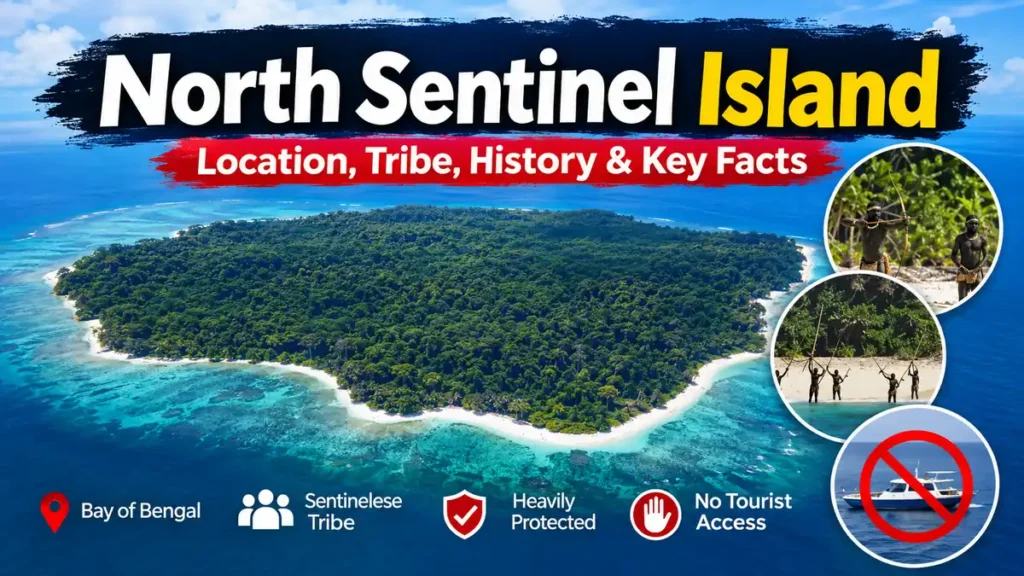
Hidden in the Bay of Bengal, north sentinel island is one of the few places on Earth where an Indigenous community continues to live with almost no sustained contact with the outside world. Its inhabitants, the Sentinelese, have repeatedly resisted outsiders, making the island a subject of global curiosity and an important example of Indigenous autonomy.
North Sentinel Island is a protected Indian island in the Andaman and Nicobar Islands, inhabited by the Sentinelese people. India prohibits unauthorized visits to protect the community from infectious diseases, intrusion, and disruption of its way of life. Its population, language, and cultural practices remain largely undocumented because sustained contact is deliberately avoided.
Where Is North Sentinel Island Located?
North Sentinel Island lies in the Bay of Bengal, within India’s Andaman and Nicobar Islands, an archipelago between the Indian subcontinent and Southeast Asia.
The island belongs administratively to India’s Union Territory of Andaman and Nicobar Islands. It is situated west of the main Andaman island group, separated from inhabited areas by open water.
Although it appears relatively close to other islands on a map, its isolation is reinforced by surrounding coral reefs, limited landing areas, and strict legal restrictions.
Geography and physical features
| Feature | Details |
|---|---|
| Country | India |
| Territory | Andaman and Nicobar Islands |
| Location | Bay of Bengal |
| Approximate area | 60 square kilometers |
| Landscape | Tropical forest, beaches, coral reefs |
| Indigenous inhabitants | Sentinelese |
| Official access | Restricted tribal reserve |
| Protected coastal zone | 5 kilometers from the high-water mark |
The island is covered by dense tropical vegetation, with narrow stretches of sandy shoreline and reefs surrounding much of its coast.
Satellite images reveal the island’s forest cover and coastline, but they provide little information about the everyday activities of its inhabitants.
How big is North Sentinel Island?
North Sentinel Island covers approximately 60 square kilometers, although published measurements vary slightly. Its widest dimension is roughly 10 kilometers.
For comparison, its land area is similar to that of Manhattan in New York City.
Despite its modest size, the island contains coastal and forest ecosystems that have supported its Indigenous inhabitants for generations.
Who Lives on North Sentinel Island?
The Sentinelese are the only known permanent inhabitants of North Sentinel Island.
They are an Indigenous Andamanese people who have maintained a largely independent existence despite centuries of outside activity in the surrounding region.
Unlike communities that regularly interact with neighboring populations, the Sentinelese have consistently resisted sustained contact.
This does not mean they are unaware of outsiders. Historical encounters demonstrate that they recognize approaching boats, aircraft, and unfamiliar people.
Their responses indicate a clear preference for maintaining distance.
How many Sentinelese people are there?
The exact population is unknown.
Published estimates vary widely, often ranging from several dozen to a few hundred people. Figures such as 50, 100, or 150 should not be interpreted as verified census totals.
Reliable population counting is difficult because researchers cannot conduct conventional household surveys without violating the community’s protected isolation.
Observations from boats or aircraft may reveal only a small portion of the population.
Consequently, no precise current population figure can be established.
What language do the Sentinelese speak?
The Sentinelese speak a language that has not been adequately documented by outside linguists.
It is generally discussed in connection with the Indigenous languages of the Andaman Islands, but its precise linguistic relationships remain uncertain.
Researchers do not possess a reliable grammar, comprehensive vocabulary, or verified translation system.
The lack of documentation is not evidence that the language is simple. It reflects the absence of sustained, consensual linguistic research.
Are the Sentinelese an ancient or primitive tribe?
Descriptions of the Sentinelese as a Stone Age or primitive people are misleading.
Their community uses hunting, gathering, fishing, and locally available materials, but this does not mean they have remained culturally unchanged for thousands of years.
All human societies adapt over time.
The Sentinelese have also been observed using metal recovered from outside objects, demonstrating practical adaptation to available resources.
Their isolation should be understood as a matter of autonomy rather than evidence of cultural inferiority.
How Do the Sentinelese Survive Without Modern Infrastructure?
The Sentinelese appear to maintain a subsistence economy based on the island’s natural resources.
Available observations suggest that fishing, hunting, and gathering are central to their food supply.
However, outsiders know relatively little about the community’s internal organization, seasonal activities, or detailed food practices.
Food and hunting methods
The island’s coastal and forest environments provide access to several potential food sources.
Observed or reasonably documented subsistence activities include:
- Fishing in shallow coastal waters.
- Hunting animals using bows and arrows.
- Collecting shellfish and other marine resources.
- Gathering edible plants and forest products.
- Using locally constructed tools and equipment.
The community’s dependence on natural resources helps explain why protection of the surrounding coastal waters is especially important.
Commercial fishing, unauthorized landings, and environmental damage could interfere with food supplies.
Homes, boats, and tools
Historical observations have identified simple shelters, including communal structures and smaller temporary shelters.
The Sentinelese also use narrow watercraft suitable for shallow coastal environments.
These boats are generally described as being propelled with poles rather than designed for long-distance ocean travel.
Bows and arrows are among the community’s most recognizable tools.
Metal recovered from shipwrecks or other outside sources has reportedly been incorporated into some implements.
Such practices demonstrate knowledge of local conditions and the ability to use available materials effectively.
Do they have electricity or modern technology?
There is no reliable evidence of a conventional electrical grid, telecommunications network, or modern public infrastructure on the island.
That does not mean the Sentinelese lack sophisticated knowledge.
Their survival requires practical understanding of coastal conditions, seasonal resources, construction, navigation within familiar waters, and their surrounding ecosystems.
Technology should not be measured solely by the presence of electronics or industrial machinery.
Why Is North Sentinel Island Forbidden to Visit?
North Sentinel Island is closed to unauthorized visitors primarily to protect the Sentinelese people.
The restrictions also protect outsiders, but the central concern is the community’s right to remain undisturbed.
The Indian government has designated the island and surrounding waters as a protected tribal reserve.
According to India’s Ministry of Home Affairs, the reserve includes the entire island and coastal waters extending five kilometers from the high-water mark. Press Information Bureau
Risk of infectious diseases
One of the greatest dangers associated with outside contact is the introduction of infectious diseases.
Communities with little exposure to common external pathogens may face serious health risks when unfamiliar infections are introduced.
Respiratory illnesses, including influenza and measles, have historically caused devastating outbreaks among some isolated Indigenous populations following contact.
The precise immunity profile of the Sentinelese is unknown, but the potential consequences of uncontrolled contact are serious.
Even a visitor who appears healthy could carry an infection.
Protection of Indigenous rights
The restrictions also recognize that the Sentinelese have repeatedly demonstrated their unwillingness to engage in sustained contact.
Attempts to force interaction can violate their autonomy and expose them to unwanted cultural and environmental disruption.
India has adopted an approach commonly described as eyes-on, hands-off: monitoring the protected area while avoiding unnecessary direct interference. Digital Sansad
What laws protect the island?
Several Indian legal provisions contribute to protecting the community, particularly the Andaman and Nicobar Islands (Protection of Aboriginal Tribes) Regulation, 1956, as amended.
Other relevant frameworks include restrictions affecting foreign visitors and laws protecting Scheduled Tribes.
Unauthorized entry can lead to arrest, prosecution, and other legal consequences.
The restrictions apply to Indian citizens as well as foreign tourists.
There is no ordinary tourist permit that makes visiting North Sentinel Island lawful. The U.S. State Department also explicitly warns travelers that India forbids visits to the island. U.S. Department of State Travel
History of North Sentinel Island and Outside Contact
The history of North Sentinel Island is often presented as a series of dramatic confrontations. However, its documented encounters with outsiders reveal a more complicated story involving colonial expeditions, anthropological research, maritime accidents, and changing government policies.
The Sentinelese have not always responded to visitors in exactly the same way. Some encounters involved warnings or defensive actions, while others included brief peaceful exchanges.
Early colonial encounters
During the nineteenth century, British colonial authorities expanded their presence throughout the Andaman Islands.
In 1880, British officer Maurice Vidal Portman organized an expedition to North Sentinel Island.
His party captured an elderly couple and several children and transported them to Port Blair.
The adults became ill and died. The children were subsequently returned to the island with gifts.
The incident illustrates the dangers of forced contact, particularly the potential introduction of disease and the trauma caused by removing people from their community.
The longer-term consequences for the Sentinelese remain unknown. Survival International+1
Indian contact expeditions from 1967 onward
After Indian independence, government officials and anthropologists undertook expeditions intended to learn more about the Sentinelese.
Anthropologist T. N. Pandit participated in several of these missions.
Some expeditions involved leaving coconuts, bananas, metal objects, or other items near the shore.
The responses varied. At times, islanders approached the visitors or accepted gifts. During other encounters, they signaled warnings or fired arrows.
These experiences gradually raised questions about whether contact missions benefited the community.
The peaceful encounter of 1991
One of the best-known encounters occurred in January 1991.
During a government expedition, Sentinelese individuals approached a visiting boat and accepted coconuts without the same degree of confrontation seen during many earlier visits.
Further interactions took place that year.
Anthropologist Madhumala Chattopadhyay was among the researchers associated with the contact expeditions of this period.
Although these encounters demonstrated that peaceful interaction was possible, they did not establish consent for permanent outside involvement.
By the mid-1990s, regular gift-giving missions had ended, reflecting increasing concern about their risks. Humanities and Social Sciences Communications+1
Major events in North Sentinel Island history
| Year | Event | Significance |
|---|---|---|
| 1880 | British colonial expedition | Forced removal of islanders and deaths following illness |
| 1967 | Indian contact expeditions begin | Organized anthropological observations |
| 1974 | Contact expedition and documentary visit | Defensive response to approaching outsiders |
| 1981 | MV Primrose runs aground | Shipwreck leads to confrontation |
| 1991 | Peaceful exchanges of coconuts | Rare close interactions |
| Mid-1990s | Regular contact missions end | Shift toward non-interference |
| 2004 | Indian Ocean tsunami | Aerial checks confirm visible survivors |
| 2006 | Two fishermen killed | Highlights risks of unauthorized approaches |
| 2018 | John Allen Chau killed | International debate over missionary contact |
| 2025 | American visitor arrested | Renewed concerns over illegal tourism |
These incidents helped shape the modern approach to protecting the island.
What Happened During the 2004 Tsunami?
The Indian Ocean earthquake and tsunami of December 26, 2004, caused extensive destruction across coastal communities in South and Southeast Asia.
Because North Sentinel Island lies in the affected region, authorities were concerned about the survival of its inhabitants.
Indian Coast Guard personnel conducted aerial observations to assess the situation.
During one helicopter flight, a Sentinelese man was photographed aiming a bow and arrow toward the aircraft.
The image became internationally recognized.
Did the Sentinelese survive the tsunami?
The helicopter observations confirmed that at least some islanders had survived.
However, they did not establish the precise number of survivors or the full extent of damage to the community.
Researchers have suggested that local environmental knowledge may have helped the islanders respond to the disaster, but specific accounts of their actions cannot be verified.
The earthquake also altered coastal geography in parts of the Andaman Islands, affecting reef exposure and shallow-water environments.
These changes could have influenced fishing areas and other coastal resources.
The Sentinelese response to the approaching helicopter also demonstrated that they continued to defend their territory after the disaster. Wiley Online Library+1
Why Have People Been Killed Near North Sentinel Island?
Several fatal incidents involving outsiders have contributed to North Sentinel Island’s reputation as a dangerous destination.
However, describing the Sentinelese simply as violent overlooks the context of these encounters.
The recorded incidents generally involve outsiders entering or approaching territory that the community has repeatedly sought to defend.
The 2006 fishermen incident
In January 2006, two Indian fishermen, Sunder Raj and Pandit Tiwari, were killed after their boat drifted toward North Sentinel Island.
Reports indicate that the men had been fishing illegally in nearby waters and that their vessel moved close to shore while they were sleeping.
The incident emphasized the dangers of entering the protected coastal area.
It also demonstrated why preventing unauthorized fishing is important for both local communities and the Sentinelese. Survival International
The death of John Allen Chau in 2018
In November 2018, American missionary John Allen Chau attempted to visit North Sentinel Island.
His stated objective was to establish contact and introduce Christianity to the Sentinelese.
He arranged unauthorized transportation toward the island and attempted to approach its inhabitants.
Chau was reportedly killed by arrows during the encounter.
His body was not recovered.
The incident attracted international attention and prompted debate about missionary activity, religious freedom, Indigenous autonomy, and the risks of forced contact.
The central issue was not simply whether Chau understood the danger to himself. His actions also risked exposing the Sentinelese to infections and unwanted intervention.
Why do the Sentinelese attack outsiders?
The most evidence-supported explanation is territorial defense and resistance to unwanted contact.
The Sentinelese have demonstrated through repeated encounters that they do not welcome uninvited visitors.
Their responses may also reflect historical experiences with outsiders, although their exact motivations cannot be known without direct testimony.
They should not be characterized as attacking strangers without reason.
Their actions occur in the context of protecting their home and maintaining separation from outside society.
What Happened on North Sentinel Island in 2025?
North Sentinel Island returned to international headlines after an American visitor illegally landed on the island in March 2025.
The incident raised renewed concerns about social media attention, unauthorized exploration, and the vulnerability of isolated Indigenous communities.
The American tourist’s unauthorized landing
On March 29, 2025, American national Mykhailo Viktorovych Polyakov traveled to North Sentinel Island in a small motorized inflatable boat.
According to police reports, he brought a coconut and a can of cola, apparently intending to leave them as gifts.
He reportedly attempted to attract attention by blowing a whistle.
After failing to establish contact, he briefly landed, left the objects, collected sand samples, and recorded footage.
Authorities subsequently arrested him on March 31.
Investigators reported that he had previously attempted to approach the island.
He was granted bail by an Indian court on April 25, 2025, subject to conditions. ABC News+1
Why the incident caused concern
The immediate concern was the potential exposure of the Sentinelese to outside pathogens.
Even though reports indicated that Polyakov did not directly meet any islanders, an unauthorized landing still created unnecessary risk.
The incident also illustrated a modern problem: isolated communities can become targets of attention-seeking visitors who treat protected Indigenous territories as destinations for extreme adventures.
Organizations advocating for Indigenous rights criticized the attempted contact and called for continued enforcement of the restrictions.
The case reinforced the importance of preventing unauthorized visits rather than responding only after a landing occurs.
Can Tourists Visit North Sentinel Island?
No. North Sentinel Island is not open to tourism.
Visitors cannot legally land on its beaches, enter its forests, or arrange ordinary sightseeing excursions into its protected coastal waters.
The restrictions exist regardless of a visitor’s nationality, purpose, or willingness to accept personal risk.
Can you see the island from a boat?
The island can be observed through satellite imagery, but unauthorized boating within its protected waters is prohibited.
Commercial tour operators cannot lawfully offer landings or close-contact experiences with the Sentinelese.
Visitors should also avoid attempting to approach the restricted boundary independently.
Even remaining aboard a boat does not automatically make an unauthorized approach permissible.
Can scientists visit North Sentinel Island?
Scientific interest does not provide automatic permission to enter the reserve.
The government’s approach prioritizes non-interference and protection of the community.
Historical research expeditions provide valuable records, but they also demonstrate why direct contact can be ethically and medically dangerous.
Research conducted through historical documents, remote observation, and environmental monitoring can offer information without requiring close interaction.
Are there other Andaman Islands tourists can visit?
Yes. Several destinations elsewhere in the Andaman and Nicobar Islands are open to tourism under applicable regulations.
Popular destinations include Swaraj Dweep, Shaheed Dweep, and parts of South Andaman Island.
These locations have established visitor infrastructure and are separate from North Sentinel Island’s protected territory.
Tourism in the wider archipelago should not be confused with permission to enter Indigenous reserves.
What Makes North Sentinel Island Different From Other Isolated Communities?
North Sentinel Island is unusual because its inhabitants have maintained a high degree of separation from surrounding societies despite their proximity to established maritime routes and inhabited islands.
However, the Sentinelese are not the only Indigenous people who have experienced isolation or resisted outside interference.
Other communities in the Andaman and Nicobar Islands include the Jarawa, Onge, Great Andamanese, and Shompen.
Their histories and relationships with outside society differ substantially.
| Community | General location | Contact situation |
|---|---|---|
| Sentinelese | North Sentinel Island | Reject sustained outside contact |
| Jarawa | South and Middle Andaman | Have experienced increasing outside contact |
| Onge | Little Andaman | Established contact with outside authorities |
| Great Andamanese | Andaman Islands | Long history of colonial and modern contact |
| Shompen | Great Nicobar | Some groups remain highly isolated |
These communities should not be treated as interchangeable.
Each has its own history, language, cultural traditions, and relationship with outside authorities.
Why is isolation important to their survival?
Contact with outside populations has historically caused severe disruption among several Indigenous communities.
Introduced diseases, displacement, exploitation, and loss of traditional resources have contributed to population decline and cultural change.
The experience of neighboring Andamanese peoples helps explain the strong emphasis on protecting the Sentinelese from uncontrolled interaction.
Maintaining separation does not guarantee that the community will face no future challenges, but it reduces several immediate and preventable risks.
What Do We Still Not Know About North Sentinel Island?
Despite decades of international attention, substantial gaps remain in scientific knowledge about the island and its inhabitants.
These gaps are not necessarily problems that should be solved through direct contact.
Some information may remain unknown because respecting the community’s autonomy takes priority over satisfying outside curiosity.
Their exact population and family structure
There is no reliable contemporary census.
The number of households, age distribution, family relationships, and broader social organization cannot be described with confidence.
Brief sightings from offshore are insufficient to establish these details.
Their religious beliefs and cultural traditions
The Sentinelese community’s religious practices, ceremonies, oral traditions, and beliefs remain largely undocumented.
Claims that they follow a particular religion or worship specific deities are generally unsupported.
Similarly, outsiders cannot reliably describe their marriage customs, leadership systems, or detailed social rules.
Their ancestry and genetic history
The Sentinelese are frequently described as descendants of populations that reached the Andaman region many thousands of years ago.
Although the broader Andamanese population has a long history in the region, precise claims about Sentinelese ancestry are difficult to verify.
There is no comprehensive modern genetic dataset for the community.
Statements that the Sentinelese have lived unchanged for 60,000 years confuse long-term human settlement with cultural continuity.
Their ancestors, like those of every living population, experienced generations of biological, social, and cultural change.
Their health and life expectancy
No reliable modern statistics establish the Sentinelese average lifespan, infant mortality rate, or prevalence of particular diseases.
Photographs of apparently healthy individuals cannot substitute for population-level medical research.
It is reasonable to recognize the dangers of introduced infections without assuming that every aspect of the community’s health is known.
How Is North Sentinel Island Protected Today?
Protection involves legal restrictions, coastal surveillance, and a policy of avoiding unnecessary contact.
Indian authorities, including maritime and police agencies, monitor the surrounding area to discourage illegal approaches.
The Indian Coast Guard and marine police have participated in surveillance operations intended to protect the reserve.
Government policy also recognizes the importance of safeguarding marine resources used by protected Indigenous communities.
Main threats facing the island
The most significant external risks include unauthorized fishing, deliberate attempts at contact, infectious diseases, and environmental disturbance.
Poachers may target valuable marine species in the surrounding waters.
Unauthorized visitors can introduce waste, pathogens, or other materials that the community has not chosen to receive.
Natural disasters and environmental changes present additional challenges, although their effects on the Sentinelese cannot always be assessed directly.
Why the hands-off policy matters
The government’s non-contact approach reflects a fundamental principle: protection does not always require intervention.
For a community that has consistently resisted sustained contact, maintaining territorial security may be more beneficial than imposing outside services or institutions.
This approach also requires careful judgment.
Authorities must consider how to respond to serious emergencies while avoiding actions that could create even greater harm.
The most practical long-term protection strategy is to prevent unnecessary intrusion and preserve the community’s environment.
Why North Sentinel Island Matters
North Sentinel Island is more than a remote geographical curiosity.
It raises important questions about Indigenous rights, cultural diversity, environmental protection, and the limits of outside intervention.
The Sentinelese demonstrate that a community can maintain its own way of life without becoming integrated into global industrial society.
Their existence also challenges the assumption that every population must follow the same path of technological and social development.
There is a distinction between learning about a community and claiming the right to enter its territory.
Respectful interest does not require direct access.
Historical research, verified government records, and responsible reporting can help people understand North Sentinel Island without threatening its inhabitants.
Final Thoughts on north sentinel island
North Sentinel Island remains one of the world’s most distinctive protected Indigenous territories. Its tropical forests and surrounding waters support a community whose language, population, and internal traditions are still largely unknown to outsiders.
Historical encounters, including the 1991 peaceful exchanges, the 2004 tsunami observations, the 2018 death of John Allen Chau, and the unauthorized landing in 2025, demonstrate both the fascination surrounding the island and the serious consequences of unwanted contact.
The most important fact about north sentinel island is not that outsiders know so little about it. It is that the Sentinelese have repeatedly expressed their preference to remain separate, and respecting that choice is central to protecting their future.