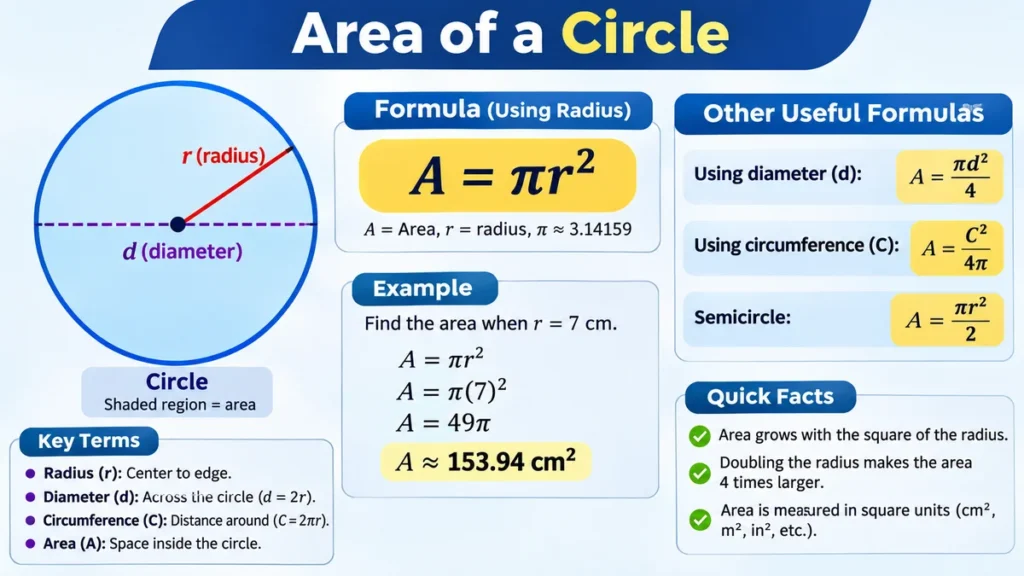
Finding the area of a circle is easier than it might seem. Whether you’re measuring a circular garden, solving a geometry problem, or calculating how much material a round surface needs, one simple formula does most of the work.
The area of a circle is the amount of two-dimensional space enclosed by its curved boundary. To calculate it, multiply pi (π) by the square of the radius: A = πr². The radius is the distance from the center to the edge, and the result is expressed in square units.
What Is the Area of a Circle?
The area of a circle measures the region inside its circumference. Unlike the perimeter, which measures the distance around a shape, area tells you how much surface the shape covers.
For example, imagine a circular tabletop with a radius of 50 centimeters. Its area tells you how much tabletop surface is available, while its circumference tells you the length around the outer edge.
Three measurements are especially useful in circle geometry:
- Radius (r): The distance from the center of a circle to any point on its boundary.
- Diameter (d): The distance across the circle through its center, equal to twice the radius.
- Circumference (C): The total distance around the circle.
A circle showing its radius, diameter, and enclosed area.
The area is measured in square units, such as cm², m², in², or ft², depending on the original measurement.
The Area of a Circle Formula
The standard formula is:
\[ A=\pi r^2 \]
Area = Pi × Radius × Radius
Where:
- A represents the area.
- π (pi) is approximately 3.14159.
- r represents the radius.
- r² means the radius multiplied by itself.
For most school calculations, using 3.14 for π is sufficient unless the question specifies otherwise. For greater accuracy, use your calculator’s π button.
How to Calculate the Area of a Circle Step by Step
Suppose a circle has a radius of 7 cm.
- Identify the radius: r = 7 cm.
- Square the radius: 7 × 7 = 49.
- Multiply by pi: 49 × 3.14159 = 153.938.
- Write the result in square units: approximately 153.94 cm².
Therefore:
\[ A=\pi(7)^2=49\pi\approx153.94\text{ cm}^2 \]
The exact answer is 49π cm². The decimal answer is an approximation because π is irrational.
Interactive Area of a Circle Calculator
RadiusUnit
cm
Calculated Area
153.938 cm²
\(A=\pi\times 7^2\)
Diameter
14 cm
Circumference
43.9823 cm
Reset calculator
How to Find the Area of a Circle Using the Diameter
Sometimes a geometry problem provides the diameter rather than the radius.
Because the diameter is twice the radius, divide the diameter by 2 before applying the standard formula.
\[ r=\frac d2 \]
Substituting this relationship into A = πr² gives:
\[ \boxed{A=\frac{\pi d^2}{4}} \]
Here, d represents the diameter.
Example: Circle With a Diameter of 10 cm
Suppose the diameter is 10 cm.
First, calculate the radius:
\[ r=\frac{10}{2}=5\text{ cm} \]
Then calculate the area:
\[ A=\pi(5)^2=25\pi \]
\[ A\approx78.54\text{ cm}^2 \]
You can also use the diameter formula directly:
\[ A=\frac{\pi(10)^2}{4}=25\pi \]
Both methods produce the same result.
A common mistake is using the diameter directly as the radius. Because area depends on the square of the radius, doing this makes the calculated area four times too large.
How to Find the Area of a Circle Using Circumference
The circumference is the distance around a circle. Its formula is:
\[ C=2\pi r \]
If you know the circumference but not the radius, rearrange the equation:
\[ r=\frac{C}{2\pi} \]
Substitute this expression into the area formula:
\[ \boxed{A=\frac{C^2}{4\pi}} \]
Example: Circumference of 31.42 cm
Suppose a circle has a circumference of approximately 31.42 cm.
Using the circumference formula:
\[ A=\frac{31.42^2}{4\pi} \]
\[ A\approx78.55\text{ cm}^2 \]
The small difference from 78.54 cm², the area of a circle with an exact 5 cm radius, comes from rounding the circumference.
This method is useful when measuring circular objects with a flexible tape measure, especially when the center is difficult to locate.
Area of a Circle Formulas Compared
The correct formula depends on which measurement you already know.
| Known measurement | Formula | Example |
|---|---|---|
| Radius (r) | A = πr² | r = 3 → 28.27 |
| Diameter (d) | A = πd²/4 | d = 6 → 28.27 |
| Circumference (C) | A = C²/(4π) | C = 6π → 28.27 |
All three examples describe a circle with a radius of 3 units, so they produce the same area, approximately 28.27 square units.
Area of a Circle Examples With Different Measurements
Working through several examples helps explain how the formula behaves.
Example 1: Area of a Circle With Radius 5 cm
\[ A=\pi(5)^2=25\pi \]
Answer: Approximately 78.54 cm².
Example 2: Area of a Circle With Radius 10 m
\[ A=\pi(10)^2=100\pi \]
Answer: Approximately 314.16 m².
Example 3: Area of a Circle With Diameter 14 cm
The radius is 7 cm.
\[ A=\pi(7)^2=49\pi \]
Answer: Approximately 153.94 cm².
Example 4: Area of a Circle With Radius 2.5 Inches
\[ A=\pi(2.5)^2=6.25\pi \]
Answer: Approximately 19.63 in².
Area of a Circle Reference Table
| Radius | Diameter | Area (approx.) |
|---|---|---|
| 1 | 2 | 3.14 |
| 2 | 4 | 12.57 |
| 3 | 6 | 28.27 |
| 4 | 8 | 50.27 |
| 5 | 10 | 78.54 |
| 6 | 12 | 113.10 |
| 7 | 14 | 153.94 |
| 8 | 16 | 201.06 |
| 9 | 18 | 254.47 |
| 10 | 20 | 314.16 |
The values assume consistent length units, with area expressed in the corresponding square units.
Notice how the area grows faster than the radius. This happens because the radius is squared rather than multiplied by a fixed constant alone.
Why Is the Area of a Circle πr²?
The formula A = πr² is not simply a rule to memorize. It can be understood by rearranging a circle into a shape whose area is easier to calculate.
Imagine dividing a circle into many narrow, equal sectors, similar to slices of pizza.
If you arrange these sectors alternately, with one pointing upward and the next downward, they begin to resemble a parallelogram.
Conceptual illustration: rearranging circular sectors into an approximately parallelogram-shaped region.
As the sectors become increasingly narrow, the rearranged shape approaches a rectangle or parallelogram with:
- A base equal to half the circumference, πr.
- A height equal to the radius, r.
Since the area of a parallelogram is base multiplied by height:
\[ A=\pi r\times r \]
Therefore:
\[ \boxed{A=\pi r^2} \]
This geometric explanation is also used in educational material from Khan Academy. Khan Academy+1
Why Is Pi Used?
Pi (π) is the constant ratio between a circle’s circumference and its diameter:
\[ \pi=\frac{C}{d} \]
Its decimal expansion begins 3.1415926535 and continues indefinitely without repeating.
Because every circle has the same circumference-to-diameter ratio, π appears in formulas for circular measurements, regardless of the circle’s size.
The approximation 22/7 is sometimes used in school mathematics, but it is not exactly equal to π.
Area vs. Circumference of a Circle
Area and circumference describe different properties of the same geometric figure.
| Feature | Area | Circumference |
|---|---|---|
| Meaning | Space inside the circle | Distance around the circle |
| Formula | πr² | 2πr |
| Dimension | Two-dimensional | One-dimensional |
| Units | cm², m², ft² | cm, m, ft |
| Main use | Surface coverage | Boundary length |
Consider a circular swimming pool with a radius of 4 meters.
Its area is:
\[ A=\pi(4)^2\approx50.27\text{ m}^2 \]
Its circumference is:
\[ C=2\pi(4)\approx25.13\text{ m} \]
You would use the area to estimate the surface covered by a pool cover. You would use the circumference to estimate the length of edging needed around the pool.
The distinction matters because substituting the circumference formula into an area problem gives an answer with the wrong dimensions.
How to Find the Radius From the Area
Some problems reverse the usual calculation. Instead of providing the radius and asking for the area, they give the area and ask for the radius.
Starting with:
\[ A=\pi r^2 \]
Divide both sides by π:
\[ r^2=\frac A\pi \]
Then take the square root:
\[ \boxed{r=\sqrt{\frac A\pi}} \]
Example: Find the Radius When the Area Is 200 cm²
\[ r=\sqrt{\frac{200}{\pi}} \]
\[ r\approx7.98\text{ cm} \]
The diameter is twice the radius:
\[ d\approx15.96\text{ cm} \]
This reverse calculation is useful when you know how much surface an object covers but need to determine its dimensions.
How Does Changing the Radius Affect the Area?
One of the most useful properties of circles is that their area grows with the square of the radius.
If you double the radius, the area becomes four times as large.
If you triple the radius, the area becomes nine times as large.
More generally, multiplying the radius by a factor of k multiplies the area by k².
\[ A_{\text{new}}=k^2A_{\text{original}} \]
Doubling the radius quadruples the area.
Radius and Area Growth Table
| Radius multiplier | Area multiplier |
|---|---|
| 0.5× | 0.25× |
| 1× | 1× |
| 1.5× | 2.25× |
| 2× | 4× |
| 3× | 9× |
| 4× | 16× |
This relationship explains why a modest increase in the diameter of a circular garden, pizza, or tabletop can produce a substantial increase in surface area.
Finding the Area of Semicircles, Sectors, and Rings
Not every geometry problem involves a complete circle. The same basic formula can be adapted to calculate portions of circles and regions between circular boundaries.
Area of a Semicircle
A semicircle is half of a circular region.
Its area is:
\[ A=\frac{\pi r^2}{2} \]
For a semicircle with radius 6 cm:
\[ A=\frac{\pi(6)^2}{2}=18\pi \]
Answer: Approximately 56.55 cm².
Area of a Quarter Circle
A quarter circle represents one-fourth of a complete circular region.
\[ A=\frac{\pi r^2}{4} \]
For a radius of 8 cm:
\[ A=\frac{\pi(8)^2}{4}=16\pi \]
Answer: Approximately 50.27 cm².
Area of a Circular Sector
A sector is a region enclosed by two radii and the arc between them.
For a central angle θ measured in degrees:
\[ A=\frac{\theta}{360^\circ}\pi r^2 \]
Suppose the sector has a central angle of 60° and a radius of 12 cm.
\[ A=\frac{60}{360}\pi(12)^2 \]
\[ A=24\pi\approx75.40\text{ cm}^2 \]
When θ is measured in radians, the formula becomes:
\[ A=\frac12r^2\theta \]
Area of an Annulus (Circular Ring)
An annulus is the region between two concentric circles.
To find its area, subtract the smaller circle’s area from the larger circle’s area:
\[ A=\pi(R^2-r^2) \]
Here, R is the outer radius and r is the inner radius.
For an outer radius of 10 cm and an inner radius of 6 cm:
\[ A=\pi(100-36)=64\pi \]
Answer: Approximately 201.06 cm².
This formula is useful for calculating the surface area of washers, circular pathways, and ring-shaped objects.
Real-Life Applications of the Area of a Circle
Circular area calculations are used in construction, engineering, landscaping, manufacturing, and everyday planning.
Measuring a Circular Garden
Suppose a circular garden has a radius of 3 meters.
\[ A=\pi(3)^2\approx28.27\text{ m}^2 \]
The garden covers approximately 28.27 square meters.
If grass seed covers 5 m² per packet, the number of packets required is:
\[ \frac{28.27}{5}\approx5.65 \]
You would need at least 6 packets, assuming the stated coverage and no additional waste.
Calculating the Area of a Pizza
Imagine two pizzas with diameters of 10 inches and 14 inches.
For the 10-inch pizza:
\[ A=\pi(5)^2\approx78.54\text{ in}^2 \]
For the 14-inch pizza:
\[ A=\pi(7)^2\approx153.94\text{ in}^2 \]
The larger pizza has approximately 96% more surface area, even though its diameter is only 40% greater.
Measuring Circular Flooring
A round room with a diameter of 6 meters has a radius of 3 meters.
Its floor area is:
\[ A=\pi(3)^2\approx28.27\text{ m}^2 \]
This provides a starting estimate for flooring materials. Actual purchasing quantities may need to account for cutting losses, patterns, and installation requirements.
Engineering and Manufacturing
The area of a circular cross-section is used when calculating the volume of cylinders, analyzing pipes, and designing circular components.
For a cylinder with a constant circular cross-section:
\[ V=\pi r^2h \]
Here, h is the cylinder’s height or length.
The circle area formula is therefore a building block for three-dimensional geometry as well.
Common Mistakes When Calculating the Area of a Circle
Even when the formula is familiar, small errors can produce significantly incorrect results.
Confusing Radius and Diameter
The radius is half the diameter.
If the diameter is 12 cm, use r = 6 cm, not r = 12 cm.
Forgetting to Square the Radius
The formula is πr², not πr.
For a radius of 4 cm:
- Incorrect: π × 4 ≈ 12.57
- Correct: π × 16 ≈ 50.27 cm²
Squaring Pi Instead of the Radius
The expression πr² means π multiplied by r².
It does not mean (πr)².
Using Incorrect Units
If the radius is measured in meters, the area must be expressed in square meters.
For example, a circle with radius 2 m has an area of approximately 12.57 m², not 12.57 m.
Mixing Measurement Units
A radius of 50 cm should not be combined directly with measurements in meters without conversion.
Convert all lengths to a consistent unit before calculating.
Rounding Too Early
Using π = 3.14 is acceptable for many basic exercises, but rounding intermediate calculations can reduce accuracy.
When possible, keep π in symbolic form or use the calculator’s π function until the final step.
Practice Problems: Test Your Understanding
Try these questions before checking the solutions.
Circle Area Quiz
0 of 4 answered
1. A circle has a radius of 4 cm. What is its area?12.57 cm²50.27 cm²25.13 cm²
2. A circle has a diameter of 18 m. What is its area?254.47 m²56.55 m²1017.88 m²
3. If a circle’s radius triples, how does its area change?3 times larger6 times larger9 times larger
4. Which unit is appropriate for the area of a circle measured in inches?inin²in³
Check answers
Try again
Final Thoughts on the Area of a Circle
The area of a circle is calculated using A = πr², where r is the radius and π is approximately 3.14159.
If you know the diameter, divide it by two to find the radius. If you know the circumference, divide it by 2π. In either case, you can then use the standard area formula.
Remember that area describes the space inside a circle, not the distance around it, and always express the result in square units.
With these principles, you can solve basic geometry exercises, calculate partial circular regions, and apply circular measurements to practical situations with confidence.