Writing a check may seem old-fashioned in an age of mobile banking, debit cards, and instant payments. Yet checks remain useful for paying rent, making donations, handling certain business expenses, and sending payments when electronic methods aren’t available.
If you’ve never filled out a check before, the different lines, numbers, and boxes can feel confusing. Fortunately, the process is straightforward once you understand what belongs in each section.
To write a check, enter the date, write the recipient’s name, fill in the payment amount in numbers and words, add an optional memo, and sign your name. Before handing it over, verify that the amounts match, the recipient is correct, and sufficient money is available in your checking account.
This guide explains each part of a check, provides a realistic example, and covers the safety precautions that help prevent payment errors and fraud.
How to Write a Check in 6 Easy Steps
A standard personal check has six main fields that you should understand before making a payment. Most American checks follow a similar layout, although the design may vary depending on the bank or credit union.
Step 1: Write the Date
Find the date line in the upper-right corner of the check.
Enter the current date using a standard format such as:
October 20, 2026
You can also use a numerical format such as 10/20/2026.
The date indicates when you issued the check and can help both parties maintain accurate financial records.
Some people write a future date, known as postdating a check. However, postdating does not guarantee that the bank will wait until that date to process it. Under applicable banking rules, a bank may pay a postdated check early unless it has received an effective notice of postdating.
For ordinary payments, using the actual date is generally the safest approach.
Step 2: Write the Recipient’s Name
Locate the line labeled Pay to the Order of.
Write the full name of the person or organization receiving the money.
For example:
- Individual: Sarah Johnson
- Business: Green Valley Property Management
- Organization: American Red Cross
Use the recipient’s correct legal or accepted payment name whenever possible.
Avoid writing “Cash” as the recipient unless necessary. A check payable to cash can potentially be cashed by whoever possesses it, making it riskier if lost or stolen.
If you’re paying a company, confirm its payment instructions before writing the name.
Step 3: Enter the Amount in Numbers
Look for the small box on the right side of the check, usually marked with a dollar sign ($).
Write the exact payment amount using numbers.
For example:
$1,250.75
The digits before the decimal point represent dollars, while the two digits after the decimal point represent cents.
Always include two decimal places, even when the amount is a whole number.
Examples:
| Payment amount | Write in the box |
|---|---|
| Fifty dollars | 50.00 |
| One hundred dollars | 100.00 |
| Two hundred fifty dollars and fifty cents | 250.50 |
| One thousand dollars | 1,000.00 |
| One thousand two hundred fifty dollars and seventy-five cents | 1,250.75 |
Start writing close to the dollar sign or left edge of the box to reduce the possibility of additional digits being inserted.
Step 4: Write the Amount in Words
Below the recipient line, you’ll find a longer line ending with the word “Dollars.”
Write the payment amount in words on this line.
For a check worth $1,250.75, write:
One thousand two hundred fifty and 75/100
The fraction represents the cents portion of the payment.
For instance, 75/100 means seventy-five cents, while 05/100 means five cents.
Other examples include:
| Numeric amount | Amount in words |
|---|---|
| $25.00 | Twenty-five and 00/100 |
| $85.50 | Eighty-five and 50/100 |
| $120.25 | One hundred twenty and 25/100 |
| $500.00 | Five hundred and 00/100 |
| $2,345.67 | Two thousand three hundred forty-five and 67/100 |
The written amount and numeric amount should always match.
If there is unused space after the written amount, draw a horizontal line through the remaining area to discourage alterations.
When the numeric and written amounts conflict, banks generally follow the written amount under Uniform Commercial Code rules, subject to applicable law and circumstances. Nevertheless, a mismatch can cause delays, rejection, or disputes.
Step 5: Fill Out the Memo Line
The memo line is usually located in the lower-left corner of the check.
This field is generally optional, but it helps identify the purpose of a payment.
For example, you might write:
- October rent
- Invoice #1045
- School tuition
- Charitable donation
- Utility bill
A clear memo makes it easier to review your bank statements and understand older transactions.
For bill payments, a company may ask you to include an account number or invoice reference. Follow its instructions, but avoid putting unnecessary sensitive information, such as your Social Security number, on a check.
The memo line usually does not control whether the check can be negotiated or cashed.
Step 6: Sign the Check
The signature line is located in the bottom-right corner.
Sign the check using the signature associated with your checking account.
Your signature authorizes the payment and is one of the essential parts of a properly completed check.
Do not sign a blank check. Someone who obtains it could potentially fill in the remaining fields without your permission.
Before signing, verify the recipient’s name, payment amount, and date.
Once the check is complete, record the transaction so you can track your available balance.
Example of How to Write a Check for $1,250.75
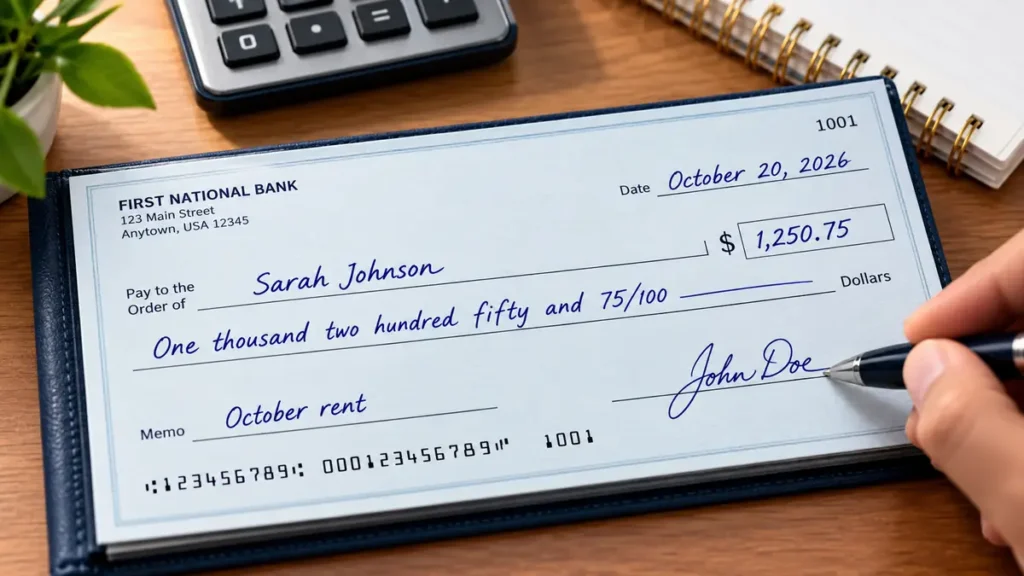
Consider a situation where you’re paying $1,250.75 in monthly rent to Sarah Johnson.
Here’s how the completed fields would look:
| Check field | Example entry |
|---|---|
| Date | October 20, 2026 |
| Pay to the Order of | Sarah Johnson |
| Amount in numbers | $1,250.75 |
| Amount in words | One thousand two hundred fifty and 75/100 |
| Memo | October rent |
| Signature | Your authorized signature |
This example shows how all six fields work together.
The bank uses the information to process the payment, while the recipient can deposit or cash the check according to applicable banking procedures.
Keep in mind that writing a check does not immediately remove the money from your account. The funds are generally deducted when the check is presented and processed.
Understanding the Different Parts of a Check
Besides the fields you fill in, a personal check contains printed information that helps banks identify the account and process transactions.
Routing Number
The routing number is a nine-digit number typically printed at the bottom-left of a U.S. check.
It identifies the financial institution involved in processing the payment.
The American Bankers Association routing-number system supports payment routing throughout the United States.
Account Number
Your checking account number appears near the routing number along the bottom of the check.
It identifies the specific bank account from which the payment will be drawn.
Because checks expose account information, store unused checks securely and avoid sharing photographs of completed checks.
Check Number
The check number helps identify individual checks.
It usually appears in the upper-right corner and may also be printed along the bottom.
For example, check number 1052 allows you to identify that particular payment when reviewing your records.
MICR Line
The numbers and special symbols printed along the bottom form the Magnetic Ink Character Recognition (MICR) line.
Banks use this standardized information to process and identify checks efficiently.
The line typically contains the routing number, account number, and check number, although their exact arrangement may differ.
Bank Information and Personal Details
Checks may also display the account holder’s name, address, and the financial institution’s name.
Some designs include the bank’s logo or contact details.
These printed elements help identify the check’s origin, but their presence alone does not guarantee that a check is genuine.
How to Write Different Check Amounts Correctly
One of the most common difficulties beginners face is converting a numeric amount into words.
The basic rule is simple: write the dollar amount in words and express the cents as a fraction of 100.
How to Write a Check for $100
Enter 100.00 in the numeric amount box.
On the written amount line, enter:
One hundred and 00/100
Because there are no cents, use 00/100.
How to Write a Check for $1,000
Write 1,000.00 in the amount box.
Then write:
One thousand and 00/100
You can draw a line through the remaining space to prevent additional words from being inserted.
How to Write a Check for $1,500.50
Enter 1,500.50 in the numeric box.
Write:
One thousand five hundred and 50/100
The 50/100 represents fifty cents.
How to Write a Check for an Amount Less Than One Dollar
Suppose you need to write a check for $0.75.
In the numeric box, enter 0.75.
On the amount line, write:
Zero and 75/100
Although checks for very small amounts are uncommon, the same formatting principles apply.
How to Write a Check Safely and Avoid Fraud
Proper check writing involves more than filling out the required fields. Paper checks contain sensitive financial information and can be vulnerable to theft, alteration, and unauthorized use.
The Federal Deposit Insurance Corporation (FDIC), Federal Reserve Board, and Office of the Comptroller of the Currency have identified check fraud as an important concern in payment security.
FDIC
+1
Use Permanent Blue or Black Ink
Use a pen with permanent blue or black ink rather than a pencil.
Pencil marks can be erased, while some erasable inks make it easier for someone to alter payment information.
Write clearly so that bank processing systems and employees can accurately interpret the check.
Never Leave Blank Spaces
Begin writing amounts close to the left edge of the designated field.
If unused space remains on the written amount line, draw a straight line through it.
For example:
Five hundred and 00/100 —————
This reduces the opportunity for someone to insert additional numbers or words.
Protect Your Blank Checks
Store your checkbook in a secure location.
Avoid leaving unused checks in a vehicle, public workspace, or other easily accessible place.
If a checkbook is lost or stolen, contact your financial institution promptly.
Verify the Recipient Before Mailing
Confirm the recipient’s address and payment details before sending a check.
When mailing checks, use secure mailing practices and avoid leaving envelopes containing checks in an unsecured outgoing mailbox.
If you suspect a check has been altered, notify your bank immediately. Depending on the circumstances, consumer protections may help you recover an unauthorized increase in the payment amount.
Consumer Financial Protection Bureau
Common Mistakes to Avoid When Writing a Check
Even experienced account holders occasionally make check-writing errors.
Understanding these mistakes can help prevent returned payments, processing delays, and unnecessary fees.
| Common mistake | Why it matters | How to avoid it |
|---|---|---|
| Missing signature | The bank may reject the check | Sign before issuing |
| Incorrect recipient | The intended person may have difficulty depositing it | Verify the full name |
| Different numeric and written amounts | Creates ambiguity about the payment | Compare both amounts |
| Using pencil | Information may be altered | Use permanent ink |
| Leaving large blank spaces | Increases alteration risk | Fill or cross out unused space |
| Insufficient funds | May result in a returned payment or fees | Check available funds |
| Signing a blank check | Allows unauthorized completion | Fill out the check first |
| Incorrect date | May create confusion or processing issues | Use the actual issue date |
One particularly important mistake is assuming that the amount written in numbers always controls the payment.
According to the Consumer Financial Protection Bureau (CFPB), when the written amount differs from the numeric amount, the amount expressed in words generally determines the check’s value.
Consumer Financial Protection Bureau
The best practice is to avoid any disagreement between the two fields.
What to Do If You Make a Mistake on a Check
If you accidentally write the wrong recipient, amount, or other essential information, the safest solution is usually to void the check and start again.
How to Void a Check
Write the word VOID prominently across the front of the check.
Make sure the word is large enough to indicate clearly that the check should not be used for payment.
Record the check number and mark it as voided in your transaction records.
If you’re discarding the check, shred it securely to protect your banking information.
Avoid using correction fluid or making complicated alterations to the payment amount. These changes may cause the bank to question or reject the check.
Can You Cross Out a Mistake?
Some banks may accept minor corrections if they are clear and properly initialed, but acceptance is not guaranteed.
For important details such as the payee or payment amount, using a new check is generally preferable.
If the check has already been delivered, contact the recipient and your bank before attempting to replace it.
How to Write a Check to Yourself or Multiple People
Checks are not limited to payments made to a single person or company.
You may occasionally need to write one to yourself or issue a payment involving more than one recipient.
Writing a Check to Yourself
You can write a personal check payable to yourself.
On the Pay to the Order of line, enter your own name.
Complete the date, amount, and signature as usual.
This method can sometimes be used to move money between accounts at different banks, although electronic transfers are often more convenient.
To deposit the check, follow the receiving bank’s endorsement requirements.
Writing a Check to Two People
When paying two recipients, the wording between their names can affect who must endorse the check.
For example:
Sarah Johnson and Michael Brown
A check made payable to two people using “and” generally requires both recipients to endorse it.
By comparison:
Sarah Johnson or Michael Brown
A check using “or” can generally be endorsed by either recipient.
Bank policies and applicable law can affect how jointly payable checks are handled, so confirm the requirements before issuing one.
Writing a Business Check
Business checks work similarly to personal checks.
They typically require the payment date, recipient’s name, numeric amount, written amount, and an authorized signature.
A business check may also include an invoice number, company details, or an accounting reference.
Organizations using accounting software may generate printed checks instead of completing them manually.
For business payments, verify that the person signing has authority over the account.
Chase
How to Record and Track Checks After Writing Them
Completing a check is only the first part of managing the payment.
You should also maintain accurate records of outstanding checks so that you know how much money remains available.
Use a Check Register
A check register is a record of payments and deposits associated with your checking account.
Traditionally, checkbooks include a small paper register, but you can also use a spreadsheet or budgeting application.
Record the following information:
- Check number
- Date issued
- Recipient
- Payment amount
- Purpose of payment
- Updated account balance
For example:
| Check no. | Date | Recipient | Amount |
|---|---|---|---|
| 1051 | Oct. 15, 2026 | Electric Company | $125.40 |
| 1052 | Oct. 18, 2026 | Sarah Johnson | $750.00 |
| 1053 | Oct. 20, 2026 | Local Charity | $50.00 |
Recording checks immediately is particularly useful because recipients may wait several days or weeks before depositing them.
Monitor Outstanding Checks
An outstanding check is one you have issued that has not yet cleared your account.
For example, if you write a $500 check and the recipient deposits it a week later, that $500 remains part of your bank’s displayed balance until the payment is processed, assuming no hold or other adjustment.
Do not treat outstanding check amounts as money available for other spending.
Compare your check register with your bank statement regularly to identify missing payments, duplicate transactions, or unexpected withdrawals.
How Long Does a Check Stay Valid?
In the United States, ordinary personal checks are generally considered stale-dated after six months.
Under Uniform Commercial Code provisions, banks are generally not obligated to pay checks presented more than six months after their date, although they may choose to do so in good faith.
This does not mean every check automatically becomes invalid on the six-month anniversary.
Different rules may apply to government checks, cashier’s checks, certified checks, and other specialized payment instruments.
If you receive an older check, contact the issuing party or financial institution before attempting to deposit it.
Can You Deposit a Postdated Check Early?
A postdated check contains a future date.
For example, someone might issue a check on October 20 but date it November 1.
However, banks and credit unions generally are not required to wait until the written date before paying it.
Some state laws provide additional protections when the account holder gives the bank effective advance notice.
The CFPB advises consumers to contact their financial institution about its policies rather than assuming a future date will prevent early payment.
Consumer Financial Protection Bureau
What Happens After You Write and Deliver a Check?
Once the recipient receives your check, they can generally deposit it into a bank account or attempt to cash it.
The bank then processes the payment through the banking system.
Check Endorsement
The recipient may need to endorse the check by signing the designated area on the back.
For mobile check deposits, the bank may require additional wording, such as “For Mobile Deposit Only,” along with other specific instructions.
Endorsement requirements can vary by institution.
Chase
Mobile Check Deposit
Many banks allow customers to deposit checks through a mobile banking application.
The recipient typically photographs the front and back of the endorsed check and submits the images through the bank’s secure app.
After making a mobile deposit, the recipient should follow the bank’s instructions for storing and eventually destroying the original check.
Depositing the same check twice can cause financial and legal problems.
When Is the Money Deducted?
The amount is generally deducted from the check writer’s account when the payment is processed.
Processing times vary depending on the financial institutions involved, deposit timing, and other circumstances.
Because checks do not always clear immediately, maintain enough available funds to cover outstanding payments.
Personal Checks vs. Cashier’s Checks vs. Certified Checks
Not all checks operate in exactly the same way.
Understanding the differences can help you recognize which type is appropriate for a particular situation.
| Feature | Personal check | Cashier’s check | Certified check |
|---|---|---|---|
| Issued by | Account holder | Bank | Account holder, certified by bank |
| Payment source | Customer’s account | Bank’s funds | Customer’s verified or reserved funds |
| Common use | Everyday payments | Large transactions | Payments requiring greater assurance |
| Bank involvement | Standard processing | Bank issues and signs | Bank certifies the check |
| Fraud risk | Possible | Possible, including counterfeits | Possible, including counterfeits |
A cashier’s check is issued by a bank, typically after the purchaser provides the required funds.
A certified check is a personal check that the bank has certified according to applicable procedures.
Although cashier’s and certified checks may offer greater payment assurance than ordinary personal checks, counterfeit versions exist.
The FDIC warns that fraudulent official checks can appear convincing, so recipients should independently verify suspicious payments and avoid sending money back to unknown parties.
FDIC
When Should You Use a Check Instead of an Electronic Payment?
Checks can still be useful even though electronic payments have become common.
Some landlords, contractors, schools, and charitable organizations accept or prefer paper checks.
Checks can also provide a documented payment trail through check numbers, bank records, and deposited check images.
However, they have limitations.
Paper checks may take longer to deliver and process, can be lost or stolen, and expose banking information printed on the document.
Electronic options such as Automated Clearing House (ACH) transfers, bank bill pay, and person-to-person payment services may be more convenient for certain transactions.
The appropriate payment method depends on the recipient’s requirements, timing, fees, and security considerations.
For recurring bills, automatic payments can reduce the need to write individual checks, provided you monitor your account and keep sufficient funds available.
Final Thoughts on how to write a check
Learning how to write a check is a practical financial skill that remains useful even with modern digital banking.
The essential process involves dating the check, identifying the recipient, entering the amount in numbers and words, including a memo when useful, and signing the document.
Accuracy and security matter just as much as completing the fields. Always verify the payment details, avoid blank spaces, use permanent ink, and maintain a record of every check you issue.
Before handing over your next check, review all six fields and confirm that your account has sufficient funds. These simple habits can help prevent payment delays, unnecessary fees, and avoidable financial risks.