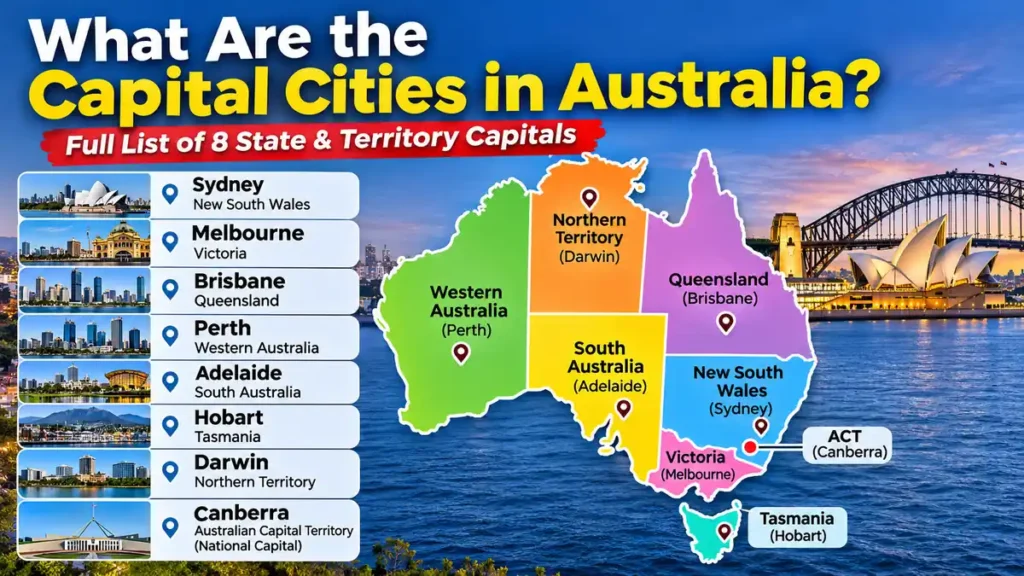
Australia has eight state and territory capital cities, but only one national capital. While Sydney and Melbourne are internationally famous, neither is the capital of Australia. That distinction belongs to Canberra, a purpose-built city located in the Australian Capital Territory.
The eight capital cities in Australia are Sydney, Melbourne, Brisbane, Perth, Adelaide, Hobart, Darwin, and Canberra. Six serve as capitals of Australia’s states, while Darwin and Canberra serve as capitals of its two major mainland territories. Canberra is also Australia’s national capital and the seat of the federal government.
Understanding these cities is useful for learning Australian geography, planning travel, studying the country’s political system, or exploring the differences between its states and territories.
What Are the Capital Cities in Australia? Full List
Australia consists of six states and two major mainland territories, each with its own capital city.
| State or territory | Capital city |
|---|---|
| New South Wales | Sydney |
| Victoria | Melbourne |
| Queensland | Brisbane |
| Western Australia | Perth |
| South Australia | Adelaide |
| Tasmania | Hobart |
| Northern Territory | Darwin |
| Australian Capital Territory | Canberra |
These eight cities are important administrative, cultural, and economic centers. However, their roles differ depending on their geography, population, history, and political responsibilities.
Sydney is the capital of New South Wales and Australia’s largest metropolitan center by commonly used urban-area measures. Melbourne is Victoria’s capital and a major cultural and sporting hub. Canberra, although smaller than both, houses Australia’s national political institutions.
How many capital cities does Australia have?
Australia has eight capitals when counting its six states and two major mainland territories. Of these, six are state capitals and two are territory capitals.
The national capital, Canberra, is included among those eight rather than counted as a ninth city.
Australia also has external territories, some of which have their own administrative centers. These are not normally included in the standard list of eight Australian capital cities.
Canberra: The National Capital of Australia
Top 15 Things To Do Canberra with Kids – Little Travellers
Parliament house canberra australia
10
Canberra is the capital city of Australia and the administrative center of the Australian Capital Territory (ACT). It is located inland in southeastern Australia, between Sydney and Melbourne.
Unlike many national capitals that developed naturally as commercial ports or trading centers, Canberra was planned specifically to serve as the seat of the Australian Government.
Why is Canberra the capital instead of Sydney or Melbourne?
When Australia’s six colonies federated in 1901, Sydney and Melbourne were both influential cities. Choosing either as the permanent national capital would have favored one of the country’s two largest states.
The Australian Constitution required the federal capital to be in New South Wales but at least 100 miles (approximately 161 kilometers) from Sydney.
Canberra was selected as the site in 1908, and the city was officially named in 1913.
American architects Walter Burley Griffin and Marion Mahony Griffin played central roles in the city’s design, which features geometric street patterns, landscaped spaces, and carefully planned civic areas.
Before the federal parliament moved to Canberra in 1927, Melbourne served as the temporary seat of the national government.
What is Canberra famous for?
Canberra is home to several nationally significant institutions:
- Parliament House: The meeting place of Australia’s federal parliament.
- Australian War Memorial: A national institution commemorating Australians who served in wars and military operations.
- National Museum of Australia: A museum exploring Australian history, culture, and identity.
- National Library of Australia: A major collection of Australian and international publications.
- High Court of Australia: The country’s highest court.
- Lake Burley Griffin: An artificial lake central to Canberra’s urban design.
Canberra’s role is primarily political, administrative, educational, and cultural, rather than being Australia’s largest commercial center.
The Six State Capital Cities of Australia
Each Australian state has a capital city that houses its state government and serves as an important center for public services and economic activity.
1. Sydney — Capital of New South Wales
Things to Do in Sydney: An Insider’s Guide | Discover by Silversea
Sydney is the capital of New South Wales (NSW) and one of the most recognizable cities in the Southern Hemisphere.
Located on Australia’s southeastern coast, Sydney is known for its natural harbor, beaches, financial district, and cultural attractions.
Its most famous landmarks include the Sydney Opera House and Sydney Harbour Bridge, both of which have become international symbols of Australia.
Other notable attractions include Bondi Beach, the Royal Botanic Garden Sydney, Darling Harbour, and the historic Rocks district.
Sydney is a major center for finance, tourism, international business, education, and media.
Although Sydney is Australia’s largest and arguably best-known city, it is not the national capital. That distinction belongs to Canberra.
2. Melbourne — Capital of Victoria
Voyage à Melbourne : toutes les infos sur la ville australienne
Melbourne is the capital of Victoria and one of Australia’s leading cultural, educational, and sporting centers.
Located on Port Phillip Bay in southeastern Australia, Melbourne is known for its distinctive laneways, coffee culture, arts scene, and historic architecture.
The city hosts several internationally recognized events, including the Australian Open tennis tournament and the Australian Formula One Grand Prix.
Major landmarks include Federation Square, Flinders Street Station, the Royal Botanic Gardens Victoria, and the Melbourne Cricket Ground (MCG).
Melbourne also has a significant role in Australian political history. It was the temporary seat of the federal government from Federation until Parliament moved to Canberra in 1927.
Today, Melbourne remains a major center for higher education, healthcare, professional services, and creative industries.
3. Brisbane — Capital of Queensland
Brisbane is the capital of Queensland, a state in northeastern Australia known for its warm climate, tropical and subtropical environments, and coastal attractions.
The city lies along the Brisbane River and has developed into an important economic and cultural center.
Popular locations include South Bank Parklands, the Queensland Museum, the Gallery of Modern Art (GOMA), and the Story Bridge.
Brisbane is also a gateway to destinations such as the Gold Coast, Sunshine Coast, and parts of the Great Barrier Reef region farther north.
The city is preparing to host the 2032 Olympic and Paralympic Games, an event expected to influence transport, sporting infrastructure, and urban development.
Brisbane’s economy includes tourism, technology, education, construction, and professional services.
4. Perth — Capital of Western Australia
Perth is the capital of Western Australia, the country’s largest state by land area.
Located along the Swan River near the Indian Ocean, Perth is geographically separated from Australia’s eastern capital cities by vast distances.
The city is known for its sunny weather, beaches, riverside landscapes, and proximity to major natural attractions.
Popular landmarks and destinations include Kings Park and Botanic Garden, Elizabeth Quay, Cottesloe Beach, and nearby Rottnest Island.
Perth is an important administrative and commercial center for Western Australia’s mining and resources industries.
Its position on Australia’s western coast also supports trade and economic connections with Asian markets.
5. Adelaide — Capital of South Australia
File:Adelaide skyline, December 2022 b.jpg – Wikimedia Commons
Adelaide is the capital of South Australia and is known for its planned urban layout, parklands, cultural festivals, and nearby wine regions.
Located near Gulf St Vincent, Adelaide was established in 1836 and developed according to a city plan associated with Colonel William Light.
The city center is surrounded by an extensive ring of parklands, which remains one of its defining features.
Notable attractions include Adelaide Oval, Adelaide Central Market, the Art Gallery of South Australia, and the Adelaide Botanic Garden.
Adelaide also serves as a gateway to the Barossa Valley and McLaren Vale, two internationally recognized wine-producing regions.
Its economy includes healthcare, education, defense, manufacturing, tourism, and technology.
6. Hobart — Capital of Tasmania
10 Best Things to Do in Hobart, Tasmania
Hobart is the capital of Tasmania, Australia’s island state located south of the mainland across Bass Strait.
Situated along the River Derwent beneath kunanyi / Mount Wellington, Hobart is known for its historic waterfront, natural surroundings, and distinctive cultural attractions.
The city has a strong connection to Australia’s colonial history, maritime industries, and Antarctic research.
Popular destinations include Salamanca Place, Salamanca Market, the Museum of Old and New Art (MONA), and the Royal Tasmanian Botanical Gardens.
Hobart is also an important gateway for scientific operations associated with Antarctica and the Southern Ocean.
Compared with Sydney, Melbourne, and Brisbane, Hobart has a smaller urban population and a more compact metropolitan area.
Its combination of heritage architecture, mountainous scenery, and waterfront landscapes makes it distinctive among Australian state capitals.
The Two Mainland Territory Capital Cities
Australia’s two major mainland territories are the Northern Territory and the Australian Capital Territory. Both have their own capitals, although the territories have a different constitutional status from the six states.
7. Darwin — Capital of the Northern Territory
THE 15 BEST Things to Do in Darwin (2026) – Must-See Attractions
Darwin is the capital of the Northern Territory and the northernmost of Australia’s eight major capital cities.
Situated on the Timor Sea, Darwin experiences a tropical climate characterized by distinct wet and dry seasons.
The city is known for its multicultural population, tropical landscapes, outdoor markets, and connections to northern Australia’s natural attractions.
Popular places include Mindil Beach, the Museum and Art Gallery of the Northern Territory, Darwin Waterfront Precinct, and Crocosaurus Cove.
Darwin also provides access to Kakadu National Park and Litchfield National Park.
The city has an important place in Australian history. During World War II, Darwin was subjected to Japanese air raids, including the major bombing on February 19, 1942.
Today, Darwin plays an important role in defense, tourism, government administration, and trade with Southeast Asia.
8. Canberra — Capital of the Australian Capital Territory
Canberra is the administrative center of the Australian Capital Territory and the national capital of Australia.
The ACT is a self-governing territory surrounded by New South Wales. Canberra contains both federal government institutions and the ACT’s own legislative and administrative institutions.
This creates a distinctive arrangement: Canberra serves as the center of national government while also functioning as the territory’s principal city.
Unlike Darwin, Canberra is inland and experiences four distinct seasons, including relatively cold winters.
Map of Australia’s Eight Capital Cities
Australia’s capital cities are spread across a vast geographical area. Most are located near the coastline, while Canberra is inland.
🏙️
🏙️
🏙️
🏙️
🏙️
🏙️
🏙️
🏛️
Use two fingers to move the map
Use ctrl + scroll to zoom the map
Geographically, the capital cities can be understood through their locations:
- Eastern Australia: Sydney, Brisbane, Melbourne, and Canberra.
- Southern Australia: Adelaide and Hobart.
- Western Australia: Perth.
- Northern Australia: Darwin.
Hobart is the only capital among the eight located on the island of Tasmania, while Perth is the only state capital on Australia’s western coastline.
Australian Capital Cities by Population
Population is one of the clearest ways to compare Australia’s major cities.
According to the Australian Bureau of Statistics, the following figures represent estimated residents within Greater Capital City Statistical Areas as of June 30, 2025. Australian Bureau of Statistics+1
| Rank | Capital city | Population |
|---|---|---|
| 1 | Sydney | 5,638,830 |
| 2 | Melbourne | 5,435,590 |
| 3 | Brisbane | 2,833,524 |
| 4 | Perth | 2,452,765 |
| 5 | Adelaide | 1,491,015 |
| 6 | Canberra | 484,630 |
| 7 | Hobart | 255,250 |
| 8 | Darwin | 159,284 |
Greater capital city population, June 2025
01.5M3M4.5M6MSydneyMelbourneBrisbanePerthAdelaideCanberraHobartDarwin
Source: Australian Bureau of Statistics. Estimated resident population, Greater Capital City Statistical Areas.
Sydney and Melbourne have considerably larger populations than the other capitals. Together, their metropolitan areas account for more than 11 million residents.
Brisbane and Perth form the next tier of major population centers, followed by Adelaide.
Canberra, Hobart, and Darwin have smaller populations, although each performs significant administrative and regional functions.
Which is the largest capital city in Australia?
Sydney is Australia’s largest capital city by estimated resident population under the Australian Bureau of Statistics’ Greater Capital City Statistical Area definition.
Melbourne ranks second and recorded the largest absolute population increase among the capitals during the 2024–25 financial year.
Which is Australia’s smallest capital city?
Darwin is the smallest of Australia’s eight major capitals by population.
Its smaller population reflects factors including its remote location, tropical climate, and the relatively low population density of the Northern Territory.
How Australia’s Capital Cities Differ
Although all eight cities serve administrative purposes, they have distinct economic, cultural, and geographic characteristics.
| City | Climate characteristics | Major economic strengths | Distinguishing feature |
|---|---|---|---|
| Sydney | Temperate, humid summers | Finance, tourism, services | Sydney Harbour |
| Melbourne | Temperate, changeable weather | Education, culture, services | Sporting and arts events |
| Brisbane | Humid subtropical | Tourism, technology, services | Brisbane River |
| Perth | Mediterranean | Mining, energy, services | Indian Ocean location |
| Adelaide | Mediterranean | Defense, manufacturing, wine | Planned city and parklands |
| Hobart | Temperate maritime | Tourism, research, services | Historic waterfront |
| Darwin | Tropical savanna | Defense, tourism, government | Wet and dry seasons |
| Canberra | Temperate inland | Government, education, research | National political institutions |
These differences influence housing, transport, industries, lifestyles, and environmental conditions.
For example, Perth and Adelaide generally experience hot, dry summers associated with Mediterranean climates, while Darwin’s tropical climate brings monsoonal rainfall during the wet season.
Canberra’s inland location contributes to colder winter nights than those typically experienced in Australia’s coastal capitals.
Why Do Australian States Have Their Own Capitals?
Australia operates as a federal parliamentary democracy. Its system distributes responsibilities among national, state and territory, and local governments.
The Commonwealth of Australia was established in 1901 when six British colonies federated into one nation.
Each former colony became a state, retaining significant governmental powers under the Australian Constitution.
Today, state capitals contain important institutions such as parliamentary chambers, government departments, and administrative offices.
Federal government versus state and territory governments
The federal government, based in Canberra, handles national responsibilities such as defense, immigration, foreign affairs, and aspects of taxation.
State and territory governments oversee many services and responsibilities involving public schools, hospitals, transport infrastructure, and policing.
Local governments handle community-level services, although their specific responsibilities vary by jurisdiction.
The Parliamentary Education Office identifies these as Australia’s three levels of government. Parliament of Australia+1
Are Australian territories the same as states?
No. Australia’s six states and two major self-governing territories have different constitutional arrangements.
States possess powers recognized under the Australian Constitution. Territories exercise powers through arrangements established by federal legislation.
The federal parliament retains constitutional authority to legislate for territories, although the ACT and Northern Territory have substantial self-government.
This distinction explains why Canberra and Darwin are territory capitals rather than state capitals. DFAT+1
Interesting Facts About Australia’s Capital Cities
Several facts help explain why Australia’s capital cities are geographically and historically distinctive.
Canberra was designed to become a capital
Unlike Sydney and Melbourne, which developed as major settlements long before Federation, Canberra was selected and planned to serve as the national seat of government.
Its design deliberately incorporated civic spaces, broad avenues, and significant landscape features.
Sydney was Australia’s first major colonial settlement
The First Fleet arrived in the Sydney Cove area in 1788, establishing a British penal colony on lands traditionally belonging to Aboriginal peoples.
Sydney subsequently developed into an important port and commercial center.
Melbourne was once Australia’s temporary federal capital
The federal parliament met in Melbourne from 1901 until 1927, when it moved to Canberra.
This sometimes causes confusion about whether Melbourne was previously Australia’s official permanent capital. It was the temporary seat of government, not the selected permanent federal capital.
Perth is geographically distant from eastern capitals
Perth is separated from Sydney and Melbourne by thousands of kilometers of Australian mainland.
This distance has helped shape Western Australia’s distinct economic and transport connections.
Hobart is Australia’s second-oldest state capital
Hobart was established as a British settlement in 1804, making it one of the country’s oldest European-established cities.
The region has a much longer history of Aboriginal occupation.
Darwin has been rebuilt after major destruction
Darwin experienced extensive damage during World War II and again when Cyclone Tracy struck in December 1974.
Subsequent rebuilding significantly changed the city’s infrastructure and urban landscape.
How to Remember All Eight Australian Capital Cities
For students learning Australian geography, the easiest approach is to connect each capital with its state or territory rather than memorizing an isolated list of city names.
Start with the six states:
| State | Capital |
|---|---|
| New South Wales | Sydney |
| Victoria | Melbourne |
| Queensland | Brisbane |
| Western Australia | Perth |
| South Australia | Adelaide |
| Tasmania | Hobart |
Then remember the two mainland territories:
| Territory | Capital |
|---|---|
| Northern Territory | Darwin |
| Australian Capital Territory | Canberra |
A useful geographical memory method is to picture the capitals around Australia.
Starting in the west with Perth, move toward Darwin in the north, Brisbane and Sydney in the east, Canberra and Melbourne in the southeast, Adelaide in the south, and Hobart on Tasmania.
This approach also helps distinguish the national capital from the larger coastal cities.
Final Thoughts: what are the capital cities in australia?
Australia has eight major state and territory capitals: Sydney, Melbourne, Brisbane, Perth, Adelaide, Hobart, Darwin, and Canberra.
Canberra is the country’s national capital and the seat of the federal government. Sydney is the largest capital by metropolitan population, while Darwin is the smallest.
Each city has its own geography, history, culture, and administrative role, reflecting the diversity of Australia’s six states and two major mainland territories.
For a simple way to remember them, learn the six state capitals first, add Darwin for the Northern Territory, and remember Canberra as both the ACT capital and Australia’s national capital.