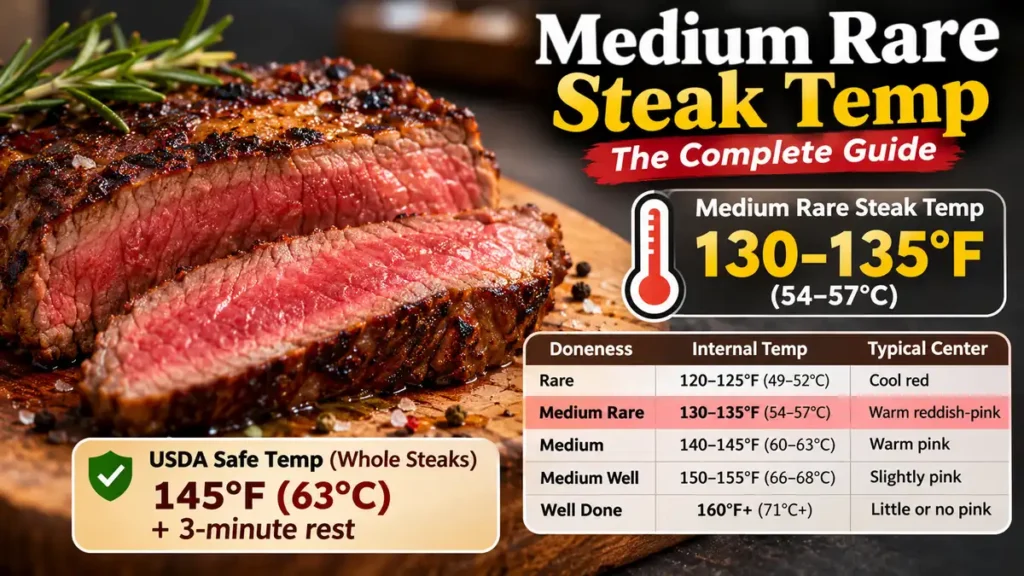
A beautifully cooked medium-rare steak has a warm, reddish-pink center, a flavorful browned crust, and a tender, juicy texture. But getting that result consistently depends on more than cooking time. The most reliable approach is to measure the steak’s internal temperature.
The ideal medium rare steak temp is 130–135°F (54–57°C) for the finished steak. Remove it from the heat a few degrees earlier to account for carryover cooking, then check the temperature again after resting. For food safety, the USDA recommends cooking whole beef steaks to 145°F (63°C) followed by a three-minute rest.
Understanding the difference between preferred doneness and official food safety recommendations helps you make informed cooking decisions.
What Is the Ideal medium rare steak temp?
Medium-rare steak is generally defined by an internal temperature of 130–135°F (54–57°C). At this temperature, the center remains reddish-pink, while the outer layers develop a firmer texture.
MEDIUM-RARE FINISHED TEMPERATURE
130–135°F
54–57°C · Culinary doneness range, not the USDA minimum safe temperature
A properly cooked medium-rare steak typically has these characteristics:
- Center color: Warm red to reddish-pink.
- Texture: Tender, with slight resistance when pressed.
- Juiciness: Moist interior with relatively limited moisture loss.
- Crust: Browned exterior produced through high-temperature cooking.
- Flavor: Rich beef flavor enhanced by browning and rendered surface fat.
Color alone cannot reliably establish internal temperature or food safety. A digital meat thermometer is a much more dependable tool.
Steak doneness temperature chart
Different doneness levels produce noticeably different textures and appearances.
| Doneness | Internal temperature | Typical center |
|---|---|---|
| Rare | 120–125°F (49–52°C) | Cool red |
| Medium rare | 130–135°F (54–57°C) | Warm reddish-pink |
| Medium | 140–145°F (60–63°C) | Warm pink |
| Medium well | 150–155°F (66–68°C) | Slightly pink |
| Well done | 160°F+ (71°C+) | Little or no pink |
These are conventional culinary temperature ranges, not a food safety chart. The USDA recommends a minimum of 145°F (63°C), followed by a three-minute rest, for whole beef steaks.
Is 130°F or 135°F better for medium rare?
Both temperatures fall within the usual medium-rare range, but the eating experience differs slightly.
At 130°F, the center is redder and softer. At 135°F, it becomes somewhat firmer and more pink.
For someone who prefers a softer steak, 130°F is often the preferred culinary target. For a slightly firmer medium-rare texture, 135°F may be more appealing.
Neither temperature meets the USDA’s recommended minimum for whole beef steaks.
medium rare steak temp: When Should You Remove Steak From Heat?
One of the most common cooking mistakes is waiting until a steak reaches its desired final temperature before removing it from the pan or grill.
A steak often continues heating after it leaves the cooking surface. This process is called carryover cooking.
Heat stored in the hotter exterior moves toward the cooler center, sometimes raising the internal temperature by several degrees.
Understanding carryover cooking
The amount of carryover heating depends on several factors:
- Steak thickness and overall size.
- Cooking temperature.
- Whether the steak was grilled, pan-seared, or roasted.
- Temperature difference between the exterior and center.
- Resting environment.
A thick steak cooked over intense heat may experience more carryover than a thin steak cooked gently.
For a culinary medium-rare target of 130–135°F, cooks sometimes remove the steak around 125–130°F, anticipating a further rise during resting. This is an estimate, not a guaranteed temperature increase.
For USDA-compliant cooking, verify that the steak reaches the recommended minimum safe temperature rather than relying on an assumed carryover increase.
How long should medium-rare steak rest?
A short rest allows temperature differences within the steak to decrease and reduces the immediate loss of juices when cutting.
For many individual steaks, approximately five minutes is a practical resting period. Large or especially thick cuts may benefit from longer.
Resting does not automatically make an undercooked steak safe. The final internal temperature and the applicable food safety guidance remain essential.
How to Check Steak Temperature Accurately
Cook Meat Safely: USDA Internal Temp Guide
Grilled beef ribeye steak sliced medium rare on wooden board
ThermoMaven F1 Stealth Digital Food Thermometer – Black
7
An instant-read digital thermometer is the most reliable way to determine steak doneness.
Visual cues, cooking times, and the finger-pressure test can be useful for experienced cooks, but none consistently measures the internal temperature.
Step-by-step thermometer method
- Remove the steak from direct heat briefly if necessary to take a safe measurement.
- Insert the thermometer probe into the thickest part of the meat.
- For thinner steaks, insert the probe horizontally through the side.
- Position the tip near the center, away from bones and large pockets of fat.
- Wait for the thermometer reading to stabilize.
- Check another location if the steak is unusually thick or unevenly shaped.
- Continue cooking if the temperature is below your intended target.
The probe’s sensing area must be fully inside the meat. Inserting it too shallowly can produce a misleading reading.
Why thermometer placement matters
The outside of a steak heats faster than its center. Measuring near the surface can therefore give a temperature significantly higher than the actual center temperature.
Bones can also affect heat distribution, making measurements near them less representative.
For a thick ribeye or porterhouse, checking more than one location helps identify cooler areas.
Can you tell medium rare by touching the steak?
Some cooks use the finger test, comparing the firmness of steak with the fleshy part of their hand.
However, firmness changes with the cut, fat content, muscle structure, and thickness. Two steaks at the same temperature can feel quite different.
Touch is not a dependable replacement for a thermometer, especially when food safety is a concern.
How to Cook Medium-Rare Steak Using Different Methods
The cooking method affects how quickly the steak heats, how evenly the center cooks, and how much browning develops on the surface.
Regardless of the method, internal temperature should determine doneness rather than a fixed number of minutes.
Pan-seared medium-rare steak
Sizzling Ribeye Steak with Herb Butter – backiee
Pan-searing works especially well for ribeye, New York strip, and filet mignon.
A heavy cast-iron skillet retains heat effectively and helps create a browned crust.
For a steak approximately 1–1.5 inches thick:
- Pat the steak dry with paper towels.
- Season with salt and freshly ground black pepper.
- Preheat a heavy skillet over medium-high to high heat.
- Add a small amount of high-smoke-point cooking oil.
- Sear the steak, turning as needed to develop an even crust.
- Reduce the heat if the exterior browns too quickly.
- Begin checking the center temperature before the steak appears finished.
- Remove at the appropriate temperature and allow it to rest.
Butter, garlic, and rosemary can be added toward the end for flavor. Adding butter too early to an extremely hot pan can cause it to burn.
For culinary medium-rare doneness, the final internal temperature is 130–135°F. For the USDA-recommended safe minimum, cook the steak to at least 145°F before removing it from the heat and rest for three minutes.
Grilled medium-rare steak
Grilling produces a distinctive browned exterior and smoky flavor.
A two-zone setup offers better control than placing the steak over intense heat throughout cooking.
One side of the grill provides direct heat for searing, while the other offers lower indirect heat for gentler cooking.
Start by browning the exterior, then move the steak to indirect heat if the center needs additional cooking.
For thicker steaks, a reverse-sear approach can also work: cook gently over indirect heat before finishing with a brief high-temperature sear.
Keep the lid position, grill temperature, and steak thickness in mind, but rely on thermometer readings to determine when the steak is ready.
Oven-finished medium-rare steak
The oven-finish method combines stovetop browning with more controlled heating.
First, sear the steak in an oven-safe skillet. Then transfer the skillet to an oven preheated to approximately 375–400°F (190–204°C).
Continue cooking while checking the internal temperature frequently.
This approach is particularly useful for thick steaks that might become excessively dark on the outside before the center reaches the desired temperature.
Sous vide medium-rare steak
Sous vide cooking uses a temperature-controlled water bath to heat food gradually.
A steak cooked in a water bath set to approximately 130–135°F can develop a relatively uniform medium-rare appearance, followed by a brief high-heat sear for browning.
However, sous vide temperature alone does not establish food safety. Pasteurization depends on the combination of temperature, time, thickness, and handling conditions.
Lower-temperature sous vide cooking requires validated time-temperature guidance, particularly when preparing food for people at increased risk of foodborne illness.
How Steak Thickness and Cut Affect Cooking
Two steaks placed on the same grill at the same time may finish cooking at very different moments.
Thickness is one of the biggest reasons.
A thin steak has a short distance between its surface and center, so heat penetrates relatively quickly. A thick steak requires more time for its center to warm.
Steak thickness and cooking time
The following times are broad planning estimates for conventional pan-searing or grilling. They are not reliable indicators of doneness or safety.
| Steak thickness | Approximate total cooking time |
|---|---|
| ½ inch | 3–5 minutes |
| 1 inch | 6–10 minutes |
| 1½ inches | 8–14 minutes |
| 2 inches | 12–20+ minutes |
Actual cooking times vary substantially with starting temperature, equipment, heat intensity, and cooking technique.
A thermometer should always take priority over these estimates.
Does the steak cut change the ideal temperature?
The conventional medium-rare temperature range remains approximately 130–135°F across common beef steak cuts.
However, different cuts may feel and taste different at the same temperature.
Quiénes Somos | SUCARNE – Carnicería San Fernando y Rancagua
Ribeye steak
Rich intramuscular fat, known as marbling, contributes to its juicy texture. Some diners prefer the upper end of medium rare for a slightly firmer fat texture.
豊西牛ヒレステーキ用120g 5パックセット|豊西牛と帯広牛の牛肉通販サイト トヨニシファーム ステーキ用
Filet mignon
Naturally tender and relatively lean, with a fine muscle structure. Overcooking can make its delicate texture less appealing.
Buy New York Strip Steak Online | Texas-Raised Black Angus | Wellborn Ranch – Wellborn 2R Beef
New York strip
Combines a firm bite with substantial beef flavor. Its relatively even shape makes thermometer placement straightforward.
Grassfed Beef Flank Steak – Florida Premium Beef
Flank steak
Has pronounced muscle fibers and benefits from slicing thinly across the grain. Cutting direction matters greatly for perceived tenderness.
Other popular cuts, including sirloin, T-bone, porterhouse, and tomahawk steak, can also be prepared to medium-rare doneness.
Bone-in cuts require careful thermometer positioning because temperature distribution may vary near the bone.
Is Medium-Rare Steak Safe to Eat?
Medium-rare steak is a common culinary preference, but its conventional temperature range falls below the USDA’s recommended minimum safe internal temperature for whole beef steaks.
According to the USDA Food Safety and Inspection Service, whole beef steaks should reach 145°F (63°C) before removal from the heat, followed by a rest of at least three minutes. Ask USDA+1
The distinction matters because a preferred eating temperature and a recommended food safety temperature are not necessarily the same.
Why does cooking temperature affect food safety?
Raw beef can contain harmful microorganisms, including certain strains of Escherichia coli (E. coli) and Salmonella.
Cooking reduces microbial hazards through exposure to heat.
For intact whole-muscle steaks, contamination is more commonly associated with exterior surfaces. However, that does not guarantee the interior is free of contamination.
Mechanical tenderization, needle injection, and other processing methods can introduce surface microorganisms deeper into the meat.
A browned exterior also does not prove that the steak has reached a safe internal temperature.
Is medium-rare steak safe during pregnancy?
Pregnant people, young children, older adults, and people with weakened immune systems face greater risks from certain foodborne infections.
For these groups, following established food safety temperature recommendations is particularly important.
The FDA identifies 145°F with a three-minute rest as the safe minimum for whole beef steaks. FDA+1
Is medium-rare ground beef safe?
Ground beef requires different handling because grinding can distribute microorganisms throughout the meat.
The USDA recommends cooking ground beef to an internal temperature of 160°F (71°C).
That recommendation applies to hamburgers and other ground beef preparations, even when made from high-quality beef. Ask USDA+1
Common Mistakes When Cooking Medium-Rare Steak
Small temperature errors can noticeably change a steak’s final texture.
Understanding the most frequent mistakes makes cooking more consistent.
Relying entirely on cooking time
Cooking time varies with the steak’s thickness, starting temperature, heat source, and equipment.
A six-minute cooking time may produce medium rare in one situation and an entirely different result in another.
Use time as a rough guide for when to begin measuring, not as proof that the steak is finished.
Checking temperature only once
Steaks do not always heat uniformly.
One area may reach the target while another remains cooler, especially in irregularly shaped or bone-in cuts.
Taking measurements in multiple locations helps identify the lowest internal temperature.
Ignoring carryover cooking
The internal temperature may continue rising after the steak leaves the heat.
For culinary doneness, this can push a medium-rare steak toward medium.
Monitor the resting temperature rather than assuming every steak experiences the same amount of carryover heating.
Cutting the steak immediately
Cutting immediately after cooking can release more juices onto the cutting board.
A short resting period generally improves the eating experience, although it cannot compensate for an inadequate cooking temperature.
Using steak color as a thermometer
The color of cooked beef depends on factors beyond temperature, including meat chemistry, packaging, and cooking conditions.
A pink center does not reliably establish whether meat is safe, and a brown center does not necessarily establish that it has reached the recommended minimum.
Confusing Fahrenheit and Celsius
A thermometer displaying Celsius when the cook expects Fahrenheit can create serious measurement errors.
Remember these common conversions:
| Fahrenheit | Celsius |
|---|---|
| 125°F | 52°C |
| 130°F | 54°C |
| 135°F | 57°C |
| 140°F | 60°C |
| 145°F | 63°C |
| 160°F | 71°C |
Check the thermometer’s display settings before cooking.
How to Get a Better Crust Without Overcooking the Center
A flavorful steak depends on both internal doneness and exterior browning.
The browned crust develops largely through the Maillard reaction, a series of chemical reactions involving amino compounds and reducing sugars.
These reactions produce many of the aromas and flavors associated with seared meat.
Dry the surface before searing
Moisture on the steak’s surface must evaporate before effective browning can occur.
Patting the meat dry with paper towels helps the surface brown more efficiently.
A dry surface is particularly useful when cooking thin steaks, where the center can heat quickly.
Season appropriately
Salt enhances flavor and can influence moisture distribution.
Seasoning immediately before cooking works well. Alternatively, salting in advance and refrigerating the steak uncovered on a rack can help dry the surface.
Keep raw beef refrigerated during advance seasoning.
Use appropriate heat
High heat promotes browning, but excessively intense heat can burn the exterior before the center is properly cooked.
A thick steak often benefits from a combination of high-temperature searing and gentler finishing heat.
A thin steak may require only a short sear.
Avoid overcrowding the pan
Placing several cold steaks into a small skillet can reduce the pan’s surface temperature.
That encourages moisture accumulation and slows browning.
Cooking in batches helps maintain a more consistent searing environment.
Final Thoughts on medium rare steak temp
The conventional medium rare steak temp is 130–135°F (54–57°C), producing a warm reddish-pink center and tender texture.
For consistent culinary results, measure the internal temperature with a digital thermometer, account for carryover cooking, and allow the steak to rest before slicing.
The essential food safety distinction is that the USDA recommends whole beef steaks reach at least 145°F (63°C) before removal from heat, followed by a three-minute rest. Ground beef requires 160°F (71°C).
Temperature measurement, rather than color, touch, or cooking time alone, is the most dependable way to evaluate doneness and follow food safety guidance.