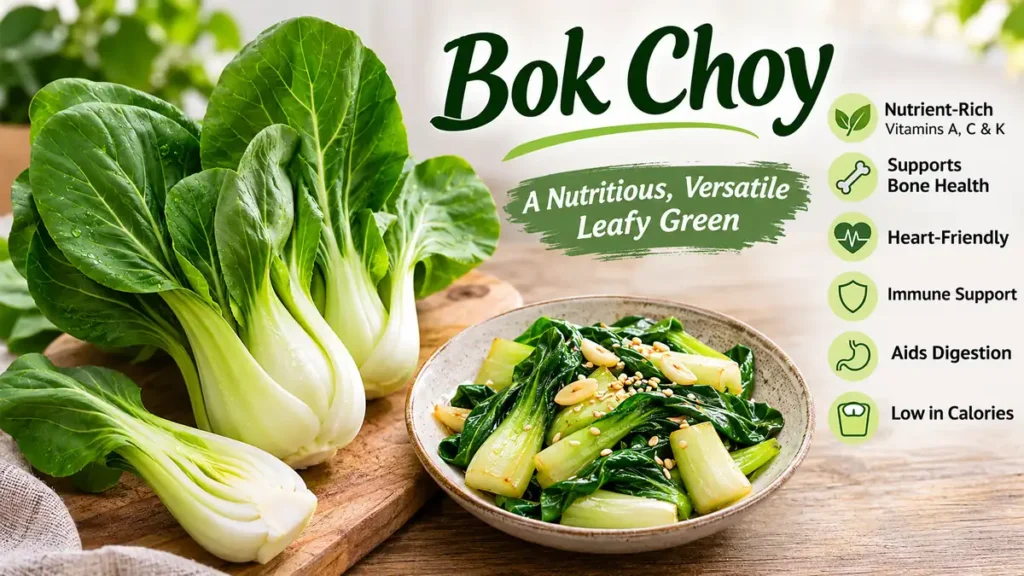
Bok choy might look like a cross between celery and spinach, but this leafy green has a character of its own. Its crunchy stalks, tender leaves, and mild flavor make it a versatile ingredient in everything from quick stir-fries to comforting soups.
Bok choy is a leafy green vegetable belonging to the cabbage family, Brassicaceae. Also called pak choi or Chinese white cabbage, it has crisp white or pale green stalks and smooth green leaves. It is low in calories, provides vitamins A, C, and K, and can be eaten raw, steamed, sautéed, or stir-fried.
Unlike some cabbage varieties, bok choy does not form a tightly packed head. Instead, its leaves grow outward from a clustered base, giving it a distinctive appearance and making both the stems and leaves useful in cooking.
Understanding its nutritional value, different varieties, and preparation methods can help you make the most of this nutritious vegetable.
What Is Bok Choy?
Bok choy is a type of Chinese cabbage scientifically classified as Brassica rapa subsp. chinensis. It belongs to the same botanical family as broccoli, kale, cauliflower, Brussels sprouts, and mustard greens.
It has been cultivated in China for centuries and is now widely used in Chinese, Korean, Japanese, and other Asian-inspired cuisines.
The vegetable has two main edible parts:
- Stalks: Thick, juicy, and crunchy, with a mild sweetness.
- Leaves: Tender, smooth, and slightly peppery, with a flavor resembling spinach or mild mustard greens.
Both parts are edible, although they cook at different speeds.
Bok choy is also known as pak choi, pok choi, and Chinese white cabbage. These names generally refer to the same vegetable, although regional naming conventions and specific cultivars vary.
What Does Bok Choy Taste Like?
Fresh bok choy has a mild, slightly sweet flavor with a subtle peppery or mustard-like undertone.
Its taste changes depending on how it is prepared. Raw stalks are crisp and refreshing, while the leaves have a more pronounced leafy-green flavor. Cooking softens the stalks, reduces bitterness, and brings out their natural sweetness.
Baby bok choy is often more tender and delicate than mature plants.
The mild flavor makes it especially suitable for garlic, ginger, sesame oil, soy sauce, mushrooms, and chili.
Is Bok Choy the Same as Chinese Cabbage?
Bok choy is a type of Chinese cabbage, but it differs from Napa cabbage.
Napa cabbage forms an elongated, tightly layered head with pale, crinkled leaves. Bok choy grows in an open cluster of individual stalks and smooth leaves.
Both belong to the species Brassica rapa, but they are different cultivated groups with distinct textures and culinary uses.
Bok Choy Nutrition Facts
One of the biggest advantages of bok choy is its nutrient content relative to its low calorie count.
It contains water, dietary fiber, vitamins, minerals, and naturally occurring plant compounds while contributing very little fat.
According to Purdue University Extension, one cup of shredded raw bok choy, weighing approximately 70 grams, provides the following nutrients. Purdue Extension+1
| Nutrient | Amount per 1 cup (70 g) |
|---|---|
| Calories | 9 kcal |
| Protein | 1 g |
| Carbohydrates | 2 g |
| Dietary fiber | 1 g |
| Total sugars | 1 g |
| Total fat | 0 g |
| Calcium | 74 mg |
| Sodium | 46 mg |
| Iron | Approximately 1 mg |
Values are rounded and may vary by variety, serving weight, and preparation method.
Bok choy also supplies vitamins A, C, and K, along with folate and potassium.
Vitamins Found in Bok Choy
Vitamin A and carotenoids: Bok choy contains carotenoids that the body can convert into vitamin A. This nutrient supports normal vision, immune function, and healthy cell development.
Vitamin C: This water-soluble vitamin supports collagen formation, immune function, and antioxidant protection. It also helps the body absorb non-heme iron from plant foods.
Vitamin K: Leafy greens such as bok choy contain vitamin K, which contributes to normal blood clotting and bone metabolism.
Folate: Folate, also called vitamin B9, is necessary for DNA synthesis, red blood cell formation, and normal cell division.
Minerals Found in Bok Choy
Bok choy contributes several minerals that support normal body functions.
Calcium helps maintain bones and teeth and supports muscle contraction. Potassium contributes to normal nerve signaling, muscle function, and blood pressure regulation.
Iron is required for hemoglobin production, while magnesium participates in numerous metabolic processes.
Although bok choy contains these nutrients, it should be part of a varied diet rather than relied upon as the sole source of any essential mineral.
Health Benefits of Bok Choy
Bok choy provides several nutrients associated with maintaining overall health. Its benefits come from its nutritional composition and its role in a balanced eating pattern, not from any ability to prevent or cure disease on its own.
1. Supports Bone Health
Bok choy provides calcium and vitamin K, two nutrients involved in maintaining healthy bones.
Calcium is a structural component of bone tissue, while vitamin K supports the normal activity of proteins involved in bone metabolism.
Unlike some leafy vegetables, such as spinach, bok choy is relatively low in oxalates, compounds that can reduce calcium absorption.
This makes it a useful vegetable for adding dietary calcium, although it does not replace other calcium-rich foods.
2. Contributes to Heart Health
Bok choy contains potassium, fiber, and antioxidant compounds.
Potassium helps regulate fluid balance and supports normal blood pressure, particularly as part of a dietary pattern that is not excessively high in sodium.
Its naturally low saturated fat content also makes it suitable for heart-conscious meals.
However, cooking methods matter. A bok choy dish prepared with large amounts of salty sauces can contain considerably more sodium than the vegetable itself.
3. Supports Normal Immune Function
Vitamin C and vitamin A are involved in normal immune system function.
Vitamin C also acts as an antioxidant, helping protect cells from oxidative damage.
Eating bok choy alongside a variety of fruits, vegetables, whole grains, and protein sources can contribute to an adequate intake of these nutrients.
4. Promotes Digestive Health
Bok choy contains dietary fiber, which supports normal bowel movements and digestive function.
Its high water content can also contribute to overall fluid intake.
Although one cup provides only a modest amount of fiber, combining bok choy with beans, whole grains, and other vegetables can help build a fiber-rich meal.
5. Provides Antioxidant Plant Compounds
As a cruciferous vegetable, bok choy contains naturally occurring phytochemicals, including glucosinolates.
When plant tissues are chopped or chewed, enzymes can help convert certain glucosinolates into biologically active compounds, including isothiocyanates.
These substances are being studied for their effects on cellular processes and oxidative stress.
Research into cruciferous vegetables is promising, but laboratory findings should not be interpreted as proof that eating bok choy prevents cancer or treats existing disease.
6. Fits Well Into Weight-Management Diets
With approximately nine calories per cup of shredded raw leaves and stalks, bok choy adds volume and texture to meals without contributing many calories.
Its water content and modest fiber contribution can help make vegetable-rich meals satisfying.
It works particularly well with lean protein sources, tofu, legumes, and whole grains.
No single vegetable causes weight loss, but bok choy can be a practical ingredient in a balanced dietary approach.
Types of Bok Choy and Their Differences
Several varieties of bok choy are available, with differences in stalk color, leaf size, maturity, and texture.
The University of Massachusetts Amherst Extension identifies baby bok choy, white-stem varieties, and green-stem Shanghai types among the common forms. UMass Amherst+1
Baby Bok Choy
Baby bok choy generally refers to bok choy harvested at an immature stage rather than one specific botanical variety.
It has smaller stalks and tender leaves, making it suitable for quick cooking.
Baby bok choy can be steamed, sautéed, or sliced lengthwise and grilled.
White-Stem Bok Choy
A+ 1000 CHINESE WHITE STEM PAK CHOI Bok Choy Chinese Cabbage Seeds Non-GMO USA | eBay
White-stem bok choy, sometimes called Canton bok choy, has broad white stalks and dark green leaves.
Its firm texture makes it useful for stir-fries, soups, and braised dishes.
Because the stalks are relatively thick, they generally require more cooking time than the leaves.
Shanghai Bok Choy
Asian Veg – Bok Choy – Harvest Markets
Shanghai bok choy typically has light green stalks and soft green leaves.
It is often tender and mildly sweet, especially when harvested young.
This variety works well in steamed dishes, noodle soups, and quick garlic stir-fries.
Bok Choy Variety Comparison
| Variety | Appearance | Common uses |
|---|---|---|
| Baby bok choy | Small, tender stalks and leaves | Steaming, grilling |
| White-stem bok choy | White stalks, dark green leaves | Stir-frying, soups |
| Shanghai bok choy | Pale green stalks and green leaves | Sautéing, steaming |
| Mature bok choy | Larger leaves and thicker stalks | Braising, soups |
The terms baby, mature, white-stem, and Shanghai describe different characteristics, so they are not always mutually exclusive.
How to Clean and Prepare Bok Choy
Proper cleaning is especially important because dirt and grit can collect between the tightly clustered stalks.
Bok choy is easy to prepare once the leaves have been separated and thoroughly rinsed.
Step-by-Step Cleaning Instructions
- Inspect the vegetable. Remove any damaged, slimy, or heavily discolored outer leaves.
- Trim the base. Cut off the tough bottom portion of the stalk cluster.
- Separate the stalks. Pull individual stalks apart to expose areas where soil may be trapped.
- Rinse under running water. Gently rub the stalks and leaves to remove visible dirt.
- Drain thoroughly. Use a colander or clean towel to remove excess moisture.
- Cut as needed. Slice large stalks into smaller pieces and keep the leaves separate for cooking.
For small baby bok choy, cutting the plant lengthwise into halves or quarters may be sufficient. Open the layers slightly and rinse carefully.
The University of Illinois Extension specifically recommends paying attention to soil trapped between the layers. Bok Choy
Can You Eat Bok Choy Raw?
Yes. Both the leaves and stalks of bok choy can be eaten raw after thorough washing.
The stalks add crunch to salads and slaws, while young leaves can be mixed with other salad greens.
Thinly sliced raw bok choy pairs well with carrots, cucumber, citrus dressings, and sesame-based sauces.
Larger mature leaves may taste more peppery or slightly bitter, making them more appealing when lightly cooked.
People who need to avoid raw produce for medical reasons should follow their healthcare professional’s food-safety guidance.
How to Cook Bok Choy
Bok choy cooks quickly and can be prepared using several methods.
The main technique is to account for the difference between the firm stalks and delicate leaves. Cooking the stalks first helps prevent the leaves from becoming overly soft.
Purdue University Extension recommends approximately five minutes for stalks and two minutes for leaves when stir-frying, although actual times vary with size and heat. Purdue Extension
Stir-Frying Bok Choy
Perfect Garlic Bok Choy: Quick Stir-Fry Guide & Pro Tips
Stir-frying is one of the most common ways to prepare bok choy.
It uses relatively high heat and a short cooking time to preserve the vegetable’s color and texture.
Basic ingredients:
- 1 pound fresh bok choy
- 1 tablespoon vegetable oil
- 2 garlic cloves, minced
- 1 teaspoon grated fresh ginger
- 1 tablespoon reduced-sodium soy sauce
- 2 tablespoons water
- A few drops of sesame oil, optional
Instructions:
- Wash and drain the bok choy thoroughly.
- Separate the stalks from the leaves and cut them into bite-sized pieces.
- Heat the oil in a large skillet or wok over medium-high heat.
- Add the stalks and cook for approximately three minutes, stirring frequently.
- Add the garlic and ginger, stirring briefly until fragrant.
- Add the leaves, soy sauce, and water.
- Cook for another one to two minutes, until the leaves wilt and the stalks are tender-crisp.
- Finish with sesame oil if desired, and serve immediately.
Avoid overcrowding the pan. Too much bok choy at once releases moisture and causes the vegetable to steam rather than stir-fry.
Steaming Bok Choy
Steaming is a simple method that requires little added fat.
Place cleaned bok choy in a steamer basket over simmering water. Cover and cook until tender.
Small, sliced leaves may need only two to three minutes, while thicker stalks can take approximately five minutes.
Serve with lemon juice, ginger, garlic, or a light sauce.
Boiling and Blanching
Bok choy can be briefly boiled or blanched before being added to other dishes.
For separated mature stalks, begin cooking the stalks first and add the leaves later.
Once tender, drain immediately to prevent overcooking.
Blanching is useful when preparing bok choy for soups, cold vegetable dishes, or freezing.
Roasting Bok Choy
Roasting creates lightly browned edges and concentrates some of the vegetable’s natural sweetness.
To roast bok choy:
- Preheat the oven to 425°F (220°C).
- Wash and dry the vegetable thoroughly.
- Cut larger heads into halves or quarters.
- Toss lightly with oil, salt, and pepper.
- Arrange cut-side down on a baking sheet.
- Roast for approximately 10–15 minutes, checking early for smaller pieces.
The stalks should become tender while the leaf edges develop a little crispness.
Adding Bok Choy to Soups
Bok choy works particularly well in broth-based dishes because it cooks quickly and absorbs surrounding flavors.
It can be added to ramen, wonton soup, chicken soup, miso soup, and vegetable noodle bowls.
Add thick stalks a few minutes before the soup finishes cooking, then add the leaves near the end.
This keeps the greens vibrant rather than dull and overly soft.
Bok Choy vs. Other Leafy Greens
Bok choy is often compared with spinach, kale, and Napa cabbage because these vegetables can sometimes be used in similar dishes.
However, their textures, flavors, and nutritional characteristics are not identical.
| Feature | Bok choy | Spinach | Kale | Napa cabbage |
|---|---|---|---|---|
| Family | Brassicaceae | Amaranthaceae | Brassicaceae | Brassicaceae |
| Flavor | Mild, slightly peppery | Mild, earthy | More robust, sometimes bitter | Mild, sweet |
| Texture | Crisp stalks, tender leaves | Soft leaves | Firm leaves | Tender, layered leaves |
| Typical cooking | Stir-fry, steam, soup | Sauté, salad | Sauté, roast, soup | Soup, stir-fry, fermentation |
| Notable nutrients | Vitamins A, C, K, calcium | Folate, vitamin K, carotenoids | Vitamins C and K | Vitamin C, folate |
Bok Choy vs. Spinach
Spinach has softer leaves and no comparable thick, crunchy stalks.
Both provide vitamins and minerals, but their nutrient profiles differ.
Bok choy is relatively low in oxalates compared with spinach, which can make some of its calcium more readily available for absorption.
For stir-fries requiring a crunchy texture, bok choy is usually the better choice.
Bok Choy vs. Kale
Kale generally has tougher leaves and a stronger flavor.
It often benefits from longer cooking, chopping, or massaging when used raw.
Bok choy is typically quicker to prepare and provides a combination of tender greens and crunchy stalks.
Bok Choy vs. Napa Cabbage
Napa cabbage forms a tightly layered head, while bok choy grows in a more open arrangement.
Napa cabbage is commonly used in kimchi, dumpling fillings, and soups. Bok choy is especially convenient for quick stir-fries and lightly cooked side dishes.
Both are useful, but they create different textures in finished meals.
How to Choose and Store Fresh Bok Choy
Freshness affects both the flavor and texture of bok choy.
Look for firm stalks and crisp leaves without extensive yellowing, wilting, or soft spots.
How to Choose Good Bok Choy
Fresh bok choy should have:
- Firm, crisp stalks
- Green leaves without significant yellowing
- A clean, fresh appearance
- No slimy patches or unpleasant odors
- Minimal bruising or visible damage
Small blemishes do not always make a vegetable unusable, but widespread softening or decay indicates declining quality.
How Long Does Bok Choy Last in the Refrigerator?
For home storage, plan to use fresh bok choy within approximately three to five days for the best quality.
Purdue Extension recommends refrigerating unwashed bok choy in a loosely wrapped bag or with paper towels, with an expected storage period of up to five days. Purdue Extension
Commercial storage conditions can preserve bok choy longer, but they require tightly controlled temperatures and humidity.
The University of California, Davis Postharvest Research and Extension Center recommends approximately 2°C (36°F) for optimal cold storage while avoiding freezing damage. Postharvest Research and Extension Center
Best Refrigerator Storage Method
Keep bok choy unwashed until you are ready to use it.
Wrap it loosely in a paper towel and place it inside a perforated or loosely closed produce bag.
Store it in the refrigerator’s vegetable drawer, away from raw meat and potential sources of cross-contamination.
Avoid leaving wet leaves sealed in an airtight container, as excess moisture can encourage deterioration.
Can You Freeze Bok Choy?
Yes, bok choy can be frozen, although freezing changes its texture.
The stalks become softer after thawing, so frozen bok choy is best suited to cooked dishes such as soups, stews, and stir-fries.
For better quality:
- Wash and trim the vegetable.
- Separate the stalks and leaves.
- Blanch them briefly, adjusting the time for thickness.
- Cool rapidly in ice water.
- Drain and dry thoroughly.
- Pack into freezer-safe containers or bags.
- Label and freeze promptly.
Use a tested vegetable-freezing guide for precise blanching times. Freezing does not make spoiled vegetables safe to eat.
Are There Any Risks or Side Effects of Eating Bok Choy?
Bok choy is safe for most people when eaten in normal food quantities.
However, several considerations are worth understanding.
Bok Choy and Thyroid Health
Bok choy belongs to the cruciferous vegetable family and contains glucosinolates.
Some compounds produced from glucosinolates can interfere with iodine utilization under particular circumstances.
For most people with adequate iodine intake, eating normal servings of bok choy is not considered a thyroid health problem.
Very large quantities of raw cruciferous vegetables, especially alongside iodine deficiency, may create concerns.
Cooking can reduce the activity of certain plant enzymes involved in forming goitrogenic compounds.
People with thyroid disorders should seek individualized medical advice rather than automatically eliminating nutritious vegetables.
Bok Choy and Blood-Thinning Medication
Bok choy contains vitamin K, which can affect the action of warfarin.
People taking warfarin generally need to maintain a consistent vitamin K intake rather than suddenly increasing or eliminating leafy greens.
Anyone using this medication should discuss significant dietary changes with their healthcare professional.
Can Bok Choy Cause Gas or Bloating?
Like other cruciferous vegetables, bok choy may cause gas or digestive discomfort in some individuals.
This can occur when intestinal bacteria ferment certain carbohydrates and fibers.
Cooking the vegetable thoroughly and starting with smaller servings may improve tolerance.
Food Safety Considerations
Raw bok choy should always be washed carefully under running water before eating.
Keep it separate from raw meat, poultry, and seafood, and use clean cutting boards and utensils.
Discard bok choy showing signs of spoilage, including sliminess, extensive decay, or an unpleasant smell.
How to Grow Bok Choy at Home
Bok choy is a relatively fast-growing, cool-season vegetable suitable for home gardens and containers.
It grows best when temperatures are moderate and moisture is consistent.
Excessive heat, long days, or other environmental stress can encourage bolting, which means the plant begins producing a flower stalk.
Growing Conditions
| Growing factor | General recommendation |
|---|---|
| Sunlight | Full sun to partial shade |
| Soil | Fertile, well-drained soil |
| Soil pH | Approximately 6.0–7.5 |
| Water | Consistently moist, not waterlogged |
| Growing season | Spring or autumn in many climates |
| Harvest | Often around 40–50 days, depending on variety |
The University of Florida IFAS Extension reports that bok choy can commonly be harvested around 40–50 days after seeding, although maturity varies with growing conditions. Ask IFAS
Steps for Growing Bok Choy
- Select a planting location with suitable sunlight and well-drained soil.
- Prepare the soil with mature compost if needed.
- Sow seeds according to the spacing and depth specified for the variety.
- Keep the soil evenly moist during germination and growth.
- Thin seedlings to provide adequate space.
- Monitor for aphids, flea beetles, and cabbage caterpillars.
- Harvest while the stalks and leaves are tender.
Gardeners can harvest individual outer leaves or cut the entire plant near its base.
The University of Minnesota Extension notes that removing older outer leaves can allow younger leaves to continue growing. UMN Extension
Why Does Bok Choy Bolt?
Bolting occurs when the plant shifts from leaf production to flowering.
Temperature fluctuations, seasonal day length, and plant stress can contribute to early flowering.
Once bok choy bolts, the leaves may become tougher or more bitter.
Choosing a variety suited to the local season, watering consistently, and harvesting promptly can help maintain quality.
Common Mistakes When Preparing Bok Choy
Despite its simplicity, bok choy can lose much of its appeal when handled incorrectly.
Overcooking the leaves: The leaves cook faster than the stalks. Adding everything at once can produce mushy greens and undercooked stems.
Not washing between the stalks: Soil often becomes trapped near the base. A quick rinse over the outside may not remove all the grit.
Using too much sauce: Bok choy has a delicate flavor that can be overwhelmed by excessive soy sauce or strongly seasoned dressings.
Cooking wet vegetables over low heat: Excess water and insufficient heat can make a stir-fry watery. Drain the vegetable well and avoid overcrowding.
Storing washed leaves without drying: Trapped moisture can accelerate spoilage. Keep the vegetable unwashed until needed whenever practical.
Throwing away the stalks: The stalks are edible and provide much of the vegetable’s signature crunch. Only the tough base and damaged portions generally need trimming.
Easy Ways to Include Bok Choy in Everyday Meals
Bok choy can be incorporated into meals without complicated recipes.
For a quick side dish, sauté it with garlic and a small amount of oil. For a more substantial meal, combine it with tofu, mushrooms, and brown rice.
It also works in noodle bowls, vegetable soups, fried rice, dumpling fillings, and broth-based meals.
Thinly sliced raw stalks can replace some of the cabbage in a slaw, while baby bok choy can be halved and lightly grilled.
Its versatility comes from the contrast between its crisp stalks and tender leaves. Using both textures thoughtfully often produces the best results.
Final Thoughts on Bok Choy
Bok choy is a nutritious, low-calorie vegetable that combines the freshness of leafy greens with the satisfying crunch of cabbage-like stalks.
It provides vitamins A, C, and K, along with calcium and other nutrients, and fits easily into a varied eating pattern.
The key to preparing bok choy successfully is simple: wash between the stalks, cook the thicker portions before the leaves, and avoid overcooking.
Whether eaten raw in salads, quickly stir-fried with garlic, steamed, or added to soup, bok choy offers an easy way to bring more vegetables, flavor, and texture into everyday meals.