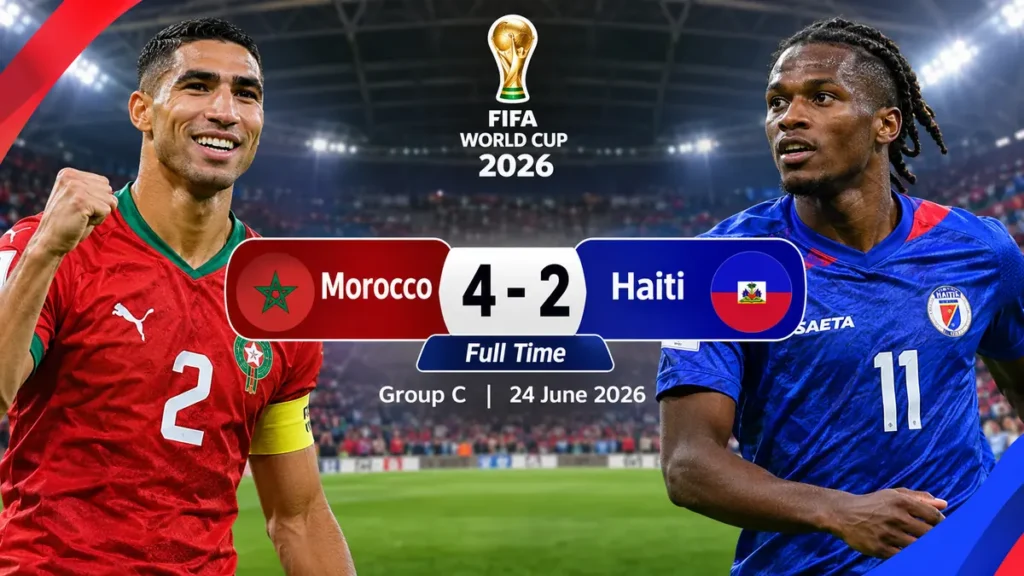
Morocco and Haiti delivered one of the more dramatic encounters of the 2026 FIFA World Cup group stage. Haiti twice took the lead, but Morocco responded with four goals to secure a 4-2 victory in Atlanta on June 24, 2026.
The morocco vs haiti match ended 4-2 in Morocco’s favor at Mercedes-Benz Stadium in Atlanta, Georgia. Achraf Hakimi, Ismael Saibari, Soufiane Rahimi, and Gessime Yassine scored for Morocco. Haiti’s goals came from a Yassine Bounou own goal and Wilson Isidor. The victory sent Morocco into the World Cup round of 32. FIFA Football Data Platform+1
The result was significant for both nations. Morocco demonstrated the attacking depth and resilience that had helped establish the Atlas Lions as a major force in international football. Haiti, despite elimination, produced a competitive performance against a team with considerably greater recent World Cup success.
morocco vs haiti: Match Overview and Final Score
Escudo de la selección de Marruecos: diseño, color y símbolos
MoroccoAtlas Lions
4 – 2
Full time
24 June 2026
Festival International Espoirs Football Tournoi Maurice Revello Toulon
HaitiLes Grenadiers
Competition
2026 FIFA World Cup
Stage
Group C
Venue
Mercedes-Benz Stadium
Attendance
68,239
Halftime
2–2
Full time
4–2
The fixture took place on Wednesday, June 24, at 6:00 p.m. local time in Atlanta. Depending on the time zone, some international listings show June 25.
Morocco entered the contest seeking to secure its position in the knockout stage, while Haiti was attempting to finish its group-stage campaign with a positive result.
Although the final score suggested a relatively comfortable Moroccan victory, the match was tied until the 78th minute. Haiti’s direct attacking approach repeatedly challenged Morocco’s defense during the opening half. FB Ref+1
morocco vs haiti Goals and Match Timeline
The match featured six goals, several momentum changes, and decisive second-half substitutions.
10′
Haiti takes the lead — 0-1
Lenny Joseph’s attacking move forced a deflection off Moroccan goalkeeper Yassine Bounou. The goal was officially recorded as a Bounou own goal.
39′
Achraf Hakimi equalizes — 1-1
The Moroccan captain converted from close range after goalkeeper Johny Placide could not fully deal with the attacking opportunity.
43′
Wilson Isidor restores Haiti’s lead — 1-2
Isidor produced an impressive long-range finish into the upper corner, giving Haiti its second advantage.
45+1′
Ismael Saibari levels the score — 2-2
Saibari finished a delivery from Hakimi, ensuring Morocco reached halftime on equal terms.
78′
Soufiane Rahimi puts Morocco ahead — 3-2
The second-half substitute broke the deadlock and gave Morocco its first lead of the match.
89′
Gessime Yassine seals the victory — 4-2
Another Moroccan substitute scored late to establish the final two-goal margin.
The sequence illustrates why the match was more competitive than the scoreline alone might suggest. Haiti led twice, but Morocco’s persistence and substitutions ultimately determined the result. Concacaf+1
Morocco vs Haiti Match Statistics Compared
Morocco dominated several important statistical categories, particularly possession, attacking attempts, and corner kicks.
The official FIFA match report recorded the following figures:
| Match statistic | Morocco | Haiti |
|---|---|---|
| Goals | 4 | 2 |
| Ball possession | 67% | 33% |
| Total attempts at goal | 23 | 8 |
| Attempts on target | 11 | 2 |
| Corner kicks | 9 | 1 |
| Fouls committed | 10 | 18 |
| Yellow cards | 0 | 3 |
| Red cards | 0 | 0 |
Source: FIFA’s official full-time match report. Some third-party providers report slightly different shot and possession totals because of statistical definitions and subsequent revisions. FIFA Football Data Platform+1
Ball possession
Morocco 67%
Haiti 33%
Attempts on target
Morocco 11
Haiti 2
Morocco
Haiti
What do the statistics reveal?
Morocco’s 67% possession indicates that it controlled the ball for approximately twice as much time as Haiti.
The difference in attempts on target was even more substantial. Morocco registered 11, compared with Haiti’s two.
Nevertheless, Haiti converted its limited attacking opportunities into meaningful pressure on the scoreboard. Its two first-half goals forced Morocco to respond rather than simply protect an early advantage.
The corner-kick difference also reflected Morocco’s sustained presence in attacking areas. With nine corners compared with Haiti’s one, the Atlas Lions repeatedly forced the opposition into defensive situations.
The statistics support Morocco’s overall superiority, but they do not diminish Haiti’s effectiveness during important moments.
Key Players Who Influenced the Result
Several players shaped the outcome through goals, assists, defensive contributions, and important saves.
Morocco v Haiti: Group C – FIFA World Cup 2026
Achraf Hakimi — Morocco
Hakimi played a decisive role in Morocco’s comeback. The captain scored the first equalizer and supplied the delivery for Saibari’s goal before halftime. His attacking movement from defense created problems for Haiti.
Morocco v Haiti: Group C – FIFA World Cup 2026
Wilson Isidor — Haiti
Isidor scored Haiti’s standout goal with a powerful long-range strike. His finish demonstrated how dangerous Haiti could be when attacking space quickly.
France v Morocco: Quarter Final – FIFA World Cup 2026
Soufiane Rahimi — Morocco
Rahimi entered during the second half and scored the goal that changed the score from 2-2 to 3-2. His contribution highlighted Morocco’s ability to introduce effective attacking options from the bench.
Haiti Portraits – FIFA World Cup 2026
Johny Placide — Haiti
Despite conceding four goals, Placide made important saves, including a notable double intervention against Hakimi and Ayoub El Kaabi in the first half.
Ismael Saibari and Gessime Yassine also made major contributions for Morocco, while Lenny Joseph was central to the move that produced Haiti’s opening goal. Concacaf+1
Tactical Analysis: How Morocco Defeated Haiti
The result can be understood through three major tactical factors: Morocco’s control of possession, Haiti’s effectiveness in transition, and the influence of Morocco’s substitutes.
Morocco’s possession-based attacking approach
Morocco sought to control the match through sustained possession and attacks involving its technically skilled midfielders and advancing defenders.
Hakimi’s attacking involvement was particularly important. Rather than remaining exclusively in defensive positions, he contributed directly to goalscoring opportunities.
Players such as Sofyan Amrabat, Brahim Díaz, Bilal El Khannouss, and Neil El Aynaoui gave Morocco options for circulating possession and progressing the ball.
The approach created substantial attacking volume, although Morocco initially struggled to translate its territorial advantage into a lead.
Haiti’s counterattacking threat
Haiti did not need prolonged possession to create danger.
Its attacks were more direct, using forward movement and quick transitions to challenge Morocco’s defensive organization.
Wilson Isidor’s goal demonstrated this effectiveness. Haiti capitalized on an opportunity outside the penalty area and briefly regained control of the scoreline.
The Caribbean side’s willingness to attack also prevented Morocco from treating the contest as a routine group-stage fixture.
However, Haiti faced a difficult task sustaining defensive concentration while Morocco continued to apply pressure.
Why Morocco’s substitutions mattered
Morocco made important attacking changes around the 70th minute, introducing Soufiane Rahimi, Gessime Yassine, and Azzedine Ounahi.
Rahimi scored in the 78th minute, while Yassine added the fourth goal in the 89th.
Both goals came after the substitutions, providing clear evidence that Morocco’s bench contributed directly to the result.
This depth proved valuable during a match in which the starting lineup had twice fallen behind. FB Ref+1
Morocco and Haiti Starting Lineups
Both national teams used players with experience in competitive international and professional club football.
Morocco starting XI
Morocco’s starting lineup included:
| Position | Player |
|---|---|
| Goalkeeper | Yassine Bounou |
| Defender | Achraf Hakimi |
| Defender | Chadi Riad |
| Defender | Redouane Halhal |
| Defender | Anass Salah-Eddine |
| Midfielder | Sofyan Amrabat |
| Midfielder | Ismael Saibari |
| Midfielder | Bilal El Khannouss |
| Midfielder | Neil El Aynaoui |
| Forward | Brahim Díaz |
| Forward | Ayoub El Kaabi |
Morocco was managed by Mohamed Ouahbi, with Hakimi serving as captain.
Haiti starting XI
| Position | Player |
|---|---|
| Goalkeeper | Johny Placide |
| Defender | Ricardo Adé |
| Defender | Hannes Delcroix |
| Defender | Martin Expérience |
| Defender | Jean-Kévin Duverne |
| Midfielder | Jean-Ricner Bellegarde |
| Midfielder | Danley Jean Jacques |
| Forward | Ruben Providence |
| Forward | Lenny Joseph |
| Forward | Wilson Isidor |
| Forward | Josué Casimir |
Haiti was managed by Sébastien Migné, with Placide captaining the side.
The lineups underline the contrasting strengths of the teams. Morocco possessed numerous attacking options, while Haiti relied on collective defensive work and moments of individual quality in forward positions. Official Website of J.LEAGUE+1
Morocco vs Haiti Head-to-Head and World Cup History
The 2026 meeting provides an important reference point when comparing the two national teams, but their broader international histories also help explain the significance of the result.
Morocco’s international football achievements
Morocco has become one of Africa’s most recognizable football nations.
Its most notable modern achievement came at the 2022 FIFA World Cup, when the Atlas Lions reached the semifinals.
That performance made Morocco the first African and first Arab national team to reach the men’s World Cup semifinals.
The tournament included major victories over established European opponents and strengthened Morocco’s international reputation.
By 2026, Morocco had experience competing against leading national teams in high-pressure tournament matches.
Its comeback against Haiti reflected that experience, particularly in its response to conceding twice.
Haiti’s World Cup journey
Haiti has a distinct football history, including participation in the 1974 FIFA World Cup.
The Caribbean nation returned to the men’s World Cup in 2026, ending a long absence from the competition.
Haiti competes internationally through CONCACAF, the regional governing body covering North America, Central America, and the Caribbean.
Morocco, by contrast, represents CAF, the Confederation of African Football.
These different regional pathways mean that competitive encounters between the countries are relatively uncommon.
The 2026 World Cup match offered Haiti an opportunity to measure itself against one of Africa’s strongest international sides.
Who won Morocco vs Haiti?
Morocco won the June 24, 2026 encounter by four goals to two.
For historical head-to-head comparisons, it is important to distinguish this verified World Cup result from any additional friendly or international meetings. A single match should not automatically be treated as a complete all-time head-to-head record.
What the Result Meant for World Cup Group C
The victory had immediate consequences for Morocco’s tournament position.
Morocco finished Group C with seven points, level with Brazil but behind the South American team on goal difference.
That placed Morocco second in the group and secured qualification for the round of 32.
Haiti, meanwhile, completed its campaign in fourth place after three defeats. Confédération Africaine de Football+1
Why Morocco’s victory was important
The win demonstrated several qualities necessary for success in international tournaments.
First, Morocco showed resilience after falling behind twice. Recovering from a deficit requires attacking effectiveness as well as composure.
Second, its substitutes produced goals at decisive moments.
Third, the victory allowed Morocco to finish the group stage unbeaten, providing momentum ahead of the knockout rounds.
The performance was not without weaknesses. Conceding two goals against a team that had relatively little possession highlighted defensive vulnerabilities.
Nevertheless, Morocco achieved its immediate objective: qualification for the next stage.
What Haiti gained despite defeat
Haiti’s elimination was disappointing, but its performance offered evidence of attacking potential.
The team scored twice against an opponent with recent World Cup semifinal experience.
Its willingness to attack and the quality of Isidor’s finish were positive features of the match.
At the same time, Haiti’s inability to contain Morocco’s sustained second-half pressure showed the challenge of competing against teams with greater squad depth.
For Haiti, the tournament also represented a significant milestone after more than five decades away from the men’s World Cup.
Morocco vs Haiti: Comparing the Two Football Nations
Morocco and Haiti differ considerably in geography, football development, and international tournament experience.
| Category | Morocco | Haiti |
|---|---|---|
| Continent or region | Africa | Caribbean, North America |
| Football confederation | CAF | CONCACAF |
| National team nickname | Atlas Lions | Les Grenadiers |
| Capital | Rabat | Port-au-Prince |
| First men’s World Cup appearance | 1970 | 1974 |
| Best men’s World Cup finish through 2026 | Semifinals (2022) | Group stage |
| 2026 group-stage outcome | Advanced to round of 32 | Eliminated |
| 2026 head-to-head result | Won 4-2 | Lost 2-4 |
Which team has the stronger World Cup record?
Morocco has the stronger men’s World Cup record.
Its 2022 semifinal appearance represents a level of tournament achievement Haiti has not matched.
Morocco has also developed a reputation for competing effectively against highly ranked opponents.
Haiti’s football history includes important regional accomplishments and World Cup qualification achievements, but its experience at the tournament’s later stages is more limited.
Is Haiti capable of competing with Morocco?
The 2026 match showed that Haiti could challenge Morocco during individual phases of play.
Haiti twice led and forced the Atlas Lions to recover.
However, competing for short periods is different from controlling an entire match.
Morocco’s possession advantage, greater attacking output, and effective substitutes ultimately produced a decisive victory.
The result illustrates the importance of sustaining performance over 90 minutes rather than judging a team’s ability solely by isolated attacking moments.
Five Major Takeaways From Morocco’s 4-2 Victory
1. Morocco showed resilience. The Atlas Lions recovered from two separate deficits and eventually secured a two-goal victory.
2. Haiti’s attack was dangerous. Despite limited possession, Haiti scored twice in the first half and challenged Morocco’s defense.
3. Achraf Hakimi was influential. His goal and attacking contribution helped Morocco recover before halftime.
4. Substitutions changed the match. Soufiane Rahimi and Gessime Yassine scored the decisive late goals.
5. The result shaped Group C. Morocco advanced to the knockout stage, while Haiti concluded its World Cup campaign.
These lessons extend beyond the final score. They show how possession, efficiency, individual quality, and squad depth can influence a match in different ways.
Final Thoughts on morocco vs haiti
The morocco vs haiti encounter at the 2026 FIFA World Cup ended in a 4-2 victory for Morocco, but the contest was considerably closer than the final margin suggested.
Haiti twice led during the opening half, demonstrating determination and attacking quality. Morocco responded through Hakimi and Saibari before second-half goals from Rahimi and Yassine completed the comeback.
Morocco’s victory secured its progression from Group C and reinforced its standing as a competitive international football team. Haiti departed the tournament without a win, but its performance in Atlanta provided memorable moments and highlighted its ability to challenge a stronger opponent.
The defining lesson of the match was Morocco’s ability to turn sustained attacking pressure and squad depth into a victory after facing unexpected resistance.
For the official match record, FIFA’s full-time match report provides the confirmed score, statistics, and match details.