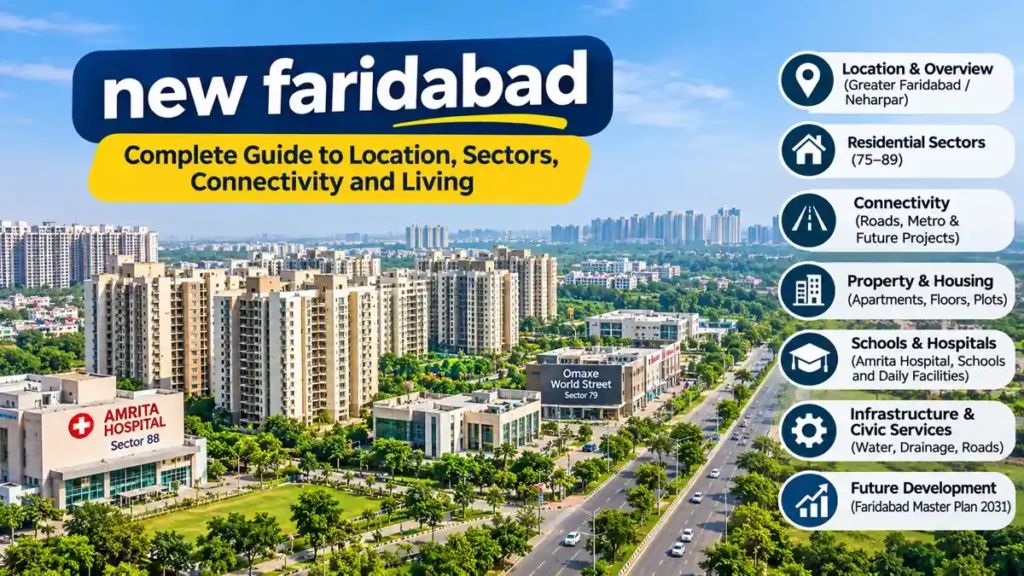
New Faridabad is one of the major urban expansion areas in Haryana’s National Capital Region (NCR). Known for its planned residential sectors, apartment communities, wider roads and growing social infrastructure, it offers a different living environment from the older, more established parts of Faridabad.
new faridabad generally refers to Greater Faridabad, also called Neharpar, the developing urban area east of the Agra Canal. Its wider planned area includes Sectors 66–89, while Sectors 75–89 form the principal residential belt. The locality contains apartments, builder floors, schools, hospitals and commercial developments, although infrastructure quality varies between sectors. ADiHomes+1
Understanding the area requires more than looking at its new buildings. Connectivity, water supply, drainage, public transport and the difference between completed and proposed infrastructure all influence everyday life.
Where Is new faridabad Located?
New Faridabad lies in the eastern part of Faridabad city, across the Agra Canal from many of its older residential and commercial neighborhoods.
It forms part of Haryana’s planned urban development within the Delhi NCR region and is commonly identified by the names Greater Faridabad and Neharpar.
The word Neharpar means “across the canal,” reflecting the area’s location relative to established Faridabad.
Geographically, the development belt lies toward the Yamuna River, with road connections to Delhi, Noida, Ballabhgarh and other parts of Faridabad.
Its location is significant because residents can access employment and services in the wider NCR while living in newer residential developments. However, actual travel convenience depends heavily on the sector, canal crossings and road conditions.
New Faridabad vs Old Faridabad
Although both areas belong to the same city, they have different urban characteristics.
| Feature | New Faridabad | Old Faridabad |
|---|---|---|
| Development | Newer planned sectors | Older established neighborhoods |
| Housing | High-rise apartments, builder floors, plots | Independent houses, apartments, older colonies |
| Roads | Wider planned roads in many areas | Established roads, often busier |
| Metro | No operational station within Neharpar | Several Violet Line stations serve established Faridabad |
| Markets | Growing commercial facilities | Established shopping and trading areas |
| Infrastructure | Varies by sector and project | More established in many locations |
| Main appeal | Newer housing and planned layouts | Existing transport and urban services |
Neither area is automatically better. An established neighborhood may offer easier access to daily necessities, while a newer sector may provide larger housing communities and modern layouts.
Major Residential Sectors in new faridabad
The Faridabad Master Plan identifies Sectors 66–89 as part of a planned sub-city. Sectors 66–74 are predominantly designated for industrial use, while Sectors 75–89 are primarily residential. The Tribune+1
The residential belt is not a single uniform neighborhood. Each sector has different housing projects, occupancy levels, amenities and road access.
Sectors 75–78: Established Township Developments
These sectors contain some of the earlier large residential developments in Greater Faridabad.
BPTP Parklands and other group-housing projects helped establish the area as a residential destination.
Typical housing includes multi-storey apartments, gated societies and builder floors.
Residents should evaluate the condition of individual buildings, maintenance arrangements, parking availability and the quality of internal roads rather than relying solely on the sector number.
Sectors 79–82: Residential and Commercial Growth
Sectors 79–82 include residential communities and developing neighborhood services.
Their appeal comes from planned layouts and connections to surrounding residential sectors.
The availability of grocery stores, schools, medical facilities and public transport varies between specific locations.
For families, the distance between home, school and workplace may matter more than the advertised amenities of a housing project.
Sectors 83–86: Apartment Communities and Urban Amenities
This part of Greater Faridabad includes established residential societies and a mixture of apartments and other housing formats.
Omaxe Heights in Sector 86 is among the recognizable residential developments in the wider Neharpar belt.
The area offers access to neighborhood retail and services, although individual projects differ considerably in maintenance quality and infrastructure.
Sectors 87–89: Healthcare and Newer Residential Development
These sectors form another important residential cluster.
Sector 88 is particularly notable for Amrita Hospital, a major tertiary healthcare institution that opened in August 2022.
Residential developments in the surrounding sectors include apartment complexes and other planned housing communities.
Access to a major hospital is useful, but residents should still check the availability of local clinics, pharmacies, emergency transport and routine medical services. ADiHomes+1
Overview of the Residential Belt
| Sector group | Main characteristics | What residents should check |
|---|---|---|
| 75–78 | Earlier townships and apartment societies | Building condition and civic services |
| 79–82 | Residential development and neighborhood facilities | Daily shopping and school access |
| 83–86 | Established apartment communities | Maintenance, parking and road connectivity |
| 87–89 | Residential projects and major healthcare access | Public transport and service reliability |
These are broad descriptions rather than official quality rankings. Conditions can differ even between neighboring housing societies.
Connectivity and Transportation in new faridabad
Connectivity is one of the most important factors affecting life in Greater Faridabad.
Although the area benefits from several major road corridors, residents still depend heavily on private vehicles, autorickshaws and connections to the existing Delhi Metro network.
Road Connectivity to Delhi, Noida and Gurugram
The Faridabad Bypass Road is a major transport corridor serving the city and the Neharpar development belt.
Important road connections include:
- Faridabad Bypass Road: Provides access along the city’s eastern side and connects several residential areas.
- Mathura Road (NH-44): An important north–south route connecting Faridabad with Delhi and other destinations.
- DND–Faridabad–Sohna corridor (NH-148NA): Improves regional expressway connectivity.
- Kheri Road: Serves parts of the northern Greater Faridabad residential belt.
- Tigaon Road: Provides connections to southern sectors and surrounding localities.
Travel to Noida commonly involves crossing the Yamuna through available road connections, while journeys to Gurugram require travel across the wider Faridabad road network.
The best route depends on the starting sector, destination and traffic conditions. NXTutors+1
Metro Connectivity in New Faridabad
The Delhi Metro Violet Line serves established parts of Faridabad, with stations including Old Faridabad, Neelam Chowk Ajronda, Bata Chowk, Escorts Mujesar and Raja Nahar Singh in Ballabhgarh.
However, there is no operational Delhi Metro station within the main Neharpar residential sectors as of November 2026.
Residents typically travel by road to a suitable Violet Line station before continuing toward Delhi.
The Haryana Mass Rapid Transport Corporation has examined metro connectivity proposals involving Neharpar. Feasibility studies have taken place, but these proposals should not be confused with an approved, operating extension. Projects+1
For someone commuting daily, the total journey should include:
- Travel from home to the metro station.
- Waiting time and any interchange.
- The metro journey itself.
- Travel from the destination station to the workplace.
A location described as being close to the metro may still require a substantial road journey.
Proposed Regional Transport Projects
Several major transport proposals could influence future accessibility.
The Faridabad–Noida–Ghaziabad (FNG) Expressway is intended to improve regional road connectivity, although incomplete sections and delays have affected its development.
The Faridabad–Jewar Expressway is another important project associated with improved access to Noida International Airport.
In February 2026, Haryana approved an alignment for a proposed Gurugram–Faridabad–Noida–Greater Noida Namo Bharat RRTS-cum-Metro corridor. Planning documents have also identified a possible station near the Sector 87–88 intersection.
These developments could improve regional mobility if completed, but proposed routes, stations and travel-time estimates should not be treated as existing services. The Tribune+2
Housing and Property Prices in New Faridabad
Greater Faridabad has a varied residential property market, including apartments, independent floors, plots and gated communities.
The area is often compared with other NCR residential markets because it offers a substantial supply of planned housing.
Types of Residential Properties
High-rise apartments are common throughout the Neharpar belt. These range from relatively basic housing complexes to developments with security, lifts, parking, landscaped areas and recreational facilities.
Builder floors provide an alternative for households that prefer fewer units within a building and a more independent residential arrangement.
Residential plots are available in certain planned developments, although ownership, permitted land use and development approvals require careful verification.
Independent houses exist in selected locations, but availability and surrounding infrastructure vary considerably.
Property Prices in 2026
Property prices depend on the sector, project, building age, floor, property condition and available facilities.
Published market estimates differ significantly because property portals use different listing samples and measurement methods.
For example, an October 2026 locality analysis reported the following indicative asking-price figures:
| Market indicator | Approximate figure |
|---|---|
| Lower portal average | ₹5,319 per sq. ft. |
| Upper figure in one portal range | ₹6,648 per sq. ft. |
| Another portal’s apartment estimate | ₹7,950 per sq. ft. |
| Local project-listing median | ₹6,438 per sq. ft. |
These figures are not official transaction averages and should not be interpreted as a single price range for every property. ADiHomes+1
A 1,000-square-foot apartment advertised at ₹6,000 per square foot would have an indicative base price of ₹60 lakh. However, that simple calculation excludes possible registration charges, taxes, maintenance deposits and other costs.
The quoted area also matters. Carpet area, built-up area and super built-up area are different measurements.
Comparing one property’s carpet-area rate with another property’s super-area rate can create a misleading impression of affordability.
Renting in Greater Faridabad
Renting provides an opportunity to experience the locality before making a longer-term housing decision.
A November 2026 neighborhood guide cited indicative monthly rents of approximately ₹11,000–₹18,000 for a two-bedroom apartment and ₹15,000–₹23,000 for a three-bedroom apartment, based on July 2026 market observations. NCR Guide
Actual rent depends on furnishing, location, building quality, maintenance charges and amenities.
Tenants should establish whether maintenance, parking and utility expenses are included in the advertised amount.
Schools, Hospitals and Everyday Facilities
The development of schools, healthcare facilities and neighborhood markets has made parts of Greater Faridabad more practical for family living.
However, the availability of facilities does not mean they are equally accessible from every sector.
Education and Schools
The residential belt has access to private schools and educational institutions in Greater Faridabad and the wider city.
Families should assess schools using practical criteria rather than proximity alone.
These include school recognition, curriculum, transport arrangements, fees, class sizes, safety procedures and actual travel time.
For younger children, a school journey that crosses congested roads can be significantly more demanding than a similar-distance journey within the same neighborhood.
Parents should also confirm whether school transport serves their specific housing society.
Hospitals and Medical Services
Amrita Hospital in Sector 88 is one of the area’s most significant healthcare facilities.
The large private hospital provides specialist medical services and has contributed to the development of healthcare infrastructure in the Greater Faridabad region.
Other hospitals and healthcare providers operate across Faridabad, but their accessibility depends on the residential sector and traffic conditions. ADiHomes
For everyday healthcare, residents should identify nearby pharmacies, general practitioners, diagnostic centers and emergency medical services.
A major hospital within the wider locality does not necessarily mean emergency care is only a few minutes away.
Shopping and Commercial Areas
Commercial development includes neighborhood shops, local markets, shopping complexes and planned retail spaces.
Omaxe World Street in Sector 79 is one of the recognizable commercial developments in the Greater Faridabad area. Haryana RERA records also list commercial development phases associated with the project. Haryana RERA
Daily shopping options vary by sector. Some residential communities have convenient access to grocery stores and pharmacies, while others depend on nearby commercial areas.
Before moving into a property, it is useful to check the actual availability of essential services rather than relying on future commercial development plans.
Infrastructure and Civic Challenges in new faridabad
One of the most important things to understand about Greater Faridabad is that planned development and completed infrastructure are not the same.
A sector may have occupied apartment buildings while certain public facilities remain incomplete.
Water Supply and Sewerage
Water supply has been a recurring concern in parts of the Neharpar region.
Some housing societies have depended on borewells, water tankers or their own arrangements where municipal connections have been inadequate.
Residents should ask about the source of drinking water, the reliability of supply, water treatment and the cost of any tanker dependence.
Sewerage connections and wastewater disposal also deserve attention.
Past reporting has documented gaps in these services, although conditions may have changed in individual societies since those reports were published. ADiHomes+1
Waterlogging and Drainage
Heavy monsoon rainfall can expose weaknesses in stormwater drainage.
Some Greater Faridabad roads and residential pockets have experienced waterlogging, making road access difficult and increasing maintenance concerns.
When evaluating a neighborhood, a visit during or shortly after heavy rainfall can reveal conditions that are not apparent in dry weather.
It is also worth checking basement parking areas, entrance levels, drainage outlets and the history of water entering residential compounds.
In April 2026, the Haryana government announced rainwater-harvesting measures for public facilities as part of wider efforts to improve water management. Such announcements should be distinguished from completed drainage improvements at individual locations. PRMS
Road Maintenance and Street Lighting
Wide master roads are one of the recognizable features of planned sectors, but road width alone does not guarantee convenient travel.
Internal roads, junctions, footpaths and street lighting may be maintained to different standards.
Pedestrian safety is particularly relevant around schools, markets and major road crossings.
Residents should check whether footpaths are usable, whether crossings are safe and whether streets remain adequately illuminated after dark.
Air Quality and Environmental Conditions
Faridabad is part of the wider NCR air-quality region, where seasonal pollution can affect daily life.
Traffic emissions, road dust, industrial activity and construction can contribute to local pollution.
Greater Faridabad’s newer residential environment does not make it immune to these problems.
People considering a move should examine seasonal air-quality information, nearby construction activity and the condition of roads surrounding a particular housing society.
Is New Faridabad a Good Place to Live?
Greater Faridabad can be a practical residential choice, especially for households seeking newer apartments and planned communities within the NCR.
Its suitability depends less on the general reputation of the locality and more on the exact address.
Advantages of Living in Greater Faridabad
- A substantial selection of apartments, builder floors and other housing formats.
- Planned residential layouts in several sectors.
- Access to established and developing schools, healthcare and retail facilities.
- Regional road connectivity through Faridabad’s bypass and expressway network.
- A range of housing prices and rental options.
- Opportunities to live in gated communities with shared amenities.
Limitations to Consider
- No operational metro station within the principal Neharpar residential belt.
- Variable water supply, drainage and sewerage arrangements.
- Road maintenance differences between sectors.
- Dependence on road transport for many daily journeys.
- Potential construction activity around developing projects.
- Uncertainty surrounding the completion dates of proposed transport infrastructure.
These advantages and disadvantages explain why two residents of Greater Faridabad may have very different experiences.
One may live in a well-maintained society near essential services, while another may face longer commutes and recurring infrastructure problems.
Who May Find the Area Suitable?
Families who prioritize apartment space, gated-community amenities and access to schools may find suitable neighborhoods within the residential belt.
People who work in Faridabad or have flexible working arrangements may also find the location convenient.
For daily commuters to central Delhi, Noida or Gurugram, travel time should be tested during actual working hours.
A lower housing cost may offer limited practical benefit if it comes with a substantially longer commute and higher transport expenses.
Future Development Under the Faridabad Master Plan 2031
The Faridabad Master Plan 2031 provides a broader framework for the city’s long-term expansion.
It includes residential, industrial, commercial and infrastructure development across existing and proposed sectors.
The Greater Faridabad belt forms part of this planning framework, but the wider master plan also includes expansion areas beyond the established Neharpar sectors.
According to reporting in December 2024, development of numerous newly proposed sectors had not begun because of land acquisition and infrastructure challenges. The Tribune
This distinction matters because a sector appearing on a planning map does not necessarily mean that roads, water supply, utilities and public facilities are already available.
Role of Development Authorities
Different public bodies have responsibilities connected with urban development.
Haryana Shahari Vikas Pradhikaran (HSVP), formerly known as HUDA, is associated with planned urban development.
The Faridabad Metropolitan Development Authority (FMDA) is involved in metropolitan infrastructure, while the Municipal Corporation of Faridabad (MCF) provides municipal services within its jurisdiction.
The Department of Town and Country Planning Haryana oversees relevant planning and licensing matters.
Responsibility for a particular road, utility connection or housing development can depend on its location and approval status.
What Future Infrastructure Could Change
Improved road links, public transport and reliable utilities could make Greater Faridabad more accessible and convenient.
Potential benefits include reduced travel dependence on congested routes, better access to employment centers and improved neighborhood services.
However, infrastructure projects frequently move through feasibility, approval, land acquisition, funding and construction stages before becoming operational.
A proposed expressway or metro line should therefore be treated as a possibility, not a guaranteed benefit.
How to Evaluate a Property or Neighborhood in New Faridabad
Choosing a suitable neighborhood requires checking both the property and its surroundings.
A practical assessment should focus on conditions that can be independently verified.
Check the Property’s Legal and Regulatory Status
For applicable real estate projects, verify the registration details through the official Haryana RERA project search.
Faridabad projects are generally handled through the Haryana RERA Panchkula authority.
Check the exact project phase and tower rather than assuming that a registration for one phase covers the entire development.
Relevant documents may include the approved building plan, completion certificate, occupation certificate and ownership records, as applicable.
RERA registration alone does not establish that every legal or construction issue has been resolved. Haryana RERA+1
Inspect the Housing Society
A physical inspection should cover the lifts, fire-safety equipment, common areas, parking facilities, water systems and building maintenance.
Residents can often provide useful information about recurring service problems and maintenance charges.
It is also worth checking whether promised amenities are operational or still under construction.
Test the Daily Commute
Use the same route that would be required on an ordinary working day.
Check travel times during morning and evening peak hours.
For metro users, include the time and expense involved in reaching the station.
For families, test the school journey as well as the workplace commute.
Verify Essential Services
Before making a decision, confirm:
- The regular source and reliability of water supply.
- Electricity arrangements and power-backup costs.
- Sewerage and drainage conditions.
- Waste collection and road maintenance.
- Availability of grocery shops, pharmacies and emergency services.
- Monthly maintenance charges and any outstanding dues.
These details can affect daily comfort more directly than a project’s advertised facilities.
Understanding the Long-Term Outlook for New Faridabad
New Faridabad has progressed from a relatively new development belt into a substantial residential area within the NCR.
Its established apartment communities, expanding retail facilities, major healthcare infrastructure and road network provide a foundation for further development.
At the same time, the area continues to face challenges associated with rapid urban expansion.
The most important future improvements are likely to involve dependable water and sewerage services, better drainage, road maintenance and stronger public transport connectivity.
For property owners, infrastructure improvements may support neighborhood demand, but they do not guarantee rising property values.
Housing-market performance also depends on construction quality, legal status, supply, maintenance costs and broader economic conditions.
For residents, the more meaningful measure of development is whether daily journeys become easier and essential services become more reliable.
Final Thoughts on new faridabad
New Faridabad, commonly known as Greater Faridabad or Neharpar, is an important part of Faridabad’s residential expansion. Its Sectors 75–89 offer a broad selection of housing communities, access to educational and healthcare facilities, and connections to the wider Delhi NCR road network.
The area combines the advantages of planned urban development with the practical challenges of infrastructure that has not matured equally everywhere.
Anyone researching new faridabad should compare individual sectors, examine existing transport links, verify civic services and distinguish completed projects from future proposals.
The most reliable way to understand the locality is to evaluate what is available and functioning today, rather than relying on what development plans suggest may arrive tomorrow.