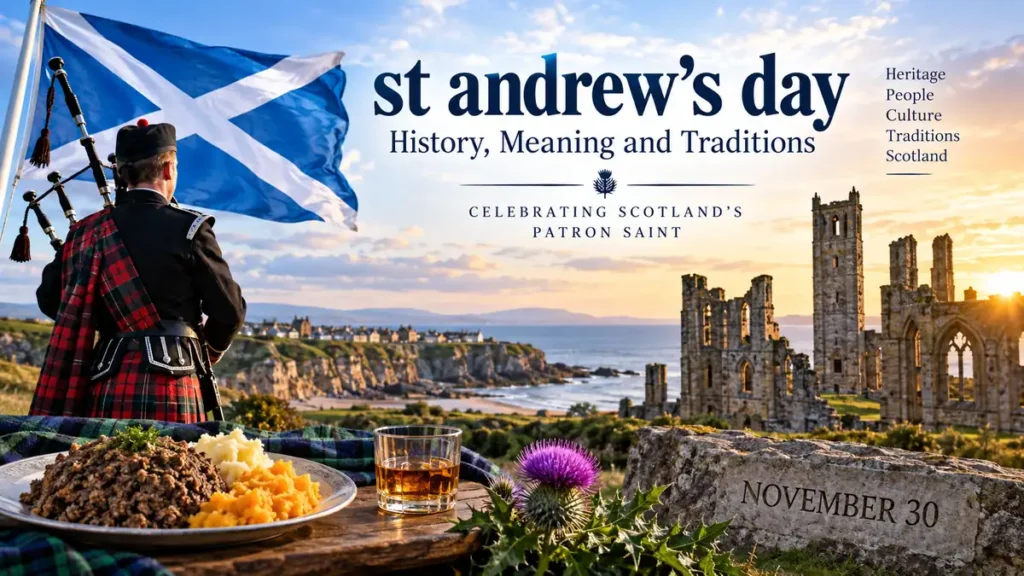
Every November 30, Scotland celebrates a first-century fisherman who never set foot in the country yet became one of its most recognizable national symbols. His story is now woven into Scotland’s flag, medieval history, religious heritage and modern cultural celebrations.
st andrew’s day is observed every year on November 30 in honor of Saint Andrew the Apostle, Scotland’s patron saint. In Scotland, the day combines a Christian feast with a celebration of Scottish culture, commonly featuring the Saltire, ceilidh dancing, traditional music, Scottish food, community gatherings and events celebrating the country’s heritage.
The celebration has developed over many centuries. To understand why November 30 matters so much, it helps to start with the man behind the day and then follow his unlikely connection from the ancient Middle East to Scotland.
What Is st andrew’s day?
st andrew’s day is the feast day of Saint Andrew, one of the twelve apostles of Jesus Christ and the patron saint of Scotland. It falls on November 30 every year and has both religious and cultural significance.
For Christians who observe saints’ feast days, November 30 commemorates Andrew and his martyrdom. In Scotland, however, the occasion has grown into something broader: a national celebration of Scottish history, identity and culture.
Typical celebrations may include:
- Flying the Saltire, Scotland’s national flag
- Ceilidhs and traditional Scottish dancing
- Folk music and bagpipes
- Community festivals and cultural performances
- Scottish meals and gatherings
- Church services
- Storytelling and historical activities
- Events organized by Scottish communities overseas
St Andrew’s Day also traditionally helps open Scotland’s winter festival season, followed later by Hogmanay and Burns Night.
When is st andrew’s day?
The date is always November 30.
In 2026, November 30 falls on a Monday, and the Scottish Government lists that date as the official St Andrew’s Day bank holiday for the year.
| Year | Date | Day |
|---|---|---|
| 2025 | November 30 | Sunday |
| 2026 | November 30 | Monday |
| 2027 | November 30 | Tuesday |
When November 30 falls on a weekend, the associated Scottish bank holiday is generally observed on the following Monday. For example, because November 30, 2025 was a Sunday, the bank holiday was observed on Monday, December 1.
Who Was Saint Andrew?
Saint Andrew was a Galilean fisherman and one of the twelve apostles of Jesus. According to Christian tradition, he was also the brother of Saint Peter.
The New Testament associates Andrew with Bethsaida and the Sea of Galilee. Before becoming a disciple of Jesus, Christian accounts connect him with John the Baptist. He later became one of Jesus’s earliest followers.
His occupation as a fisherman is one reason Andrew has traditionally been regarded as a patron saint of fishermen and fishmongers as well as various communities and countries.
Andrew’s significance extends far beyond Scotland. Christian traditions associate him with several regions, particularly in eastern and southeastern Europe, and he is honored as a patron saint in countries including Greece, Romania and Ukraine.
How did Saint Andrew die?
Christian tradition holds that Andrew was martyred at Patras in Greece.
He became particularly associated with an X-shaped cross, now commonly called St Andrew’s Cross or a saltire. Later traditions say he was crucified on this shape rather than the conventional upright cross.
That symbol eventually became central to Scottish identity.
Today, the white diagonal cross against a blue background forms Scotland’s national flag: the Saltire.
Why Is Saint Andrew the Patron Saint of Scotland?
This is where documented history and medieval legend overlap.
Saint Andrew was not Scottish, and there is no historical evidence that he personally visited Scotland. His connection to the country instead developed through religious traditions, stories about his relics and the growth of his cult during the medieval period.
One famous tradition concerns St Rule, also known as Regulus. According to legend, Rule transported some of Andrew’s relics from the eastern Mediterranean to Scotland, eventually bringing them to the area that became St Andrews in Fife.
The settlement developed into an important religious center and pilgrimage destination.
Another tradition connects Andrew with a battle involving the Picts. The story says a white diagonal cross appeared against a blue sky before a battle and was interpreted as a sign of Saint Andrew’s protection.
Historical accounts of these events were written much later, so the stories should be understood as traditions rather than straightforward contemporary records.
What is clear is that devotion to Andrew became deeply established in medieval Scotland.
Celebrations in his honor can be traced back many centuries, with Scotland.org noting that feasts associated with him were being held as far back as around AD 1000.
Saint Andrew and the Declaration of Arbroath
Saint Andrew’s importance also became connected with Scotland’s medieval political and religious identity.
The Declaration of Arbroath, sent to Pope John XXII in 1320, appealed to Scotland’s relationship with Saint Andrew while arguing the Scottish case during the Wars of Independence.
Andrew’s status within Christianity was especially significant because he was traditionally regarded as the brother of Saint Peter, who occupied a central place in the history of the Church. Scotland.org notes that this connection strengthened the importance of Andrew in medieval Scottish appeals to the papacy.
By this period, the saint’s association with Scotland was firmly established.
The Saltire and the Meaning of St Andrew’s Cross
Few symbols are more closely connected with st andrew’s day than the Saltire.
Scotland’s national flag consists of a white diagonal cross on a blue field. The cross represents the traditional form of Saint Andrew’s martyrdom.
According to the famous Scottish legend, the Saltire’s origins stretch back to a ninth-century battle near Athelstaneford in East Lothian.
The story tells of a Pictish force facing a stronger enemy. After prayers for assistance, a white saltire-shaped formation supposedly appeared in the blue sky. Victory followed, strengthening the association between Saint Andrew and Scotland.
The historical details surrounding the legend are uncertain, but the diagonal cross became an established Scottish emblem over subsequent centuries.
By 1385, the Parliament of Scotland was requiring Scottish soldiers to display a white St Andrew’s Cross as an identifying mark.
Today the Saltire appears everywhere from government buildings and sporting events to schools and private homes.
On St Andrew’s Day itself, the symbolism becomes particularly visible. Scottish Government flag-flying guidance for November 30 specifies the Saltire for government buildings covered by the guidance.
Quick takeaway: Saint Andrew’s cross connects three parts of the story: Andrew’s traditional martyrdom, medieval Scottish legends and the modern national flag.
How Is st andrew’s day Celebrated in Scotland?
Modern celebrations tend to focus on Scottish culture rather than following one fixed national ritual.
A St Andrew’s Day event in one town may look quite different from a celebration elsewhere. Some people attend large cultural events, while others simply enjoy Scottish food or music with family and friends.
Ceilidh dancing
A ceilidh is one of the activities most strongly associated with Scottish celebrations.
Modern ceilidhs usually combine traditional Scottish music with group or partner dances. A band may feature fiddles, accordions and other instruments, while a caller explains the dance steps.
Experience is not essential. In fact, part of the appeal is that newcomers can join in after receiving basic instructions.
Ceilidhs are particularly well suited to St Andrew’s Day because they bring music, dance and social gathering together.
Scottish music
Music is another major feature of November 30 celebrations.
Depending on the event, that can include:
- Bagpipe performances
- Fiddle music
- Traditional folk songs
- Gaelic music
- Contemporary Scottish performers
- Ceilidh bands
The emphasis is not necessarily on recreating one historical celebration. Modern events often combine traditional and contemporary Scottish culture.
Festivals and community events
Cities, towns, schools, cultural organizations and community groups may organize their own St Andrew’s Day programs.
Events can include concerts, storytelling, historical exhibitions, dancing, food, family activities and public performances.
The town of St Andrews in Fife has an especially obvious connection because its name and medieval religious history are tied directly to the saint.
Traditional Food for st andrew’s day
There is no single compulsory St Andrew’s Day meal. Instead, celebrations often use familiar Scottish dishes to turn the occasion into a broader celebration of national food traditions.
One of the best-known combinations is:
Haggis, neeps and tatties
Haggis is traditionally made from seasoned sheep offal mixed with oatmeal and other ingredients. “Neeps” generally refers to swede in modern Scottish usage, while “tatties” means potatoes.
Other foods that may appear at Scottish celebrations include:
| Food | What it is |
|---|---|
| Cullen skink | A creamy smoked haddock, potato and onion soup |
| Scotch broth | A hearty soup traditionally made with barley, vegetables and meat |
| Cranachan | A dessert commonly made with cream, oats, raspberries and whisky |
| Shortbread | Rich, crumbly Scottish biscuits |
| Salmon | A food strongly associated with Scotland’s rivers and coastal cuisine |
| Oatcakes | Thin, savory oat-based biscuits or crackers |
Food traditions naturally vary between families, regions and events. A modern St Andrew’s Day gathering can be as simple as a Scottish-inspired dinner rather than a formal traditional feast.
Is st andrew’s day a Bank Holiday?
Yes. St Andrew’s Day is an official bank holiday in Scotland.
The St Andrew’s Day Bank Holiday (Scotland) Act 2007 established November 30 as a bank holiday, with provisions for an alternative weekday when the date falls on a weekend. The House of Commons Library notes that the day has held official Scottish bank-holiday status since the legislation was passed.
There is an important practical distinction, though: a bank holiday does not automatically mean everyone in Scotland gets a paid day off.
The Scottish Government explains that there is no law requiring banks or other businesses to close on bank holidays, and entitlement to time off depends on employment arrangements.
Employers may also count bank holidays toward a worker’s statutory annual leave entitlement.
So the practical answer is:
- November 30 is a Scottish bank holiday.
- It is not automatically a day off for every employee.
- Some organizations remain open.
- Employment contracts determine many workers’ arrangements.
- Local public holidays can differ from national Scottish bank holidays.
This distinction is useful when planning work, travel or appointments around the date.
Why Is st andrew’s day Celebrated on November 30?
November 30 is traditionally regarded as the date of Saint Andrew’s martyrdom and became his feast day within Christian calendars.
A saint’s feast day traditionally commemorates that person’s life, death or religious significance. Over time, patron-saint feast days often developed cultural significance in the countries associated with them.
That is exactly what happened in Scotland.
What began as religious veneration eventually became closely linked with Scottish national identity. November 30 now brings together several layers of meaning:
Christian heritage → medieval Scottish history → the Saltire → national identity → modern cultural celebration
This is why St Andrew’s Day can mean different things to different people.
For some Christians, it remains primarily a religious feast. For others, it is a cultural occasion centered on Scotland, family heritage, food, music and community.
St Andrew’s Day Around the World
Scotland may be the country most closely associated with November 30, but Saint Andrew’s significance is international.
Christian traditions involving Andrew developed across Europe and beyond. He is particularly important within both Western and Eastern Christianity and has patronal associations with several countries and communities.
Scottish migration also carried St Andrew’s Day traditions overseas.
One particularly interesting part of the modern story comes from the United States.
The St Andrew’s Society of Charleston in South Carolina was founded by Scottish immigrants in 1729. The St Andrew’s Society of the State of New York followed in 1756. Such organizations helped Scottish communities abroad maintain connections with their heritage while also undertaking charitable work.
Today, Scottish societies and diaspora communities around the world continue to hold dinners, dances, concerts and other gatherings around November 30.
That international dimension explains why someone can celebrate St Andrew’s Day without living in Scotland.
St Andrew’s Day Traditions and Folklore
Not every tradition associated with November 30 comes directly from Scotland.
Across parts of Europe, the eve of Saint Andrew’s feast developed folklore involving marriage, luck and attempts to predict the future.
Historical customs sometimes involved young unmarried women looking for signs concerning a future husband. One tradition involved carefully peeling an apple in one continuous strip and throwing the peel over the shoulder, with its resulting shape supposedly offering a clue to a future spouse’s initial.
Such customs are better understood today as folklore rather than religious requirements.
Scottish celebrations are generally more strongly associated with national symbols, music, dancing, food and community gatherings.
What Is the Difference Between St Andrew’s Day, Burns Night and Hogmanay?
These three celebrations are sometimes grouped together because they all occur during Scotland’s winter festival season, but they commemorate very different things.
| Celebration | Date | Main Meaning |
|---|---|---|
| St Andrew’s Day | November 30 | Scotland’s patron saint and Scottish culture |
| Hogmanay | December 31 | Scottish New Year’s Eve traditions |
| Burns Night | January 25 | Life and work of poet Robert Burns |
St Andrew’s Day comes first and is connected to Saint Andrew and Scotland’s patron-saint tradition.
Hogmanay is Scotland’s famous New Year’s Eve celebration, with customs centered on welcoming the new year.
Burns Night commemorates the poet Robert Burns, traditionally with a Burns Supper featuring poetry, speeches, music and haggis.
The three occasions therefore represent different aspects of Scottish identity: patron-saint tradition, New Year customs and literary heritage.
How to Celebrate st andrew’s day
You do not need to attend a major festival to take part.
A meaningful celebration can be built around learning about Scottish history and sharing Scottish culture with other people.
One simple approach is:
- Display or learn about the Saltire. Explore how St Andrew’s Cross became a national Scottish symbol.
- Prepare Scottish food. Try haggis, neeps and tatties, Cullen skink, cranachan or another regional dish.
- Listen to Scottish music. Mix traditional folk, Gaelic, fiddle and contemporary Scottish music.
- Try ceilidh dancing. Community events often welcome complete beginners.
- Explore Scottish history. Read about medieval St Andrews, the Declaration of Arbroath or Scotland’s patron-saint traditions.
- Attend a cultural or religious event. Local churches, Scottish societies and community organizations may hold November 30 events.
- Connect with Scottish heritage. Families with Scottish ancestry can use the occasion to explore family history, places and traditions.
There is also a charitable element that fits Andrew’s traditional reputation for generosity. Scottish St Andrew’s Day messaging has previously encouraged acts of kindness, volunteering and support for neighbors or charities as ways of reflecting the values associated with the saint.
Why st andrew’s day Still Matters
The most interesting thing about st andrew’s day is how many historical layers fit into one date.
It begins with Andrew the Apostle, a fisherman from Galilee. Christian tradition takes his story to Patras in Greece, where he was martyred. Medieval legends connect his relics and influence with St Andrews in Fife. The Saltire turns his diagonal cross into Scotland’s national flag. Centuries of Scottish history then transform his feast day into a celebration recognized around the world.
November 30 is therefore both old and modern.
For religious observers, it remains the feast of Saint Andrew. For many Scots and people of Scottish heritage, it is a day to celebrate national history, music, dancing, food and community. And in contemporary Scotland, it is also an official bank holiday—although that does not guarantee every worker a day off.
The simplest way to understand st andrew’s day is as a meeting point between faith, legend, history and living Scottish culture. On November 30, learning the story behind the Saltire, sharing Scottish food or joining a local celebration can reveal why a saint from the ancient Mediterranean remains connected with Scotland more than a thousand years later.