The word accommodation appears everywhere—from hotel bookings and university applications to workplace policies and everyday conversations. Yet its meaning changes depending on the context.
Understanding accommodation meaning is easier when you start with its central idea: providing a place, arrangement, adjustment, or service that meets a particular need. Most commonly, accommodation means somewhere to live or stay, such as a hotel room, apartment, student residence, or temporary housing. It can also mean an adjustment made for someone’s needs, an agreement between different sides, or even the eye’s ability to focus.
Here is a simple way to remember it:
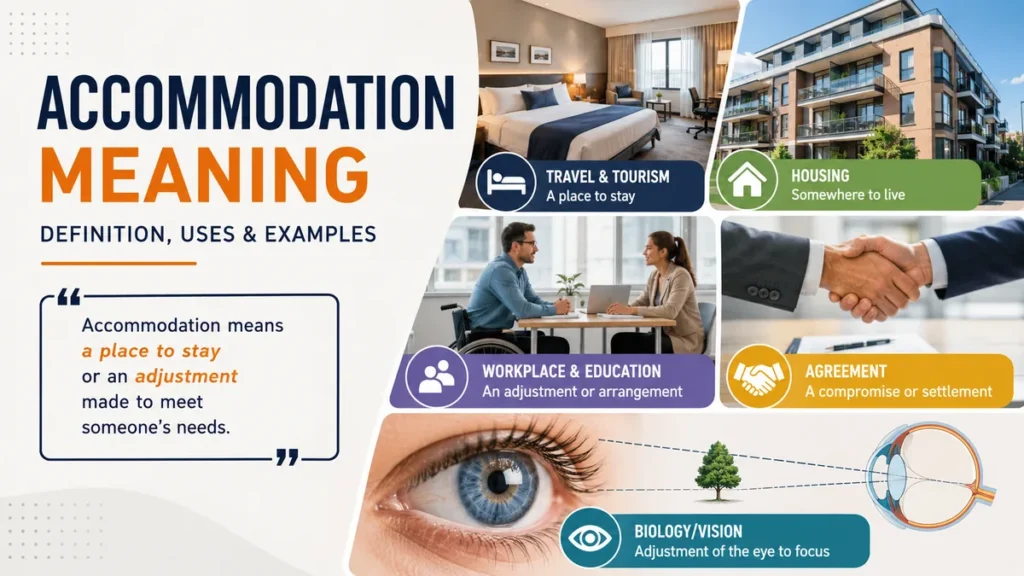
Accommodation usually means a place to stay or an adjustment made to meet someone’s needs. In travel and housing, it refers to lodging. In workplaces and education, it can describe changes that help someone participate effectively. In formal contexts, it can also mean compromise or adaptation.
What Is the accommodation meaning in Simple English?
In everyday English, accommodation most often means a place where someone can live or stay.
For example:
- “We need accommodation for three nights in London.”
- “The university provides accommodation for students.”
- “Our accommodation was close to the beach.”
- “The company arranged temporary accommodation for its employees.”
Depending on the situation, the place could be a hotel, hostel, apartment, house, guesthouse, dormitory, cabin, rented room, or another form of lodging.
Major English dictionaries also recognize broader meanings involving convenience, adaptation, settlement, and adjustment. Merriam-Webster, for example, includes lodging and related services as well as adaptation, reconciliation of differences, and adjustment of the eye among its definitions.
Accommodation at a glance
| Context | What accommodation means | Simple example |
|---|---|---|
| Travel | A place to stay | A hotel room |
| Housing | Somewhere to live | A rented apartment |
| University | Student housing or adjustments | A dormitory or exam adjustment |
| Workplace | A change made to meet a need | Modified work arrangements |
| Negotiation | Compromise or agreement | Two sides reaching a settlement |
| Biology | Adjustment of the eye | Focusing on near and distant objects |
| General use | Adaptation or convenience | Changing an arrangement for someone |
The correct interpretation normally becomes obvious from the words surrounding it.
accommodation meaning in Travel and Tourism
Travel is probably the context in which most people encounter the word.
Here, accommodation means a place where travelers stay temporarily.
Common types of travel accommodation include:
- Hotels
- Motels
- Hostels
- Resorts
- Guesthouses
- Bed and breakfasts
- Holiday homes
- Serviced apartments
- Vacation rentals
- Cabins
- Campsites
Collins defines the British-English travel sense as buildings or rooms where people live or stay. Oxford similarly describes the North American plural accommodations as somewhere to live or stay, sometimes with food or other services.
What does accommodation mean when booking a holiday?
If a holiday package says:
“Flights and accommodation included.”
It means the price includes transportation by air and somewhere to stay.
It does not necessarily mean meals, airport transfers, activities, or other services are included. Those depend on the individual booking.
Similarly:
“Accommodation not included”
means you will need to arrange and usually pay separately for your lodging.
Does accommodation mean hotel?
Not necessarily.
A hotel is one type of accommodation, while accommodation is the broader concept.
Think of it this way:
Accommodation → Hotel, hostel, apartment, guesthouse, resort, holiday home, etc.
So you can say:
“Hotel accommodation is available.”
But accommodation itself does not automatically mean a hotel.
What is overnight accommodation?
Overnight accommodation simply means somewhere suitable for staying for one or more nights.
For example:
“The conference organizer will arrange overnight accommodation for speakers.”
The speakers may be given hotel rooms, guest rooms, apartments, or another suitable place to sleep.
Merriam-Webster specifically recognizes lodging, food, services, and traveling space among uses associated with accommodations.
accommodation meaning in Housing
Accommodation is also used for places where people live for longer periods.
Examples include:
- Private housing
- Rented apartments
- Shared houses
- Temporary housing
- Social housing
- Student residences
- Employer-provided housing
Consider this sentence:
“Finding affordable accommodation in the city can be difficult.”
Here, accommodation means somewhere suitable to live.
The person may be searching for a room, flat, apartment, or house rather than a hotel.
Temporary accommodation
Temporary accommodation means housing provided or used for a limited period.
Someone might need it while:
- Moving between homes
- Studying away from home
- Working temporarily in another city
- Waiting for permanent housing
- Having a home repaired
- Traveling for an extended period
The exact form can vary considerably. Temporary accommodation could be a hotel for several nights or an apartment used for several months.
Student accommodation
Student accommodation means housing intended for students.
Typical examples are:
- University halls of residence
- Dormitories
- Shared student houses
- Private student apartments
- Rooms rented from private landlords
When a university says it “offers accommodation,” it normally means that students can apply for somewhere to live during their studies.
Quick takeaway: In travel, accommodation generally means temporary lodging. In housing and education, it can mean a place where someone lives for a longer period.
accommodation meaning as an Adjustment or Special Arrangement
Accommodation has another important meaning that has little to do with hotels or housing.
It can mean an adjustment, adaptation, or arrangement made to meet a particular person’s needs.
Merriam-Webster includes providing something needed for convenience and making an adaptation or adjustment within its definitions of accommodation.
For example:
“The schedule was changed as an accommodation to the client.”
Here, nobody is being given a hotel room. The schedule is being adjusted to make things more convenient or workable.
This meaning frequently appears in education and employment.
Accommodation in education
In an educational setting, an accommodation can be an adjustment to the way a student accesses learning, instruction, assessment, or the educational environment.
Depending on the situation and applicable rules, examples might involve:
- Additional time for an assessment
- Accessible learning materials
- Assistive technology
- Alternative formats
- Changes to the physical environment
- Adjustments to how information is presented
The basic idea remains the same: something is adjusted to address a particular need.
Accommodation in the workplace
Workplace accommodation similarly refers to adjustments to working conditions, practices, facilities, or arrangements to address an employee’s needs.
The exact meaning and legal requirements depend on the country, jurisdiction, employer, and circumstances.
That distinction matters. The everyday dictionary meaning explains what the word means, while employment law determines when a particular accommodation is required and what form it must take.
accommodation meaning as an Agreement or Compromise
Accommodation also has a formal meaning: an agreement or compromise between people or groups with different positions.
Oxford describes this sense as an arrangement acceptable to people or groups with different opinions, while Collins associates it with adjustment, settlement, or reconciliation.
For example:
“The two groups eventually reached an accommodation.”
This means they found an arrangement they could both accept.
Similar words in this context include:
- Agreement
- Compromise
- Settlement
- Reconciliation
- Adjustment
- Arrangement
You may encounter this meaning in discussions about politics, diplomacy, business negotiations, or disputes.
“Reach an accommodation” meaning
The expression “reach an accommodation” usually means to arrive at a compromise or mutually acceptable arrangement.
For example:
“Management and employees reached an accommodation over the new working hours.”
It does not mean that they found somewhere to stay.
Context changes everything.
accommodation meaning in Biology and Vision
There is also a specialized biological meaning of accommodation.
In vision, accommodation is the process by which the eye adjusts its focus so that objects at different distances can be seen clearly.
Oxford describes it as the way the lens becomes flatter or thicker to create a clear image of the object being viewed. Merriam-Webster similarly describes accommodation as automatic adjustment of the eye for viewing objects at different distances, chiefly through changes in the crystalline lens.
Imagine looking at a distant road sign and then immediately looking at a book in your hands. Your visual system needs to adjust its focus.
That focusing process is called accommodation.
This technical definition is mainly encountered in:
- Biology
- Anatomy
- Ophthalmology
- Optometry
- Vision science
So if you see “accommodation of the eye,” the term has nothing to do with housing.
Accommodation vs. Accommodations
One of the most common sources of confusion is whether to use accommodation or accommodations.
The answer often depends on the variety of English being used.
British English: accommodation
In British English, accommodation is normally an uncountable noun when referring to somewhere to live or stay.
Cambridge specifically notes this grammatical treatment and warns against using an indefinite article with the word in this sense.
Natural British-English examples include:
Correct: “We found accommodation near the station.”
Correct: “They provide student accommodation.”
A common learner mistake is:
Less natural in standard British English: “We found an accommodation.”
If you want to refer to one individual place, use a countable expression such as:
- A hotel
- A room
- An apartment
- A house
- A place to stay
Cambridge gives comparable countable alternatives such as a house, flat, place to live, or place to stay.
American English: accommodations
American English commonly uses the plural accommodations when referring to lodging.
For example:
“The package includes flights and accommodations.”
Oxford identifies accommodations as the North American form for somewhere to live or stay, while Collins likewise notes the regional difference between British accommodation and American accommodations.
| British English | American English |
| We need accommodation. | We need accommodations. |
| Hotel accommodation is included. | Hotel accommodations are included. |
| They arranged overnight accommodation. | They arranged overnight accommodations. |
Neither variety is inherently better. The appropriate form depends on your audience and style of English.
How Do You Pronounce Accommodation?
The pronunciation varies slightly between British and American English.
A useful simplified pronunciation is:
uh-kom-uh-DAY-shuhn
The strongest stress falls on DAY.
Merriam-Webster gives the American pronunciation as approximately ə-ˌkä-mə-ˈdā-shən, while Oxford’s American entry provides a comparable pronunciation.
Breaking the word into parts can make it easier:
ac + com + mo + da + tion
Say it slowly first:
ac-com-mo-da-tion
Then increase your speed until it sounds natural.
How Do You Spell Accommodation?
The correct spelling is:
accommodation
A very common mistake is dropping either a c or an m.
Remember:
a + cc + o + mm + odation
So the word contains:
- Two c’s
- Two m’s
Cambridge specifically highlights this spelling point: accommodation is written with cc and mm.
Common incorrect spellings include:
- accomodation
- acommodation
- accomadation
- accomodation
A useful memory trick is:
Accommodation has room for two c’s and two m’s.
That fits the meaning rather nicely: accommodation has enough “room” for both pairs of letters.
Accommodation Synonyms and Related Words
The best synonym depends on what accommodation means in the sentence.
When talking about somewhere to stay
Possible alternatives include:
- Lodging
- Housing
- Residence
- Quarters
- Shelter
- Room
- Place to stay
Merriam-Webster lists lodging as a direct synonym, while Collins includes terms such as housing, homes, houses, board, space, and room for particular senses.
When talking about adjustment
Possible words include:
- Adaptation
- Adjustment
- Modification
- Arrangement
When talking about disagreement
Possible alternatives include:
- Compromise
- Settlement
- Agreement
- Reconciliation
These words are not interchangeable in every sentence.
For example:
“We booked lodging for the weekend.”
works naturally.
But:
“The two governments reached lodging.”
does not.
In that context, agreement, settlement, or accommodation would make sense.
Accommodation vs. Lodging
Accommodation and lodging can both describe somewhere to stay, but they are not always identical.
Lodging is strongly associated with a place to sleep or stay temporarily.
Accommodation is broader because it can refer to lodging but also to adjustments, compromises, facilities, and biological adaptation.
For example:
“We need lodging for tonight.”
The meaning is clearly somewhere to sleep.
“The university made an accommodation for the student.”
Here, accommodation refers to an adjustment rather than housing.
So lodging can often replace accommodation in travel contexts, but not in every context.
Common Accommodation Phrases and What They Mean
Learning the word through common combinations makes it much easier to understand.
Hotel accommodation
Rooms or lodging provided by a hotel.
Example: “Hotel accommodation is included in the tour.”
Holiday accommodation
A place used while someone is on vacation, such as a hotel, apartment, resort, or holiday home.
Example: “Holiday accommodation becomes expensive during peak season.”
Self-catering accommodation
A place to stay where guests have facilities to prepare their own meals.
This could be an apartment, cottage, villa, or another property with cooking facilities.
Shared accommodation
Housing where two or more people share some living facilities.
For example, residents might have private bedrooms but share a kitchen, bathroom, or living room.
Private accommodation
Housing or lodging intended for private use rather than shared living.
The exact meaning depends on context.
Suitable accommodation
A place considered appropriate for someone’s circumstances or requirements.
Example: “They searched for suitable accommodation near the campus.”
Affordable accommodation
Housing or lodging that is reasonably priced relative to a person’s budget or the context being discussed.
Accommodation costs
The amount spent on a place to live or stay.
Travel budgets often separate:
- Transportation costs
- Accommodation costs
- Food costs
- Activity costs
Accommodation facilities
This phrase may describe lodging facilities themselves or the amenities and services associated with a place.
The precise meaning depends on the sentence.
Examples of Accommodation in Sentences
Seeing the different meanings side by side makes the distinctions clearer.
Travel
“We booked our accommodation three months before the trip.”
Meaning: A place to stay.
Housing
“The family is looking for affordable accommodation near the city center.”
Meaning: Somewhere to live.
University
“First-year students can apply for university accommodation.”
Meaning: Student housing.
Adjustment
“The organization changed the timetable as an accommodation to participants.”
Meaning: An adjustment made for convenience or need.
Agreement
“After several meetings, both sides reached an accommodation.”
Meaning: A compromise or acceptable agreement.
Vision
“Accommodation allows the eye to focus at different distances.”
Meaning: Adjustment of the eye’s focusing system.
The surrounding words—such as hotel, student, workplace, agreement, eye, temporary, or overnight—usually reveal which definition is intended.
What Is the Difference Between Accommodation and Amenities?
These two travel terms are sometimes confused.
Accommodation is the place where you stay.
Amenities are features or services available at that place.
For example, a hotel is accommodation. Its amenities might include:
- Wi-Fi
- Swimming pool
- Gym
- Parking
- Breakfast
- Room service
- Laundry facilities
So if someone asks:
“What accommodation is available?”
they are generally asking about places to stay.
If they ask:
“What amenities are available?”
they want to know about the facilities and services.
Is Food Included in Accommodation?
Not automatically.
Accommodation primarily refers to the place or arrangement for staying. Food may be included depending on the booking or service.
Common arrangements include:
| Arrangement | Typical meaning |
| Room only | Accommodation without meals |
| Bed and breakfast | Accommodation plus breakfast |
| Half board | Accommodation plus selected meals, commonly breakfast and dinner |
| Full board | Accommodation plus the main daily meals |
| Self-catering | Accommodation with facilities to prepare your own food |
Always check the specific terms of a booking rather than assuming that “accommodation included” means meals are included.
Why Does Accommodation Have So Many Meanings?
The different meanings make more sense when you look at the word’s history.
Merriam-Webster traces accommodation through Middle French to Latin accommodatio, associated with fitting, adapting, or accommodating. It records the word’s first known English use in 1603. Oxford likewise traces it to Latin accommodare, meaning essentially to fit one thing to another.
That underlying idea of fitting or adapting something to a need connects the modern definitions.
A hotel accommodates a traveler by giving them somewhere to stay.
A workplace accommodation adjusts conditions to a need.
A compromise accommodates different viewpoints.
The eye accommodates different viewing distances by adjusting its focus.
The meanings may initially seem unrelated, but they all share the idea of adjustment, suitability, or meeting a need.
Understanding accommodation meaning From Context
The easiest way to determine accommodation meaning is to look at the situation in which the word appears.
If the conversation is about travel, hotels, holidays, university housing, or renting, accommodation probably means somewhere to stay or live.
If the conversation is about work or education, it may mean an adjustment or arrangement made to address someone’s needs.
If people are negotiating or resolving a disagreement, accommodation may mean compromise or settlement.
If the subject is eyes or vision, accommodation refers to the eye’s focusing adjustment.
For most everyday conversations, though, the simplest definition is enough: accommodation is a place to live or stay. Remember the context, the British-English and American-English grammar difference, and the double c plus double m, and you will be able to understand and use the word confidently.