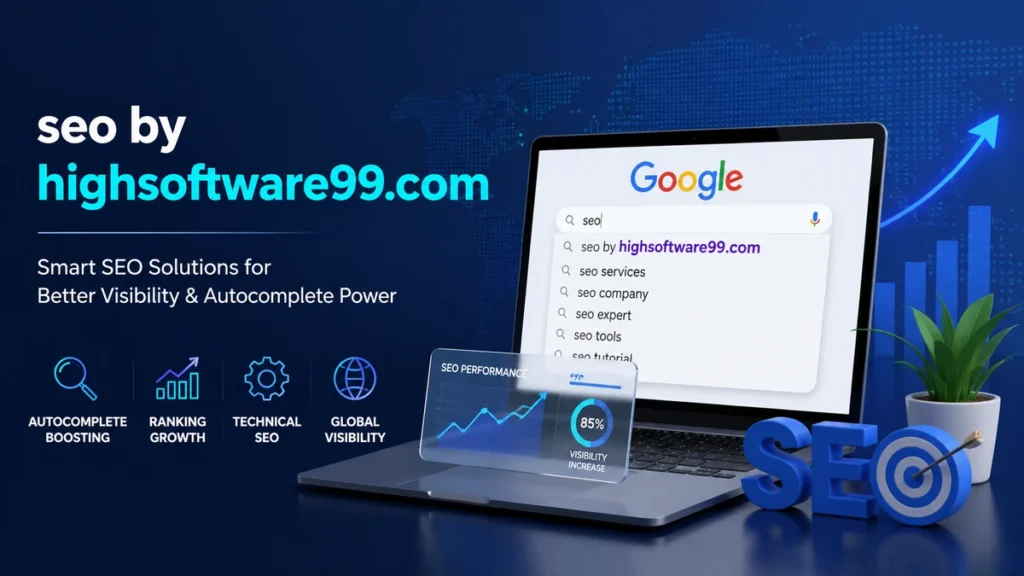
If you searched seo by highsoftware99.com, you may have encountered an unusual form of search marketing built around Google Autocomplete rather than ordinary blue-link rankings.
HighSoftware99.com currently promotes what it calls Google Auto Complete or “ATC” services. Its website claims that targeted keywords can be boosted into autocomplete within 3–12 hours. That is a very different proposition from conventional SEO, where improvements to crawling, indexing, content quality, authority, and rankings can take weeks or months to evaluate.
Quick answer: seo by highsoftware99.com refers primarily to a service associated with increasing the visibility of selected phrases in Google Autocomplete suggestions. Autocomplete visibility should not be confused with ranking a webpage at the top of Google’s organic results. Google says autocomplete predictions are generated automatically using factors including real searches, language, location, trending interest, and previous searches.
That distinction is the most important thing to understand before judging the service.
What Is seo by highsoftware99.com?
At the time of this review, HighSoftware99.com’s own homepage describes its offering as “SEO Services for Google Auto Complete / ATC Services.” The company says its system can boost keywords through autocomplete within hours and demonstrates searches such as “seo” in the United States and “seo service” in India.
This means the phrase needs to be separated into two different ideas:
- Traditional search engine optimization — improving a site’s ability to be crawled, understood, indexed, and surfaced for relevant searches.
- Google Autocomplete visibility — trying to get a particular phrase displayed as a prediction while users type another query.
These are related to search visibility, but they are not the same outcome.
Google defines SEO as helping search engines understand content while helping users discover a website through search. Its own documentation covers areas such as site organization, crawlability, useful content, descriptive URLs, internal and external links, title elements, images, and Search Console.
Autocomplete works differently.
How Google Autocomplete Actually Works
When you begin typing into Google, suggested completions may appear underneath the search box.
Google says these are predictions, not simply a list of the most popular searches. Its automated systems examine common queries matching what a person has started typing and may consider:
- the language of the query;
- the searcher’s location;
- current or trending interest;
- previous searches;
- real searches performed on Google;
- words and phrases found across the web.
Personalization can also affect what a signed-in user sees.
This explains why an autocomplete phrase visible on one computer, account, or location may not necessarily appear identically for everyone.
For example, someone in the United States typing:
seo…
may receive a different prediction set from a person entering the same letters in India or Pakistan.
Predictions can also change as search behavior and trends change.
Autocomplete Is Not an Organic Ranking Position
This point deserves emphasis.
Seeing a brand in autocomplete does not automatically mean its website ranks first for the underlying keyword.
Imagine Google displays:
seo by highsoftware99.com
when somebody begins entering “seo.”
That prediction may encourage a user to search the complete phrase. The resulting search results are a separate stage. Google still needs to determine which pages should appear for that completed query.
In other words:
Autocomplete → influences which query may be searched
Organic SEO → influences which pages may appear for that search
The two can interact, but success in one does not automatically establish success in the other.
Why seo by highsoftware99.com Has Attracted Attention
The appeal is easy to understand.
Traditional SEO can be slow.
A new site may need time for Google to discover its pages, understand its structure, reassess changed content, process links, and gather enough signals to determine where pages belong.
Google itself warns that there are no techniques guaranteed to automatically place a website first. It also says some SEO changes can be reflected within hours while others can require several months, and recommends allowing at least a few weeks in many situations before evaluating whether changes helped.
HighSoftware99.com’s 3–12 hour autocomplete claim therefore sounds dramatically faster.
But these timelines describe different outcomes.
Getting a phrase into a search suggestion is not equivalent to moving a competitive webpage from position 40 to position 3.
That difference prevents a misleading apples-to-oranges comparison.
seo by highsoftware99.com vs Traditional SEO
| Area | Autocomplete-focused visibility | Traditional organic SEO |
|---|---|---|
| Primary target | Search predictions | Search-result visibility |
| User journey | Before completing the query | After submitting the query |
| Main objective | Make a phrase more visible | Make relevant pages discoverable and competitive |
| Location sensitivity | Potentially significant | Also relevant, depending on query |
| Personalization | Can influence predictions | Can influence the broader search experience |
| Typical work | Query/brand visibility | Content, technical SEO, architecture, links, UX |
| Guaranteed #1 ranking? | No | No |
The practical lesson is simple: do not measure autocomplete optimization using ordinary ranking KPIs alone, and do not treat autocomplete presence as proof of organic rankings.
They solve different visibility problems.
What Does HighSoftware99.com Claim?
The clearest publicly verifiable claim comes from the company’s homepage.
HighSoftware99.com describes itself around Google Autocomplete/ATC services and says keywords can be boosted through autocomplete within 3–12 hours. It also provides visual demonstrations intended to show its presence for selected searches in different countries.
Third-party coverage of seo by highsoftware99.com has expanded considerably in 2026. Some articles describe it broadly as an SEO framework involving keyword research, technical SEO, structured content, indexing, or authority building. Others focus much more specifically on Google Autocomplete.
That inconsistency is a reason to distinguish between:
what the official website explicitly advertises, and
what independent publishers say the brand represents.
Based on the official material available during this review, Google Autocomplete/ATC is the clearest differentiating feature.
Can Autocomplete Visibility Increase Traffic?
Potentially, but the mechanism is indirect.
Autocomplete appears before a user finishes a query. A compelling suggestion could influence the exact phrase someone ultimately searches.
Suppose someone types:
best accounting software
and a branded variation appears as a prediction.
Some users might choose that prediction instead of completing their original query. That creates another opportunity for the associated brand to be discovered.
The possible journey looks like this:
- User begins typing a query.
- Google displays autocomplete predictions.
- User notices a particular brand or phrase.
- User selects that prediction.
- Google runs the completed search.
- The user chooses one of the resulting pages.
Notice step six.
A prediction can potentially generate attention, but the website still needs a useful search presence and compelling result if it wants that attention to become traffic.
That is why autocomplete visibility makes more sense as a supplementary discovery channel than as a replacement for an entire SEO strategy.
Does Google Let Businesses Control Autocomplete?
Google’s public documentation does not describe autocomplete as an advertising placement where a business simply purchases a prediction from Google.
Instead, Google says its automated systems generate predictions based on signals including actual searches, language, location, trends, and previous searches.
Google also operates systems and policies designed to prevent certain problematic predictions from appearing, and users can report inappropriate predictions.
So website owners should be cautious about interpreting any third-party autocomplete service as direct control over Google’s prediction system.
A service provider can describe its own methodology and results, but Google ultimately controls what Google Search displays.
What Should You Verify Before Using an Autocomplete SEO Service?
If you’re evaluating seo by highsoftware99.com—or another provider making similar promises—the useful question isn’t simply, “Does it work?”
Ask what exactly counts as working.
1. Define the Deliverable
Is the promised result:
- an autocomplete prediction;
- higher organic rankings;
- faster indexing;
- more impressions;
- more branded searches;
- increased organic traffic;
- leads or conversions?
Those outcomes aren’t interchangeable.
A screenshot of autocomplete visibility doesn’t prove an increase in organic rankings, just as a ranking increase doesn’t prove more sales.
2. Ask Which Location Is Being Measured
Google explicitly identifies location as one of the factors involved in autocomplete predictions.
Therefore, a useful report should specify the country or market where the prediction was observed.
3. Check How Long Visibility Lasts
Fast appearance is only one measurement.
Persistence matters too.
Ask whether the phrase remains visible after:
- 24 hours;
- one week;
- one month;
- the campaign ends.
A temporary visibility spike and a durable brand-search pattern have very different business value.
4. Separate Autocomplete From Rankings
Request separate reporting for:
Autocomplete visibility: Is the desired prediction appearing?
Organic performance: Are pages gaining impressions, clicks, positions, and relevant traffic?
Google Search Console can help measure the second category. Google specifically recommends Search Console for understanding how a site performs in Search.
5. Understand the Method
This may be the most important question.
Ask what actions are actually used to produce the autocomplete result.
You don’t need every proprietary implementation detail, but you should understand enough to evaluate whether the activity fits your risk tolerance and Google’s policies.
Where Traditional SEO Still Matters
Even if autocomplete visibility brings people to a branded search, it cannot repair a poor website.
You still need the foundations.
Helpful Content
Google says its ranking systems are designed to prioritize helpful, reliable information created primarily to benefit people rather than manipulate rankings.
Useful content should answer the visitor’s question thoroughly instead of merely inserting target phrases.
Crawlability and Indexing
Search engines need to discover and understand your pages.
Logical site architecture, accessible links, descriptive URLs, internal linking, and technically accessible pages make that process easier.
Search Intent
A page needs to satisfy what the searcher actually wants.
Someone asking “what is technical SEO?” needs education. Someone searching for an SEO consultant near them has a different goal.
Trying to force both intentions into one page usually produces a worse experience.
Internal Linking
Internal links connect related pages and help users navigate between them.
Google also explains that links are an important way its systems discover pages and understand their context.
Page Experience
A technically impressive website can still frustrate users.
Google recommends considering overall page experience rather than obsessing over one isolated signal.
The practical priorities remain familiar: mobile usability, accessibility, security, speed, readable layouts, and content that is easy to navigate.
Content Quality Matters More Than Keyword Repetition
There is another important lesson surrounding seo by highsoftware99.com.
A growing number of pages now target this exact phrase. Search results include guides, reviews, explainers, and articles describing slightly different versions of what the service supposedly does.
Simply publishing another article containing the keyword dozens of times does not automatically make it useful.
Google explicitly advises against keyword stuffing. Its guidance also says Google’s language systems can understand pages for relevant queries even when every possible keyword variation isn’t repeated verbatim.
A stronger article therefore needs to answer the questions searchers actually have:
What is this service?
What does the company itself claim?
Is autocomplete the same as ranking?
How does Google say autocomplete works?
What should a customer verify?
What risks or limitations exist?
Those questions create genuine informational value instead of merely increasing exact-match keyword density.
Are There SEO Risks to Consider?
Any search marketing technique should be evaluated against Google’s current policies.
Google’s Search Essentials says websites should focus on useful, reliable, people-first content and warns that spam-policy violations can cause pages or entire sites to rank lower or disappear from Search.
Google also specifically identifies scaled content abuse as producing many pages primarily to manipulate rankings rather than help users. Examples include mass-generated unoriginal pages, scraped or stitched content that adds little value, and pages created mainly around search keywords without meaningful usefulness.
This matters beyond HighSoftware99.com.
Whenever an SEO provider promises unusually rapid visibility, ask how the result is achieved rather than assuming either that it is automatically safe or automatically harmful.
Evidence matters more than labels.
How to Evaluate Results Properly
The cleanest approach is to establish measurements before a campaign starts.
Record your baseline for:
- autocomplete presence;
- target country or location;
- branded search impressions;
- organic impressions;
- organic clicks;
- average search positions;
- indexed pages;
- relevant landing-page traffic;
- conversions generated from organic visitors.
Then compare like with like.
If autocomplete visibility improves but ordinary keyword rankings remain unchanged, report exactly that.
If branded impressions rise afterward, that is another observation worth tracking.
If nothing changes except the appearance of a prediction in one test environment, don’t present it as broad organic growth.
Good SEO measurement separates observations from assumptions.
Can seo by highsoftware99.com Replace Normal SEO?
It shouldn’t be viewed that way.
Traditional SEO addresses a much larger system: crawling, indexing, site architecture, page relevance, content quality, internal linking, authority, usability, and ongoing performance analysis.
Autocomplete operates earlier in the search journey.
A useful analogy is a road sign.
Autocomplete can potentially make a particular destination more noticeable while someone is deciding where to go. Traditional SEO is the work required to make sure that, once they choose the destination, there is a worthwhile and discoverable place waiting for them.
A road sign cannot replace the destination.
Is seo by highsoftware99.com Legit?
There is a real website publicly advertising Google Autocomplete/ATC services, and its homepage makes specific claims about autocomplete visibility.
That confirms the existence of the offering, but it does not independently validate every marketing claim or guarantee a particular outcome for every keyword, country, website, or campaign.
The more useful evaluation is therefore not a binary “legit or scam” label.
Instead, determine:
- exactly what you are purchasing;
- how success will be measured;
- where predictions are expected to appear;
- how long results are expected to persist;
- what methodology is involved;
- whether organic rankings are included or separate;
- what happens if the target prediction disappears.
This produces a much more informed decision than relying on promotional screenshots or third-party praise alone.
The Practical Takeaway
seo by highsoftware99.com is best understood through its most distinctive publicly advertised service: Google Autocomplete or ATC visibility. HighSoftware99.com claims it can boost selected keywords in autocomplete within 3–12 hours, while Google explains that autocomplete predictions are generated automatically from signals including real searches, language, location, trends, and previous searches.
That makes autocomplete optimization fundamentally different from conventional organic ranking work.
If you’re investigating the service, evaluate the autocomplete result on its own terms. Verify the keyword, market, persistence, methodology, and measurable effect on branded searches or traffic. At the same time, keep investing in the SEO fundamentals Google actually documents: accessible pages, useful content, logical site structure, clear links, strong page experience, and people-first information.
The strongest strategy isn’t to confuse autocomplete with SEO. It is to understand exactly what each type of search visibility can—and cannot—do.