The U.S. Constitution protects many freedoms, but one of its least discussed provisions addresses something surprisingly specific: whether the government can force people to house soldiers in their homes.
The 3rd amendment protects Americans against the forced quartering of soldiers in private homes. Ratified in 1791 as part of the Bill of Rights, it prohibits housing soldiers in someone’s home during peacetime without the owner’s consent and restricts quartering during wartime to circumstances authorized by law.
Although the amendment rarely appears in modern court cases, it reflects an enduring constitutional principle: military authority has limits, and private homes deserve protection from unwanted government intrusion.
What Is the 3rd amendment?
The Third Amendment to the United States Constitution limits the government’s authority to station soldiers in privately owned homes.
Its primary purpose is to prevent military personnel from occupying a person’s residence without permission, particularly during peacetime.
Exact text of the Third Amendment
The amendment states:
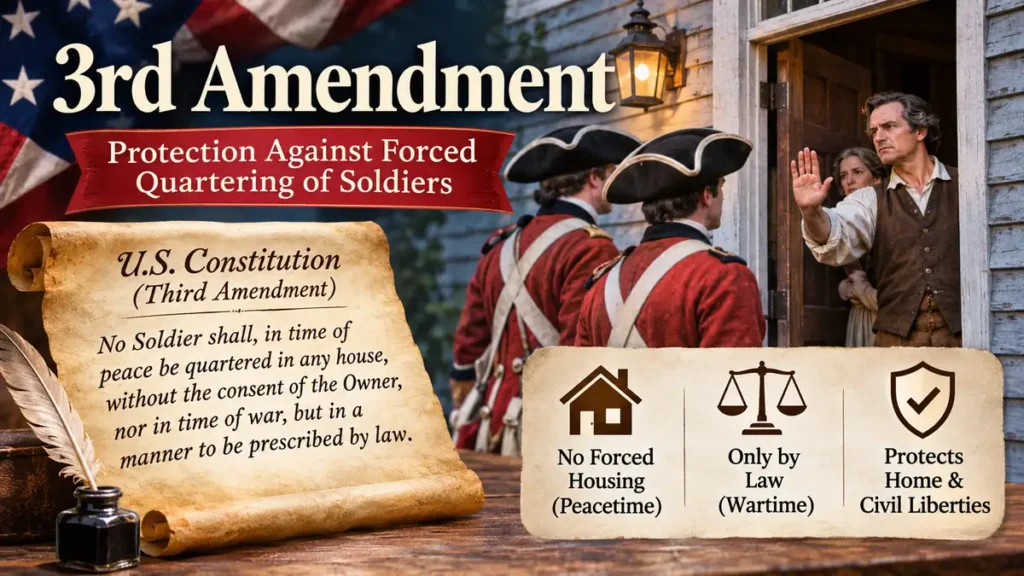
No Soldier shall, in time of peace be quartered in any house, without the consent of the Owner, nor in time of war, but in a manner to be prescribed by law.
This language establishes two distinct protections.
- During peacetime: Soldiers cannot be quartered in a home without the owner’s consent.
- During wartime: Soldiers may be quartered only in a manner established by law.
The distinction matters because the Constitution does not impose an absolute prohibition on military quartering under every circumstance. Instead, it creates a strict peacetime rule and a separate legal requirement for wartime.
What does quartering soldiers mean?
Quartering means providing lodging or accommodation to military personnel.
Historically, quartering could involve requiring civilians to accommodate soldiers in their houses or other buildings. The practice sometimes involved supplying food, bedding, heating, or other necessities, depending on the governing law.
The Third Amendment specifically addresses the quartering of soldiers in houses. It does not establish a general constitutional right to refuse every form of military-related government activity.
Why Was the 3rd amendment Created?
The Third Amendment originated in colonial Americans’ experiences with British military policies before the American Revolution.
British authorities maintained troops in North America, and Parliament enacted laws governing where those troops could be accommodated and how colonial governments would support them.
These policies contributed to tensions between the colonies and Great Britain.
The Quartering Acts of 1765 and 1774
The Quartering Act of 1765 required colonial authorities to provide accommodations and supplies for British soldiers under specified circumstances.
The law primarily addressed barracks and other available accommodations rather than granting a general right to occupy inhabited private homes.
When barracks were insufficient, colonial authorities were expected to arrange alternative lodging in places such as inns, alehouses, and certain other buildings.
The Quartering Act of 1774 expanded the authority to arrange military accommodations in the Massachusetts colony, including the use of certain uninhabited buildings.
It became one of the measures colonists associated with Parliament’s increasingly coercive policies.
| Historical event | Significance |
|---|---|
| Quartering Act of 1765 | Required colonial authorities to arrange accommodations and supplies for British troops |
| Boston Massacre, 1770 | Intensified colonial hostility toward the presence of British troops |
| Quartering Act of 1774 | Expanded quartering arrangements in Massachusetts |
| Declaration of Independence, 1776 | Listed grievances against King George III, including quartering troops |
| Constitutional Convention, 1787 | Created the framework for the federal government |
| Bill of Rights, 1791 | Established explicit constitutional protection against forced military quartering |
Colonial resistance to British troops
Many colonists considered the presence of British troops during peacetime a threat to civilian liberty.
Their concerns extended beyond accommodation costs. They feared that a permanent military presence could be used to enforce unpopular laws and intimidate communities.
The Declaration of Independence specifically criticized King George III for:
For Quartering large bodies of armed troops among us
The grievance reflected broader objections to military power operating without sufficient civilian accountability.
James Madison and the Bill of Rights
After the Constitution was drafted in 1787, critics argued that it needed clearer protections for individual rights.
James Madison introduced proposed constitutional amendments in 1789, drawing on state declarations of rights and recommendations from state ratifying conventions.
The states ratified ten amendments on December 15, 1791. Together, these became known as the Bill of Rights.
The Third Amendment was included to ensure that the federal government could not revive the kind of forced military accommodation associated with British colonial rule.
What Rights Does the 3rd amendment Protect?
The Third Amendment establishes a specific constitutional restriction on government power rather than a broad, unrestricted right to residential privacy.
Its protections are nevertheless closely connected to the principle that a person’s home should be secure against certain forms of government interference.
1. Protection against forced military housing
During peacetime, the government cannot require an owner to accommodate soldiers in a house without consent.
For example, suppose military officials wanted to place active-duty soldiers in privately owned houses because nearby barracks were overcrowded.
The Third Amendment would prevent officials from compelling homeowners to provide that accommodation during peacetime without their permission.
2. The right to refuse consent during peacetime
The amendment expressly recognizes the owner’s consent as the condition for quartering soldiers in a house during peacetime.
An owner can voluntarily agree to accommodate military personnel, but the government cannot simply substitute its own preference for the owner’s permission.
The constitutional text does not specify a particular form of consent, and the courts have developed relatively little case law addressing such questions.
3. Legal restrictions during wartime
Wartime does not eliminate the Third Amendment.
Instead, the Constitution requires that any quartering of soldiers occur according to a manner prescribed by law.
This means military officials cannot rely solely on their own authority to impose quartering arrangements.
The precise constitutional limits of wartime quartering remain largely untested in modern federal courts.
4. Limits on military authority over civilian homes
The amendment reflects a distinction between civilian life and military power.
Its historical purpose was to prevent government authorities from using the armed forces to impose unwanted lodging obligations on civilians.
That principle helps explain why the amendment remains relevant to discussions of constitutional government, even though direct quartering disputes are unusual.
How Does the 3rd amendment Work in Real Life?
The easiest way to understand the amendment is to examine situations involving military lodging.
| Situation | Third Amendment implications |
|---|---|
| Soldiers demand lodging in a homeowner’s house during peacetime without permission | Prohibited by the amendment |
| A homeowner voluntarily allows soldiers to stay | Generally consistent with the consent requirement |
| Military officials seek to quarter soldiers in houses during wartime | Must follow a manner prescribed by law |
| Soldiers stay in government-owned military barracks | Ordinarily outside the amendment’s prohibition |
| A civilian rents a room to an individual service member voluntarily | Not forced quartering |
| Police officers enter a house during an investigation | Usually analyzed under other constitutional provisions, particularly the Fourth Amendment |
Does the Third Amendment apply to renters?
The text specifically refers to the consent of the “Owner,” but modern constitutional litigation has raised questions about whether tenants and other lawful occupants can invoke its protections.
In Engblom v. Carey, the U.S. Court of Appeals for the Second Circuit recognized that certain tenants could have sufficient possessory interests to receive Third Amendment protection.
The decision does not mean every occupant automatically qualifies. The legal analysis depends on the nature of the person’s property or occupancy rights.
Can the government force soldiers into hotels?
The Third Amendment refers to quartering soldiers in a “house.”
Whether its protection extends to particular commercial accommodations depends on the circumstances and unresolved questions about the amendment’s scope.
It would therefore be inaccurate to assume that every hotel, business property, or temporary lodging arrangement receives exactly the same protection as an occupied private residence.
Important 3rd amendment Court Cases
The Third Amendment has generated far less litigation than the First, Fourth, Fifth, or Fourteenth Amendments.
Nevertheless, a small number of decisions help explain its constitutional significance.
Engblom v. Carey (1982)
Engblom v. Carey, 677 F.2d 957 (2d Cir. 1982), is one of the most important federal appellate decisions interpreting the Third Amendment.
The dispute arose during a 1979 strike by correction officers in New York.
National Guard members were deployed to maintain prison operations, and some were housed in residences normally occupied by correction officers.
Two officers challenged the use of their employee housing.
The Second Circuit addressed several important constitutional questions.
First, it concluded that National Guard members could qualify as soldiers for Third Amendment purposes.
Second, it held that the amendment applies to state governments through the Fourteenth Amendment.
Third, it recognized that a person with a sufficient legal interest in a residence may be protected even without holding full ownership title.
The court did not ultimately establish that the defendants were liable for violating the amendment. The case was remanded for further proceedings, and qualified-immunity considerations limited the plaintiffs’ claims.
Why it matters: The decision shows that the Third Amendment is not necessarily confined to eighteenth-century disputes or traditional homeowners.
Griswold v. Connecticut (1965)
Griswold v. Connecticut, 381 U.S. 479 (1965), concerned a Connecticut law restricting contraception.
The Supreme Court invalidated the law and recognized constitutional protection for marital privacy.
In the majority opinion, Justice William O. Douglas discussed several constitutional provisions that help establish zones of privacy.
The Third Amendment was among the provisions mentioned.
However, Griswold was not a forced-quartering case, and the Supreme Court did not hold that the Third Amendment independently establishes a general right to privacy.
Why it matters: The case illustrates how the amendment has contributed to broader constitutional reasoning about privacy and the home.
Mitchell v. City of Henderson (2015)
In Mitchell v. City of Henderson, a federal district court in Nevada considered a Third Amendment argument arising from police officers’ use of a private residence during an investigation.
The court rejected the claim, concluding that municipal police officers were not soldiers within the meaning of the Third Amendment.
The case highlights an important distinction: government officers and military personnel are not automatically interchangeable for constitutional purposes.
Claims involving police entry into a residence generally raise different legal questions, especially under the Fourth Amendment.
How Is the 3rd amendment Different From the 4th amendment?
Both amendments concern protections associated with the home, but they regulate different kinds of government conduct.
3rd amendment
Military quartering
Protects against involuntary lodging of soldiers in houses during peacetime and restricts wartime quartering.
4th amendment
Searches and seizures
Protects against unreasonable government searches and seizures of persons, houses, papers, and effects.
The Fourth Amendment is frequently involved in cases concerning police searches, warrants, arrests, electronic surveillance, and evidence collection.
The Third Amendment is much narrower. Its central concern is whether soldiers may be quartered in a house.
For example, if police enter a residence without a warrant, the Fourth Amendment may be relevant. If military officials require an owner to accommodate soldiers during peacetime without consent, the Third Amendment directly addresses that conduct.
The two amendments share historical concerns about governmental intrusion but provide distinct legal protections.
Why Is the 3rd amendment Rarely Used Today?
The Third Amendment is frequently described as one of the least litigated provisions of the Bill of Rights.
The main reason is that the historical practice it was designed to prevent is no longer a routine feature of American military organization.
Modern armed forces generally use military installations, barracks, bases, and other formally arranged accommodations.
Consequently, disputes involving forced quartering in private homes are exceptionally uncommon.
Has the Supreme Court ever ruled on the Third Amendment?
The U.S. Supreme Court has never decided a case directly based on an alleged violation of the Third Amendment.
The Court has referred to the provision in opinions involving privacy and the relationship between military and civilian authority, but it has not developed a comprehensive body of Third Amendment doctrine.
The Constitution Annotated, published through the Library of Congress’s constitutional research resources, identifies Engblom v. Carey as the principal modern case involving substantial judicial interpretation. LII / Legal Information Institute+1
Is the Third Amendment still legally enforceable?
Yes. The Third Amendment remains part of the Constitution and has not been repealed.
The rarity of lawsuits does not make a constitutional provision invalid.
However, the absence of extensive Supreme Court precedent means that some questions about its application remain unresolved.
For instance, courts have not comprehensively determined how the amendment would apply to every possible military emergency, property arrangement, or wartime housing situation.
Does the 3rd amendment Apply to the National Guard?
The National Guard presents an interesting constitutional question because its members can serve in different legal capacities.
National Guard personnel may operate under state authority or be called into federal service.
In Engblom v. Carey, the Second Circuit concluded that National Guard members deployed during the New York correction officers’ strike could qualify as soldiers under the Third Amendment.
This was significant because the amendment does not expressly define the word “Soldier.”
The decision indicates that the protection is not necessarily limited to regular active-duty Army personnel.
However, the exact application of the amendment depends on the legal status of the personnel, the nature of the accommodation, and the circumstances involved.
Does it apply to police officers?
Ordinary civilian police officers are not generally considered soldiers for purposes of the Third Amendment.
In Mitchell v. City of Henderson, the federal district court rejected an attempt to apply the amendment to municipal police officers occupying a home during an investigation.
The court distinguished civilian law enforcement from the military. Practical Law+1
This does not mean police can enter or occupy private property without legal restrictions. Their conduct may be governed by the Fourth Amendment and other applicable laws.
Questions involving military personnel performing domestic law-enforcement functions can be more complicated and remain an area of constitutional discussion.
Why Does the 3rd amendment Still Matter?
The amendment’s importance extends beyond the likelihood that someone will experience forced military quartering.
It preserves a constitutional safeguard developed in response to a specific historical abuse.
Protection of domestic privacy
The home occupies a special place in American constitutional law.
Although the Third Amendment addresses a narrow form of government intrusion, it reinforces the idea that private residences deserve protection against certain exercises of state power.
In Griswold v. Connecticut, the Supreme Court included the Third Amendment among constitutional provisions relevant to its discussion of privacy.
That connection does not transform the amendment into a general privacy guarantee, but it demonstrates its broader constitutional significance.
Civilian control over the military
The Founders were deeply concerned about the potential misuse of standing armies.
Their experiences under British rule shaped constitutional restrictions intended to prevent military power from overriding civilian rights.
The Third Amendment reflects this concern by limiting one particular way in which military authority could intrude into civilian life.
Constitutional protections during emergencies
Natural disasters, civil unrest, and national emergencies sometimes require military assistance.
The National Guard may support emergency response operations, while federal troops may perform authorized duties under applicable law.
Such deployments do not automatically create Third Amendment violations.
The relevant question is whether soldiers are being quartered in houses under circumstances prohibited by the constitutional text.
The amendment remains a potential safeguard if military accommodation practices ever conflict with those restrictions.
The significance of rarely invoked rights
A constitutional right does not have to produce frequent lawsuits to remain meaningful.
Some legal protections operate primarily by establishing boundaries that government officials generally respect.
The Third Amendment illustrates this principle particularly well.
Its original purpose was to prevent a specific form of governmental coercion, and its continued presence in the Constitution preserves that restriction.
Common Misunderstandings About the 3rd amendment
Because the amendment is short and rarely discussed, several misconceptions persist.
Misunderstanding: It prohibits all military activity on private property
The amendment specifically concerns the quartering of soldiers in houses.
It does not independently prohibit every military operation, temporary presence, or activity involving private land.
Other constitutional provisions and laws may regulate those situations.
Misunderstanding: It applies only to homeowners
Although the text uses the word “Owner,” Engblom v. Carey recognized that certain tenants may also have protected interests.
The legal question is not necessarily limited to whose name appears on a property deed.
Misunderstanding: Soldiers can never be housed in private homes
The amendment permits peacetime quartering with the owner’s consent.
During wartime, it requires quartering to follow a manner prescribed by law.
Therefore, it is not an absolute prohibition on all military lodging in residential property.
Misunderstanding: The Third Amendment no longer exists
The amendment remains part of the Bill of Rights.
Its infrequent appearance in litigation reflects the unusual nature of modern quartering disputes, not its removal from the Constitution.
Misunderstanding: It guarantees complete privacy inside the home
The Third Amendment provides a specific protection against military quartering.
Broader questions involving searches, surveillance, and government entry are primarily addressed through other constitutional provisions, especially the Fourth Amendment.
How to Remember the 3rd amendment
A simple way to remember the amendment is:
Third Amendment = No forced housing of soldiers in your home during peacetime.
For students studying American government, it helps to connect the first four amendments with their principal protections.
| Amendment | Main protection |
|---|---|
| First Amendment | Religion, speech, press, assembly, and petition |
| Second Amendment | Right to keep and bear arms |
| Third Amendment | Protection against forced quartering of soldiers |
| Fourth Amendment | Protection against unreasonable searches and seizures |
The Third Amendment can also be remembered through three historical connections: British quartering policies, colonial resistance, and the adoption of the Bill of Rights in 1791.
Those connections explain both what the amendment prohibits and why the Founders considered it necessary.
Final Thoughts on the 3rd amendment
The 3rd amendment is one of the shortest and least frequently litigated protections in the U.S. Constitution, but its historical significance remains substantial.
Created in response to colonial grievances about British military quartering, it protects owners against involuntary accommodation of soldiers during peacetime and requires lawful procedures for quartering during wartime.
Its importance also lies in the constitutional principles it represents: respect for private homes, limits on military authority, and protection of civilian liberty.
Understanding the Third Amendment offers a clearer picture of how the Bill of Rights emerged from specific historical experiences and continues to place limits on government power.