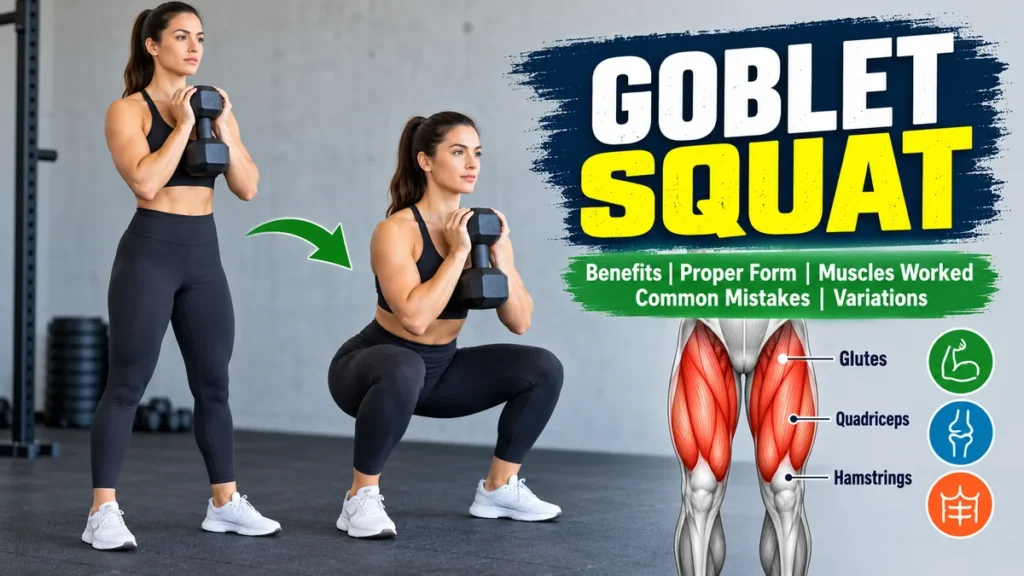
The goblet squat looks simple: hold a weight at your chest, bend your knees, and stand back up. Yet this straightforward exercise can reveal weaknesses in your balance, ankle mobility, core stability, and squatting technique.
It is one of the most accessible weighted squat variations for beginners, while remaining useful for experienced lifters who want to improve movement quality or add lower-body training volume.
The goblet squat is a lower-body strength exercise performed while holding a dumbbell or kettlebell vertically against your chest. It primarily trains the quadriceps and gluteal muscles while engaging the core and upper back to stabilize your torso. The movement helps develop leg strength, squat technique, coordination, and control.
Unlike a traditional barbell back squat, the weight sits in front of your body. This front-loaded position can make it easier to maintain an upright torso and learn a controlled squatting pattern.
What Is a Goblet Squat?
A goblet squat is a squat variation in which you hold a single weight close to your chest with both hands. The exercise gets its name from the way you hold the weight, similar to holding a large drinking goblet.
Strength coach Dan John is widely credited with popularizing the movement as a practical way to teach proper squatting mechanics.
You can perform goblet squats using a dumbbell, kettlebell, or another securely held weight. The movement involves flexing your hips, knees, and ankles to lower your body, then extending those joints to return to standing.
How Is It Different From a Regular Squat?
In a bodyweight squat, your arms may extend forward or remain near your chest. A goblet squat adds external resistance directly in front of your torso.
That positioning changes the balance demands of the exercise. The front-loaded weight can act as a counterbalance, helping some people squat more comfortably without leaning excessively forward.
However, goblet squats are not automatically easier than bodyweight squats. Holding the weight requires additional effort from your arms, shoulders, abdominal muscles, and upper back.
Why Is the Goblet Squat Popular?
The exercise requires relatively little equipment and can be performed in a gym or at home.
It also allows beginners to practice fundamental squat mechanics without immediately placing a loaded barbell across their shoulders.
For experienced lifters, goblet squats work well as a warm-up, accessory exercise, or controlled movement for developing lower-body endurance.
How to Do a Goblet Squat With Proper Form
Step-by-step technique


11
Good goblet squat technique starts with a stable stance, secure weight position, and controlled movement.
Step 1: Choose and Hold Your Weight
Stand upright and hold one dumbbell vertically in front of your chest, with both palms supporting the upper end.
If using a kettlebell, hold it by the sides of the handle with both hands.
Keep the weight close to your sternum rather than extending it away from your body. Your elbows should point generally downward.
Step 2: Set Your Foot Position
Place your feet approximately shoulder-width apart, or slightly wider if that feels more comfortable.
Turn your toes outward slightly according to your natural hip structure and mobility.
Distribute your weight across your heel, the base of your big toe, and the base of your little toe. This stable three-point contact is often called the tripod foot.
Step 3: Brace Your Core
Take a controlled breath and gently tighten your abdominal muscles as though preparing for a light impact.
Keep your ribs positioned over your pelvis without excessively arching your lower back.
Your shoulders should remain relaxed enough to avoid unnecessary neck tension, while your upper back stays engaged to support the weight.
Step 4: Lower Into the Squat
Bend your knees and hips together, allowing your knees to travel naturally in the direction of your toes.
Lower yourself between your legs rather than pushing your hips far backward.
Keep your chest relatively upright and your heels in contact with the floor.
Move slowly enough to maintain balance and control.
Step 5: Reach a Comfortable Depth
Continue lowering until you reach the deepest position you can control without significant discomfort or losing your balance.
For some people, that means thighs approximately parallel to the floor. Others can comfortably squat deeper.
There is no requirement to force an extremely deep squat if your mobility, anatomy, or current strength does not allow it.
Step 6: Stand Back Up
Push through your whole foot and straighten your knees and hips together.
Exhale as you rise, particularly during the most demanding part of the movement.
Finish standing tall with your hips and knees extended, but avoid aggressively leaning backward or thrusting your pelvis forward.
Repeat while maintaining the same controlled technique.
Quick technique checklist: Keep the weight close, brace your abdomen, maintain full-foot contact, allow your knees to follow your toes, and squat only as deeply as you can control.
Goblet Squat Muscles Worked
The goblet squat is a compound exercise, meaning multiple joints and muscle groups work together to complete the movement.
Although the quadriceps and glutes produce much of the force, several other muscles contribute to balance, stability, and posture.
| Muscle group | Primary role |
|---|---|
| Quadriceps | Extend the knees during the upward movement |
| Gluteus maximus | Extends the hips as you stand |
| Adductors | Assist hip extension and stabilization |
| Hamstrings | Support hip and knee control |
| Abdominals and obliques | Stabilize the trunk |
| Spinal erectors | Help maintain torso position |
| Upper back | Supports the front-loaded weight |
| Forearms and grip muscles | Hold the dumbbell or kettlebell securely |
| Calves | Assist ankle stability and balance |
Does the Goblet Squat Work Your Glutes?
Yes. The gluteus maximus helps extend your hips as you rise from the bottom of the squat.
Squatting through a comfortable, sufficiently deep range of motion can increase the demands on the hip extensors.
However, goblet squats are not exclusively a glute exercise. Your quadriceps also perform substantial work, and the relative emphasis depends on your technique, anatomy, load, and squat depth.
Are Goblet Squats Good for Quadriceps Development?
Goblet squats can effectively train the quadriceps because they require repeated knee extension against resistance.
An upright torso and meaningful forward knee movement can increase the relative demand on the knee extensors.
For beginners, moderate goblet squat loads may provide enough resistance to build muscle and strength.
More advanced lifters may eventually need heavier squat variations because the amount of weight they can hold at chest level becomes a limiting factor.
Do Goblet Squats Train Your Core?
Yes, although they are not a replacement for every type of abdominal exercise.
Your rectus abdominis, obliques, and deeper trunk stabilizers work to resist unwanted spinal movement while the weight is held in front of your body.
Your spinal erectors also contribute to maintaining posture.
The exercise trains the core primarily through stabilization rather than repeated spinal bending.
Benefits of Goblet Squats
Goblet squats provide several benefits beyond simply strengthening your legs. Their combination of accessible equipment, front-loaded resistance, and controlled movement makes them useful in many strength-training programs.
1. Builds Lower-Body Strength
The exercise strengthens the quadriceps, glutes, and other muscles involved in hip and knee extension.
As you gradually increase the resistance or training volume, these muscles adapt to the demands placed on them.
This strength can support activities such as climbing stairs, getting out of a chair, lifting objects, and participating in sports.
2. Helps Improve Squat Technique
Holding a weight in front of your chest changes your center of mass and can make it easier to find a balanced squat position.
This makes the movement especially useful for learning how to coordinate your hips, knees, ankles, and trunk.
The National Academy of Sports Medicine (NASM) identifies the goblet squat as a useful exercise for developing fundamental squat mechanics.
3. Develops Core Stability
The anterior load creates a challenge for your trunk muscles.
Your abdominal muscles and spinal stabilizers must work together to maintain posture throughout the movement.
Although the exercise does not isolate your abs, it teaches you to maintain trunk stability while moving your lower body.
4. Encourages Better Squat Mobility
Goblet squats involve coordinated movement at the hips, knees, and ankles.
Practicing the exercise through a comfortable range of motion may help improve your control and confidence at different squat depths.
The counterbalancing effect can also make deeper positions more accessible for some people.
However, the exercise does not automatically correct restricted ankle dorsiflexion or hip mobility. Those limitations may require additional mobility work or exercise modifications.
5. Requires Minimal Equipment
One dumbbell or kettlebell is enough to perform the exercise.
This makes goblet squats practical for home workouts, small training spaces, and gyms without squat racks.
They can also be incorporated into full-body routines or short lower-body training sessions.
6. Supports Muscle Growth
Goblet squats can contribute to muscle hypertrophy when performed with sufficient effort, progressive overload, and recovery.
For beginners, even relatively modest weights may provide a meaningful training stimulus.
As strength increases, however, grip strength or the ability to support the weight at chest height may limit how heavily you can train your legs.
Common Goblet Squat Mistakes and How to Fix Them
Even a relatively simple exercise can become less effective when technique deteriorates.
The most common problems involve losing balance, allowing the weight to move away from the torso, or attempting more resistance than you can control.
Letting Your Heels Rise
If your heels lift off the floor during the descent, you may lose stability.
Limited ankle mobility, an unsuitable stance, or shifting your weight excessively forward can contribute to this problem.
How to fix it: Try a slightly wider stance, adjust your toe angle, and focus on keeping your whole foot planted. An appropriate heel-elevated setup may also help if ankle mobility is limiting your squat.
Allowing Your Knees to Collapse Inward
Some natural inward knee movement can occur, but repeated or excessive collapse under load may indicate a control or strength issue.
How to fix it: Reduce the weight and focus on allowing your knees to track generally in line with your toes.
Do not force your knees unnaturally far outward.
Leaning Too Far Forward
Excessive forward leaning may make the weight difficult to control and increase the demand on your back.
How to fix it: Keep the weight close to your chest, brace your abdomen, and allow your knees and hips to bend together.
A small amount of forward torso inclination is normal and depends on individual body proportions.
Rounding Your Lower Back
Some pelvic movement at the bottom of a squat is normal. However, pronounced lumbar rounding under a heavy load may reduce your ability to maintain a controlled spinal position.
How to fix it: Reduce the depth or resistance until you can squat comfortably with consistent trunk control.
Choosing a Weight That Is Too Heavy
If your arms, wrists, or upper back become exhausted before your legs receive sufficient training, the weight may be inappropriate for your current ability or goals.
How to fix it: Select a load that allows you to complete the intended repetitions without losing balance or posture.
Moving Too Quickly
Dropping rapidly into the bottom position or bouncing without control can make it harder to maintain consistent technique.
How to fix it: Lower yourself over approximately two to three seconds, pause briefly if necessary, and stand up smoothly.
Controlled repetitions are especially valuable while learning the exercise.
Goblet Squat vs. Other Squat Variations
Different squat variations change the equipment, resistance placement, balance requirements, and potential training load.
Understanding these differences can help you select an exercise that matches your experience and goals.
| Exercise | Weight position | Main advantage | Main limitation |
|---|---|---|---|
| Goblet squat | Single weight at chest | Accessible technique and core stability | Holding capacity limits load |
| Bodyweight squat | No external load | Easy to learn and practice | Limited resistance |
| Barbell back squat | Barbell across upper back | High loading potential | Greater equipment and skill requirements |
| Barbell front squat | Barbell across front shoulders | Strong quadriceps and trunk demands | Requires front-rack mobility and technique |
| Sumo squat | Wide stance, variable load | Alternative stance and hip demands | Wide stance may not suit everyone |
| Bulgarian split squat | Bodyweight or external load | Unilateral leg strength | Greater balance demands |
Goblet Squat vs. Front Squat
Both exercises place resistance in front of the torso.
The main difference is how the weight is supported.
A goblet squat typically uses one dumbbell or kettlebell held in both hands, while a barbell front squat places the bar across the front shoulders.
Barbell front squats generally allow greater loading once the lifter develops the necessary technique.
Goblet squats are usually easier to set up and require less specialized equipment.
Goblet Squat vs. Back Squat
The barbell back squat allows substantial progressive loading, making it popular in strength training and powerlifting.
The goblet squat places the resistance closer to the front of the torso, often encouraging a more upright position.
Neither exercise is universally superior.
Goblet squats are particularly useful for learning technique, home training, and moderate-load accessory work. Back squats are often more practical for developing high levels of maximal lower-body strength.
Goblet Squat vs. Sumo Squat
The term sumo squat primarily describes a wider foot position rather than a particular weight placement.
You can perform a sumo squat while holding a dumbbell, kettlebell, or other resistance.
A wider stance changes hip positioning and may alter the relative demands on the adductors and other lower-body muscles.
Choose the stance that allows comfortable movement rather than assuming a wider position is automatically better.
Goblet Squat Variations for Different Fitness Levels
You can modify goblet squats to accommodate different levels of strength, mobility, and training experience.

Box Goblet Squat
Lower toward a stable box or bench, lightly touch it, and return to standing. This provides a consistent depth target and helps beginners develop confidence.

Heel-Elevated Goblet Squat
Use a stable squat wedge or weightlifting shoes with raised heels. This can make an upright squat more accessible and increase the relative demand on the quadriceps.

Kettlebell Goblet Squat
Hold the kettlebell securely by its horns at chest height. The movement pattern is similar to the dumbbell version, although the grip and weight distribution feel different.

Pause Goblet Squat
Hold the bottom position for one to three seconds before standing. This increases time under tension and challenges your ability to maintain stability.
Another option is the tempo goblet squat, where you deliberately slow the lowering phase. This is useful when a heavier weight is unavailable but you still want to make the exercise more challenging.
How Many Goblet Squats Should You Do?
The ideal number of sets and repetitions depends on your training experience, available resistance, and specific goal.
| Training goal | Sets | Repetitions | Suggested rest |
|---|---|---|---|
| Learning technique | 2–3 | 8–10 | 60–90 seconds |
| General strength | 3–4 | 6–10 | 90–180 seconds |
| Muscle growth | 3–4 | 8–15 | 60–120 seconds |
| Muscular endurance | 2–4 | 15–20 | 45–90 seconds |
| Warm-up | 1–2 | 8–12 | As needed |
These are practical starting guidelines, not rigid requirements. Training quality and appropriate effort matter more than reaching an exact repetition number.
What Weight Should Beginners Use?
Start with bodyweight squats if you cannot yet perform the movement comfortably.
When adding resistance, choose a light dumbbell or kettlebell that allows at least eight controlled repetitions without compromising technique.
There is no universally correct beginner weight. Strength, body size, training history, and mobility vary considerably.
A useful guideline is to finish a set feeling that you could complete approximately two to four more repetitions with good form.
How Often Should You Train Goblet Squats?
For general strength development, performing goblet squats two or three times per week can be effective.
Allow sufficient recovery between demanding sessions, particularly if you also perform lunges, deadlifts, leg presses, or other lower-body exercises.
If your legs remain unusually sore or performance declines, consider reducing training volume or allowing additional recovery time.
How Do You Progress?
Progressive overload means gradually increasing the demands placed on your muscles.
You can make goblet squats harder by increasing the weight, performing additional repetitions, adding sets, improving controlled range of motion, or using a slower tempo.
For example, if you can comfortably perform three sets of 12 repetitions with a particular dumbbell, try a slightly heavier weight while maintaining the same technique.
Increase one variable at a time so you can assess how your body responds.
Are Goblet Squats Safe for Your Knees and Lower Back?
Goblet squats can be appropriate for many people, but no exercise is completely risk-free.
Safety depends on your current physical capacity, technique, resistance, range of motion, and any existing injuries.
Should Your Knees Go Past Your Toes?
Your knees can naturally travel beyond your toes during a squat.
This movement is not automatically dangerous. Knee position depends on ankle mobility, limb proportions, stance, and squat depth.
Trying to keep the knees behind the toes at all costs can increase forward trunk lean and change the loading demands elsewhere in the body.
The better goal is controlled movement that remains comfortable and appropriate for your abilities.
Can Goblet Squats Cause Lower Back Pain?
Goblet squats require the trunk muscles to stabilize the spine, and some muscular fatigue in the back can occur.
However, sharp pain, radiating symptoms, or persistent lower back discomfort should not be ignored.
Excessive loading, poor bracing, and loss of control may contribute to discomfort.
If pain occurs, stop the exercise, reassess the load and technique, and seek guidance from a qualified healthcare professional when necessary.
Are Goblet Squats Suitable for People With Knee Problems?
Some individuals with knee discomfort may tolerate modified goblet squats, while others may find the exercise aggravating.
Reducing squat depth, lowering resistance, or using a box may help in certain situations.
People with recent injuries, significant joint symptoms, or rehabilitation restrictions should follow individualized guidance from their clinician or physical therapist.
NASM similarly recommends adapting the exercise to the individual’s capabilities rather than pushing through persistent pain.
How to Add Goblet Squats to Your Workout
Goblet squats can serve as a primary lower-body exercise or as an accessory movement within a larger training session.
For a beginner full-body workout, you might combine them with an upper-body pushing exercise, a pulling movement, and a hip-hinge exercise.
A simple session could look like this:
| Exercise | Sets | Repetitions |
|---|---|---|
| Goblet squat | 3 | 10 |
| Dumbbell Romanian deadlift | 3 | 10 |
| Push-up | 3 | 8–12 |
| Dumbbell row | 3 | 10 per side |
| Plank | 3 | 20–40 seconds |
Begin with a general warm-up, such as five minutes of comfortable walking or cycling, followed by a few unloaded squat repetitions.
Use a resistance level that matches your ability, and rest as needed to maintain technique.
Can Goblet Squats Replace Barbell Squats?
For general fitness, beginners, and some home training programs, goblet squats can serve as the main squat exercise.
They may be sufficient to improve strength and muscle development, especially when performed consistently with progressive overload.
For advanced lifters pursuing maximal strength, however, goblet squats are often less practical than barbell squats because the upper body may limit the amount of resistance that can be supported.
Can You Build Bigger Legs With Goblet Squats Alone?
Yes, particularly if you are relatively new to resistance training.
Muscle growth depends on adequate training stimulus, recovery, and nutrition rather than a specific piece of equipment.
However, as your legs become stronger, a single dumbbell may no longer provide enough resistance to challenge them effectively.
At that stage, exercises such as barbell squats, split squats, or leg presses may offer additional progression opportunities.
Are Goblet Squats Good for Weight Loss?
Goblet squats expend energy and can help preserve or build muscle as part of a resistance-training program.
However, performing goblet squats alone does not guarantee weight loss or specifically reduce belly fat.
Long-term fat loss generally depends on overall energy balance, while strength training helps maintain physical function and lean tissue.
For general health, combine resistance training with appropriate aerobic activity, adequate sleep, and balanced nutrition.
Final Thoughts on the Goblet Squat
The goblet squat is a practical and versatile exercise for building lower-body strength, improving squat technique, and developing core stability.
Its front-loaded position makes it especially useful for beginners learning to squat with resistance, while experienced lifters can use it for warm-ups, accessory training, and controlled higher-repetition work.
The key is to prioritize movement quality over the amount of weight you hold. Keep the resistance close to your chest, maintain a stable foot position, control your squat depth, and progress gradually.
Start with a weight you can manage for two or three sets of eight to twelve controlled repetitions. As your strength and confidence improve, increase the challenge while preserving good technique.