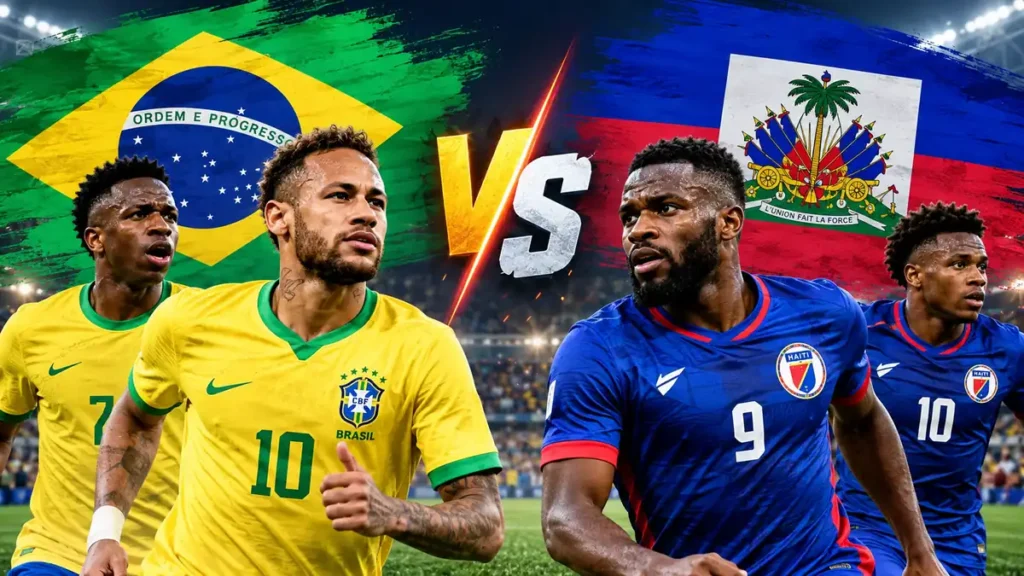
Brazil and Haiti represent two very different footballing traditions in the Americas. Brazil is one of the most successful national teams in international football, while Haiti has built its identity around Caribbean talent, resilience, and historic achievements against stronger opponents.
The brazil vs haiti matchup is best known for Brazil’s commanding performances, particularly its 7–1 victory during the 2016 Copa América Centenario. However, the rivalry also offers a fascinating look at the development of football in South America and the Caribbean.
Brazil has traditionally dominated Haiti in men’s international football through superior tournament experience, attacking quality, and squad depth. Haiti has nevertheless achieved important milestones, including qualification for the 1974 FIFA World Cup and competitive appearances in CONCACAF tournaments. Their encounters illustrate the differences in resources, tactical development, and international experience.
brazil vs haiti: Head-to-Head Overview
Brazil and Haiti belong to different continental football confederations. Brazil competes in CONMEBOL, the South American governing body, while Haiti is part of CONCACAF, which oversees football across North America, Central America, and the Caribbean.
Although both countries share a passion for football, they have experienced very different levels of international success.
| Category | Brazil | Haiti |
|---|---|---|
| National team nickname | Seleção | Les Grenadiers |
| Confederation | CONMEBOL | CONCACAF |
| FIFA World Cup titles | 5 | 0 |
| First FIFA World Cup appearance | 1930 | 1974 |
| World Cup titles won | 1958, 1962, 1970, 1994, 2002 | None |
| Regional championship | Copa América | CONCACAF Championship / Gold Cup |
| Traditional playing strengths | Technical skill, creativity, attacking combinations | Pace, physicality, counterattacking |
| Notable historical players | Pelé, Ronaldo, Ronaldinho, Neymar | Emmanuel Sanon, Duckens Nazon, Jean-Jacques Pierre |
Brazil’s record in major international tournaments makes it the historically stronger side. Haiti’s footballing achievements are particularly significant given the country’s smaller population, limited infrastructure, and more restricted financial resources.
Historical brazil vs haiti Match Results
Brazil 7–1 Haiti: Copa América Centenario 2016
One of the most memorable meetings between the two countries took place on June 8, 2016, at Camping World Stadium in Orlando, Florida.
Brazil defeated Haiti 7–1 during the group stage of the Copa América Centenario, a special tournament organized to celebrate 100 years of the South American championship.

Brazil
7 – 1

Haiti
June 8, 2016 · Copa América Centenario · Group B
Brazil’s goals came from Philippe Coutinho, Renato Augusto, and Gabriel Barbosa.
The goalscorers were:
| Player | Team | Goals |
|---|---|---|
| Philippe Coutinho | Brazil | 3 |
| Renato Augusto | Brazil | 2 |
| Gabriel Barbosa | Brazil | 1 |
| Lucas Lima | Brazil | 1 |
| James Marcelin | Haiti | 1 |
Coutinho completed a hat-trick, demonstrating the attacking quality that made him one of Brazil’s most influential players during that period.
Haiti’s goal, scored by James Marcelin, provided a memorable moment despite the heavy defeat.
What happened during the match?
Brazil controlled possession and consistently created opportunities through its attacking midfielders and wide players.
Coutinho opened the scoring in the 14th minute before doubling Brazil’s advantage in the 29th minute. Renato Augusto added a third before halftime.
Brazil continued to attack after the interval, while Haiti struggled to contain movement between the midfield and defensive lines.
Haiti scored in the second half, but Brazil’s attacking pressure ultimately produced seven goals.
The match highlighted three important differences between the teams:
- Brazil’s ability to create chances through individual technical skill.
- Greater squad depth and experience against high-level opposition.
- Haiti’s difficulty defending sustained attacking pressure.
Despite the result, the tournament provided Haiti with valuable experience against elite international opponents.
Brazil 6–0 Haiti: 2004 Friendly
Brazil also defeated Haiti 6–0 in a friendly played in Port-au-Prince on August 18, 2004.
The match was part of a high-profile visit by the Brazilian national team, which included internationally recognized players such as Ronaldo and Ronaldinho.
Ronaldo scored a hat-trick, Ronaldinho scored once, and Roger Flores contributed two goals.
The event attracted enormous public attention and demonstrated football’s cultural influence beyond competition.
The match was also associated with international peace initiatives during a period of political instability in Haiti.
Unlike the 2016 Copa América encounter, the 2004 game carried considerable diplomatic and symbolic significance.
Brazil 3–0 Haiti: FIFA World Cup 2026
The latest senior international meeting occurred on June 19, 2026, at Lincoln Financial Field in Philadelphia, United States.
Brazil won 3–0 in Group C of the FIFA World Cup, with Matheus Cunha scoring twice and Vinícius Júnior adding another goal before halftime.
| Match detail | Information |
|---|---|
| Competition | FIFA World Cup 2026 |
| Date | June 19, 2026 |
| Venue | Lincoln Financial Field, Philadelphia |
| Final score | Brazil 3–0 Haiti |
| Brazil scorers | Matheus Cunha (23′, 36′), Vinícius Júnior (45+3′) |
| Attendance | 68,324 |
Brazil established control early, with Cunha’s two first-half goals giving the South American side a commanding advantage. Vinícius Júnior extended the lead shortly before halftime.
Haiti was unable to overturn the deficit, and Brazil maintained its clean sheet.
The result represented another chapter in Brazil’s historical dominance of the senior national-team fixture.
Sports Mole
+1
Complete senior head-to-head record
As of October 2026, the recognized senior national-team results are:
| Date | Match | Result | Competition |
|---|---|---|---|
| April 21, 1974 | Brazil vs Haiti | 4–0 | Friendly |
| August 18, 2004 | Haiti vs Brazil | 0–6 | Friendly |
| June 8, 2016 | Brazil vs Haiti | 7–1 | Copa América |
| June 19, 2026 | Brazil vs Haiti | 3–0 | FIFA World Cup |
4
Brazil wins
0
Draws
0
Haiti wins
Senior international record: Brazil 20 goals, Haiti 1 goal.
11v11
+1
One historical distinction matters: Haiti defeated a Brazil under-20 selection 4–3 at the 1999 Caribbean Cup. That result appears in some broader head-to-head databases, but it should not be counted as a victory over Brazil’s senior national team.
11v11
+1
Brazil’s Football History and International Success


8
Brazil is one of football’s most influential countries, with a national-team tradition stretching back more than a century.
The Brazilian Football Confederation, commonly known as the CBF, administers the national team and domestic football structure.
Five FIFA World Cup victories
Brazil has won the men’s FIFA World Cup five times:
| Year | Final opponent | Result |
|---|---|---|
| 1958 | Sweden | 5–2 |
| 1962 | Czechoslovakia | 3–1 |
| 1970 | Italy | 4–1 |
| 1994 | Italy | 0–0, won on penalties |
| 2002 | Germany | 2–0 |
These achievements helped establish Brazil’s reputation for technical excellence, creative attacking play, and producing world-class footballers.
The country is also the only national team to have participated in every men’s FIFA World Cup through 2026.
FIFA
Famous Brazilian football players
Brazil’s international identity has been shaped by several generations of exceptional players.
Pelé became a global football icon after helping Brazil win the World Cup in 1958, 1962, and 1970.
Ronaldo Nazário was central to Brazil’s 2002 World Cup triumph and remains one of the country’s greatest strikers.
Ronaldinho became famous for his creativity, dribbling, and ability to produce unexpected attacking moves.
Neymar helped define Brazil’s modern attacking identity through his goals, technical skill, and international performances.
More recent players, including Vinícius Júnior, Rodrygo, and Matheus Cunha, have continued Brazil’s tradition of producing technically gifted attacking talent.
Brazil’s playing style
Brazil is historically associated with jogo bonito, or the beautiful game.
Although Brazilian teams have used different tactical systems over the decades, several characteristics remain prominent:
- Technical control in tight spaces.
- Creative attacking midfielders and wingers.
- Quick combinations around the penalty area.
- Full-backs contributing to attacking moves.
- Individual skill used to create scoring opportunities.
Brazil’s style is not simply about flair. Its most successful teams have combined attacking creativity with strong defensive organization.
Haiti’s Football History and International Achievements


8
Haiti has a proud footballing tradition that is sometimes overlooked because of the country’s limited appearances at major global tournaments.
The Fédération Haïtienne de Football (FHF) governs the national team, which competes within CONCACAF.
Haiti at the 1974 FIFA World Cup
Haiti made its first men’s FIFA World Cup appearance in 1974, when the tournament was held in West Germany.
The achievement followed Haiti’s success in the 1973 CONCACAF Championship, which also served as the regional qualification tournament.
Haiti faced Italy, Poland, and Argentina in the World Cup group stage.
Although Haiti lost all three matches, the tournament produced one of the country’s most celebrated football moments.
Emmanuel Sanon scored against Italy, ending goalkeeper Dino Zoff’s remarkable run of consecutive minutes without conceding an international goal.
Sanon’s achievement remains an important part of Caribbean football history.
Haiti’s return to the World Cup in 2026
Haiti qualified for the 2026 FIFA World Cup, ending a 52-year absence from the tournament.
The qualification represented a major milestone for the national team and its supporters.
At the tournament, Haiti competed in Group C against Brazil, Scotland, and Morocco. It lost all three matches, including the 3–0 defeat to Brazil, and exited during the group stage.
Despite the results, returning to the world’s biggest football tournament demonstrated the significance of Haiti’s qualification campaign.
Notable Haitian footballers
Emmanuel Sanon is remembered for his performances at the 1974 World Cup and his historic goal against Italy.
Jean-Jacques Pierre established himself as an important figure in Haitian football through his international and European club career.
Duckens Nazon has been a prominent attacking player for Haiti, contributing goals and experience across international competitions.
Frantzdy Pierrot has provided physical presence and goalscoring ability in the national team’s forward line.
Danley Jean Jacques represents the country’s newer generation of international players.
Haiti has also benefited from footballers developed abroad, particularly within European and North American football systems.
brazil vs haiti: Tactical and Playing Style Comparison
The tactical differences between Brazil and Haiti help explain their historical results.
Brazil generally possesses greater technical depth and more players accustomed to competing at elite club levels.
Haiti often relies on collective organization, physical intensity, and quick transitions to challenge stronger opponents.
| Tactical factor | Brazil | Haiti |
|---|---|---|
| Possession | Usually comfortable controlling play | Often more direct against stronger teams |
| Attacking approach | Combination play and individual creativity | Fast breaks and forward runs |
| Midfield | Technical passing and positional control | Work rate and defensive support |
| Defensive approach | Structured pressing and coordinated positioning | Compact defensive blocks |
| Squad depth | Extensive international talent pool | Smaller pool of elite-level players |
| Set pieces | Technical delivery and aerial options | Physical presence and aerial threats |
These are general tendencies, not permanent tactical rules. Both teams adjust their formations and strategies depending on the opponent, coach, and available players.
Why has Brazil historically dominated Haiti?
Brazil’s advantage can be explained by several connected factors.
First, Brazil has a much larger pool of professional footballers competing across domestic and international leagues.
Second, Brazilian players regularly gain experience in major competitions such as the UEFA Champions League, Copa Libertadores, and FIFA World Cup.
Third, Brazil benefits from an extensive football development system, including professional academies, youth competitions, and established scouting networks.
Haiti has talented players, but developing and maintaining comparable football infrastructure presents greater challenges.
How can Haiti compete against stronger teams?
A smaller national team does not necessarily need to dominate possession to produce a competitive performance.
Haiti can improve its chances by maintaining defensive compactness, limiting space between its midfield and back line, and making effective use of counterattacking opportunities.
Set pieces can also provide valuable scoring chances against technically superior opponents.
Discipline is particularly important. Losing possession in dangerous areas or leaving wide spaces behind defenders can allow an attacking team like Brazil to create repeated opportunities.
The Cultural Importance of Brazil and Haiti Football
Football carries significant cultural meaning in both countries.
In Brazil, the national team has long been associated with national identity, artistic expression, and collective pride.
In Haiti, football provides a source of community connection and international recognition.
The 2004 Match for Peace
The August 2004 friendly in Port-au-Prince is especially important because it represented more than a sporting contest.
The game took place during a period of political instability, when the United Nations was conducting a peacekeeping mission in Haiti.
Brazil’s visit attracted enormous attention, with thousands of supporters gathering to see internationally famous footballers.
The match became known as the Match for Peace.
Brazil won 6–0, with Ronaldinho scoring three goals, Roger Flores scoring twice, and Nilmar scoring once.
The occasion remains an example of how international football can create moments of shared celebration during difficult circumstances.
Confederação Brasileira de Futebol
+1
Football development in the Caribbean
Haiti’s experiences also reflect wider challenges faced by Caribbean national teams.
Many countries in the region must develop players with fewer financial resources than major South American or European football nations.
Limited facilities, inconsistent domestic competition structures, and difficulties retaining professional talent can affect national-team development.
However, overseas player development, international scouting, and regional competitions create opportunities for improvement.
The CONCACAF Gold Cup and World Cup qualification campaigns are particularly valuable because they expose Caribbean teams to opponents with different tactical styles and levels of experience.
Key Lessons From the brazil vs haiti Matchup
The history of these encounters illustrates that international football success depends on more than individual talent.
Brazil’s record demonstrates the advantages of sustained investment in player development, competitive professional leagues, and international experience.
Haiti’s achievements show how a smaller footballing nation can establish its own identity and reach major tournaments despite structural limitations.
Three conclusions stand out.
Historical success does not guarantee every future result. Brazil has dominated the senior head-to-head record, but each international match still depends on preparation, tactics, and player performance.
Development systems matter. Strong academies, domestic leagues, coaching programs, and scouting networks contribute to long-term international competitiveness.
Football has significance beyond results. The 2004 Match for Peace demonstrated that an international fixture can become a memorable cultural event regardless of the final score.
Final Thoughts on brazil vs haiti
The brazil vs haiti football history is defined by Brazil’s dominance in senior international competition, including victories in 1974, 2004, 2016, and 2026.
Brazil leads the senior head-to-head record with four wins, 20 goals scored, and just one conceded.
Yet the fixture tells a broader story than the statistics alone suggest. Brazil represents one of international football’s most successful traditions, while Haiti represents the determination and potential of Caribbean football.
From the historic 2004 Match for Peace to their meeting at the 2026 FIFA World Cup, these encounters demonstrate the competitive and cultural importance of international football.