Finding the right word can turn an ordinary sentence into something clearer, more precise, and more engaging. But choosing a synonym isn’t simply about replacing one word with another. Words that appear similar in a dictionary can communicate different emotions, levels of formality, or shades of meaning.
When people search for “synonyms for,” they usually want alternative words that express the same or a closely related idea.
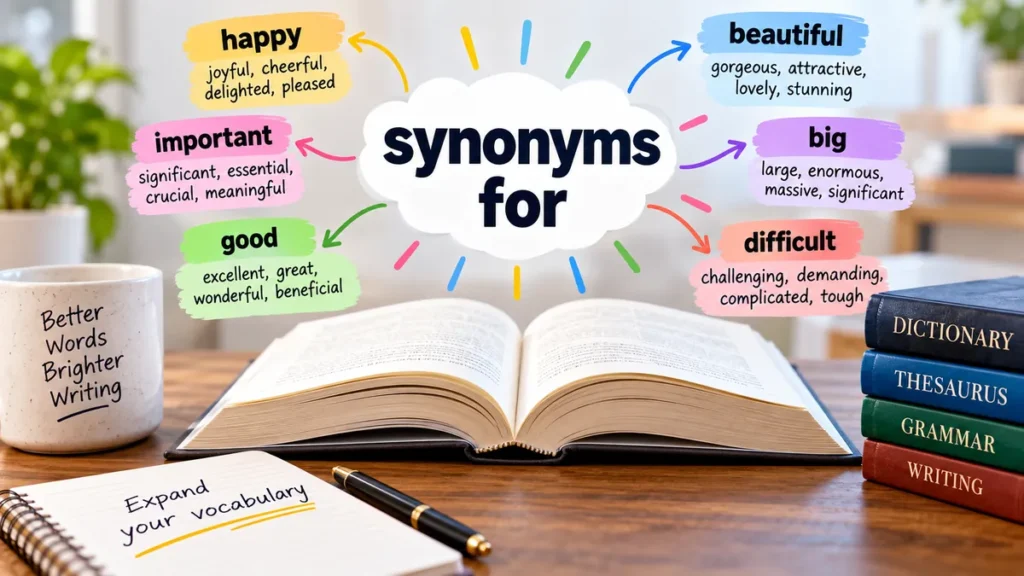
Synonyms are words or expressions with the same or nearly the same meaning as another word. For example, happy has synonyms such as joyful, cheerful, delighted, and pleased. The best alternative depends on the sentence, intended meaning, tone, and context because not every synonym can be used interchangeably.
This guide explains how synonyms work, how to find appropriate alternatives, and how to use them naturally in everyday communication, academic writing, and professional content.
What Does synonyms for Mean?
The phrase “synonyms for” introduces a request for words with similar meanings.
For example:
- Synonyms for beautiful: attractive, gorgeous, lovely, stunning.
- Synonyms for important: significant, essential, crucial, meaningful.
- Synonyms for good: excellent, positive, beneficial, favorable.
- Synonyms for happy: cheerful, joyful, pleased, delighted.
- Synonyms for difficult: challenging, demanding, complicated, tough.
A synonym does not always have exactly the same meaning as the original word.
Consider the words angry, annoyed, and furious. All three describe negative emotional reactions, but they differ in intensity.
Someone who is annoyed may feel mildly irritated. Someone who is furious is extremely angry.
Understanding these distinctions helps writers select vocabulary that accurately reflects what they intend to communicate.
Synonyms vs. Antonyms
Synonyms and antonyms describe different relationships between words.
| Original word | Synonyms | Antonyms |
|---|---|---|
| Happy | Joyful, cheerful | Sad, unhappy |
| Fast | Quick, rapid | Slow |
| Beautiful | Lovely, attractive | Ugly |
| Strong | Powerful, sturdy | Weak |
| Easy | Simple, effortless | Difficult |
| Begin | Start, commence | End, finish |
| Honest | Truthful, sincere | Dishonest |
| Increase | Grow, rise | Decrease |
Synonyms express similar meanings, while antonyms express opposite meanings.
Both are important vocabulary relationships in English grammar and language learning.
Common synonyms for Everyday English Words
English contains numerous alternatives for frequently used words. Learning them helps reduce unnecessary repetition and improves precision.
Synonyms for Good
The word good can describe quality, behavior, performance, or a positive outcome.
Common alternatives include excellent, great, wonderful, outstanding, favorable, beneficial, and satisfactory.
Examples:
- Original: She did a good job.
- Improved: She did an excellent job.
- Original: Exercise has good effects on health.
- Improved: Exercise has beneficial effects on health.
Excellent emphasizes high quality, while beneficial emphasizes a positive effect.
Synonyms for Bad
Alternatives include poor, terrible, unpleasant, harmful, unfavorable, and disappointing.
Examples:
- The weather was bad. → The weather was unpleasant.
- The product was bad. → The product was disappointing.
- Smoking has bad effects. → Smoking has harmful effects.
The correct choice depends on what makes something bad.
Synonyms for Important
Common alternatives include significant, essential, crucial, vital, major, meaningful, and consequential.
Examples:
- Education is important. → Education is essential.
- This is an important discovery. → This is a significant discovery.
- Timing is important. → Timing is crucial.
Essential suggests necessity, while significant emphasizes importance or impact.
Synonyms for Beautiful
Possible alternatives include gorgeous, attractive, lovely, stunning, elegant, picturesque, and breathtaking.
Examples:
- A beautiful landscape → A picturesque landscape.
- A beautiful dress → An elegant dress.
- A beautiful sunset → A breathtaking sunset.
Picturesque is especially suitable for scenery, whereas elegant often describes graceful appearance or design.
Synonyms for Big and Small
| Word | Alternatives | Typical use |
|---|---|---|
| Big | Large, enormous, massive | Physical size |
| Big | Major, significant | Importance |
| Small | Tiny, miniature | Physical size |
| Small | Minor, slight | Importance |
| Huge | Immense, gigantic | Very large size |
| Little | Petite, compact | Certain physical descriptions |
For example, a big decision is often better described as a major decision, while a big building may be described as a massive building.
How to Find synonyms for Any Word
Finding suitable synonyms requires more than consulting a word list.
A reliable approach involves understanding the original word, identifying its grammatical role, and evaluating potential replacements.
1. Identify the Meaning of the Original Word
Many English words have multiple meanings.
Consider bright:
- Bright light means intense illumination.
- Bright student means intelligent.
- Bright future means promising.
- Bright colors means vivid.
Each meaning requires different synonyms.
| Phrase | Suitable alternatives |
|---|---|
| Bright light | Brilliant, intense |
| Bright student | Intelligent, clever |
| Bright future | Promising, hopeful |
| Bright colors | Vivid, vibrant |
Using intelligent as a synonym for bright works when describing a student, but not when describing sunlight.
2. Check the Part of Speech
A synonym should generally fit the grammatical structure of the original sentence.
For example, success is a noun, successful is an adjective, and succeed is a verb.
Although these words belong to the same word family, they cannot automatically replace one another.
Original: The project was successful.
Correct alternative: The project was prosperous, if the intended meaning concerns financial success.
Incorrect: The project was success.
Grammar determines whether a replacement is appropriate.
3. Compare Meaning and Intensity
Some synonyms differ primarily in strength.
For example:
Increasing intensity of anger
Annoyed
Irritated
Angry
Furious
Illustrative intensity levels, not standardized linguistic measurements.
Replacing annoyed with furious can exaggerate the emotion being described.
4. Consider Formality and Tone
Some synonyms sound conversational, while others suit professional or academic communication.
| Informal word | More formal alternative |
|---|---|
| Help | Assist |
| Buy | Purchase |
| Get | Obtain |
| Ask | Inquire |
| Show | Demonstrate |
| Start | Commence |
| End | Conclude |
| Need | Require |
Formal alternatives are not automatically better. In many situations, everyday language is clearer and more natural.
5. Test the Replacement in Context
Read the complete sentence after substituting a synonym.
Ask whether the new word preserves the meaning, fits grammatically, sounds natural, and matches the intended audience.
For example:
Original: She made a strong argument.
Natural alternative: She made a compelling argument.
Awkward alternative: She made a muscular argument.
Although muscular can sometimes mean strong, it is not a natural substitute in this particular sentence.
Types of Synonyms in English
Linguists distinguish several kinds of synonym relationships.
Absolute Synonyms
Absolute synonyms would have identical meanings and be interchangeable in every context without changing the message.
True absolute synonyms are extremely rare in natural language.
Even closely related words often differ in register, regional usage, emotional associations, or grammatical patterns.
Partial Synonyms
Partial synonyms share similar meanings but cannot replace each other in every situation.
Examples include:
- Big and large
- Angry and furious
- Smart and intelligent
- Mistake and error
- House and home
House typically refers to a building, while home can express personal attachment and belonging.
Contextual Synonyms
Contextual synonyms function as alternatives only in specific situations.
For example, heavy and intense may convey similar meanings when describing rainfall.
- Heavy rain
- Intense rain
However, intense suitcase is not a normal replacement for heavy suitcase.
This shows why sentence context matters more than simply matching dictionary definitions.
Best Online Tools to Find synonyms for Words
A thesaurus is a reference resource that groups words by similar or opposite meanings. Online thesauruses make vocabulary research easier by offering definitions, examples, and alternative expressions.
Several established resources are especially useful.
| Tool | Main strength | Best for |
|---|---|---|
| Thesaurus.com | Synonym and antonym lookup | Everyday writing |
| Merriam-Webster Thesaurus | Definitions and related vocabulary | Precise word choices |
| Cambridge Thesaurus | Usage explanations and examples | English learners |
| WordHippo | Alternative words and phrases | Vocabulary exploration |
| Collins Dictionary | Dictionary and thesaurus references | British English usage |
Cambridge provides examples that help distinguish closely related words, while WordHippo offers extensive alternative-word searches.
Synonyms, antonyms and examples
+1
Dictionary vs. Thesaurus: Which Should You Use?
A dictionary primarily explains what a word means. A thesaurus helps identify words with similar or opposite meanings.
For example, a dictionary may explain that generous describes someone willing to give or share.
A thesaurus may suggest:
- Giving
- Charitable
- Kindhearted
- Benevolent
- Openhanded
These alternatives overlap in meaning but emphasize different qualities.
For accurate writing, use a dictionary to confirm the definition and a thesaurus to explore suitable replacements.
Using synonyms for Better Writing and Communication
Synonyms improve writing when they add clarity, reduce distracting repetition, or communicate a more specific meaning.
However, replacing every repeated word can make writing less coherent.
Improving Academic Writing
Academic writing often benefits from precise, neutral vocabulary.
Consider this sentence:
“The study shows that exercise has a good effect on students.”
A more precise version is:
“The study indicates that exercise has a beneficial effect on students.”
Here, indicates can communicate the relationship between research findings and conclusions, while beneficial identifies the effect as positive.
Other useful academic alternatives include:
| Common expression | Academic alternative |
|---|---|
| Shows | Demonstrates, indicates |
| Looks at | Examines, investigates |
| Finds out | Determines, discovers |
| Talks about | Discusses, addresses |
| Uses | Employs, utilizes |
| Makes better | Improves, enhances |
| Causes | Produces, contributes to |
| Thinks | Suggests, proposes |
These alternatives must match the evidence. For instance, demonstrates can express greater certainty than suggests.
Making Professional Writing Clearer
Professional emails, reports, and presentations often require a balance between clarity and formality.
Instead of:
“We need to fix this big problem quickly.”
You could write:
“We need to resolve this significant issue promptly.”
The revised sentence is more formal, although the original may be preferable in a casual workplace conversation.
Effective communication depends on the audience, not simply the sophistication of the vocabulary.
Improving Creative Writing
Creative writing benefits from descriptive variety, especially when portraying movement, emotions, dialogue, and atmosphere.
Compare:
“The man walked into the dark room.”
With:
“The man crept into the dimly lit room.”
The second sentence communicates cautious movement and a particular atmosphere.
However, crept is not a universal synonym for walked. It adds a specific manner of movement.
That distinction is what makes thoughtful synonym selection valuable.
Avoiding Repetition Without Changing Meaning
Repetition is not always a writing mistake.
Technical documents, scientific explanations, and instructional content frequently repeat terminology to maintain consistency.
For example, replacing blood pressure with loosely related expressions throughout a medical explanation could confuse readers.
Likewise, in legal writing, a defined term may need to remain consistent.
Use synonyms when they improve readability, but retain established terminology when precision matters more than variety.
Understanding Meaning, Connotation, and Word Choice
Two words may share a dictionary definition while creating different impressions.
This difference is called connotation.
Denotation refers to a word’s direct or literal meaning. Connotation refers to the associations, attitudes, or feelings connected with that word.
Positive, Negative, and Neutral Connotations
Consider these adjectives:
| Positive | Neutral | Negative |
|---|---|---|
| Confident | Self-assured | Arrogant |
| Economical | Inexpensive | Cheap |
| Slender | Thin | Skinny |
| Curious | Inquisitive | Nosy |
| Determined | Persistent | Stubborn |
These words are related, but the columns are not interchangeable descriptions.
Calling someone determined often sounds complimentary. Calling the same person stubborn can suggest unwillingness to compromise.
A writer should consider these associations before selecting a replacement.
Collocations: Why Some Synonyms Sound Unnatural
A collocation is a combination of words that commonly occur together.
English speakers naturally say:
- Make a decision
- Heavy rain
- Strong coffee
- Deep sleep
- Pay attention
Even when individual words have similar meanings, replacing them may produce awkward combinations.
For example, powerful coffee can be understood, but strong coffee is the more conventional expression.
Similarly, do a decision is not a natural alternative to make a decision.
Understanding collocations is especially helpful for English language learners because natural word combinations are not always predictable from dictionary definitions.
British and American English Differences
Some synonyms vary according to regional usage.
| British English | American English |
|---|---|
| Lift | Elevator |
| Flat | Apartment |
| Lorry | Truck |
| Holiday | Vacation |
| Rubbish | Trash |
| Petrol | Gasoline |
| Autumn | Fall |
These terms often refer to the same concepts, although regional conventions and contexts may differ.
When writing for an international audience, choose vocabulary that your readers are likely to understand.
Common Mistakes When Choosing synonyms for Words
Even experienced writers sometimes select alternatives that change the intended meaning.
The most common problems involve word intensity, grammar, register, and context.
Choosing a More Complicated Word Unnecessarily
A longer word is not automatically more accurate.
For example:
Simple: “We used the new method.”
More formal: “We utilized the new methodology.”
The second sentence is appropriate only if its terminology matches the intended meaning. Methodology may refer to a system of methods rather than one individual method.
In many cases, used and method are clearer.
Confusing Related Words With Synonyms
Words can be semantically related without sharing the same meaning.
For example, doctor, hospital, and patient belong to a related topic, but they are not synonyms.
Similarly, teacher and student are associated through education but represent different roles.
This distinction matters when using automated synonym generators or vocabulary tools.
Ignoring Multiple Word Meanings
The word run can describe physical movement, managing an organization, operating machinery, or the flow of liquid.
Examples:
- Run quickly → Sprint
- Run a company → Manage
- Run a machine → Operate
- Tears ran down her face → Flowed
No single synonym works across all these meanings.
The correct alternative depends on the sense of the original word.
Replacing Words Without Checking Grammar
Synonyms may require changes to prepositions, sentence structure, or surrounding words.
For example:
- Discuss the issue.
- Talk about the issue.
Both express similar ideas, but discuss about the issue is incorrect in standard English.
Likewise:
- Explain the problem to someone.
- Describe the problem to someone.
Choosing a synonym involves checking how the word behaves grammatically, not just its definition.
How to Build a Stronger English Vocabulary With Synonyms
Learning synonyms is more effective when words are studied in context rather than memorized as disconnected lists.
A practical vocabulary-building routine combines reading, comparison, writing, and review.
Learn Words in Meaning Groups
Group words around a shared concept.
For example, the concept of happiness includes:
| Word | Meaning or nuance |
|---|---|
| Content | Quietly satisfied |
| Pleased | Happy about something |
| Cheerful | Noticeably positive |
| Delighted | Very pleased |
| Elated | Extremely happy |
| Ecstatic | Overwhelmingly joyful |
Studying the differences makes these words easier to remember and use accurately.
Practice Rewriting Sentences
Take a simple sentence and rewrite it using alternative vocabulary.
Original:
“The movie was very good.”
Possible revisions:
- The movie was excellent.
- The movie was entertaining.
- The movie was impressive.
- The movie was captivating.
Each version emphasizes something different.
Entertaining focuses on enjoyment, while captivating suggests that the movie held the viewer’s attention.
Use a Vocabulary Journal
Record each new word with its definition, grammatical category, common collocations, and example sentence.
For example:
Word: Meticulous
Meaning: Extremely careful and attentive to detail.
Related words: Thorough, precise, painstaking, careful.
Example: “The editor conducted a meticulous review of the manuscript.”
Recording complete sentences helps develop an understanding of natural usage.
Review Vocabulary Through Active Recall
Instead of rereading a list repeatedly, try recalling alternatives from memory.
For example, choose the word important and write five suitable synonyms without consulting a thesaurus.
Then compare your answers with dictionary examples.
Spaced repetition and regular reading can help reinforce vocabulary over time.
Why Synonyms Matter in Language Learning and SEO
Synonyms have applications beyond creative writing. They also play a role in reading comprehension, translation, information retrieval, and search engine optimization.
Synonyms in Reading Comprehension
Readers frequently encounter unfamiliar vocabulary.
Recognizing synonyms can help them infer meaning from context.
For example:
“The instructions were concise, providing a brief explanation without unnecessary details.”
The surrounding description helps readers understand that concise means brief and clearly expressed.
This contextual approach supports vocabulary development and reading fluency.
Synonyms in Translation
Translating a word into another language is not always straightforward because languages organize meaning differently.
A word may have several possible translations depending on its grammatical function, cultural associations, and surrounding sentence.
For accurate translation, it is useful to compare definitions, example sentences, and natural expressions in both languages.
Synonyms and Semantic SEO
Search engines attempt to understand the meaning and relevance of content rather than relying solely on exact keyword matches.
For example, an article about improving writing may naturally discuss vocabulary, word choice, alternative expressions, sentence clarity, and repetition.
These related concepts help explain the topic comprehensively.
However, simply inserting large numbers of synonyms does not guarantee better rankings.
Useful content should prioritize clear explanations, accurate terminology, and genuine relevance to the reader’s question.
Final Thoughts on synonyms for Better Word Choice
Finding synonyms for words is an essential language skill, but the goal is not to replace familiar vocabulary with complicated alternatives.
The best synonym preserves the intended meaning while matching the sentence’s grammar, tone, audience, and context.
A thesaurus can introduce useful alternatives, while dictionary definitions and real-world examples help determine whether those alternatives are appropriate.
When choosing a word, focus on what you want to communicate. A simple, accurate expression is usually more effective than an impressive-sounding replacement that changes the meaning.
With regular reading, contextual practice, and careful word comparison, selecting natural synonyms becomes easier and more intuitive.