A suitcase can look perfectly manageable until sweaters, jackets, trousers, and several days of clothing go inside. Suddenly, the zipper barely closes. Compression packing cubes are designed for exactly this problem: they organize clothing while reducing the amount of space soft items occupy.
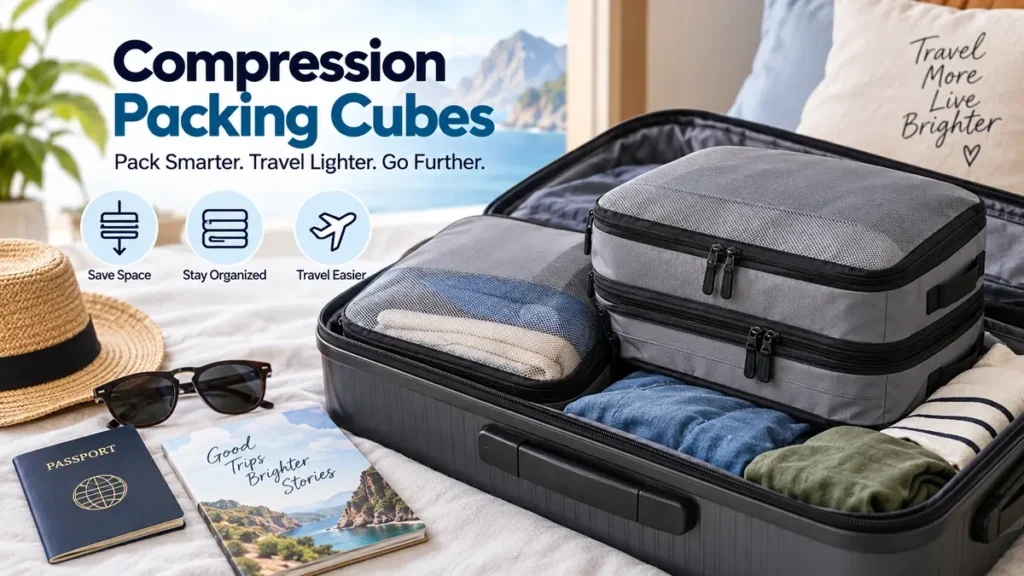
Compression packing cubes are zippered travel organizers with a secondary compression zipper that pulls the cube’s panels closer together. This pushes excess air from soft clothing and creates a thinner, denser bundle. They can improve suitcase organization and free usable space, but they reduce volume—not the actual weight of your luggage.
The difference sounds small, but understanding how compression works—and what it cannot do—makes these organizers much more useful.
What Are Compression Packing Cubes?
Compression packing cubes are lightweight fabric containers designed to hold clothing inside luggage. Unlike standard packing cubes, which primarily organize belongings, compression versions normally include two zipper systems.
The main zipper closes the compartment containing your clothes. A second zipper runs around an expandable section of the cube. Closing that second zipper pulls the two sides closer together, reducing the cube’s depth and forcing excess air from the clothing.
There is no vacuum and no pump.
The process is mechanical: pack, close, compress.
That distinction matters because these cubes cannot shrink solid material. They work by removing some of the air trapped between and within compressible fabrics. Soft sweaters and fleece therefore respond much better than shoes or other rigid objects.
Compression packing cube anatomy
Most designs combine several familiar travel-organizer features:
- Main zippered clothing compartment
- Secondary compression zipper
- Nylon, polyester, or ripstop fabric
- Mesh or semitransparent panels on some models
- Carry or grab handles
- Reinforced seams
- Small, medium, and large size options
Construction varies considerably. For example, Thule’s current compression cubes use 100-denier ripstop nylon, YKK zippers, webbing handles, and semitransparent fabric. Other designs emphasize lighter materials, mesh visibility, or lower packed weight.
Quick Takeaway: A regular cube organizes clothing. A compression cube organizes it and then uses an additional zipper to reduce the depth of the packed bundle.
How Do Compression Packing Cubes Work?
The easiest way to understand compression packing cubes is to picture a soft-sided suitcase inside your suitcase.
First, the cube is expanded. Clothing is placed inside and the main zipper is closed. At this stage, it behaves much like a standard packing cube.
Then the compression zipper is closed.
As that zipper travels around the perimeter, the expansion panel collapses and the top and bottom surfaces move closer together. Air escapes from between the garments, leaving a flatter package.
Some products illustrate how dramatic the change in external dimensions can be. Thule lists its medium compression cube at 14 × 10 × 4 inches expanded and 14 × 10 × 1.25 inches compressed. Its small model is listed at 10 × 7 × 4 inches expanded and 10 × 7 × 1.25 inches compressed. Those specifications describe the cube’s dimensions rather than guaranteeing the same reduction for every combination of clothes.
Actual results depend heavily on what is inside.
A fleece jacket contains considerable compressible air. A stack of dense denim contains much less. Put a rigid toiletry case inside, and it barely compresses at all.
That is why claims that every traveler will save a fixed percentage of luggage space should be treated cautiously. There is no universal compression percentage.
Compression Packing Cubes vs Regular Packing Cubes
Both systems make luggage easier to organize, but they solve slightly different problems.
| Feature | Compression Packing Cubes | Regular Packing Cubes |
|---|---|---|
| Organizes clothing | Yes | Yes |
| Main closure zipper | Yes | Yes |
| Secondary compression zipper | Usually | No |
| Reduces clothing bulk | Yes, for compressible items | Limited |
| Easy access | Good | Excellent |
| Risk of extra wrinkles | Higher when tightly compressed | Lower |
| Weight of organizer | Often slightly higher | Often lighter |
| Best use | Space-limited luggage | General organization |
A standard packing cube is often enough if your suitcase already closes comfortably. It keeps shirts, underwear, trousers, sleepwear, and accessories separated without applying much pressure.
Compression becomes valuable when volume is the limiting factor.
Carry-on travelers, backpackers, winter travelers, families sharing luggage, and people packing bulky layers can benefit more because a few centimeters of recovered depth can make the layout easier.
Regular cubes may be preferable when you primarily want organization or travel with delicate garments.
Are compression packing cubes better than regular packing cubes?
Not automatically.
They are better at reducing the bulk of compressible clothing. Regular cubes are simpler and can be better for garments that should not be tightly pressed.
The practical approach is often a mixed system rather than choosing one type exclusively.
Use compression for bulky casual clothing and standard organizers for items where easy access or wrinkle prevention matters more.
Compression Packing Cubes vs Vacuum Bags
These two products are sometimes treated as interchangeable, but their mechanisms are quite different.
Compression cubes use physical pressure from a zipper. Vacuum storage bags remove much more air by extracting it through a valve or by manually rolling air out, depending on the design.
| Factor | Compression Cubes | Vacuum Bags |
|---|---|---|
| Compression method | Secondary zipper | Air extraction |
| Pump required | No | Sometimes |
| Organization | Excellent | Moderate |
| Access during trip | Easy | Less convenient |
| Compression potential | Moderate | Usually greater |
| Shape | Structured | Irregular/flat |
| Good for repeated access | Yes | Less ideal |
| Best for | Everyday travel | Maximum volume reduction |
Vacuum bags can make sense for very bulky textiles, especially when maximum volume reduction matters. But reopening and recompressing them repeatedly during a trip can be inconvenient.
Compression cubes provide a middle ground: useful volume reduction without giving up the organizational advantages of traditional packing cubes.
Neither method changes how much your belongings weigh.
Quick Takeaway: Choose compression cubes when you want organization plus moderate space savings. Vacuum bags prioritize stronger compression over convenient everyday access.
What Should You Pack in Compression Packing Cubes?
The best items are soft, flexible, and capable of holding substantial air.
Good candidates include:
- T-shirts
- Underwear
- Socks
- Pajamas
- Activewear
- Leggings
- Casual dresses
- Sweatshirts
- Hoodies
- Fleece layers
- Knitwear
- Soft sweaters
- Lightweight insulated clothing
Bulky but compressible garments often provide the most noticeable benefit. Current travel guidance particularly highlights items such as jumpers, puffer jackets, fleece, and towels because their loft occupies substantial luggage volume.
What should stay outside?
Compression is less useful—or potentially undesirable—for:
- Shoes
- Toiletry bottles
- Electronics
- Cameras
- Structured jackets
- Formalwear
- Easily wrinkled dress shirts
- Delicate fabrics
- Fragile accessories
- Hard cases
Rigid objects cannot become smaller just because pressure is applied around them.
Structured garments present a different problem. They may technically fit, but strong compression can produce deep creases and distort carefully shaped clothing.
Dense denim is somewhere in the middle. Jeans can certainly go inside a packing cube, but they contain less compressible air than fleece or a puffy layer, so the space-saving benefit may be smaller.
How to Use Compression Packing Cubes Properly
The basic technique is straightforward, but packing technique determines whether the cube closes neatly or turns into an overstuffed lump.
1. Sort your clothes before packing
Start with your complete packing list rather than immediately filling every cube you own.
Group clothing by type, person, activity, or destination.
For example:
- Cube 1: shirts and tops
- Cube 2: underwear and socks
- Cube 3: sleepwear and activewear
- Cube 4: sweaters and other bulky layers
Travelers who move between several hotels may prefer organizing by outfit or destination instead. Families sharing one suitcase can assign different cubes or colors to each person.
2. Fully expand the cube
Open the compression zipper before loading it.
You want the cube at maximum depth while arranging your clothing. Trying to stuff clothing into an already compressed cube creates unnecessary pressure on the main zipper.
3. Roll or fold clothes neatly
There is no universal rule that every garment must be rolled.
Rolling works particularly well for T-shirts, underwear, casual clothing, and flexible synthetic garments. Folding often works better for collared shirts and garments that naturally form flat rectangles.
The goal is consistent packing density without large pockets of unused space.
A useful approach is to fold garments roughly to the width of the cube, then arrange them evenly rather than creating a mound in the center. Recent practical packing guidance similarly recommends choosing rolling or folding according to the garment rather than treating one technique as universally superior.
4. Fill evenly without overstuffing
This is where many people get compression packing cubes wrong.
A cube should feel comfortably full before compression, but the main zipper should still close without a fight.
If you have to pull hard enough that the seams are stretching or the zipper teeth are under obvious strain, remove something.
Compression requires somewhere for the fabric and clothing to move.
5. Close the main zipper
Close the clothing compartment completely before using the compression zipper.
Check the edges carefully. Loose socks, fabric corners, or shirt sleeves can get caught in the zipper.
Do not force it.
6. Press gently while closing the compression zipper
Place the cube on a flat surface and apply light downward pressure with one hand.
Slowly move the compression zipper with the other.
Working gradually around the perimeter helps prevent fabric from becoming trapped in the zipper track.
If the zipper suddenly requires excessive force, stop.
Open it slightly, rearrange the contents, press the cube again, and continue. Forcing a heavily loaded compression zipper places unnecessary stress on the zipper, stitching, and fabric.
7. Arrange the compressed cubes inside your luggage
Once compressed, the cubes should form relatively predictable rectangular shapes.
In wheeled luggage, heavier items are generally easiest to manage toward the wheel end when the suitcase stands upright.
In a travel backpack, keep dense and heavy items reasonably close to your back rather than putting all the weight on the outermost side.
Smaller cubes can then occupy gaps around larger organizers.
Do Compression Packing Cubes Really Save Space?
Yes—but with an important qualification.
They can save volume when the contents contain air that can be squeezed out. They cannot reduce the physical mass of the material itself.
Think about packing a thick fleece.
Uncompressed, its fibers and folds trap a considerable amount of air. Compressing the fleece reduces that loft, allowing the same garment to occupy a smaller volume.
Now imagine a hardcover book.
There is essentially nothing useful to compress.
Clothing falls somewhere between those examples, which explains why real-world results vary considerably.
Independent travel testing and current product guides continue to feature compression models from brands including Peak Design, Eagle Creek, Gonex, Thule, Tortuga, Gossamer Gear, and Osprey, but designs differ in compression method, weight, zipper construction, materials, and organization.
The more useful question therefore isn’t “How much space will compression packing cubes save?”
It is “How compressible is what I’m packing?”
Do Compression Packing Cubes Make Luggage Lighter?
No.
This is one of the most important limitations to understand.
If your clothes weigh 5 kilograms before compression, they still weigh 5 kilograms afterward. The cube itself adds a small amount of additional weight.
Compression can actually make airline weight limits easier to accidentally exceed because a traveler sees newly available space and fills it with more belongings.
A suitcase can therefore look impressively compact while being overweight.
This matters particularly with checked baggage and airlines that enforce cabin-bag weight limits.
Treat space and weight as separate packing constraints.
Use cubes to control volume. Use a luggage scale when weight is the concern.
Can Compression Packing Cubes Cause Wrinkles?
Yes, especially when garments are compressed tightly for long periods.
Compression presses folds and creases against one another. Fabrics that wrinkle easily may emerge with more noticeable lines than clothes stored loosely.
That does not mean every item becomes badly wrinkled.
Synthetic activewear, knitwear, underwear, socks, and many casual garments usually tolerate compression better than formal shirts, linen garments, structured jackets, or delicate dresses.
To reduce wrinkles:
- Smooth garments before packing.
- Avoid bunching fabric.
- Fold wrinkle-prone pieces along natural seams.
- Do not overfill the cube.
- Remove clothes after reaching your accommodation.
- Hang garments that need to recover.
If appearance matters more than suitcase volume, leave that particular garment uncompressed.
Choosing the Right Size Compression Packing Cubes
Cube size should match both your clothing and the dimensions of your luggage.
Small cubes
Small cubes are useful for underwear, socks, swimwear, accessories, and children’s clothing.
They are also useful in backpacks because they can fill narrow spaces around other gear.
Medium cubes
For many travelers, medium cubes are the most versatile.
They can accommodate shirts, activewear, sleepwear, lightweight trousers, dresses, and smaller sweaters while remaining manageable when compressed.
As one real-world reference, Thule’s medium model is listed with an 11-liter capacity, while its small model has a 4-liter capacity.
Large cubes
Large cubes work well for sweaters, hoodies, jackets, trousers, and larger clothing collections.
But bigger is not always better.
A huge cube packed until it is extremely dense may become difficult to fit around shoes, toiletry bags, laptop compartments, and the structural elements inside a suitcase.
Several medium and small cubes often provide greater layout flexibility than one enormous organizer.
Quick Takeaway: Measure the interior of your suitcase before selecting cube sizes. The best packing cube is not simply the one that holds the most—it is the one that fits your luggage layout efficiently.
What Features Matter in Compression Packing Cubes?
Not all compression packing cubes are constructed equally. A few details make a meaningful difference.
Strong compression zippers
The compression zipper handles more resistance than an ordinary organizer zipper.
Quality zipper hardware matters because repeatedly forcing an overloaded compression system can become the primary failure point.
YKK hardware, for example, appears on current Thule models and on some other premium travel organizers.
Durable lightweight fabric
Ripstop nylon is common because it provides a useful balance between strength and weight.
Thicker material may feel more structured and durable, but ultralight travelers may prefer thinner fabric because several organizers can add noticeable weight.
Current products span lightweight materials through more structured 100-denier nylon constructions.
Visibility
Mesh or semitransparent panels let you identify clothing without opening every cube.
Opaque designs provide more privacy.
Neither is inherently better; it depends on how you travel.
Handles
A simple webbing handle makes a bigger difference than it appears.
It allows a tightly packed cube to be lifted from a deep suitcase or backpack without grabbing the zipper or fabric panel.
Water resistance
Water-repellent fabric can provide useful protection from minor spills and damp luggage interiors.
It should not be confused with waterproofing. Unless a manufacturer specifically rates the cube as waterproof, assume that prolonged exposure to water can eventually reach the contents.
Sustainability standards
Travel organizers increasingly use recycled materials or independently assessed textile systems.
For example, current Thule compression models use bluesign-approved material, while REI’s expandable cubes use ripstop nylon with a durable water-repellent treatment made without PFAS.
Common Compression Packing Cube Mistakes
A good cube cannot compensate for poor packing technique.
Overfilling
The most common mistake is treating the expansion capacity as permission to stuff in as much clothing as physically possible.
If the main zipper barely closes, the compression zipper has little room to work.
Remove an item instead of forcing it.
Expecting weight savings
Compression changes volume, not mass.
If baggage weight is your problem, pack fewer or lighter items.
Compressing everything
Not every garment benefits from compression.
Formalwear, structured clothing, delicate materials, and frequently needed items may be better packed separately.
Using too many cubes
Packing organizers themselves occupy space and add weight.
You do not need a cube for every category imaginable. Use enough to create a practical system without turning the suitcase into a puzzle of unnecessary containers.
Ignoring suitcase dimensions
A beautifully compressed cube is not useful if its footprint prevents it from fitting efficiently inside your carry-on.
Measure the bag rather than relying only on labels such as small, medium, and large.
Forcing the zipper
Resistance is information.
When the compression zipper becomes unusually difficult to move, stop and redistribute the contents. Repeatedly pulling harder can damage zipper teeth, sliders, seams, or lightweight fabric.
Are Compression Packing Cubes Good for Carry-On Travel?
Carry-on travel is one of their strongest use cases.
Cabin luggage has limited internal volume, and bulky clothing can consume that space quickly. Compression allows soft items to become denser while maintaining clear categories.
A simple carry-on setup might use:
- One medium cube for shirts and tops
- One medium cube for trousers, sleepwear, or sweaters
- One small cube for socks and underwear
- Separate space for shoes, toiletries, electronics, and documents
The exact arrangement depends on the suitcase.
For example, REI notes that most carry-on luggage can accommodate either two medium Thule compression cubes or a medium with two small cubes, though individual suitcase dimensions obviously vary.
Compression is particularly helpful for cold-weather carry-on travel because sweaters and insulating layers consume far more volume than lightweight summer clothing.
Are Compression Packing Cubes Good for Backpacks?
They can work very well in travel backpacks, but shape matters.
A rectangular cube can prevent clothes from expanding into every corner of the pack and makes it easier to remove one category without emptying the entire bag.
For backpack packing, consider:
- Keeping heavier cubes closer to your back
- Using cube dimensions that match the backpack’s internal width
- Avoiding an excessively rigid compressed block
- Leaving access to frequently needed layers
- Using smaller cubes to fill irregular spaces
Weight becomes especially important when you are carrying the bag for long periods.
A highly organized backpack is still uncomfortable if compression tempts you to pack several kilograms of unnecessary gear.
How to Keep Clean and Dirty Clothes Organized
Packing cubes remain useful after the outbound journey.
One approach is to start the trip with an empty laundry bag or spare organizer. As clothes become dirty, move them out of your clean-clothing cubes.
Some packing organizers use dedicated clean/dirty compartments. REI’s current packing-organizer selection, for example, includes Thule’s Clean/Dirty Packing Cube alongside compression models.
Another simple method is to designate one compression cube for dirty laundry during the return journey.
This can be particularly useful because worn clothing rarely folds as carefully as freshly packed clothing. Compression keeps it contained while separating it from clean garments.
How to Care for Compression Packing Cubes
Maintenance is simple but should follow the manufacturer’s instructions because materials and coatings differ.
After a trip:
- Empty every compartment.
- Shake out lint and debris.
- Spot-clean small marks.
- Follow the care label for washing.
- Let cubes dry completely before storage.
- Store them with compression zippers open to reduce unnecessary tension.
- Check zipper tracks for caught threads or damaged teeth.
Avoid assuming that a water-resistant nylon cube can automatically withstand hot machine washing or tumble drying. Heat and harsh cleaning products can affect coatings, mesh panels, fabric, or zipper components.
The manufacturer’s care instructions should take priority.
When Are Compression Packing Cubes Worth Using?
Compression packing cubes make the most sense when luggage volume is genuinely limited.
They are particularly useful for:
- Carry-on-only trips
- Cold-weather travel
- Long trips with limited luggage
- Backpack travel
- Family packing
- Multi-destination itineraries
- Cruises
- Road trips
- Travelers carrying bulky casual clothing
- Separating clean and dirty clothes
They are less compelling when your suitcase has plenty of unused space, when weight rather than volume is the main restriction, or when most of your wardrobe is formal and wrinkle-sensitive.
You also do not need to replace every ordinary packing cube.
A hybrid system often works better: compression cubes for sweaters, casual clothing, sleepwear, and soft layers; ordinary cubes or garment storage for pieces that need gentler handling.
Compression Packing Cubes: The Practical Bottom Line
Compression packing cubes solve two problems at once: they organize luggage and reduce the volume of soft, compressible clothing.
Their second zipper collapses the cube’s expansion panel, squeezing excess air from items such as T-shirts, fleece, sweaters, underwear, pajamas, and lightweight jackets. They require no vacuum or pump, and they can make a noticeable difference when packing a carry-on or travel backpack.
But the limitations are just as important. Compression does not reduce luggage weight, rigid objects gain almost nothing from it, excessive pressure can wrinkle clothing, and overstuffing places unnecessary stress on zippers and seams.
The most effective approach is simple: pack only what you need, match cube sizes to your luggage, put compressible clothing inside, close the main zipper first, and compress gradually.
Used that way, compression packing cubes are not a trick for making unlimited belongings fit into a suitcase. They are a practical tool for making the space you already have easier to control.