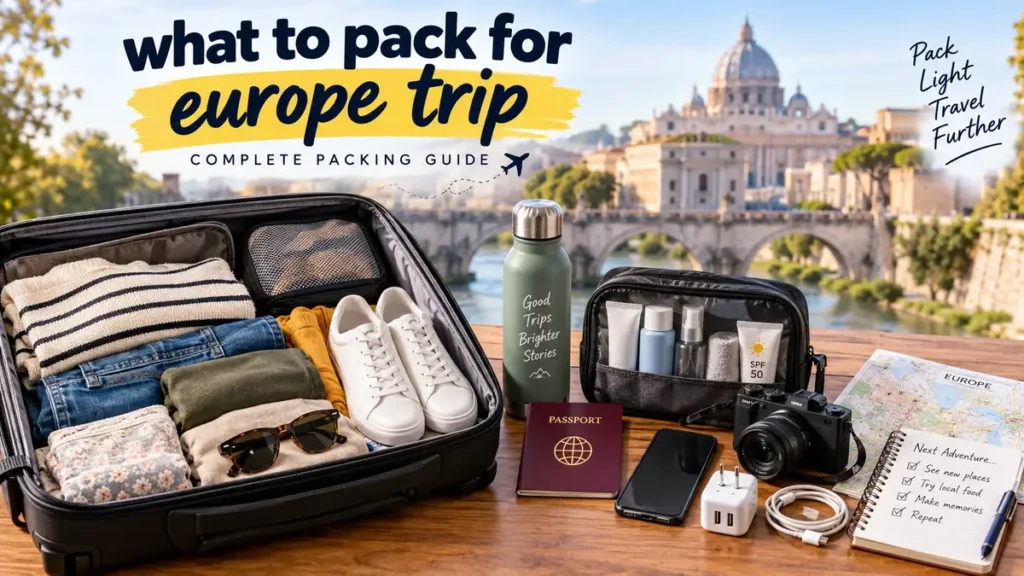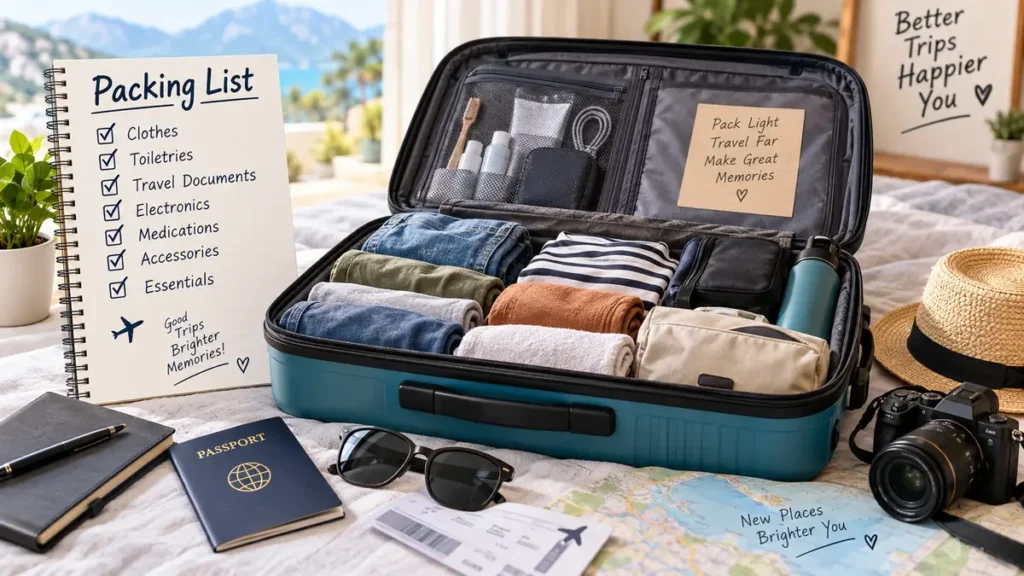
Packing seems simple until you are standing beside an open suitcase wondering what you have forgotten. A good packing list solves two problems at once: it helps you remember genuine essentials and prevents you from filling your luggage with things you will never use.
A complete packing list should cover travel documents, money, clothing, footwear, toiletries, medications, electronics, chargers, comfort items, and destination-specific gear. Keep passports, prescriptions, valuables, and essential electronics in your carry-on, then adjust clothing and equipment for the weather, trip length, activities, accommodation, and baggage allowance.
The checklist below is designed as a flexible starting point. A three-day city break, two-week international vacation, beach holiday, business trip, and backpacking adventure obviously require different equipment. The goal isn’t to pack everything listed here. It is to identify what your particular trip requires.
Complete Packing List at a Glance
Before getting into the details, run through this master travel checklist.
Travel documents and money
- Passport
- Visa or entry authorization, when required
- National ID or other identification
- Driver’s license, if needed
- Boarding passes or digital tickets
- Hotel and accommodation confirmations
- Train, bus, or rental-car reservations
- Travel insurance information
- Emergency contact information
- Credit cards
- Debit or ATM card
- Appropriate cash
- Copies or secure digital backups of important documents
- Student, senior, membership, or other useful identification
- Itinerary and important addresses
Clothing
- Underwear
- Socks
- T-shirts or casual tops
- Long-sleeved shirts
- Pants or trousers
- Shorts
- Skirt or dress, if needed
- Sweater, fleece, or other warm layer
- Jacket
- Rain jacket
- Sleepwear
- Swimsuit
- Comfortable walking shoes
- Sandals or secondary footwear
- Hat or cap
- Belt
- Scarf
- Appropriate clothing for planned activities
Toiletries and personal care
- Toothbrush
- Toothpaste
- Dental floss
- Deodorant
- Shampoo
- Conditioner
- Soap or body wash
- Face wash
- Moisturizer
- Sunscreen
- Razor
- Comb or hairbrush
- Hair-care products
- Contact lenses and solution
- Glasses
- Personal hygiene products
- Hand sanitizer
- Tissues
- Small toiletry bag
Health and medication
- Prescription medication
- Copies of prescriptions where useful
- Regular over-the-counter medication
- Basic first-aid supplies
- Adhesive bandages
- Pain reliever
- Motion-sickness medication, when appropriate
- Insect repellent for relevant destinations
- Anti-chafing or blister care
- Any destination-specific health supplies
Electronics
- Smartphone
- Phone charger
- Charging cables
- Power bank
- Travel plug adapter
- Voltage converter if your equipment actually requires one
- Laptop or tablet
- Laptop/tablet charger
- E-reader
- Camera
- Camera charger or spare batteries
- Memory cards
- Headphones or earbuds
- Smartwatch charger
- Luggage tracker, if used
Useful travel gear
- Suitcase, backpack, or duffel
- Daypack or small day bag
- Packing cubes
- Laundry bag
- Reusable water bottle
- Travel pillow
- Eye mask
- Earplugs
- Luggage tags
- TSA-recognized luggage lock when appropriate
- Small umbrella
- Quick-dry towel when needed
- Resealable bags
- Pen
- Notebook
That covers the basics. Now comes the more useful part: deciding what deserves space in your bag.
How to Build a Packing List for Your Specific Trip
A generic checklist is useful, but copying one without adapting it is one of the easiest ways to overpack.
Before putting anything into your suitcase, answer five questions:
- How many days will I be away?
- What will the weather actually be like?
- What activities are planned?
- Can I wash clothes during the trip?
- Am I checking luggage or traveling carry-on only?
Check the forecast close to departure rather than relying only on assumptions about a destination’s normal climate. Then think through your itinerary one day at a time.
If your seven-day trip includes four sightseeing days, one hiking day, one formal dinner, and one beach day, your wardrobe should reflect those activities rather than seven completely different outfits.
Pack around activities, not possibilities
A common packing mistake is preparing for dozens of unlikely scenarios.
You probably don’t need three formal outfits because you might visit somewhere fancy. You probably don’t need hiking equipment unless hiking is actually planned.
Pack first for confirmed activities. Add a small amount of flexibility afterward.
Quick Takeaway: Build your packing list from your itinerary, weather, baggage rules, and access to laundry. This produces a much more accurate checklist than simply packing one outfit for every day.
Clothing Packing List: How Much Should You Bring?
Clothing usually consumes more suitcase space than anything else, making it the best place to reduce unnecessary weight.
For many trips, versatile pieces outperform lots of specialized outfits.
A practical starting point for one week
Depending on climate and activities, consider:
| Clothing | Practical Starting Point |
|---|---|
| Tops | 4–5 |
| Pants/trousers/skirts | 2–3 |
| Underwear | 5–7 |
| Socks | 5–7 pairs |
| Sleepwear | 1 set |
| Warm layer | 1 |
| Weatherproof outer layer | 1 |
| Main walking shoes | 1 pair |
| Secondary footwear | 0–1 pair |
| Formal outfit | Only if required |
| Swimwear | 1 if needed |
These numbers are guidelines, not rules. Hot climates, athletic activities, formal events, religious or cultural considerations, and limited laundry access can change the calculation.
Experienced light packers often bring fewer clothes on longer journeys because they plan to do laundry. Rick Steves, for example, recommends a relatively compact travel wardrobe and emphasizes lightweight, quick-drying clothing.
Choose clothes that work together
Try to make most tops compatible with most bottoms.
Neutral or coordinated colors help because fewer pieces can create more combinations. Lightweight layers also give you more flexibility than one bulky garment.
A T-shirt, long-sleeved layer, sweater, and rain shell can adapt to changing temperatures while remaining useful separately.
Wear bulky clothing in transit
If you need boots, jeans, a coat, or another bulky piece, consider wearing it during the journey instead of sacrificing a large section of your suitcase.
Just make sure your airport outfit remains comfortable enough for sitting and walking.
Documents, Money, and Essentials You Should Never Check
Some belongings are inconvenient to lose. Others can seriously disrupt a trip.
Keep essential documents and high-value necessities with you rather than placing them in checked luggage.
Your personal item or carry-on should normally contain:
- Passport and identification
- Wallet and payment cards
- Necessary visas and travel documents
- Prescription medicines
- Smartphone
- Essential chargers
- Keys
- Valuables
- Glasses or contact-lens essentials
- Important work equipment
- Basic toiletries permitted through security
- One change of clothing when practical
REI’s adventure travel guidance similarly recommends keeping important documents with you and putting essentials in your carry-on.
Make backups of critical documents
Store secure copies of important information separately from the originals.
Useful backups can include:
- Passport identification page
- Visa
- Travel insurance details
- Driver’s license
- Important reservations
- Prescription information
- Emergency phone numbers
Rick Steves recommends scans or photocopies of key documents because they can make replacement easier if originals disappear. Printed copies of important reservations can also provide a backup when technology fails.
Avoid keeping every copy in exactly the same place. If the bag containing both your passport and its photocopy disappears, your backup strategy hasn’t helped much.
Toiletries Packing List Without Overpacking
Bathroom cabinets encourage overpacking because everyday routines involve many individual products.
Travel rarely requires full-size bottles of all of them.
Start with products you genuinely use:
| Essential | Add When Needed |
|---|---|
| Toothbrush | Makeup |
| Toothpaste | Shaving products |
| Deodorant | Hair styling products |
| Soap/body wash | Contact-lens supplies |
| Shampoo | Personal hygiene products |
| Sunscreen | Nail-care items |
| Moisturizer | Specialized skincare |
| Comb/brush | Laundry detergent |
Hotels and other accommodations frequently provide some basic toiletries, although availability varies. Check what your accommodation supplies before packing duplicates.
Remember airport liquid restrictions
For U.S. airport security, the Transportation Security Administration’s 3-1-1 liquids rule generally limits carry-on liquids, aerosols, gels, creams, and pastes to containers of 3.4 ounces (100 mL) or less, fitting within one quart-size clear bag per passenger.
Security requirements differ internationally, and airports can change screening procedures. Check the official rules for every relevant airport or aviation authority before departure rather than assuming one country’s requirements apply everywhere.
Keep liquids accessible if they may need to be removed during screening.
Prevent leaks before they happen
Pressure changes and rough baggage handling can turn a small shampoo bottle into a surprisingly large problem.
Close lids firmly and place potential leaks inside resealable bags or waterproof toiletry organizers. Keep liquids away from passports, electronics, and other items that cannot tolerate spills.
Medication and Health Essentials
Medication deserves its own section on any serious packing list.
Bring enough of your regular prescription medicine for the planned trip, with an appropriate buffer where practical. Keep essential medication accessible rather than relying entirely on checked luggage.
Depending on your needs and destination, your health kit might contain:
- Prescription medicines
- Prescription documentation
- Pain relief
- Adhesive bandages
- Blister treatment
- Antiseptic supplies
- Allergy medication
- Motion-sickness treatment
- Hand sanitizer
- Sunscreen
- Insect repellent
REI’s travel-preparation checklist recommends confirming before departure that your prescription supply covers the duration of the journey.
Medication rules can differ between countries. A medicine that is routine at home may be controlled or restricted elsewhere, so international travelers should check destination-specific government requirements before carrying regulated medication across borders.
Electronics Packing List
Technology has simplified travel while creating an entirely new category of things to forget.
A phone without its charging cable isn’t particularly useful on day four.
Essential electronics checklist
Pack according to your actual needs:
- Phone
- Charger
- Charging cable
- Power bank
- Headphones
- Plug adapter
- Laptop or tablet
- E-reader
- Camera
- Memory card
- Spare batteries where appropriate
- Smartwatch charger
Before an international journey, check the electrical plug type and voltage used at your destination.
A plug adapter changes the physical connection between your device and the wall socket. A voltage converter changes electrical voltage. They are not the same thing.
Many modern phone and laptop chargers support a broad voltage range, but check the input information printed on the charger before plugging it in.
Reduce cable clutter
One multi-port charger can sometimes replace several separate charging bricks.
Label unusual cables if traveling with multiple people, and download anything you may need offline before leaving reliable internet access. Useful downloads can include maps, boarding information, hotel addresses, translation data, entertainment, and copies of reservations.
A portable power bank can also be valuable on long sightseeing days when navigation, photography, messaging, and digital tickets put heavy demands on your phone battery.
Carry-On Packing List for Flights
Think of your carry-on as the bag that needs to keep you functional if your checked suitcase is delayed.
That changes what belongs inside.
What should you pack in a carry-on?
Prioritize:
- Passport and documents
- Wallet
- Medication
- Phone
- Chargers
- Valuable electronics
- Headphones
- Glasses
- Travel-size toiletries
- Comfortable layer
- One change of underwear
- One basic change of clothes
- Essential personal-care products
- Snacks where permitted
- Empty reusable water bottle
- Entertainment
Travel + Leisure’s international packing guidance similarly emphasizes tech, comfort, organization, luggage, and travel-bag essentials when preparing for overseas travel.
If baggage is delayed for 24 hours, you should ideally still be able to sleep, take required medication, communicate, access your reservations, and get through the following morning.
Know what cannot go in your bag
Do not assume an item is allowed simply because you have flown with something similar before.
The TSA recommends checking restrictions for both carry-on and checked baggage before packing and provides a “What Can I Bring?” resource for specific items.
Other countries have their own aviation-security authorities and requirements.
Airlines also set baggage size and weight limits separately from airport security rules. Verify both.
Packing List for International Travel
International journeys introduce requirements that may not matter on domestic trips.
Add these checks to your standard travel packing list:
- Passport with sufficient validity
- Required visa or electronic authorization
- Destination entry documents
- Travel insurance details
- International driving documentation if applicable
- Appropriate payment methods
- Destination currency when useful
- Plug adapter
- Medication documentation
- Copies of important documents
- Accommodation addresses
- Emergency contacts
- Offline maps
- Translation resources when useful
Do not assume passport validity rules are identical everywhere. Lonely Planet notes that some destinations require passports to remain valid for a particular period, potentially six months, and visa conditions can change between visits.
Always verify passport, visa, health, customs, and entry requirements with official government or destination authorities for your specific nationality and itinerary.
Packing List by Type of Trip
A universal checklist becomes much more useful when you add destination-specific equipment.
Beach vacation
Add:
- Swimsuit
- Sunscreen
- Sunglasses
- Hat
- Sandals
- Lightweight cover-up
- Beach bag
- Quick-dry towel if accommodation doesn’t provide one
- Waterproof pouch
- After-sun skincare if normally used
Cold-weather trip
Add:
- Thermal base layers
- Insulating mid-layer
- Weatherproof coat
- Warm socks
- Gloves
- Hat
- Scarf or neck covering
- Appropriate waterproof footwear
- Lip balm
- Moisturizer
Layering is usually more adaptable than relying entirely on one extremely heavy garment.
Hiking or adventure trip
Your equipment depends heavily on the activity, terrain, weather, and remoteness.
Possible additions include:
- Suitable backpack
- Hiking footwear
- Moisture-wicking clothing
- Rain shell
- Water supply
- Navigation equipment
- Headlamp
- First-aid supplies
- Trekking poles
- Quick-dry towel
- Dry bag
- Destination-appropriate sun and insect protection
REI’s adventure checklist includes items such as water storage, headlamps, trekking poles, travel packs, rain protection, dry bags, portable power, and destination-specific equipment.
Do not treat a general vacation checklist as a substitute for a dedicated wilderness equipment plan when safety depends on specialized gear.
Business trip
Add:
- Work laptop
- Laptop charger
- Presentation or meeting materials
- Business clothing
- Appropriate shoes
- Backup copies of critical files
- Business cards if relevant
- Portable charger
- Wrinkle-resistant clothing
Try to build several professional outfits around the same shoes, jacket, or trousers instead of packing an entirely separate combination for every meeting.
Backpacking trip
Prioritize low weight, versatility, and easy washing.
Useful items may include:
- Travel backpack
- Daypack
- Lightweight clothing
- Quick-dry underwear
- Comfortable walking shoes
- Laundry supplies
- Combination lock
- Quick-dry towel
- Universal plug adapter
- Reusable water bottle
- First-aid kit
- Essential documents
Lonely Planet recommends planning for laundry and coordinating clothing colors as practical ways to travel with fewer clothes.
How to Pack a Suitcase Efficiently
Knowing what to bring is only half the job. Organization determines how easily everything fits and how quickly you can find it.
1. Lay everything out first
Do not place items directly into your suitcase as you think of them.
Put everything on your bed or floor first. Seeing the entire pile makes duplicates obvious.
You may discover that you’ve selected five pairs of shoes for a four-day trip.
2. Remove the “just in case” items
Ask yourself:
When exactly will I use this?
If you cannot identify a realistic occasion, reconsider it.
Do this before packing rather than after your suitcase exceeds the airline’s weight allowance.
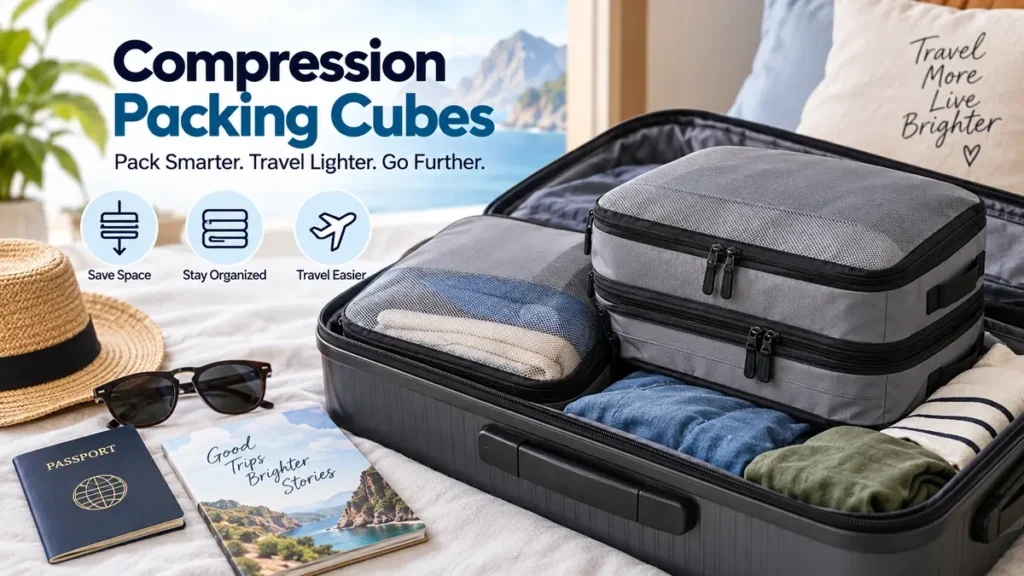
3. Use packing cubes strategically
Packing cubes help separate categories such as:
- Tops
- Bottoms
- Underwear
- Sleepwear
- Electronics
- Laundry
Compression organizers can reduce the physical volume of soft clothing, but remember that compression does not reduce its weight.
4. Use awkward spaces
Socks and other small soft items can occupy gaps around larger objects. Shoes can hold suitable small items if hygiene is managed appropriately.
The goal isn’t to force every cubic centimeter full. Leaving a little space makes repacking considerably easier.
5. Separate dirty laundry
Carry a lightweight laundry bag or another method of isolating used clothing.
Resealable bags are also useful for wet swimsuits, potential toiletry leaks, and small objects. Rick Steves specifically highlights sealable bags for liquids, wet clothes, leftovers, and organization.
6. Weigh your luggage
Airline baggage allowances vary by carrier, route, fare, and cabin.
Check your specific booking rather than assuming a familiar allowance applies. Weighing your suitcase at home gives you time to reorganize instead of doing it beside an airport check-in desk.
Quick Takeaway: The easiest way to pack lighter is not a clever folding technique. It is taking fewer things. Organization saves space; editing your packing list saves both space and weight.
How to Avoid Overpacking
Overpacking usually happens because travelers pack for anxiety rather than probability.
The most effective approach is to prioritize items that serve more than one purpose.
A sweater can work on the plane, during cool evenings, and inside aggressively air-conditioned buildings. Comfortable shoes can handle sightseeing and casual dinners. A smartphone may replace a separate alarm clock, map, notebook, entertainment device, and basic camera.
Plan to do laundry on longer trips
A 14-day trip does not necessarily require 14 complete sets of clothing.
Laundry access can dramatically reduce your load. This is especially valuable for underwear, socks, T-shirts, and lightweight travel clothing.
Don’t pack things easily available at your destination
Some inexpensive everyday products can simply be purchased if needed.
There are exceptions. Specialized medication, unusual sizes, prescription products, critical equipment, and items that may be difficult to find locally deserve more careful planning.
Limit footwear
Shoes are bulky and heavy.
For many ordinary vacations, one comfortable primary pair plus one destination-specific alternative is enough. Extra footwear should solve a real problem: formal event, beach, hiking, snow, or another planned activity.
Common Packing Mistakes
Even a detailed packing list can fail if you use it mechanically.
Packing without checking the weather
“Summer” does not automatically mean hot and dry. Elevation, rainfall, wind, regional climate, and sudden weather changes matter.
Check conditions shortly before departure.
Forgetting activity-specific clothing
The weather may suggest casual summer clothing, but your itinerary may include a religious site, formal restaurant, business meeting, hike, or other setting with different requirements.
Review the itinerary alongside the forecast.
Putting all essentials in checked baggage
Lost or delayed luggage becomes far more serious when it contains your medicine, documents, keys, or every change of clothing.
Keep irreplaceable essentials accessible.
Bringing too many duplicates
Three chargers that serve the same purpose, four pairs of similar shoes, or multiple heavy jackets can quickly consume your allowance.
Forgetting the return journey
Your belongings rarely become easier to pack during a trip.
Allow space for dirty laundry and anything legitimately acquired while traveling. Do not rely on achieving the same perfectly compressed arrangement you created at home.
A Better Pre-Departure Packing Routine
Packing is easier when it happens in stages rather than during the final hour before leaving.
REI’s broader travel-preparation checklist starts some tasks 10–30 days before departure, including choosing appropriate luggage and creating a trip-specific gear list, then moves to prescriptions and other preparations closer to departure.
A practical routine looks like this:
Several days before departure
Check:
- Weather forecast
- Passport and entry requirements
- Airline baggage allowance
- Accommodation amenities
- Planned activities
- Medication supply
- Chargers and adapters
- Laundry availability
Start laying out clothing rather than immediately packing it.
The day before departure
Confirm:
- Online check-in where available
- Boarding information
- Airport transfer
- Passport
- Wallet
- Medication
- Phone
- Chargers
- Luggage weight
- Essential reservations
Charge your devices and power bank.
Immediately before leaving
Use a final “cannot leave without these” check:
Phone. Wallet. Passport/ID. Medication. Keys.
Then verify that windows and doors are secured, unnecessary appliances are dealt with appropriately, and any required arrangements for pets, mail, plants, or home security are in place.
Printable-Style Final Packing List
For the final check, use this condensed version.
| Category | Check Before Leaving |
|---|---|
| Documents | Passport, ID, visa, tickets, reservations |
| Money | Cards, cash, wallet |
| Clothing | Tops, bottoms, underwear, socks, layers |
| Footwear | Walking shoes, activity-specific pair |
| Weather | Jacket, rain protection, hat |
| Toiletries | Dental care, deodorant, skincare, hygiene |
| Health | Medication, first aid, sunscreen |
| Electronics | Phone, chargers, power bank, adapter |
| Flight essentials | Headphones, comfort items, permitted liquids |
| Organization | Packing cubes, laundry bag, resealable bags |
| Activities | Swim, hiking, formal, business, sports gear |
| Backups | Document copies, offline information |
| Final check | Phone, wallet, passport/ID, medicine, keys |
The Best Packing List Is the One You Edit
A useful packing list is not the longest checklist you can find. It is one that accounts for your destination, weather, itinerary, trip duration, personal needs, baggage restrictions, and access to laundry.
Start with documents and medication because they are hardest to replace. Add clothing built around actual activities, followed by toiletries and electronics. Keep critical belongings in your carry-on, verify airline and security restrictions, and then remove items you cannot realistically explain when you will use.
Pack for the trip you are actually taking—not every trip that could theoretically happen.