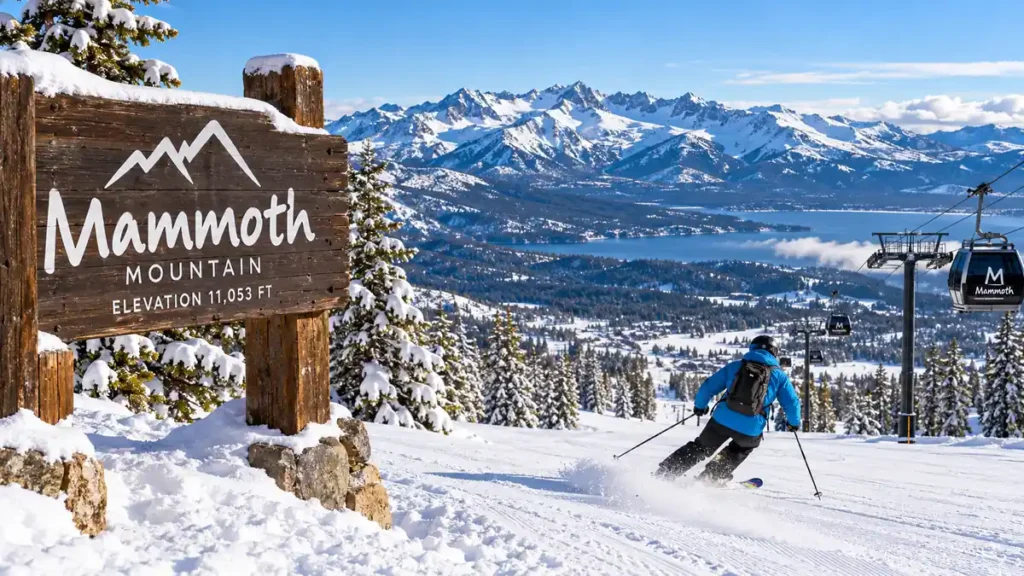
Mammoth Mountain lives up to its name. High in California’s Eastern Sierra, this huge winter playground combines a 11,053-foot summit, long ski season, extensive intermediate terrain, serious expert lines, beginner learning zones, and some of the best-known terrain parks in the United States.
mammoth ski resort is Mammoth Mountain Ski Area in Mammoth Lakes, California, with 3,500+ acres of skiable terrain, a 3,100-foot vertical rise, roughly 180 named trails and 25 lifts. Its high elevation and substantial snowfall help create a ski season that commonly extends from November into late spring or early summer.
That scale is only part of the story. Mammoth is unusual because first-time skiers, park riders, cruising intermediates and experts hunting steep alpine terrain can all find worthwhile skiing on the same mountain.
This guide explains what the resort is actually like, where to ski, when to go, how to navigate its different base areas and what first-time visitors should know.
mammoth ski resort at a Glance
Mammoth Mountain sits beside the town of Mammoth Lakes on the eastern side of California’s Sierra Nevada. The resort operates partly within Inyo National Forest and has developed into one of California’s major four-season mountain destinations.
Here are the core mountain statistics:
| Mountain feature | Mammoth Mountain |
|---|---|
| Summit elevation | 11,053 ft / 3,369 m |
| Base elevation | 7,953 ft / 2,424 m |
| Vertical rise | 3,100 ft / 945 m |
| Skiable terrain | 3,500+ acres |
| Named trails | About 180 |
| Lifts | 25 |
| Typical season | November–June |
| Average snowfall | About 400 inches according to Mammoth Mountain |
| Location | Mammoth Lakes, California |
Mammoth’s official snowfall history describes an average of roughly 400 inches per season and around 300 days of sunshine annually. Actual snowfall varies dramatically from winter to winter.
The 2022–23 winter demonstrates just how extreme those variations can become. Mammoth reported more than 700 inches at Main Lodge and close to 900 inches near the summit during that record-breaking season.
Why is it called Mammoth Mountain?
The mountain is literally volcanic.
The U.S. Geological Survey identifies Mammoth Mountain as an 11,053-foot lava-dome complex on the southwestern rim of Long Valley Caldera. Its main volcanic structure was produced through approximately 25 eruptive episodes between roughly 100,000 and 51,000 years ago.
That volcanic history helped create the broad mountain and varied terrain skiers experience today.
The ski area’s modern history is closely associated with Dave McCoy, who recognized the area’s reliable snow and developed skiing on the mountain. A U.S. Forest Service permit in 1953 helped establish the ski operation, followed by Mammoth’s first permanent chairlift in 1955.
Where Is Mammoth Mountain Ski Resort?
Mammoth Mountain is in Mammoth Lakes, California, along the US Highway 395 corridor in the Eastern Sierra.
It is particularly popular with Southern California skiers because Mammoth offers the scale and elevation of a major destination resort within driving distance of Los Angeles.
Mammoth Mountain estimates the drive at approximately:
- Los Angeles: 5 hours
- Reno: 3 hours
- San Francisco Bay Area: around 6 hours via Yosemite when Tioga Pass is open
Tioga Pass is seasonal and typically provides the more direct Yosemite route during warmer months rather than the main winter ski season.
Travel times can change substantially with traffic and winter weather, so the mileage alone does not tell you how long a ski-weekend journey will take.
Driving to Mammoth
US 395 is the primary road corridor for reaching Mammoth Lakes.
For many visitors, driving is the simplest option because it makes carrying skis, snowboards, boots and winter clothing easier. A car can also be useful for exploring destinations beyond town.
Winter changes the calculation.
Sierra storms can produce rapidly changing highway conditions. Travelers should check road restrictions, weather forecasts and chain requirements before departure rather than assuming conditions in Los Angeles or another lower-elevation city reflect conditions around Mammoth.
Can you fly to Mammoth Mountain?
Air travel can also be an option.
Mammoth Mountain identifies Mammoth Yosemite Airport as approximately 20 minutes outside town and Bishop Airport as about 45 minutes away. Available flights and schedules can vary, so travelers should verify current service when planning a specific trip.
Once in Mammoth Lakes, having a rental car is not always essential because the local transportation network connects many important areas.
Mammoth Mountain Terrain: What the Skiing Is Really Like
The biggest strength of mammoth ski resort is terrain variety.
Its 3,500+ skiable acres extend from relatively protected lower-mountain learning areas to exposed alpine terrain above the tree line. That creates noticeably different skiing experiences depending on elevation, weather and which base lodge you use.
You can spend one day making relaxed groomer laps and the next exploring steep bowls, moguls, chutes or terrain parks without leaving the resort.
Beginner terrain
Mammoth can look intimidating on a trail map, but beginners have dedicated places to learn.
Three especially useful starting zones are Main Lodge, Canyon Lodge and Eagle Lodge.
At Main Lodge, Discovery Chair 11 serves terrain specifically intended for new skiers and snowboarders. Beginner routes include Apple Pie, Sesame Street and Lower Road Runner. Once comfortable, skiers can progress toward terrain accessed by Unbound Express.
Canyon Lodge has beginner terrain around Schoolyard Express 17 and Chair 7. The latter serves a classic learning area, while Schoolyard provides several green trails for practicing turns and building confidence.
Eagle Lodge is another strong option. Its longer easy runs give developing skiers room to progress beyond the smallest learning slopes.
Quick takeaway: A first-time skier should not simply board a lift because a green trail appears somewhere on the map. Start in a dedicated progression area and learn how different base areas connect before exploring farther across the mountain.
Intermediate skiing
Intermediate skiers arguably have the easiest time taking advantage of Mammoth’s size.
Once you are comfortable on blue runs, much more of the mountain becomes accessible. Long groomers, rolling terrain and routes connecting different lift pods allow confident intermediates to explore rather than repeatedly skiing one small section.
Independent resort descriptions consistently identify intermediate terrain as a major share of Mammoth’s trail network, although exact percentages can differ depending on how runs are classified.
That makes Mammoth particularly appealing for a multi-day trip. Instead of simply repeating the same favorite runs, intermediates can progressively explore Eagle, Canyon, Main Lodge and higher mountain areas as conditions permit.
Advanced and expert terrain
This is where Mammoth’s elevation becomes especially noticeable.
The upper mountain rises above the tree line and offers exposed bowls, steep faces, chutes, moguls and ungroomed terrain. The Panorama Gondola provides access toward the summit, where experienced skiers can reach some of Mammoth’s signature terrain.
Cornice Bowl is among the better-known upper-mountain routes, while expert skiers also seek terrain around Chair 22 and areas such as the Dropout Chutes.
These runs should not be judged solely by trail-map symbols.
Snow quality, visibility, wind, bumps and surface conditions can transform the difficulty of high-alpine terrain. A run that feels manageable on a clear powder morning may be much more demanding when visibility deteriorates or the surface becomes firm.
That is one reason checking the day’s lift and trail status matters before heading upward.
Mammoth Mountain Terrain Parks
Freestyle skiing and snowboarding are a major part of Mammoth’s identity.
The resort’s Unbound Terrain Parks system spreads features across multiple areas and progression levels. Mammoth’s current trail information describes 10 unique parks, two halfpipes, more than 100 jib features and as many as 50 jumps on a given day, covering over 100 acres.
The important word is progression.
Terrain parks are not exclusively for riders attempting enormous jumps. Smaller features allow developing park skiers and snowboarders to learn fundamental skills before advancing toward more technical rails, transitions and larger jumps.
Main Park, near Main Lodge, is one of Mammoth’s best-known freestyle areas and has played an important role in the resort’s reputation among high-level riders.
If you are simply skiing past a terrain park, pay attention to entrances and signage. Park etiquette and feature inspection matter because jump shapes and landings can change throughout the season.
The Four Main Areas You Need to Understand
One common first-visit mistake is treating Mammoth Mountain as though it has a single base.
It doesn’t.
Understanding the major starting points makes navigating the mountain considerably easier.
Main Lodge
Main Lodge sits around 9,000 feet and is the classic Mammoth starting point.
It provides access to the Panorama Gondola, beginner terrain, upper-mountain connections, dining, rentals and the Unbound Main Park. It is particularly useful if reaching the summit is a priority.
Because it is such an important hub, it can also feel busy on peak days.
Canyon Lodge
Canyon Lodge sits closer to town and can be reached from The Village using the Village Gondola when that gondola is operating.
It combines beginner access, mountain connections, dining and a lively base atmosphere. For visitors staying around The Village, Canyon can be more convenient than driving toward Main Lodge.
Eagle Lodge
Eagle Lodge is especially useful for families and mixed-ability groups.
Gentler terrain provides a comfortable starting point for less experienced skiers, while connections toward Lincoln Mountain give stronger skiers access to more challenging terrain. Eagle is also adjacent to Juniper Springs Resort.
The Village at Mammoth
The Village is not simply another conventional slopeside base.
It functions as an accommodation, dining and activity hub with the Mountain Center for services such as rentals and tickets. During winter operations, the Village Gondola links it with Canyon Lodge.
There is also a Village Ski Back Trail for returning from the mountain when that route is open.
What about The Mill?
The Mill is a useful mid-mountain meeting point rather than a full base lodge in the same sense as Main, Canyon or Eagle.
It provides access around Chairs 2 and 10, parking and a convenient place for groups to regroup.
For families or friends with different skiing abilities, agreeing on a recognizable meeting point before separating can save considerable time.
Snowfall and the Mammoth Ski Season
Snow reliability is one of Mammoth Mountain’s biggest attractions.
The resort’s high summit catches Sierra storms while elevation helps preserve snow later into spring. Mammoth Mountain reports roughly 400 inches of average annual snowfall and describes its typical operating season as November through June.
That does not mean every lift or trail remains open for that entire period.
Early-season and late-season operations depend on snow coverage, temperatures, staffing and conditions. Individual lifts and lower-elevation base areas may close while skiing continues elsewhere.
When does Mammoth Mountain open?
For the upcoming 2026–27 season, Mammoth Mountain has announced its official Opening Day for November 13, 2026, with scheduled festivities beginning at 8:30 a.m.
Opening dates remain dependent on conditions, so anyone planning an early-season trip should check current mountain operations shortly before traveling.
How late does Mammoth stay open?
Mammoth is famous for spring skiing and occasionally operates unusually deep into the year.
The normal pattern is approximately November through June, but exceptional snow years can push skiing considerably later. The remarkable 2022–23 season, for example, continued into August.
A long calendar season should not be confused with midwinter conditions. Spring skiing has its own rhythm: colder, firmer snow in the morning can soften significantly as sunlight and temperatures increase.
Best Time to Ski at mammoth ski resort
There is no universally perfect month. The right period depends on what you want from the mountain.
| Period | Typical appeal | Main trade-off |
|---|---|---|
| November–December | Early-season excitement, holiday trips | Terrain coverage can vary |
| January–February | Midwinter snow and powder potential | Cold, storms and busy weekends |
| March | Deep seasonal base with longer daylight | Variable storm cycles |
| April | Spring conditions and sunshine | Snow changes through the day |
| May–June | Late-season skiing in good snow years | Reduced terrain/services possible |
If powder is your main goal, you are really chasing storm cycles rather than choosing a guaranteed month.
If you prefer groomers, sunshine and comfortable temperatures, spring can be excellent.
Families tied to school calendars often arrive during Christmas, Presidents’ Day periods and spring break, which can increase crowds.
The Mammoth wind factor
High elevation comes with a trade-off: exposure.
Upper-mountain lifts and terrain can be affected by strong winds or poor visibility even while lower slopes remain skiable. That makes flexibility valuable.
On a stormy or windy day, do not build your entire plan around reaching the summit. Explore protected lower terrain and save exposed alpine runs for better conditions.
Mammoth Mountain for Beginners
Yes, Mammoth Mountain is good for beginners.
Its sheer size can make the trail map look complicated, but the resort has designated progression terrain and a ski and snowboard school. Independent ski-area evaluations also highlight the abundance of manageable lower-mountain slopes.
A sensible first-day progression looks like this:
- Choose one base area rather than trying to explore the entire resort.
- Take a lesson if you have never skied or snowboarded.
- Practice stopping and turning on the learning slope.
- Move onto green trails only when you can control your speed.
- Study the return route before riding unfamiliar lifts.
- Progress toward easy blue terrain gradually.
At Main Lodge, Discovery Chair is specifically intended for learning. Canyon’s Schoolyard area and Eagle’s longer green runs provide alternatives.
The most common beginner mistake at a large resort is progressing geographically rather than technically—traveling farther across the mountain because it looks exciting even though the required skiing skills have not caught up.
Ski Lessons and Equipment Rentals
Visitors do not need to own skis or a snowboard to experience Mammoth.
Rentals are available at multiple mountain locations, including base lodges and the Mountain Center in The Village. Mammoth distinguishes between standard rental equipment suited to many learners and demo equipment for riders interested in higher-performance gear.
Lessons are useful for more than absolute beginners.
An intermediate skier struggling with parallel turns, bumps or steeper terrain may get more value from focused instruction than from repeatedly practicing the same technique incorrectly.
Remember that lessons and rentals can be location-specific. If you book equipment at Eagle Lodge but intend to start at Main Lodge, you have created an unnecessary logistical problem.
Check the pickup location before finalizing plans.
Lift Tickets, Ikon Pass and Mountain Access
Skiers and snowboarders need valid mountain access, normally through a lift ticket or eligible pass.
Mammoth Mountain participates in the Ikon Pass system. The exact access rules, blackout dates and reservation requirements can differ by pass product and season, so passholders should check their current benefits rather than relying on information from an older ski trip.
The same principle applies to daily lift tickets.
Prices are dynamic and can change according to date and demand, making a fixed price quoted months before a trip potentially misleading.
Children aged four and under and adults aged 80 or older currently ski free according to Mammoth’s first-timer information, though current resort policies should always be verified before travel.
Getting Around Mammoth Without a Car
Mammoth Lakes has a useful advantage for a mountain town: free public transportation can reduce the need to drive once you arrive.
The Eastern Sierra Transit Authority (ESTA) operates routes connecting town with mountain areas. Mammoth’s resort information identifies free transit serving The Village and the three principal base lodges.
The Red Line, for example, connects the Community Recreation Center, The Village and Main Lodge during its winter operating period. Other services connect The Village and Canyon Lodge.
This can be particularly useful during busy weekends when parking becomes inconvenient.
Parking at Mammoth Mountain
Parking availability varies by base area.
At Main Lodge, Mammoth operates a parking shuttle serving designated parking zones along Minaret Road as well as selected chairlift lots. The published shuttle schedule currently runs from 7:00 a.m. to 5:00 p.m., with buses departing Main Lodge roughly every ten minutes.
Operational schedules can change, so treat those times as something to confirm before your trip.
A simple strategy on busy days is to use town transit instead of repeatedly moving your vehicle between mountain areas.
Where to Stay Around Mammoth Mountain
Accommodation choice affects a ski trip more than many first-time visitors expect.
The best area depends on whether you prioritize immediate slope access, restaurants, nightlife, family convenience or lower lodging costs.
The Village
Staying near The Village makes sense for visitors who want restaurants and other services close by.
The winter gondola connection to Canyon Lodge also reduces morning transportation hassles when operating.
Main Lodge area
This is useful for visitors prioritizing mountain access over being in the middle of town.
You are positioned close to high-elevation skiing and the Panorama Gondola, although dining and evening options differ from staying around The Village.
Eagle Lodge and Juniper Springs
This side of the mountain works particularly well for families and skiers who appreciate convenient access to gentler terrain.
Juniper Springs Resort sits next to Eagle Lodge, making this an attractive setup for groups that want to minimize morning travel.
Mammoth Lakes town
Staying elsewhere in town can provide a broader selection of accommodations and easy access to groceries, restaurants and local services.
The trade-off is that you need a plan for reaching the mountain each morning, whether by shuttle or car.
Altitude at Mammoth Mountain: What Visitors Should Know
Elevation is one of the most overlooked parts of a Mammoth trip.
Mammoth Lakes itself is already high, and the ski area’s elevation ranges from about 7,953 feet at its lower base to 11,053 feet at the summit.
Visitors arriving from near sea level may notice the difference.
Possible altitude-related symptoms include headache, dizziness, nausea and unusual fatigue. Mammoth recommends staying hydrated, pacing yourself and descending to lower elevation if necessary.
There is another consequence of altitude: stronger ultraviolet exposure.
Wear sunscreen and SPF lip protection even on cold days. Snow reflects sunlight, so exposed skin can burn surprisingly quickly.
Alcohol, dehydration, hard skiing and insufficient sleep are not an ideal combination when you have just arrived at elevation.
Food, Après-Ski and The Village
A Mammoth ski trip does not end with the final chair.
Dining is available around the mountain and across Mammoth Lakes, while The Village serves as one of the main social hubs for visitors. Canyon Lodge also develops a lively après atmosphere on selected winter days.
On-mountain restaurants are convenient but can become crowded around traditional lunchtime.
A practical approach is to eat slightly before or after the noon rush when possible. That often means less time waiting and more time skiing while other visitors are inside.
For multi-day trips, mixing restaurant meals with groceries can also make the trip easier and less expensive.
What Else Can You Do Besides Downhill Skiing?
Mammoth is not exclusively an alpine ski destination.
The broader Mammoth Lakes region supports numerous winter activities, making it more suitable for groups where not everyone wants to ski every day.
One notable option is the Tamarack cross-country network in the Mammoth Lakes Basin. Mammoth lists more than 19 miles of groomed terrain for cross-country skiing and snowshoeing.
Woolly’s Adventure Summit provides another alternative, with winter attractions such as tubing and the mountain coaster when operating.
Visitors can also simply explore Mammoth Lakes, enjoy scenic views or take a rest day.
That last option is underrated. On a five- or six-day mountain trip, a recovery day can make the remaining ski days much more enjoyable.
Is Mammoth Mountain Family-Friendly?
Mammoth works well for families, particularly when accommodation and base-lodge choices are planned around the least experienced skier.
Eagle Lodge’s beginner-friendly terrain is useful for mixed-skill families. Main and Canyon also have dedicated learning zones, lessons, rentals and dining facilities.
The resort’s size does create one challenge: separation.
A family member who accidentally takes the wrong lift or follows the wrong trail can end up much farther away than expected.
Before skiing, agree on:
- A primary meeting point
- A backup meeting point
- A meeting time
- Which base lodge everyone is returning to
- What to do if mobile service or battery power becomes unreliable
Children should also carry basic identification and emergency contact information.
Safety and Mountain Etiquette
A ski resort is a managed environment, but it remains a mountain environment.
Trail ratings indicate relative difficulty within that ski area; they do not guarantee identical conditions every day. Mammoth’s map uses standard categories ranging from easiest terrain through difficult and extremely difficult runs, along with separate symbols for freestyle terrain, slow zones and closed areas.
Good mountain habits include:
- Stay in control and ski within your ability.
- Give people downhill the right of way.
- Look uphill before merging onto a trail.
- Do not stop where approaching skiers cannot see you.
- Respect closures and ski-area boundaries.
- Slow down around learning areas and congested intersections.
- Check weather, lift and trail status before heading into upper terrain.
- Inspect terrain-park features before attempting them.
A closed trail is not an invitation to search for untouched powder. Closures can indicate avalanche work, insufficient coverage or another hazard that is not visible from the entrance.
Common First-Time Mammoth Mistakes
Trying to ski the whole mountain immediately
With 3,500+ acres, Mammoth is too large to understand in a couple of morning laps.
Explore one zone at a time.
Choosing the wrong base lodge
Your lesson, rental reservation, accommodation and skiing ability should influence where you begin.
A convenient base can save a surprising amount of time.
Ignoring altitude
A hard first day after arriving from sea level can leave you exhausted. Hydrate and adjust your pace.
Assuming summit terrain will always be accessible
Wind and weather can affect the upper mountain independently of lower slopes.
Keep alternative routes in mind.
Moving the car unnecessarily
Free local transit and the Village Gondola can often make transportation easier.
Forgetting how large the temperature range can be
Morning, summit and afternoon conditions may feel completely different.
Layering is more useful than relying on one extremely heavy jacket.
How to Plan a First Trip to mammoth ski resort
The easiest way to plan Mammoth is to work backward from your ski days.
Step 1: Pick the part of the season
Decide whether your priority is midwinter powder, spring sunshine or late-season skiing.
Step 2: Choose your accommodation area
Match lodging to the base lodge and atmosphere that fit your group.
Step 3: Decide how you will reach Mammoth
Most travelers drive via US 395, while air travel may be practical depending on available service.
Step 4: Arrange lift access
Confirm your current Ikon Pass benefits or lift-ticket requirements.
Step 5: Reserve lessons and rentals when needed
Pay close attention to the pickup or lesson location.
Step 6: Study the trail map
Learn where Main Lodge, Canyon Lodge, Eagle Lodge, The Village and The Mill sit relative to one another.
Step 7: Check conditions shortly before skiing
Look at snowfall, weather, wind, road conditions, lift status and open terrain.
Step 8: Start conservatively
Give yourself time to acclimatize and understand the mountain before chasing summit terrain.
Is Mammoth Mountain Worth Visiting?
For skiers and snowboarders looking for a large California mountain with substantial terrain variety, Mammoth has a compelling combination.
Its strengths are easy to identify: 3,500+ skiable acres, 3,100 feet of vertical, an 11,053-foot summit, extensive intermediate terrain, genuine expert skiing, established beginner zones, Unbound Terrain Parks and a remarkably long potential season.
There are trade-offs.
Peak weekends can be busy. High elevation requires adjustment for some visitors. Upper lifts can be affected by wind, and a resort this large takes time to learn. Travel during major Sierra storms can also become complicated.
Those weaknesses are worth understanding because Mammoth is best experienced with flexibility rather than an inflexible checklist of runs.
Final Thoughts on mammoth ski resort
mammoth ski resort stands out because it serves several kinds of skier exceptionally well on one mountain. Beginners have structured learning terrain, intermediates can spend days exploring groomed routes, experts get high-alpine bowls and chutes, and freestyle riders have Mammoth’s extensive Unbound park system.
For a first trip, focus less on covering every acre and more on understanding the mountain. Pick the right base lodge, respect the 11,053-foot elevation, use Mammoth Lakes’ transit network where practical, and check daily weather and lift conditions before heading uphill.
Do that, and Mammoth Mountain becomes much easier to navigate—and its enormous scale becomes the reason to return rather than something you have to conquer in a single visit.