People exploring Christianity often encounter unfamiliar religious terms, especially when learning about baptism and church membership. One such term is catechumen, which describes an important stage in a person’s spiritual journey.
A catechumen is an unbaptized person receiving religious instruction and spiritual preparation before entering the Christian Church through baptism. During this period, individuals learn Christian beliefs, study Scripture, practice prayer, participate in church life, and develop an understanding of the responsibilities associated with becoming a Christian.
The practice dates back to the early Christian Church and remains significant in Roman Catholicism, Eastern Orthodoxy, and several other Christian traditions.
What Does catechumen Mean?
The term describes someone formally preparing to receive baptism. Rather than simply studying Christianity out of curiosity, this individual is undertaking a process of religious formation.
The preparation involves intellectual, spiritual, moral, and practical development. Participants learn what Christians believe while discovering how those beliefs influence everyday life.
Origin and Etymology
The word comes from the Greek katēchoumenos, meaning a person receiving instruction. It is derived from katēchein, a Greek verb associated with oral teaching.
The term entered Latin as catechumenus before becoming part of the English religious vocabulary. Catholic Culture+1
Several related terms share this linguistic origin:
| Term | Meaning |
|---|---|
| Catechumen | A person preparing for Christian baptism |
| Catechumenate | The period or process of preparation |
| Catechesis | Instruction in Christian beliefs |
| Catechist | A person who provides religious instruction |
| Catechism | An organized presentation of Christian teachings |
| Neophyte | A newly baptized Christian |
How Is the Word Pronounced?
The English pronunciation is approximately kat-uh-KYOO-muhn.
The plural form is catechumens.
The word functions as a noun and generally refers to someone receiving formal instruction before baptism.
Biblical Meaning and Historical Origins
Although the modern structure of Christian initiation developed gradually, its foundations can be found in the New Testament.
Early Christian communities emphasized teaching, repentance, faith, baptism, and participation in religious fellowship.
Biblical Foundations
Several passages illustrate the importance of religious instruction and preparation.
| Bible Passage | Significance |
|---|---|
| Matthew 28:19–20 | Making disciples through baptism and teaching |
| Acts 2:41–42 | Baptism, fellowship, and apostolic teaching |
| Luke 1:4 | Understanding previously received religious instruction |
| Acts 18:24–26 | Religious instruction received by Apollos |
| Galatians 6:6 | The relationship between religious teachers and learners |
| 1 Corinthians 14:19 | The importance of understandable instruction |
Galatians 6:6 contains a Greek expression referring to someone receiving instruction, closely connected to the linguistic origins of the modern term.
These passages establish the importance of teaching within Christian discipleship, although they do not prescribe a single formal preparation program.
The Practice in the Early Christian Church
During the first centuries of Christianity, converts frequently came from religious and cultural backgrounds unfamiliar with Christian beliefs.
Church leaders developed structured preparation to help converts understand their new faith and demonstrate their commitment.
Early Christian writers associated with the development of religious instruction include Justin Martyr, Tertullian, Origen, Augustine of Hippo, and Cyril of Jerusalem.
By the third and fourth centuries, preparation for baptism had become increasingly organized in many Christian communities. Instruction was often accompanied by prayer, fasting, moral formation, and participation in worship.
Some ancient communities expected preparation to last several years. However, practices differed according to location, circumstances, and church leadership. New Advent+2
As infant baptism became more widespread, the formal adult preparation process declined in many regions. Its principles nevertheless survived and were later renewed in several Christian traditions.
How to Become a catechumen
Individuals interested in becoming baptized Christians typically begin by contacting a local church. The exact procedure depends on the denomination and its religious traditions.
The Roman Catholic Church uses the Order of Christian Initiation of Adults (OCIA), formerly known as the Rite of Christian Initiation of Adults (RCIA).
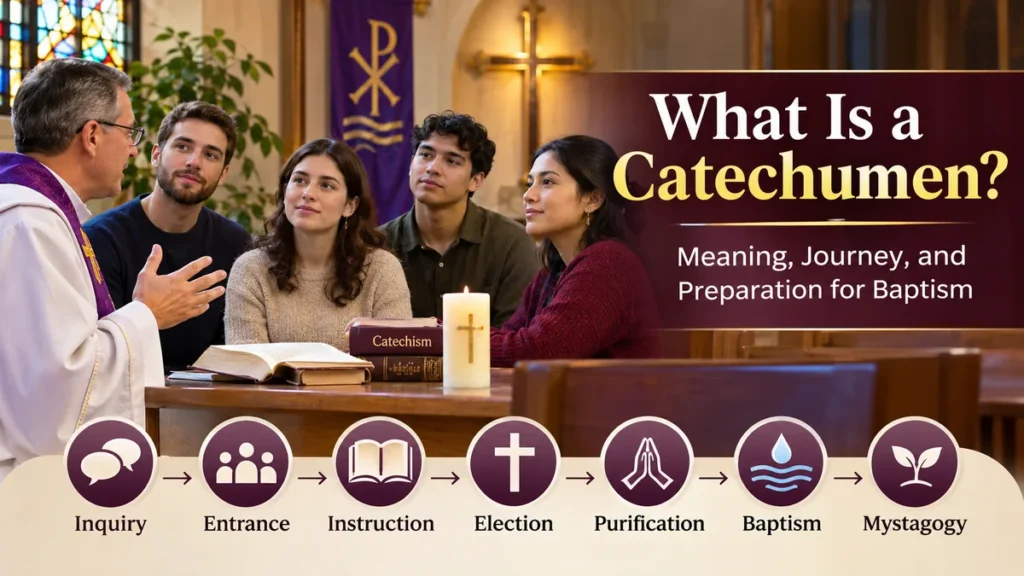
1. Inquiry and Evangelization
The initial stage is called the precatechumenate. During this period, interested individuals explore Christianity, ask questions, attend services, and learn about Jesus Christ.
There is no obligation to proceed to baptism.
2. Formal Entrance
Once an unbaptized individual decides to pursue Christian initiation, the church may formally receive that person through the Rite for Entrance into the Catechumenate, traditionally called the Rite of Acceptance.
This public ceremony acknowledges the individual’s intention to pursue baptism.
3. Religious Instruction and Formation
Participants receive structured instruction in Christian doctrine, Scripture, worship, prayer, and moral teachings.
This period also provides opportunities to develop relationships within the Christian community and receive guidance from experienced church members.
4. Rite of Election
In Catholic tradition, individuals who are considered ready for baptism participate in the Rite of Election.
This ceremony traditionally occurs around the beginning of Lent. Those selected for the forthcoming sacraments of initiation become known as the Elect.
5. Purification and Enlightenment
Throughout Lent, the Elect focus on spiritual reflection, repentance, prayer, and preparation for baptism.
Special religious ceremonies known as scrutinies encourage participants to examine their lives and deepen their commitment to Christianity.
6. Celebration of Christian Initiation
Adult converts in the Catholic Church commonly receive three sacraments during the Easter Vigil:
- Baptism
- Confirmation
- Holy Eucharist
7. Mystagogy
Mystagogy is the period of continued spiritual formation following baptism.
Newly baptized Christians reflect on their sacramental experiences and become more actively involved in their religious community. USCCB+1
What Does a Catechumen Learn?
Christian formation goes beyond memorizing religious doctrines. Its purpose is to help individuals understand Christian beliefs and apply them to everyday life.
Scripture and Christian Doctrine
Participants typically explore the Old and New Testaments, the life and teachings of Jesus Christ, salvation, resurrection, and the Holy Trinity.
They may also study foundational statements of Christian belief, including the Apostles’ Creed and Nicene Creed.
Prayer and Worship
Religious instruction introduces participants to personal prayer, communal worship, and liturgical practices.
In Catholic and Orthodox traditions, this may include learning about the significance of the church calendar, Lent, Easter, fasting, and sacramental celebrations.
Christian Moral Teaching
Participants explore how Christian principles influence personal decisions, relationships, responsibilities, and attitudes toward others.
Forgiveness, compassion, honesty, repentance, and charitable service are common areas of discussion.
Community Participation
Developing connections within a church community is another central aspect of preparation.
Through fellowship, religious education, and voluntary service, individuals become familiar with the practical dimensions of Christian discipleship.
Catechumen vs. Candidate: What Is the Difference?
Although both terms describe individuals preparing for fuller participation in the Church, they have distinct meanings in Catholic religious practice.
The primary distinction concerns baptismal status.
| Feature | Catechumen | Candidate |
|---|---|---|
| Baptismal status | Unbaptized | Already validly baptized |
| Primary purpose | Preparation for Christian initiation | Reception into full Catholic communion |
| Requires baptism | Yes | No |
| Religious instruction | Required | Adapted to previous formation |
| Rite of Election | Normally participates | Does not participate as a catechumen |
| Sacraments | Baptism, Confirmation, Eucharist | Confirmation and Eucharist, as applicable |
A baptized Christian from another denomination generally does not need to receive baptism again when entering the Catholic Church, provided the original baptism is recognized as valid. Amazon Web Services, Inc.+1
Catechumen vs. Catechist
A catechumen receives religious instruction, while a catechist provides it.
Catechists help learners understand Christian teachings, answer religious questions, and develop their spiritual understanding.
Catechumen vs. Neophyte
A neophyte is a person who has recently received baptism.
The distinction marks the transition from preparation for Christian initiation to life as a baptized church member.
Catechumens in Catholic and Orthodox Christianity
Although Catholic and Orthodox churches share historical foundations, their preparation procedures and liturgical practices are not identical.
Roman Catholic Church
Catholic preparation follows OCIA and emphasizes conversion, religious education, sacramental preparation, and participation in parish life.
The Second Vatican Council encouraged the restoration of the adult catechumenate as a structured process involving successive stages of formation.
According to the Catechism of the Catholic Church, paragraphs 1247–1249, preparation should promote spiritual maturity, faith, and participation in the Christian community. Vatican+1
Eastern Orthodox Church
Eastern Orthodox Christianity also maintains a tradition of preparing individuals before their reception into the Church.
Instruction commonly covers Orthodox theology, sacred traditions, icons, liturgical worship, prayer, fasting, and participation in the Divine Liturgy.
Christian initiation in Eastern traditions connects baptism, chrismation, and Holy Communion closely.
Local priests and bishops determine the appropriate preparation and reception process, which may differ among Orthodox jurisdictions. igoarchusa.orthodoxws.com+1
Protestant and Anglican Traditions
Some Anglican, Lutheran, and other Protestant communities maintain catechumenal programs or similar forms of baptismal instruction.
Other denominations use different terminology, such as baptism classes, discipleship courses, or new believer classes.
The structure depends on each denomination’s understanding of baptism, church membership, and religious education.
How Long Does the Catechumenate Last?
There is no universal duration for becoming a baptized Christian. Preparation may take several months, a year, or longer.
Several factors influence the length of the process:
| Factor | Influence on Duration |
|---|---|
| Previous religious knowledge | May affect educational requirements |
| Spiritual readiness | Determines whether further preparation is appropriate |
| Church denomination | Different traditions follow different procedures |
| Parish schedule | Influences instruction and ceremony dates |
| Personal circumstances | May require additional time or guidance |
In some modern Orthodox communities, preparation commonly lasts between six months and one year, although longer periods are possible.
Historically, certain Christian communities maintained preparation periods of approximately three years.
The purpose is not simply to complete a prescribed number of lessons. Christian formation is concerned with understanding, sincere commitment, and spiritual development. igoarchusa.orthodoxws.com+1
Can Children Become Catechumens?
Yes. Unbaptized children who have reached the age of reason may participate in an age-appropriate Christian initiation process.
In Catholic practice, the age of reason is generally associated with approximately seven years of age.
Instruction is adapted to the child’s maturity, understanding, and family circumstances. Infants typically follow a different baptismal preparation process involving parents and godparents.
Religious Rights, Responsibilities, and Spiritual Status
Individuals preparing for baptism occupy a distinctive position within the Christian community. They have expressed an intention to embrace Christianity but have not yet completed sacramental initiation.
Is a Catechumen Considered a Christian?
The answer depends on theological context and the particular church tradition.
In Catholic teaching, catechumens already have a special connection with the Church through their expressed desire to receive baptism.
However, this relationship is distinguished from full sacramental membership following baptism.
Can Catechumens Attend Mass?
Yes. Catechumens are generally encouraged to attend Mass and participate in appropriate religious activities.
In some Catholic parishes, they are dismissed after the homily to reflect on the Scripture readings with their catechists.
They may also participate in charitable activities, religious education, and community gatherings.
Can Catechumens Receive Holy Communion?
Unbaptized catechumens cannot receive Holy Communion in Catholic or Eastern Orthodox churches.
Baptism is a necessary foundation for participation in Eucharistic communion within these traditions.
They can nevertheless attend worship and continue preparing for sacramental initiation.
What Happens If Someone Dies Before Baptism?
Catholic theology recognizes a concept known as baptism of desire.
Paragraph 1259 of the Catechism explains that individuals who sincerely desire baptism but die before receiving it may attain salvation through that desire, repentance, and charity.
This teaching distinguishes sacramental baptism from circumstances in which receiving the sacrament becomes impossible. Vatican+1
Catholic catechumens may also receive ecclesiastical funeral rites under the provisions of canon law.
The Role of Sponsors and Godparents
Sponsors and godparents provide personal and spiritual support throughout Christian initiation.
A sponsor helps an individual become familiar with the religious community, understand its practices, and navigate the preparation process.
Godparents undertake an ongoing responsibility to support the individual’s spiritual formation, including after baptism.
Their responsibilities may include offering encouragement, attending important religious ceremonies, demonstrating Christian values, and maintaining a supportive relationship.
The involvement of sponsors reflects an essential principle of Christian initiation: religious formation is not exclusively an individual undertaking but also a communal experience.
The Oil of Catechumens and Its Significance
The oil of catechumens is a blessed oil used in Catholic baptismal preparation.
Its religious symbolism is associated with spiritual strength and preparation to resist sin.
It is distinct from other sacred oils used within Catholic sacramental practice.
| Sacred Oil | Primary Purpose |
|---|---|
| Oil of Catechumens | Strength and preparation before baptism |
| Sacred Chrism | Consecration and sacramental anointing |
| Oil of the Sick | Anointing individuals experiencing serious illness or frailty |
The anointing of catechumens represents an aspect of spiritual preparation rather than baptism itself. Vatican
Why the Catechumenate Remains Important
The catechumenate provides a structured environment in which individuals can make informed decisions about their religious commitments.
It allows people to develop their understanding of Christianity, explore challenging theological questions, establish meaningful relationships, and prepare for the responsibilities associated with baptism.
It also helps prevent Christian initiation from becoming solely a ceremonial event without adequate understanding of its spiritual significance.
Although its organization has changed across centuries, its underlying purpose remains consistent: preparing individuals for a meaningful and informed Christian life.
Conclusion
A catechumen is an individual preparing for Christian baptism through religious instruction, spiritual formation, prayer, and community participation.
From its origins in early Christianity to its continued practice in Catholic, Orthodox, and other Christian traditions, the catechumenate represents a significant stage in religious development.
Understanding this process helps clarify the relationship between faith, baptism, discipleship, and church membership. For individuals exploring Christianity, contacting a local church and learning about its initiation practices is a practical first step.