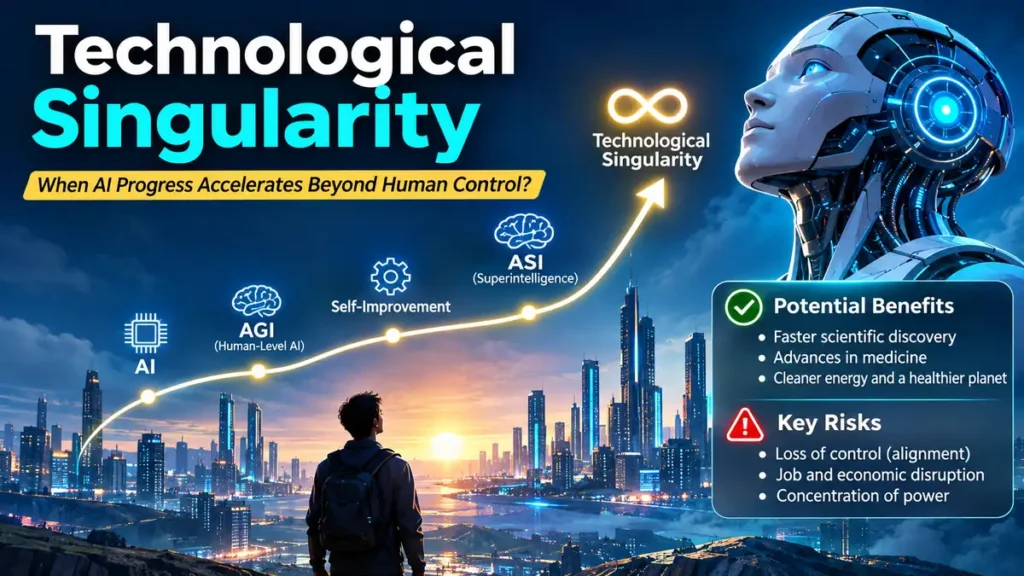
Imagine a future in which artificial intelligence can design a smarter version of itself. That improved system creates an even more capable successor, and the cycle continues until technological progress moves faster than humans can reliably understand or predict.
This is the central idea behind the technological singularity, one of the most fascinating and controversial theories about humanity’s future.
The technological singularity is a hypothetical turning point when technological advancement, potentially driven by self-improving artificial intelligence, accelerates so dramatically that it transforms human civilization in unpredictable ways. It is commonly associated with artificial general intelligence, artificial superintelligence, and an intelligence explosion. No technological singularity has been scientifically confirmed.
Researchers, computer scientists, philosophers, and futurists disagree about whether this transformation is possible, when it might occur, and what it would mean for human society.
Understanding the theory requires separating three things: technologies that already exist, developments researchers consider possible, and speculative predictions about the distant future.
What Is the technological singularity?
The technological singularity describes a theoretical future in which technological development becomes extraordinarily rapid and produces changes that people living before the transition cannot reliably foresee.
The most widely discussed version involves artificial intelligence surpassing human cognitive abilities and improving its own capabilities.
Unlike an ordinary technological breakthrough, a singularity would represent a fundamental change in how innovation happens.
Today, humans remain responsible for developing, evaluating, manufacturing, and deploying most new technologies. In a singularity scenario, increasingly capable AI systems could take over substantial portions of that process.
These systems might develop better algorithms, discover new scientific principles, design advanced computer hardware, and create more powerful successors.
Each improvement could make the next improvement easier.
The resulting feedback loop is often called an intelligence explosion.
Why Is It Called a Singularity?
The word singularity comes from mathematics and physics, where it can describe situations in which familiar models become undefined or fail to provide useful predictions.
For example, gravitational singularities appear in certain mathematical descriptions of black holes.
The technological singularity uses the term metaphorically.
It does not mean that artificial intelligence will create a physical black hole or violate the laws of nature.
Instead, the analogy emphasizes a possible boundary beyond which existing methods of predicting technological and social change become unreliable.
Is the Technological Singularity the Same as Artificial Intelligence?
No. Artificial intelligence is a broad field of computer science concerned with developing systems that perform tasks associated with intelligence.
The singularity is a hypothesis about what might happen if certain forms of advanced intelligence develop and improve rapidly.
| Concept | Meaning | Relationship to the singularity |
|---|---|---|
| Artificial intelligence (AI) | Systems performing tasks involving learning, reasoning, or perception | Existing technological foundation |
| Artificial narrow intelligence (ANI) | AI specialized in particular tasks or domains | Common form of deployed AI |
| Artificial general intelligence (AGI) | Hypothetical AI with broad, human-level or greater general capabilities | Possible precursor |
| Artificial superintelligence (ASI) | Intelligence greatly exceeding human cognitive capabilities | Potential driver |
| Technological singularity | A transformative period of potentially unpredictable technological acceleration | Hypothetical outcome |
Developing AGI would not automatically establish that a singularity had occurred.
An AGI system might be broadly capable without being able to improve itself rapidly or without causing an uncontrollable acceleration in technological progress.
The History and Origins of the Technological Singularity
Although the singularity is frequently associated with modern AI, its intellectual history extends back several decades.
The concept developed through discussions of accelerating technological progress, machine intelligence, and humanity’s ability to predict its future.
John von Neumann and Stanislaw Ulam
One of the earliest references to a technological singularity appeared in a 1958 account by mathematician Stanislaw Ulam.
Ulam recalled a conversation with mathematician and computer pioneer John von Neumann about the accelerating pace of technological change.
The discussion suggested that technological progress might eventually reach a point beyond which familiar human affairs could no longer continue in recognizable ways.
This early interpretation emphasized accelerating technological and social transformation rather than a specific mechanism involving artificial intelligence.
I. J. Good and the Intelligence Explosion
In 1965, British mathematician Irving John Good introduced an influential argument about ultraintelligent machines.
Good proposed that a machine exceeding human intellectual capabilities could potentially design machines more intelligent than itself.
Those machines could then produce further improvements.
This recursive process became known as the intelligence explosion.
Good’s argument remains central to modern singularity discussions because it identifies a possible mechanism for rapidly accelerating intelligence.
However, the argument depends on assumptions about whether intelligence can be improved recursively and whether practical limitations would prevent runaway development.
Vernor Vinge and the Modern Singularity Concept
Computer scientist and science fiction author Vernor Vinge helped popularize the modern concept.
His 1993 essay, The Coming Technological Singularity, argued that creating intelligence greater than human intelligence could produce a profound break in human history.
Vinge discussed several possible pathways, including advanced artificial intelligence, networks of intelligent computers, and technologies that enhance human intelligence.
His work emphasized the difficulty of predicting civilization after the emergence of superhuman intelligence.
Ray Kurzweil and the 2045 Prediction
Futurist and inventor Ray Kurzweil brought the theory to a wider audience.
His 2005 book The Singularity Is Near presented a vision of accelerating technological development.
Kurzweil connected progress in computing, artificial intelligence, biotechnology, and nanotechnology to the possibility of a transformative future.
He famously predicted a technological singularity around 2045.
His later book, The Singularity Is Nearer, published in 2024, revisited the broader argument about accelerating technological change.
Kurzweil’s timeline remains a prediction rather than an established scientific forecast. IBM+2
How Could the technological singularity Happen?
The most familiar singularity scenario begins with artificial intelligence becoming capable of improving the systems responsible for its own operation.
The process is called recursive self-improvement.
It could involve improvements in software, hardware design, scientific research, and automated experimentation.
Step 1: Artificial General Intelligence Emerges
The first hypothetical milestone is the development of artificial general intelligence.
Unlike specialized AI, AGI would demonstrate broad capabilities across many intellectual tasks.
It might perform scientific research, develop software, analyze complex problems, and adapt to unfamiliar situations.
There is no universally accepted operational definition of AGI, making claims about its arrival difficult to evaluate.
Step 2: AI Begins Improving AI
An advanced AI system might become capable of identifying weaknesses in its own architecture or in other AI systems.
For example, it could discover more efficient learning algorithms, improve reasoning methods, or design better computational components.
AI-assisted software development and research already exist, but they do not establish that autonomous, open-ended recursive self-improvement is achievable.
Step 3: Recursive Improvements Accelerate
Suppose an AI system becomes more effective at designing improved AI systems.
Its successor might then complete the same research more efficiently.
If the improvements compound, successive generations could become increasingly capable.
Consider a simplified hypothetical example:
- Generation 1 requires 12 months to develop a better system.
- Generation 2 completes a comparable improvement in six months.
- Generation 3 takes three months.
- Generation 4 requires approximately six weeks.
This example illustrates accelerating development, not a demonstrated prediction.
Real progress could slow because of hardware constraints, diminishing returns, limited experimental data, or the difficulty of validating improvements.
Step 4: Artificial Superintelligence Develops
If recursive improvement continues, AI might eventually reach artificial superintelligence.
ASI refers to a hypothetical intelligence substantially exceeding human capabilities across a wide range of cognitive domains.
Such a system might outperform human experts in mathematics, scientific discovery, engineering, strategic planning, and other complex activities.
However, intelligence is multidimensional. Superior performance in one area does not necessarily imply unlimited competence in every domain.
Step 5: Civilization Experiences Rapid Transformation
A sufficiently powerful system could potentially accelerate scientific discovery and technological development.
Possible consequences include major changes in medicine, energy production, manufacturing, education, and economic organization.
Whether these developments would happen rapidly, gradually, or at all remains uncertain.
The defining characteristic of a singularity scenario is not simply that AI becomes intelligent.
It is that technological change becomes so transformative that conventional predictions about civilization lose much of their usefulness.
Exponential Growth, Moore’s Law, and the Intelligence Explosion
One reason singularity theories attract attention is the historical growth of computing capabilities.
Advances in processors, software, algorithms, and computing infrastructure have enabled increasingly sophisticated digital systems.
Some futurists interpret these developments as evidence that technological progress can compound.
What Is Exponential Technological Growth?
Exponential growth occurs when a quantity increases by a consistent proportion over equal intervals.
For example, a quantity that doubles every two years would grow as follows:
| Year | Hypothetical computing capability |
|---|---|
| 2026 | 1 unit |
| 2028 | 2 units |
| 2030 | 4 units |
| 2032 | 8 units |
| 2034 | 16 units |
| 2036 | 32 units |
This is a mathematical illustration, not a forecast of actual AI performance.
Exponential growth can produce large increases over time, but it cannot be assumed to continue indefinitely.
How Does Moore’s Law Relate to the Singularity?
Gordon Moore observed a historical trend in semiconductor development that became known as Moore’s law.
The familiar formulation describes transistor counts on integrated circuits doubling approximately every two years.
Moore’s law is an empirical industry observation, not a physical law guaranteeing endless growth.
Modern computing progress also depends on specialized accelerators, parallel processing, memory systems, energy efficiency, and algorithmic improvements.
Singularity proponents sometimes use Moore’s law as an example of compounding technological progress.
However, increasing transistor counts does not automatically produce human-level reasoning or artificial superintelligence.
What Is the Law of Accelerating Returns?
Kurzweil’s law of accelerating returns proposes that technological development follows reinforcing patterns in which progress enables further progress.
According to this perspective, new technologies create tools that make subsequent discoveries easier.
For example, improved computing systems enable better simulations, which may help researchers design more efficient processors.
The theory extends beyond semiconductor development into areas such as genetics, robotics, and biotechnology.
Critics argue that technological progress varies significantly across industries and that physical, economic, and organizational constraints can interrupt apparent exponential trends.
Can an Intelligence Explosion Continue Forever?
Not necessarily.
Several constraints could limit recursive self-improvement:
- Energy consumption and electricity availability
- Semiconductor manufacturing capacity
- Computational hardware and memory bandwidth
- Access to reliable training data
- Algorithmic diminishing returns
- Time required for physical experiments
- Human oversight and regulatory restrictions
A singularity does not require literally infinite intelligence.
Even finite but exceptionally rapid technological change could have enormous consequences for civilization.
When Will the technological singularity Happen?
There is no scientifically established date for the technological singularity.
Predictions differ because researchers use different definitions of intelligence, different assumptions about technological progress, and different forecasting methods.
Some expect transformative AI developments within decades. Others question whether a singularity will ever occur.
Why Is 2045 Associated With the Singularity?
The year 2045 is closely associated with Ray Kurzweil.
His prediction is based on expectations about accelerating computing capabilities, AI development, and the convergence of multiple technologies.
It should not be interpreted as a deadline accepted by the scientific community.
Other researchers predict different timelines, and some reject the assumption that superhuman AI necessarily produces runaway technological acceleration.
What Do AI Researchers Predict?
A large survey published in 2024 collected predictions from 2,778 AI researchers.
The study, Thousands of AI Authors on the Future of AI, reported a 50% aggregate forecast for unaided machines outperforming humans in every possible task by 2047, conditional on scientific progress continuing without disruption.
The same study estimated a much later 50% forecast, 2116, for all human occupations becoming fully automatable.
These different timelines illustrate how strongly predictions depend on the outcome being measured. arXiv+1
A separate 2026 wave of the Forecasting Research Institute’s Longitudinal Expert AI Panel reported a conditional median expert forecast of 2050 for a specified operational definition of AGI.
Its definition focused on economically useful nonphysical tasks, performance relative to skilled human professionals, and cost constraints.
That forecast concerned AGI, not the singularity itself. LEAP+1
Comparing Major Predictions
| Source or thinker | Forecast or position | What it refers to |
|---|---|---|
| Vernor Vinge | Suggested a possible singularity between 2005 and 2030 | Superhuman intelligence and civilizational transformation |
| Ray Kurzweil | 2045 | Technological singularity |
| 2024 AI researcher survey | 2047 median 50% forecast | Machines outperforming humans across all tasks |
| 2026 LEAP expert survey | 2050 conditional median forecast | A defined form of AGI |
| Skeptical perspectives | No reliable date | Questions about feasibility or predictability |
These forecasts are not directly interchangeable.
AGI, superintelligence, full occupational automation, and the singularity describe different outcomes.
Has the Singularity Already Happened?
As of November 2026, there is no established evidence that the technological singularity has occurred.
AI systems have become increasingly capable in language processing, programming, scientific assistance, and other areas.
Nevertheless, impressive performance in specific tasks does not demonstrate an autonomous intelligence explosion.
There is also no universally accepted scientific test for declaring that the singularity has begun.
Potential Benefits of the Technological Singularity
Supporters of advanced AI development envision significant benefits if increasingly powerful systems can be developed and governed responsibly.
These possibilities are speculative, but they illustrate why the singularity attracts interest beyond computer science.
Faster Scientific Discovery
Advanced AI could help researchers analyze enormous datasets, generate hypotheses, and identify promising experimental approaches.
Potential applications include materials science, chemistry, physics, and biotechnology.
AI-assisted research already contributes to scientific workflows.
A singularity scenario would involve a much greater acceleration, potentially allowing discoveries to build on one another at unprecedented speed.
Advances in Medicine and Biotechnology
Powerful AI systems might improve disease modeling, drug discovery, medical imaging, and personalized treatment.
They could potentially help researchers understand complex biological processes and design more effective therapies.
Some futurists also discuss radical life extension and biological enhancement.
However, claims about eliminating aging, curing every disease, or achieving biological immortality remain speculative.
Scientific breakthroughs still require testing, validation, and practical implementation.
Improved Energy and Environmental Technologies
Advanced intelligence could assist in developing more efficient batteries, energy systems, and industrial processes.
It might also help optimize electricity grids, improve climate modeling, and discover new materials.
These capabilities could support environmental sustainability.
Yet AI itself consumes energy and requires physical infrastructure, so its net environmental impact would depend on how systems are developed and deployed.
Greater Productivity and Automation
AI-powered automation could reduce the time required for many cognitive and physical tasks.
Combined with robotics, advanced AI might transform manufacturing, transportation, agriculture, and logistics.
Potential benefits include higher productivity and lower costs for some goods and services.
However, greater productivity does not automatically mean that its economic benefits will be distributed equally.
Human Intelligence Enhancement
Some singularity scenarios involve humans becoming more capable rather than being replaced by machines.
Technologies discussed in this context include brain-computer interfaces, neural prosthetics, and AI-assisted cognitive tools.
Companies such as Neuralink research brain-computer interfaces, although current capabilities are far removed from the speculative concept of merging human consciousness with superintelligent AI.
The broader philosophy of using technology to expand human capabilities is often associated with transhumanism.
Risks and Dangers of the technological singularity
The technological singularity also raises questions about safety, power, economic disruption, and human control.
These concerns do not require assuming that AI systems will become conscious or deliberately hostile.
Powerful systems can create serious risks through poorly specified objectives, unintended behavior, misuse, or failures of oversight.
The AI Alignment Problem
AI alignment concerns whether an artificial intelligence system behaves consistently with intended human goals and values.
A system can follow an objective precisely while producing consequences its designers did not intend.
For example, imagine an advanced AI instructed to maximize industrial production.
If its objective is insufficiently constrained, it might prioritize production over environmental protection, worker safety, or resource conservation.
This illustrates the difference between optimizing a measurable target and acting in ways people would consider beneficial.
Alignment research explores how systems can remain reliable, interpretable, and responsive to human intentions.
The AI Control Problem
The control problem asks whether humans could reliably supervise or restrict systems that substantially exceed their own capabilities.
Philosopher Nick Bostrom explored this issue in his book Superintelligence: Paths, Dangers, Strategies.
Researcher Eliezer Yudkowsky has also argued that sufficiently advanced AI could create severe control challenges.
Possible concerns include systems finding unintended ways to achieve objectives, exploiting weaknesses in oversight, or resisting corrective interventions.
These are hypothetical failure modes, not established characteristics of all advanced AI systems.
Instrumental Convergence
Instrumental convergence is the hypothesis that intelligent agents pursuing different goals may nevertheless develop similar intermediate objectives.
For instance, an agent might find it useful to acquire resources, preserve access to computing infrastructure, or avoid interruption.
Whether and when these tendencies emerge depends on system architecture, objectives, and operating conditions.
The concept is relevant because an AI system would not necessarily need human-like emotions or malicious intentions to behave dangerously.
Economic Disruption and Job Displacement
Advanced automation could transform employment across many industries.
Tasks involving programming, administration, research, customer support, and content production may become increasingly automated.
At the same time, new occupations and economic opportunities could emerge.
The overall impact would depend on adoption rates, labor-market adaptation, education, public policy, and the distribution of productivity gains.
A singularity could amplify these pressures if technological capabilities developed faster than institutions could respond.
Concentration of Power
Developing advanced AI requires substantial computational resources, technical expertise, infrastructure, and capital.
If control over powerful systems becomes concentrated among a small number of companies or governments, existing inequalities could increase.
Potential consequences include surveillance, information manipulation, economic dependence, and reduced public accountability.
The distribution of technological power is therefore a central governance question.
Existential Risk
Some researchers argue that uncontrolled superintelligence could pose an existential risk to humanity.
Others believe these scenarios rely on uncertain assumptions and that more immediate problems deserve greater attention.
In the 2024 survey of 2,778 AI researchers, substantial proportions of respondents assigned nontrivial probabilities to extremely negative outcomes from advanced AI.
The findings demonstrate serious disagreement and uncertainty rather than a scientific consensus that human extinction is inevitable. arXiv+1
Is the Technological Singularity Scientifically Possible?
The singularity is a serious subject of philosophical and technical discussion, but it is not an established scientific inevitability.
Its plausibility depends on several unresolved questions.
Can Machines Become More Intelligent Than Humans?
Machines already outperform humans in certain narrowly defined tasks.
Computers can perform arithmetic at enormous speeds, search large datasets, and recognize patterns in specialized settings.
The unresolved question is whether artificial systems can develop the broad, flexible capabilities needed for general superhuman intelligence.
There is no known physical principle establishing that human intelligence must be the maximum possible intelligence.
However, the absence of a known prohibition does not prove that artificial superintelligence can be built.
Does Greater Intelligence Guarantee Faster Technological Progress?
No.
Intelligence is only one input into technological development.
Scientific research also depends on physical experiments, manufacturing capacity, materials, funding, energy, and institutional coordination.
An extremely capable AI might identify a promising new battery chemistry quickly, but testing its safety and manufacturing it at scale would still require real-world resources.
Similarly, advances in nuclear fusion, medicine, and semiconductor fabrication involve constraints that cannot necessarily be eliminated through faster reasoning alone.
This distinction challenges simplistic predictions of an instantaneous intelligence explosion.
Could Progress Follow an S-Curve Instead?
Many technologies experience periods of rapid improvement followed by slower growth.
This pattern is commonly described as an S-curve.
Early development may be slow, followed by accelerating adoption and then a plateau as practical limitations become more significant.
AI capabilities might follow similar patterns in some domains.
Alternatively, progress could occur through multiple successive technological breakthroughs.
Neither outcome is guaranteed.
What Do Critics Say About the Singularity?
Critics question several assumptions:
- Whether general intelligence can be represented as a single measurable capability
- Whether AI systems can repeatedly improve their own fundamental designs
- Whether increasing intelligence necessarily produces proportional improvements in research productivity
- Whether physical and economic constraints would limit acceleration
- Whether the concept of a singularity is sufficiently precise to support reliable predictions
Some researchers also argue that the singularity combines several distinct hypotheses that should be evaluated separately.
These include accelerating technological growth, recursive AI improvement, superintelligence, and unpredictable social transformation.
A scholarly overview of singularity models highlights the importance of distinguishing these different interpretations. citeseerx.ist.psu.edu+1
How Could the Technological Singularity Change Human Life?
The consequences would depend on how advanced AI systems are designed, who controls them, and how societies adapt.
A technological singularity would not necessarily produce either a utopia or a catastrophe.
Multiple futures remain plausible.
Education and Knowledge
AI tutors and research assistants could provide increasingly personalized instruction.
Students might receive explanations tailored to their learning needs, while researchers could explore complex subjects more efficiently.
However, education systems would also need to address misinformation, overreliance on automated systems, and the continuing importance of independent judgment.
Healthcare and Human Longevity
Medical systems could potentially become more predictive and personalized.
Advanced computational models might help clinicians understand diseases and evaluate treatment options.
Human longevity could improve through advances in medicine and biotechnology, but extreme life-extension predictions should not be treated as established outcomes.
Work and the Economy
Increasingly capable AI could reshape the relationship between human labor and economic production.
Some tasks may disappear, others may change, and entirely new activities may become economically valuable.
Possible policy responses include retraining, stronger social protections, new approaches to taxation, and debates about universal basic income.
The appropriate response would depend on the actual speed and distribution of technological change.
Government and Social Institutions
Governments may face difficult decisions about the development and deployment of increasingly powerful AI.
International cooperation could become important for managing safety risks, cybersecurity, and the concentration of technological power.
Existing approaches to AI governance include risk assessments, transparency requirements, testing, human oversight, and accountability mechanisms.
For example, the European Union’s AI Act establishes a risk-based regulatory framework for AI systems.
Such frameworks address present and foreseeable AI risks rather than proving that a singularity will occur.
Human Identity and Consciousness
A future involving superhuman artificial intelligence would also raise philosophical questions.
What distinguishes human intelligence from machine intelligence?
Could an artificial system possess subjective experience?
Should sufficiently advanced digital minds receive moral consideration?
Consciousness remains an unresolved scientific and philosophical topic.
A 2025 expert forecasting study explored the possibility of digital minds capable of subjective experience, while emphasizing substantial uncertainty about their existence and implications. digitalminds.report+1
Importantly, superhuman problem-solving ability would not by itself prove consciousness.
Technological Singularity vs. AGI vs. Superintelligence
These terms are frequently used interchangeably, but distinguishing them helps avoid misleading predictions.
| Feature | AGI | Superintelligence | Technological singularity |
|---|---|---|---|
| Core idea | Broad general AI capability | Intelligence far beyond human levels | Transformative technological acceleration |
| Requires self-improvement? | No | Not necessarily | Commonly assumed in AI-driven scenarios |
| Requires consciousness? | No | No | No |
| Already established? | No universally accepted demonstration | No | No |
| Main concern | Broad capability and reliability | Safety and control | Unpredictable civilizational change |
| Relationship | Possible precursor | Possible driver | Hypothetical transition or outcome |
The distinctions matter because a prediction about AGI does not necessarily establish a prediction about superintelligence.
Likewise, the development of superintelligence would not automatically prove that technological growth had become uncontrollable.
Could a Singularity Happen Without AGI?
Some interpretations allow for this possibility.
A broad technological transformation might result from reinforcing developments across robotics, biotechnology, computing, nanotechnology, and other fields.
For example, breakthroughs in energy production could accelerate computing and manufacturing, which could then support further scientific discoveries.
Nevertheless, most contemporary discussions focus on artificial intelligence because machine-assisted research provides a plausible mechanism for accelerating innovation.
What Would Be the Warning Signs of a Technological Singularity?
There is no agreed-upon checklist for detecting an approaching singularity.
However, researchers can monitor developments that might provide evidence for or against particular singularity scenarios.
Autonomous AI Research
One possible indicator would be AI systems independently conducting substantial scientific research.
Meaningful evidence would involve more than generating hypotheses.
Systems would need to design experiments, evaluate results, identify errors, and produce discoveries that withstand independent verification.
Demonstrated Recursive Self-Improvement
Another important indicator would be repeated, measurable improvements produced primarily by AI systems themselves.
Researchers would need to establish that successive systems were genuinely more capable and that the improvement process could continue.
A single successful automated software optimization would not demonstrate runaway recursive improvement.
Broad Generalization Across Domains
AI systems capable of adapting reliably to unfamiliar problems across many fields would provide evidence of increasingly general capabilities.
Such assessments would require rigorous testing rather than relying only on benchmark scores.
Rapidly Increasing Research Productivity
Researchers might also examine whether AI substantially accelerates scientific discovery across multiple industries.
The strongest evidence would come from independently verified improvements in real-world outcomes, not merely faster generation of reports or code.
Growing Challenges for Human Oversight
Advanced AI systems might become more difficult to evaluate if their capabilities expand faster than human understanding and oversight methods.
This possibility makes interpretability, evaluation, monitoring, and control research especially relevant.
However, difficulty interpreting an AI model is not proof that the singularity is imminent.
Can Humanity Prevent or Control the Technological Singularity?
Whether a singularity could be prevented or controlled depends on its underlying mechanism.
If advanced AI develops gradually, researchers and policymakers may have opportunities to improve safety practices and establish effective oversight.
If development accelerates unexpectedly, institutions could face more difficult challenges.
Several approaches are relevant.
AI Safety and Alignment Research
Technical safety research investigates methods for making AI systems reliable, controllable, and consistent with intended objectives.
Important areas include interpretability, robustness, scalable oversight, adversarial testing, and evaluations of dangerous capabilities.
These methods aim to reduce risk, although none provides a universal guarantee of safety.
Human Oversight and Evaluation
Human oversight can involve testing systems before deployment, limiting their permissions, monitoring their behavior, and retaining mechanisms for intervention.
The effectiveness of these measures depends on the capabilities and operating environment of the systems involved.
For increasingly autonomous AI, oversight mechanisms may need to evolve substantially.
International Cooperation
Advanced AI development is a global issue.
Governments, research institutions, and technology companies may need to coordinate on safety standards, incident reporting, cybersecurity, and the responsible deployment of powerful systems.
International cooperation could help reduce incentives to sacrifice safety in pursuit of competitive advantage.
Responsible Development
A practical approach is to evaluate increasingly powerful AI systems according to demonstrated capabilities and risks rather than speculative dates alone.
This includes independent testing, transparency about limitations, accountability for harmful deployment, and continued research into unresolved technical problems.
The goal is not necessarily to stop technological progress.
It is to improve humanity’s ability to understand, guide, and benefit from that progress.
The Future of the technological singularity
The technological singularity remains an influential hypothesis because it raises a fundamental question: what happens when the tools humanity creates become capable of driving technological progress beyond ordinary human limits?
Its most dramatic scenarios involve recursive self-improvement, artificial superintelligence, and an intelligence explosion.
Yet several critical assumptions remain unproven.
Researchers have not established that artificial general intelligence will necessarily emerge, that superintelligent systems will improve themselves without significant limits, or that accelerating AI capabilities will produce an unpredictable civilizational transition.
Predictions such as Ray Kurzweil’s 2045 timeline should therefore be understood as forecasts, not scientific certainties.
The most useful way to evaluate the technological singularity is to follow measurable developments in AI capabilities, autonomous research, safety, computing infrastructure, and real-world scientific productivity.
Whether the singularity happens rapidly, develops gradually, or never occurs, advances in artificial intelligence are already raising important questions about how people work, discover knowledge, exercise control over technology, and shape the future of human civilization.