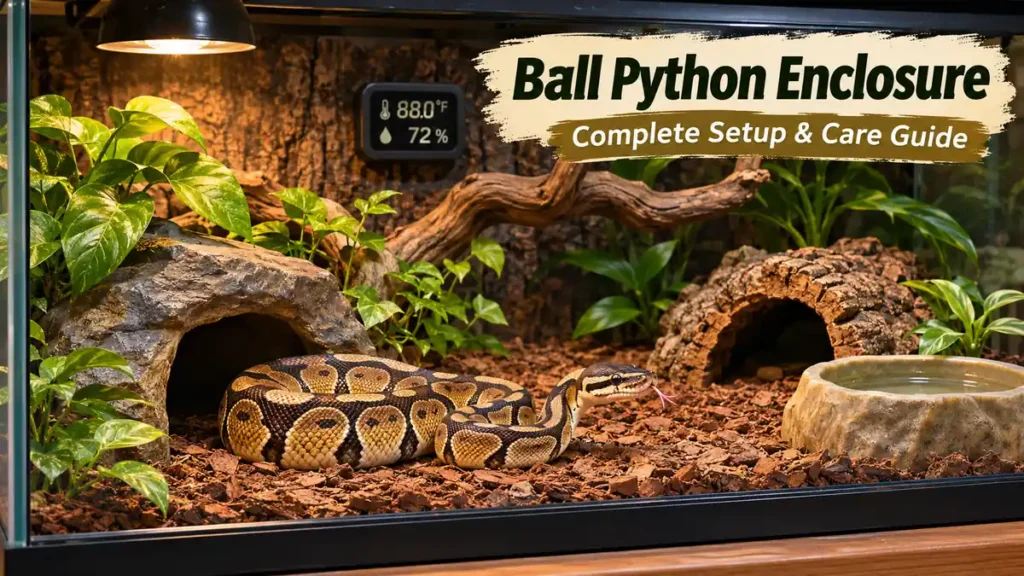
A ball python can spend much of the day hidden, but that doesn’t mean it needs a small, empty tank. The right enclosure gives your snake room to stretch, explore, climb, regulate its body temperature, and retreat into secure hiding places.
A properly designed ball python enclosure should combine adequate space, controlled heating, appropriate humidity, safe substrate, ventilation, and environmental enrichment. For most adults, a 4 × 2 × 2-foot (120 × 60 × 60 cm) enclosure is a practical minimum, although larger snakes need more room. ReptiFiles+1
This guide explains how to create a comfortable, functional habitat, from selecting an enclosure to maintaining healthy conditions over time.
What Size ball python enclosure Do You Need?
Enclosure size affects a snake’s ability to move naturally, exercise, and use different temperature zones.
Ball pythons (Python regius), also called royal pythons, are native to western and central Africa. They commonly use sheltered spaces but also explore their surroundings and climb when opportunities are available.
A suitable enclosure should allow the snake to stretch out fully along at least one dimension, with enough width and height for natural movement.
Recommended enclosure dimensions
| Life stage | Recommended dimensions |
|---|---|
| Hatchling | Approximately 20 × 11 × 13 inches or larger |
| Juvenile under 3 feet | 36 × 18 × 18 inches or larger |
| Subadult or adult over 3 feet | 48 × 24 × 24 inches or larger |
| Large adult over 4 feet | At least as long as the snake, with generous width and climbing height |
These dimensions reflect the welfare-focused recommendations published by ReptiFiles. ReptiFiles
A 4 × 2 × 2-foot enclosure provides approximately 120 US gallons of internal volume. However, dimensions matter more than the gallon rating because snakes benefit from usable floor space and vertical structure.
Can a baby ball python live in a large enclosure?
Yes. A juvenile can live in an adult-sized enclosure when the environment contains sufficient cover.
The problem is not excessive space. It is excessive exposure.
An open enclosure with only one hide can make a young snake feel vulnerable. Adding foliage, branches, cork bark, and several enclosed hiding places creates safe routes through the habitat.
Is a 40-gallon tank enough for an adult?
Some older care guides describe a 40-gallon breeder tank as acceptable for adults. However, modern welfare-oriented guidance increasingly favors larger habitats that allow full-body extension and greater environmental enrichment.
For long-term adult housing, a 4 × 2 × 2-foot enclosure is a stronger starting point than a typical 40-gallon tank. Larger individuals may require a five- or six-foot enclosure.
Choosing the Right ball python enclosure Material
Glass, PVC, wood, and plastic enclosures have different advantages. The ideal material depends on the room’s climate, the snake’s size, and how easily you can maintain stable environmental conditions.
PVC enclosures
Large PVC Reptile Enclosure 120 Gallon Terrarium Australia | Ubuy
PVC (polyvinyl chloride) enclosures are popular for tropical and humidity-sensitive reptiles.
Their main advantages include:
- Good humidity retention
- Relatively lightweight construction
- Easy-to-clean surfaces
- Insulated walls that reduce rapid temperature changes
- Front-opening doors for easier access
However, PVC habitats still need adequate ventilation. Poor airflow combined with wet substrate can encourage mold growth.
Solid-top models also require careful planning for safe heat and UVB fixture installation.
Glass terrariums
Rate My Enclosure Community Edition – Page 4 – All Reptiles – MorphMarket Reptile Community
Glass terrariums offer excellent visibility and are widely available.
They are easy to inspect and disinfect, but large mesh tops can make humidity and temperature management more difficult.
Covering selected portions of a screen lid with a secure, heat-safe material can reduce excessive moisture loss. Never obstruct ventilation completely or place coverings near hot fixtures.
Adding opaque backgrounds to the rear and sides can also help the snake feel less exposed.
Wooden vivariums
Sealed wooden enclosures can retain heat effectively and provide a sturdy structure for larger habitats.
Their main limitation is moisture resistance. Unsealed joints and exposed wood can absorb water, swell, or develop mold.
Any wooden enclosure should use reptile-safe sealants that have fully cured before the animal enters.
Plastic tubs
Plastic tubs are sometimes used for hatchlings or temporary housing.
They can maintain humidity efficiently but may offer limited visibility, climbing height, lighting options, and environmental enrichment.
For permanent housing, a properly equipped, spacious vivarium is generally preferable.
| Material | Humidity retention | Main advantage | Main limitation |
|---|---|---|---|
| PVC | High | Insulation and easy cleaning | Requires ventilation planning |
| Glass | Moderate to low | Visibility and accessibility | Greater heat and moisture loss |
| Sealed wood | Moderate to high | Sturdy and insulating | Vulnerable to water damage |
| Plastic tub | High | Lightweight and inexpensive | Often limited space and equipment options |
ball python enclosure Temperature and Heating
Ball pythons are ectothermic animals. They depend on environmental heat to regulate body temperature, digestion, and other physiological functions.
A correctly heated enclosure has a thermal gradient: one end is warmer, while the opposite end remains cooler.
This allows the snake to move between temperature zones according to its needs.
Recommended temperature ranges
| Area | Temperature |
|---|---|
| Warm basking area | 86–90°F (30–32°C) |
| Cool side | Approximately 75–80°F (24–27°C) |
| Nighttime | A modest drop is acceptable if safe temperatures are maintained |
These ranges are broadly consistent with RSPCA and ReptiFiles guidance, although exact recommendations differ slightly between care authorities. ReptiFiles+1
The basking surface, warm-side air, and cool-side air are different measurements. Monitor each appropriately rather than assuming a single thermometer represents the entire enclosure.
Creating a safe thermal gradient
Place the primary heat source at one end so the snake can choose warmer or cooler conditions.
Position the primary heating equipment over one side of the enclosure.
Install digital thermometers at both ends and use an infrared thermometer to check basking surfaces.
Every heat source must be controlled by a compatible thermostat. A thermostat regulates heating equipment; a thermometer independently verifies the resulting temperature.
Which heating equipment works best?
Halogen flood lamps provide daytime radiant heat and can support natural basking behavior. They must be installed at safe distances and controlled using an appropriate dimming thermostat.
Deep heat projectors provide radiant heat without visible light and may be useful when properly installed.
Ceramic heat emitters produce heat without visible illumination and can support nighttime temperature control.
Under-tank heat mats are sometimes used in smaller setups but should never be relied upon without a suitable thermostat. They also do not provide the same overhead radiant heating environment as a basking lamp.
Avoid heat rocks, unguarded internal bulbs, and any exposed hot surface the snake could touch.
Burns can occur even when the enclosure’s general air temperature seems acceptable.
Humidity Requirements and Moisture Control
Humidity is one of the most frequently misunderstood aspects of ball python husbandry.
Insufficient moisture can contribute to dehydration and incomplete shedding. Excessive moisture combined with poor ventilation and persistently wet surfaces can also create health problems.
What humidity does a ball python need?
Care authorities recommend somewhat different ranges.
ReptiFiles recommends approximately 60–80% relative humidity, while the RSPCA describes a baseline around 50–60%, with temporary increases toward 80%. ReptiFiles+1
A practical approach is to aim for approximately 60–80% in a clean, well-ventilated enclosure, while monitoring the snake’s shedding, substrate condition, and overall health.
Use a digital hygrometer positioned near snake level, preferably toward the cooler end.
How to increase humidity safely
Several methods can improve moisture retention:
- Use moisture-retaining substrate such as coconut husk or cypress mulch.
- Provide a substrate layer deep enough to hold moisture below the surface.
- Add water to selected substrate areas rather than soaking the entire floor.
- Reduce excessive screen-top ventilation without blocking necessary airflow.
- Provide a humid hide containing lightly damp sphagnum moss.
- Maintain a clean water bowl and monitor humidity daily.
The surface of the substrate should not remain continuously wet.
A humid hide gives the snake access to a localized moisture-rich environment without requiring the entire enclosure floor to become damp.
Signs that humidity may be incorrect
Low humidity may be associated with fragmented shedding, dry-looking skin, or retained shed.
Excessive dampness may contribute to mold, unpleasant odors, and skin problems.
Neither shedding difficulty nor abnormal skin appearance proves that humidity is the only cause. Persistent problems warrant an examination by a reptile-experienced veterinarian.
Best Substrate for a Ball Python Habitat
Substrate forms the enclosure floor and influences humidity, cleanliness, comfort, and opportunities for natural behavior.
An effective substrate should be safe, easy to maintain, and compatible with the enclosure’s moisture requirements.
Buy Exo Terra Coco Husk Substrate 7L Block Online at £5.24
Coconut husk
Zoo Med Forest Floor Cypress Mulch – Natural Reptile Bedding
Cypress mulch
Brown’s Reptile Substrate | ReptI-Soil 5kg – BROWNS PET RANGE
Organic soil mix
Coconut husk and coconut fiber
Coconut-based bedding is widely used because it retains moisture and supports humidity control.
Chunky coconut husk often provides better surface texture and air spaces than very fine, constantly wet coconut fiber.
Avoid allowing either material to become waterlogged.
Cypress mulch
Cypress mulch retains moisture reasonably well and creates a natural appearance.
Choose reptile-appropriate products without added pesticides, dyes, fragrances, or chemical treatments.
Organic topsoil mixtures
A suitable mixture of organic topsoil and other reptile-safe components can support naturalistic and bioactive habitats.
Avoid soils containing fertilizers, pesticides, perlite, or other potentially hazardous additives.
Paper towels
Paper towels are useful for temporary quarantine or veterinary monitoring because waste is easy to see and remove.
However, they provide little enrichment and do not retain moisture as effectively as naturalistic substrates.
Substrates to avoid
Avoid cedar and pine shavings, scented bedding, sharp gravel, and materials containing potentially harmful additives.
Aspen bedding appears in some care guides, but it tends to perform poorly in humid environments and can mold when damp.
For most permanent habitats, a moisture-compatible substrate is a more practical choice.
A substrate depth of approximately 3–4 inches can provide useful moisture retention and allow limited digging. Deeper layers may work in larger naturalistic setups, provided they remain hygienic.
Hides, Lighting, and Environmental Enrichment
A well-designed habitat is more than a heated container.
Ball pythons spend considerable time sheltered, but they also benefit from opportunities to investigate their surroundings, move between cover, and climb.
How many hides should a ball python have?
Provide at least two secure hides: one on the warm side and one on the cool side.
10 Ball Python Enclosure Ideas for a Perfect Habitat | minimalgardenspace.com
The hides should be snug enough that the snake can touch several interior surfaces while resting.
A hide that is too large and exposed may offer less security than a smaller, appropriately sized shelter.
Additional hides are beneficial, particularly in spacious enclosures.
Cork bark tunnels, artificial caves, and sturdy natural materials can provide different shelter options.
Do ball pythons need climbing branches?
Yes, climbing opportunities are beneficial.
Although often described as terrestrial snakes, ball pythons also use elevated structures in natural environments.
ReptiFiles discusses both terrestrial and semi-arboreal behavior, including observations of climbing and hunting in trees. ReptiFiles
Install thick, stable branches and low platforms that can support the snake’s weight.
Avoid unstable decorations, sharp edges, and excessive heights above hard surfaces.
Artificial plants, cork tubes, and leaf litter can provide additional cover and encourage exploration.
Is UVB lighting necessary?
Ball pythons can survive without dedicated UVB lighting under some husbandry conditions, but modern care guidance increasingly recognizes potential benefits from appropriate low-level UVB exposure.
The RSPCA recommends providing reptile UVB lighting, and ReptiFiles provides detailed guidance on low-intensity fluorescent UVB systems. RSPCA+1
UVB equipment should be selected according to enclosure height, fixture type, mesh obstruction, and the manufacturer’s safe exposure distances.
Provide shaded retreats so the snake can avoid UVB when desired.
Day and night lighting
A consistent photoperiod helps establish a natural day-night cycle.
Approximately 12 hours of light followed by 12 hours of darkness is a practical starting point.
Avoid leaving visible red, blue, or white heat lamps illuminated throughout the night.
If nighttime heating is required, use a suitable non-light-emitting heat source connected to a thermostat.
How to Set Up a Ball Python Enclosure Step by Step
Setting up the habitat before bringing the snake home allows you to test its temperature, humidity, and safety.
GUZZLO 120 Gallon PVC Reptile Enclosure, 48x24x24 , Black – Walmart.com
Step 1: Position the enclosure
Choose a stable surface away from direct sunlight, radiators, air-conditioning vents, and drafts. Check that doors, lids, and ventilation panels are secure.
Step 2: Install heating and monitoring equipment
Position the heat source at one end. Connect it to a compatible thermostat and install independent temperature and humidity sensors.
Zoo Med Eco Earth Coconut Chips, 500 Grams | Petco
Step 3: Add substrate
Spread a suitable moisture-retaining substrate across the floor. Establish a moisture gradient without leaving the surface saturated.
15 Ball Python Habitat Ideas for Natural and Enriching Setups
Step 4: Arrange hides and enrichment
Place secure hides at both ends. Add climbing branches, foliage, and sheltered pathways while preserving room to move.
Step 5: Provide water and lighting
Install a stable water dish with fresh water. Set daytime lighting on a timer and check all electrical fixtures for safety.
Repti-Zoo LCD Teploměr a Hygrometr
Step 6: Test the enclosure before introducing the snake
Run the complete setup for at least 24–48 hours, checking conditions during the day and night. Adjust equipment until temperatures and humidity remain stable.
When the snake arrives, place it gently inside and allow an initial settling period with minimal disturbance.
Avoid repeatedly lifting hides or handling a newly introduced animal while it adjusts to its surroundings.
Cleaning and Maintaining the Enclosure
Good maintenance protects the snake from excessive waste accumulation, contaminated water, and unhealthy environmental conditions.
A clean enclosure should still preserve suitable hiding places and familiar surroundings.
Daily maintenance
Check the enclosure each day for waste, spilled water, damaged equipment, and unusual behavior.
Remove feces and urates promptly, replace dirty water, and verify temperature and humidity readings.
Weekly maintenance
Inspect substrate for damp or moldy patches.
Clean visibly soiled decorations and examine hides for trapped waste.
Check thermostat settings, electrical cords, door locks, and the stability of climbing structures.
Periodic deep cleaning
The frequency of full substrate replacement depends on the substrate, enclosure design, waste accumulation, and whether the habitat is conventional or bioactive.
For a conventional enclosure, replace contaminated substrate as needed and perform periodic thorough cleaning.
Use reptile-safe disinfectants according to their instructions, rinse where required, and allow surfaces to dry before returning the snake.
A bioactive enclosure may require less frequent complete substrate replacement, but it still needs waste removal, plant maintenance, and monitoring of the cleanup organisms.
Simple enclosure maintenance checklist
Daily habitat check
0 of 6 completeCheck warm and cool temperaturesCheck humidity and substrate moistureRefresh drinking waterRemove visible wasteInspect hides and equipmentCheck for mold or unusual odors
Reset checklist
Common Ball Python Enclosure Problems and Solutions
Even a carefully prepared enclosure can develop problems as room temperatures, seasons, and the snake’s needs change.
Humidity keeps dropping
A large screen top, shallow substrate, or very dry room air may be responsible.
Increase the depth of moisture-compatible substrate, review ventilation, and monitor humidity at snake level.
Avoid repeatedly soaking the entire enclosure to compensate for excessive evaporation.
The enclosure is too cold
Check the thermostat settings, heat-source output, room temperature, and thermometer placement.
A larger enclosure may need a different heating arrangement, but adding powerful equipment without proper controls creates burn and overheating risks.
Never use an unregulated heat source.
The snake stays hidden constantly
Hiding is normal ball python behavior, especially during daylight hours.
However, persistent hiding combined with feeding refusal, weight loss, abnormal breathing, or unusual inactivity may indicate a husbandry or health problem.
Review temperatures, security, disturbance, and access to suitable hides.
The snake refuses food
Ball pythons sometimes refuse meals, particularly during shedding, seasonal changes, or environmental stress.
Incorrect temperatures and inadequate security may contribute.
Monitor body condition and weight rather than assuming every missed meal is an emergency.
Repeated refusal accompanied by weight loss or other symptoms requires veterinary assessment.
The snake has difficulty shedding
Incomplete shedding may be associated with inadequate humidity, dehydration, illness, or other husbandry problems.
Check humidity and provide an appropriate humid hide.
Never forcibly pull retained skin, especially around the eyes or tail. Seek veterinary assistance when shedding problems persist.
Condensation appears on the walls
Occasional condensation can occur when warm, moist air contacts cooler surfaces.
Persistent heavy condensation, wet substrate, and musty odors suggest that moisture management or ventilation needs adjustment.
Aim for humid air with hygienic, appropriately dry resting surfaces.
Naturalistic and Bioactive Enclosure Setups
A naturalistic habitat uses branches, plants, textured substrates, and shelter to imitate features of the snake’s environment.
A bioactive enclosure adds living organisms that help break down organic waste.
10 Ball Python Enclosure Ideas for a Perfect Habitat | minimalgardenspace.com
What makes an enclosure bioactive?
Bioactive systems commonly include:
- A suitable soil-based substrate
- Live, reptile-safe plants
- Springtails and isopods
- Leaf litter and decomposing organic matter
- Moisture and ventilation management
- Appropriate lighting for plant growth
Springtails and isopods are often called a cleanup crew because they consume some decomposing organic material.
However, they do not eliminate the need to remove feces, monitor sanitation, or maintain water dishes.
Benefits and limitations
Naturalistic enclosures can offer varied textures, shelter, and environmental complexity.
Live plants may also create additional cover and localized humidity differences.
However, bioactive systems require careful planning. Plants can be crushed, substrate can become waterlogged, and cleanup populations may struggle under unsuitable conditions.
Beginners may find it easier to establish a conventional naturalistic enclosure before transitioning to a fully bioactive setup.
Important Safety Considerations
A ball python enclosure should be designed to prevent escape, burns, injury, and avoidable stress.
Escape prevention
Ball pythons are strong and capable of pushing against loose doors or lids.
Use secure locks, inspect gaps around cable openings, and ensure ventilation panels cannot be displaced.
Housing snakes together
Ball pythons are generally solitary and should be housed individually.
Cohabitation can complicate feeding, environmental management, and disease prevention, while creating competition for preferred hiding and heating areas.
Electrical safety
Keep electrical connections protected from water and moisture.
Use properly rated fixtures, compatible thermostats, and secure lamp guards when heating equipment is installed inside the enclosure.
Never allow a snake to contact exposed heating elements.
Hygiene and handling
Reptiles can carry Salmonella even when they appear healthy.
Wash hands thoroughly after handling the snake, substrate, equipment, or enclosure contents.
Avoid cleaning reptile equipment in food preparation areas, and follow appropriate disinfection procedures.
Final Thoughts
A successful ball python enclosure provides more than basic survival conditions. It allows the snake to move freely, regulate its temperature, remain hydrated, hide securely, and express natural behaviors.
For most adults, start with at least a 4 × 2 × 2-foot habitat, increasing the dimensions when the snake’s length requires it. Prioritize reliable thermostatically controlled heating, appropriate humidity, secure hides, safe substrate, ventilation, and climbing opportunities.
Before introducing your snake, test the complete setup and confirm that conditions remain stable. Continue monitoring the habitat as the animal grows and as seasonal conditions change.
The goal is a safe, adaptable environment that supports the snake’s welfare throughout its life.