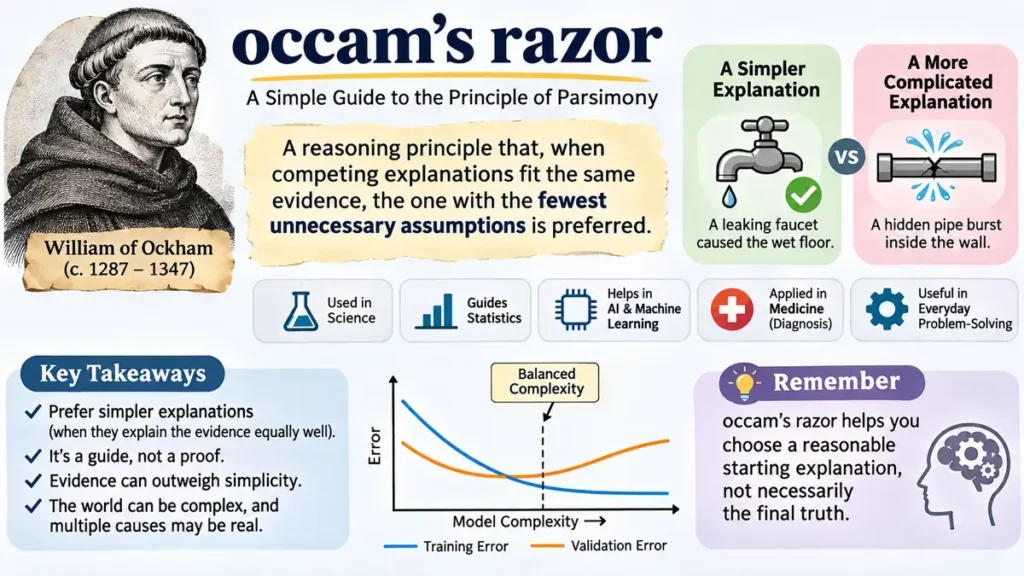
Imagine waking up to find your kitchen floor wet. You notice a dripping faucet, but you also wonder whether a pipe burst inside the wall or someone spilled water during the night. Which explanation should you investigate first?
This is where occam’s razor becomes useful.
Occam’s razor is a philosophical principle suggesting that, when competing explanations account for the same evidence equally well, the explanation requiring the fewest unnecessary assumptions should generally be preferred. It encourages clear reasoning, helps eliminate needless complexity, and provides a practical starting point for scientific investigation and everyday problem-solving.
The principle is often summarized as “the simplest explanation is usually the best.” However, that popular interpretation leaves out an essential distinction: simplicity does not automatically make an explanation true.
Understanding this distinction is the key to using Occam’s razor correctly.
What Is occam’s razor?
Occam’s razor, also called Ockham’s razor or the principle of parsimony, is a reasoning guideline used to compare competing explanations.
Its central idea is straightforward: do not introduce more assumptions, entities, or complications than are necessary to explain the available evidence.
Suppose two theories explain the same observation:
- Theory A requires three assumptions supported by existing knowledge.
- Theory B requires those same three assumptions plus four additional unsupported claims.
If both theories explain the evidence equally well, Occam’s razor favors Theory A.
This does not prove Theory A is correct. It simply makes it the more economical explanation to consider first.
Why Is It Called a Razor?
The word razor refers to a philosophical tool that cuts away unnecessary assumptions.
Just as a physical razor removes unwanted material, a philosophical razor helps remove explanations that introduce complications without improving understanding.
Other philosophical razors include Hanlon’s razor, which discourages attributing harmful intentions to actions adequately explained by error or carelessness, and Hitchens’s razor, which concerns the burden of evidence for unsupported claims.
Occam’s razor is particularly concerned with explanatory simplicity.
What Does Parsimony Mean?
Parsimony means using no more than is necessary.
In scientific reasoning, a parsimonious theory explains observations without introducing unnecessary assumptions.
However, parsimony is not identical to brevity. A detailed explanation supported by evidence can be more parsimonious than a short explanation that depends on several hidden assumptions.
The goal is not to make every explanation as short as possible. It is to avoid unnecessary complexity.
The History and Origin of Occam’s Razor
The principle takes its name from William of Ockham, an English Franciscan friar, philosopher, and theologian who lived approximately from 1287 to 1347.
Ockham was an influential medieval thinker associated with scholastic philosophy, logic, theology, and nominalism.
His approach emphasized avoiding unnecessary theoretical entities when explaining the world.
Did William of Ockham Invent the Principle?
Not entirely.
Versions of the principle appeared before Ockham’s lifetime. Earlier thinkers, including Aristotle, recognized the value of avoiding unnecessary explanatory complexity.
Ockham became especially associated with the approach because he applied principles of economy in philosophical and theological arguments.
The familiar Latin formulation is:
Entia non sunt multiplicanda praeter necessitatem.
This is commonly translated as:
“Entities should not be multiplied beyond necessity.”
Although frequently attributed to Ockham, that exact formulation is not established as a quotation from his surviving writings.
A formulation more closely associated with his work is:
Pluralitas non est ponenda sine necessitate.
It means that plurality should not be assumed without necessity.
How Did the Principle Become Popular?
Occam’s razor developed into a widely recognized philosophical guideline through later discussions of scientific method, logic, and theory selection.
It became particularly influential in scientific reasoning because researchers regularly encounter multiple possible explanations for the same observations.
Today, the principle appears in philosophy of science, medicine, statistics, artificial intelligence, engineering, and everyday critical thinking.
How Does occam’s razor Work?
Occam’s razor works by comparing explanations against the same body of evidence and identifying which requires fewer unnecessary assumptions.
It is best understood as a preference between otherwise comparable explanations, not a substitute for testing them.
A Step-by-Step Example
Consider a smartphone that suddenly stops charging.
Step 1: Identify the observation.
The phone does not charge when connected to its usual cable.
Step 2: Develop possible explanations.
Explanation A: The charging cable is damaged.
Explanation B: The phone has suffered an unusual internal hardware failure involving several components.
Explanation C: An unknown software issue, an electrical fault, and a battery malfunction occurred simultaneously.
Step 3: Examine the assumptions.
Explanation A involves a common, easily testable fault.
Explanations B and C require additional conditions that have not yet been established.
Step 4: Test the simplest reasonable explanation.
Try a different compatible charging cable and power adapter.
Step 5: Update the conclusion using evidence.
If the phone charges normally with another cable, the original cable becomes the strongest explanation.
If the problem continues, more complicated explanations deserve investigation.
The lesson is that simplicity helps determine where to begin, while evidence determines what to believe.
A Practical Comparison
| Situation | Simpler initial explanation | More complicated explanation |
|---|---|---|
| A plant is wilting | It needs water | An unusual combination of diseases |
| A computer is slow | Too many applications are running | Several hardware components failed simultaneously |
| A package is late | Shipping was delayed | Multiple unrelated logistical failures occurred |
| A light will not turn on | The bulb has failed | A rare electrical defect affects several circuits |
These examples illustrate useful starting hypotheses, not confirmed diagnoses.
A wilting plant might have root rot rather than insufficient water, and a slow computer might have failing hardware. The available evidence must guide the final judgment.
Occam’s Razor in Science and the Scientific Method
Occam’s razor is closely connected to scientific model selection and the search for explanations that are both accurate and economical.
Scientists regularly develop competing hypotheses to explain observations.
When two models produce comparable predictions and fit the available data equally well, researchers often prefer the model with fewer unnecessary parameters or assumptions.
However, scientific theories must ultimately be evaluated through observation, experimentation, predictive accuracy, and reproducibility.
Occam’s Razor and Scientific Hypotheses
Consider two hypothetical models describing planetary motion.
One uses a relatively compact mathematical framework to account for observed positions.
Another requires numerous independent adjustments to reproduce those same observations.
If both fit the evidence equally well, the first model has an advantage because it achieves similar explanatory power with less complexity.
Historically, the development of astronomy involved increasingly sophisticated comparisons among geocentric and heliocentric models.
Nicolaus Copernicus proposed a heliocentric system, while Johannes Kepler later described planetary orbits using elliptical motion.
Kepler’s laws provided a powerful mathematical description of planetary behavior.
These historical developments illustrate the importance of explanatory coherence, although the history of astronomy cannot be reduced to a simple contest between complicated and uncomplicated theories.
Observational evidence was decisive.
The Role of Albert Einstein
Albert Einstein is often associated with the idea that scientific explanations should be as simple as possible without sacrificing essential information.
A popular saying attributed to him is:
“Everything should be made as simple as possible, but not simpler.”
The exact wording is not reliably established as a direct quotation from Einstein, although it reflects an important scientific concern.
An oversimplified model can be misleading if it leaves out necessary variables.
Einstein’s theory of general relativity, for example, is mathematically sophisticated. Its value comes from explanatory and predictive success, not from being easier to understand than earlier gravitational models.
Why Simplicity Matters in Scientific Models
Scientific models can become overly complicated when researchers add parameters merely to explain individual observations.
This creates the risk of overfitting.
An overfitted model may reproduce existing data extremely well while performing poorly on new observations.
Simpler models can sometimes generalize better because they capture important relationships without modeling every random fluctuation.
But the simplest model is not always the most accurate.
A useful scientific model must balance simplicity with explanatory power.
Occam’s Razor in Statistics and Probability
The principle of parsimony also influences statistical reasoning, especially when researchers must choose between mathematical models.
A statistical model describes relationships among variables. Some models contain only a few parameters, while others contain dozens or thousands.
Adding parameters can improve a model’s fit to existing data. However, each additional parameter introduces complexity and may increase the risk of overfitting.
Bayesian Reasoning and Prior Probability
Bayesian inference provides a framework for updating beliefs when new evidence becomes available.
Bayes’ theorem is:
\[ P(H\mid E)=\frac{P(E\mid H)P(H)}{P(E)} \]
Here:
- \(P(H\mid E)\) is the probability of a hypothesis after considering evidence.
- \(P(E\mid H)\) is the likelihood of observing the evidence if the hypothesis is true.
- \(P(H)\) is the prior probability of the hypothesis.
- \(P(E)\) is the overall probability of the evidence.
Occam’s razor and Bayesian reasoning are related, but they are not identical.
Bayesian model comparison can favor simpler models because complex models spread their prior probability across more possible outcomes. When a complex model’s extra flexibility does not improve its predictive performance sufficiently, its overall evidence may be weaker.
However, Bayesian inference does not automatically favor every simpler hypothesis. The result depends on the likelihoods and prior assumptions.
Akaike Information Criterion (AIC)
The Akaike Information Criterion is a statistical tool used to compare models while accounting for their complexity.
Its standard formula is:
\[ AIC=2k-2\ln(\hat L) \]
Where \(k\) represents the number of estimated parameters and \(\hat L\) is the maximized likelihood.
AIC rewards model fit while penalizing unnecessary parameters. Among models fitted to the same data using comparable likelihoods, a lower AIC generally indicates a preferable balance.
Bayesian Information Criterion (BIC)
The Bayesian Information Criterion uses a related approach:
\[ BIC=k\ln(n)-2\ln(\hat L) \]
Here, \(n\) is the number of observations.
BIC penalizes additional parameters more strongly than AIC when the sample size is sufficiently large.
Both criteria demonstrate how the principle of parsimony can be translated into practical model-selection methods.
| Concept | Main purpose | Relationship to simplicity |
|---|---|---|
| Occam’s razor | Compare competing explanations | Avoid unnecessary assumptions |
| Bayesian inference | Update probabilities using evidence | Can account for model complexity |
| AIC | Compare statistical models | Balances fit and parameter count |
| BIC | Compare statistical models | Applies a sample-size-dependent complexity penalty |
| Minimum Description Length | Find compact representations of data | Prefers economical descriptions |
These methods are not interchangeable, but they share a concern with unnecessary explanatory complexity. Stanford Encyclopedia of Philosophy+1
Occam’s Razor in Artificial Intelligence and Machine Learning
Artificial intelligence provides another important application of Occam’s razor.
Machine learning algorithms identify patterns in training data and use those patterns to make predictions.
A central challenge is developing a model that learns meaningful relationships rather than memorizing the training examples.
Overfitting and Underfitting
Overfitting occurs when a model captures noise or random fluctuations in its training data.
For example, imagine a machine learning system designed to predict house prices.
A relatively simple model might use location, floor area, property age, and number of bedrooms.
A much more complicated model could include hundreds of weakly relevant variables and interactions.
The complex model may achieve excellent accuracy on training data but perform poorly when predicting prices for unfamiliar properties.
This is a common illustration of the bias-variance tradeoff.
At the opposite extreme, underfitting occurs when a model is too simple to capture important patterns.
Illustration: Model complexity versus prediction errorConceptual illustration only. Actual error curves depend on the model, dataset, and training procedure.
The objective is not to choose the least complicated model possible. It is to find a model that generalizes effectively to new data.
Regularization and Simpler Models
Machine learning techniques such as L1 and L2 regularization discourage unnecessary model complexity.
L1 regularization can push some coefficients to zero, effectively removing certain features from a linear model.
L2 regularization reduces the magnitude of coefficients, discouraging overly extreme parameter values.
Decision-tree pruning similarly removes branches that contribute little to predictive performance.
Cross-validation helps researchers evaluate whether these simplifications improve predictions on unseen data.
Minimum Description Length
The Minimum Description Length principle (MDL) is closely related to Occam’s razor.
It favors models that provide compact descriptions of both the model itself and the data that the model does not explain.
A useful conceptual expression is:
\[ L(\text{model})+L(\text{data}\mid\text{model}) \]
The best model minimizes the combined description length.
This does not necessarily mean selecting the model with the fewest parameters. A more complex model can be preferable when its additional structure substantially improves the explanation of the data.
Real-Life Examples of Occam’s Razor
Occam’s razor is useful beyond formal philosophy and scientific research.
People apply similar reasoning whenever they investigate problems, evaluate claims, or make decisions under uncertainty.
Example 1: Hearing a Strange Noise at Night
You hear scratching sounds coming from your attic.
Possible explanations include a small animal, loose building materials, or an elaborate unexplained phenomenon.
If animals are common in the area and the sound resembles their movement, an animal is a reasonable initial hypothesis.
Inspecting for entry points, droppings, or nesting material provides evidence.
The simpler explanation is worth investigating first, but it remains a hypothesis until supported.
Example 2: A Website Suddenly Loses Traffic
A website experiences a sharp decline in organic search traffic.
Possible causes include a tracking configuration error, accidental noindex directives, server problems, ranking changes, or a combination of factors.
A sensible investigation begins with readily verifiable causes.
Checking analytics implementation, indexing status, server responses, and Google Search Console data may reveal the problem without requiring elaborate speculation.
However, a traffic decline can have multiple causes. Occam’s razor should guide the order of investigation, not encourage ignoring evidence of a more complicated situation.
Example 3: A Friend Does Not Reply
You send a message and receive no response for several hours.
One explanation is that your friend is busy, asleep, or has not seen the message.
Another is that your friend has deliberately decided to avoid you because of an elaborate disagreement you know nothing about.
Without additional evidence, the ordinary explanation requires fewer speculative assumptions.
This example also demonstrates how Occam’s razor can reduce unnecessary overinterpretation.
It cannot establish someone’s actual intentions.
Example 4: A Car Will Not Start
A car fails to start on a cold morning.
A discharged battery is one common possibility. A simultaneous failure of several unrelated components is another.
Checking the battery and electrical connections may be a sensible first step.
But if warning lights, unusual sounds, or diagnostic codes point elsewhere, those observations must influence the investigation.
The principle works best when paired with relevant evidence and practical testing.
Occam’s Razor in Medicine and Diagnosis
Medical professionals sometimes use parsimonious reasoning when considering possible explanations for a patient’s symptoms.
A single condition that explains several symptoms may initially appear more plausible than multiple unrelated diseases.
However, medicine provides an important example of why simplicity cannot be treated as an absolute rule.
One Diagnosis Versus Multiple Conditions
Suppose a patient experiences fatigue, increased thirst, and frequent urination.
A clinician may investigate whether one underlying condition could account for all three symptoms.
That is a reasonable diagnostic approach, but the symptoms alone do not establish a diagnosis.
Medical evaluation requires patient history, examination, appropriate tests, and consideration of alternative explanations.
Occam’s Razor Versus Hickam’s Dictum
Hickam’s dictum is a medical reminder that patients can have more than one disease at the same time.
It is often summarized by the observation that a patient may have as many conditions as circumstances permit.
The two principles emphasize different risks:
| Occam’s razor | Hickam’s dictum |
|---|---|
| Look for a unified explanation when appropriate | Recognize that multiple conditions can coexist |
| Avoid unnecessary diagnostic assumptions | Avoid forcing unrelated symptoms into one diagnosis |
| Useful for organizing initial hypotheses | Useful when evidence points to several problems |
Neither principle replaces clinical judgment.
A single diagnosis is not automatically better than multiple diagnoses if the evidence supports several independent conditions.
In high-stakes situations, including medicine, accuracy and safety must take priority over simplicity.
Occam’s Razor vs. Hanlon’s Razor and Other Principles
Occam’s razor belongs to a broader family of philosophical and reasoning heuristics.
These principles help people approach uncertainty from different perspectives.
Occam’s Razor vs. Hanlon’s Razor
Hanlon’s razor discourages assuming malicious intent when ordinary mistakes or carelessness adequately explain an event.
For example, if a coworker forgets to include you in a meeting invitation, an oversight may be more plausible than a deliberate attempt to exclude you.
Occam’s razor asks which explanation requires fewer unnecessary assumptions.
Hanlon’s razor specifically addresses the tendency to attribute negative intentions.
They can complement each other, but neither establishes what actually happened.
Occam’s Razor vs. Hitchens’s Razor
Hitchens’s razor concerns the burden of proof.
It holds that unsupported assertions need not be accepted without evidence.
Occam’s razor, by contrast, compares competing explanations.
The difference is important: a claim can be simple yet unsupported, or complicated yet supported by substantial evidence.
Occam’s Razor vs. the Principle of Sufficient Reason
The principle of sufficient reason is associated with the idea that facts or events have sufficient explanations or reasons.
It is particularly associated with the philosopher Gottfried Wilhelm Leibniz.
Occam’s razor does not claim that every event has a discoverable explanation.
Instead, it advises economy when selecting among possible explanations.
Comparison of Common Reasoning Principles
| Principle | Central question |
|---|---|
| Occam’s razor | Which explanation avoids unnecessary assumptions? |
| Hanlon’s razor | Could an error explain the behavior without assuming malice? |
| Hitchens’s razor | What evidence supports the claim? |
| Principle of sufficient reason | What sufficiently explains why something is the case? |
| Falsifiability | What observation could show that a claim is false? |
Falsifiability is particularly associated with philosopher Karl Popper and his account of scientific testing.
These principles address different aspects of reasoning and should not be treated as interchangeable rules.
Limitations and Criticisms of Occam’s Razor
Although Occam’s razor is widely used, philosophers and scientists have identified several limitations.
The most important criticism is that the world is not obligated to be simple.
Nature can contain complex interactions, multiple causes, and unexpected relationships.
A simple explanation may be attractive without being correct.
1. Simplicity Is Difficult to Define
What makes one explanation simpler than another?
Possible measures include the number of assumptions, mathematical parameters, theoretical entities, causal processes, or independent principles.
These measures do not always agree.
A theory with fewer entities may require more complicated equations. Another theory may use more entities but describe their relationships through simpler rules.
Philosophers distinguish between ontological simplicity, which concerns what entities a theory assumes exist, and syntactic simplicity, which concerns the structure and formulation of the theory.
There is no universal measure that resolves every comparison. Stanford Encyclopedia of Philosophy+1
2. Simple Explanations Can Be Wrong
Imagine a patient has two unrelated medical conditions.
A theory that attributes every symptom to one disease may seem simpler.
But if clinical evidence establishes two conditions, the more complex explanation is correct.
The same issue arises in engineering, economics, environmental science, and historical analysis.
Simplicity is valuable only when it remains compatible with the facts.
3. The Principle Can Encourage Premature Conclusions
People sometimes use Occam’s razor to dismiss unfamiliar possibilities before investigating them.
For example, a rare technical failure may initially appear less plausible than an ordinary configuration problem.
However, repeated diagnostic tests might eventually establish that the rare failure occurred.
Rejecting it merely because it is unusual would misuse the principle.
4. Assumptions Are Not Equally Plausible
Counting assumptions is not enough.
One explanation may require two highly implausible assumptions, while another requires four well-supported assumptions.
The second explanation could be substantially more credible.
The quality and probability of assumptions matter more than their raw number.
5. Complexity Can Improve Predictions
Some systems genuinely require complicated models.
Weather forecasting, molecular biology, economic systems, and human physiology involve many interacting variables.
Removing important variables can reduce predictive accuracy.
The challenge is to distinguish necessary complexity from unnecessary complexity.
Walter Chatton’s Objection
The medieval philosopher Walter Chatton, a contemporary of William of Ockham, challenged excessive reliance on parsimony.
His opposing approach emphasized that explanations must include enough entities or assumptions to account for what needs explaining.
This is sometimes described as an anti-razor.
The underlying lesson remains relevant: remove unnecessary assumptions, but retain everything the evidence requires. Internet Encyclopedia of Philosophy+1
Common Misconceptions About Occam’s Razor
Several popular interpretations distort the original principle.
Misconception: The Simplest Explanation Is Always Correct
Occam’s razor does not guarantee truth.
It provides a preference between explanations when other relevant considerations are equal.
A complex explanation supported by strong evidence should be preferred over a simple explanation contradicted by evidence.
Misconception: The Most Obvious Explanation Is the Simplest
Familiarity and simplicity are different.
An explanation may feel obvious because it matches someone’s existing beliefs, even if it depends on several unsupported assumptions.
Proper use of Occam’s razor requires identifying those assumptions rather than relying on intuition alone.
Misconception: Occam’s Razor Proves Something Does Not Exist
The principle cannot independently prove the nonexistence of ghosts, extraterrestrial life, supernatural phenomena, or any other proposed entity.
It may discourage introducing unsupported entities into an explanation when existing evidence can be explained without them.
But questions about existence ultimately require appropriate evidence and argument.
Misconception: Occam’s Razor Eliminates the Need for Research
The principle does the opposite.
It helps researchers organize competing hypotheses and decide which explanations deserve investigation.
Experiments, observations, and critical evaluation remain necessary.
Misconception: Every Problem Has One Cause
Many events result from multiple interacting factors.
A business failure might involve declining demand, poor financial management, and increased competition.
A natural disaster may involve several environmental conditions.
A preference for simple explanations should never become an insistence on single-cause explanations.
How to Apply Occam’s Razor Correctly
Occam’s razor becomes most useful when treated as a disciplined reasoning process rather than a slogan.
Use the following approach when evaluating an uncertain situation.
- Define the problem clearly. Identify what actually happened, separating observations from interpretations.
- List plausible explanations. Include alternatives that are consistent with the available evidence.
- Identify each explanation’s assumptions. Look for unsupported claims, additional causes, and unnecessary theoretical entities.
- Compare explanatory power. Determine whether each explanation accounts for all important observations.
- Prefer the more parsimonious explanation when evidence is otherwise comparable. Do not automatically choose the shortest or most familiar answer.
- Test the explanation. Seek observations that could support or contradict it.
- Revise your judgment. Accept additional complexity when new evidence requires it.
A Practical Example: Diagnosing an Internet Connection Problem
Suppose your home internet connection suddenly stops working.
Your initial hypotheses might include a router problem, an internet service provider outage, or a device-specific configuration error.
If every connected device loses internet access, a problem affecting only one device becomes less plausible.
If restarting the router restores connectivity, a temporary router issue becomes more likely.
If the connection remains unavailable and the provider confirms an outage, the evidence supports a different explanation.
Notice that the process does not require proving the simplest hypothesis before considering alternatives.
It requires making reasonable comparisons and updating conclusions as evidence accumulates.
Questions to Ask Before Choosing an Explanation
A useful mental checklist includes:
- Does the explanation account for all relevant observations?
- What assumptions does it require?
- Are those assumptions independently supported?
- Does a competing explanation predict the evidence more accurately?
- What additional information could distinguish the explanations?
These questions help prevent simplicity from becoming an excuse for careless reasoning.
Why Occam’s Razor Still Matters
Occam’s razor remains influential because people constantly face situations in which the available evidence supports multiple possible interpretations.
In science, it helps guide theory development and model comparison.
In technology, it encourages efficient troubleshooting and discourages unnecessary system complexity.
In medicine, it can help organize diagnostic hypotheses while remaining subordinate to clinical evidence.
In everyday life, it encourages people to avoid elaborate speculation when ordinary explanations adequately account for what they observe.
Its deeper value lies in intellectual discipline.
The principle asks us to distinguish what we know from what we merely assume, while recognizing that an explanation must be sufficiently detailed to fit reality.
Contemporary philosophy continues to debate why simpler theories should be preferred and how simplicity should be measured. Research in formal learning theory, probability, and statistics offers different ways of understanding that preference. Stanford Encyclopedia of Philosophy+1
Final Thoughts on occam’s razor
Occam’s razor is one of philosophy’s most practical reasoning principles. Its central message is not that reality is always simple, but that explanations should not become more complicated than necessary.
When competing hypotheses explain the same evidence equally well, the one requiring fewer unsupported assumptions is generally the better starting point.
That preference can save time, improve clarity, and encourage more disciplined investigation.
However, evidence must always take precedence over elegance. If a complicated explanation accounts for observations that a simpler one cannot, the additional complexity may be essential.
The next time you face several possible explanations for a problem, identify their assumptions, compare how well they fit the facts, and test the most promising possibilities.