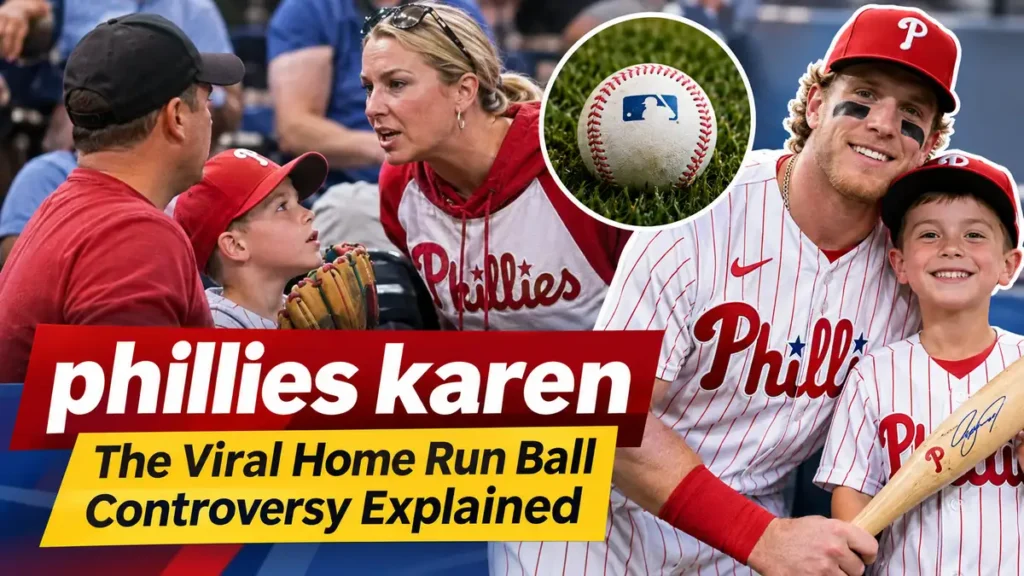
A routine baseball game between the Philadelphia Phillies and Miami Marlins turned into one of September 2025’s most talked-about sports controversies. The reason wasn’t a disputed umpire decision or an extraordinary play. It was an argument between spectators over a home run baseball.
The incident quickly became known as phillies karen, attracting widespread attention on social media and raising questions about fan etiquette, sportsmanship, and online harassment.
Phillies Karen refers to an unidentified female baseball fan who confronted a father over a home run ball he had retrieved and given to his young son during a Phillies–Marlins game on September 5, 2025. The confrontation went viral, prompting criticism, mistaken identity accusations, and a response from Phillies outfielder Harrison Bader. Inquirer.com+2
What Happened During the Phillies Karen Incident?
The controversy began on September 5, 2025, at loanDepot Park in Miami, Florida, during a Major League Baseball game between the Philadelphia Phillies and Miami Marlins.
Phillies outfielder Harrison Bader hit a solo home run into the left-field stands during the fourth inning.
Several spectators attempted to retrieve the baseball, including a woman wearing Phillies clothing and a father who had attended the game with his young son.
The father managed to pick up the ball and brought it back to his seat, where he placed it in his son’s glove.
Moments later, the woman approached him and demanded the baseball, claiming it belonged to her.
The disagreement escalated into a confrontation captured by television cameras and spectators.
Rather than prolong the argument, the father handed over the ball.
The Phillies ultimately won the game 9–3, but the confrontation became a major talking point beyond the result itself. CBS Philadelphia+1
The key moments of the controversy
| Event | What happened |
|---|---|
| Date | September 5, 2025 |
| Location | loanDepot Park, Miami |
| Teams | Philadelphia Phillies vs. Miami Marlins |
| Home run hitter | Harrison Bader |
| Inning | Fourth |
| Initial dispute | Two spectators sought the same home run ball |
| Confrontation | A woman demanded the ball from a father |
| Immediate outcome | The father surrendered the ball |
| Final score | Phillies 9, Marlins 3 |
| Aftermath | Viral criticism and gifts for the young fan |
The video shows the confrontation, but it does not conclusively establish who first secured the ball when it landed. That distinction matters when assessing competing claims about possession. CBS Philadelphia
Who Is Phillies Karen?
One of the most frequently searched questions following the incident was the identity of the woman involved.
The nickname “Phillies Karen” emerged online after viewers circulated footage of her confrontation with the father.
The term “Karen” is an internet slang expression commonly applied to someone perceived as acting excessively entitled, demanding, or confrontational.
In this case, social media users applied the nickname because the woman appeared to insist on receiving a souvenir that had already been given to a child.
However, the nickname is not her verified identity.
Was Phillies Karen ever identified?
Contemporaneous reporting did not establish the woman’s identity.
Several names circulated across social media platforms, but those accusations were unsupported or explicitly disputed.
The Philadelphia Inquirer reported that online efforts to identify the woman resulted in innocent people being targeted.
A New Jersey woman who was falsely associated with the footage publicly denied being involved.
The Hammonton Public School District also issued a statement rejecting claims that the woman in the video worked for the district. Inquirer.com+1
The distinction between an internet accusation and verified reporting is essential. A photograph, hairstyle resemblance, or unverified social media post is not sufficient evidence to establish someone’s identity.
Why Did Phillies Karen Go Viral?
The incident spread because it combined several elements that commonly generate strong reactions online: a child, a memorable sports souvenir, a public confrontation, and a moment captured on camera.
1. The baseball had sentimental value
For many baseball fans, catching a home run ball is a rare experience.
A ball hit by a Major League Baseball player can become a treasured souvenir, particularly for a child attending a game with family.
In this instance, the father had retrieved the ball and handed it to his son, Lincoln, who was celebrating his birthday.
That detail made the confrontation especially emotional for viewers. Hindustan Times
2. The confrontation happened in public
The incident occurred in a crowded stadium during a televised sporting event.
Footage showed the woman approaching the father after he had already given the baseball to his son.
Because the interaction was recorded from multiple perspectives, viewers could watch the exchange rather than rely entirely on secondhand accounts.
3. Social media amplified the footage
The video circulated across X, Facebook, TikTok, Reddit, and other platforms.
According to Know Your Meme, a widely shared post from the Phillies Tailgate account accumulated more than 61 million views within approximately two days.
The nickname became an easy way for users to discuss and search for the incident. Know Your Meme
4. Viewers disagreed about appropriate behavior
Many viewers criticized the woman’s decision to confront the father.
Others focused on the uncertainty surrounding who had initially reached the baseball.
This produced two related debates: who had the strongest claim to the souvenir, and whether arguing over it in front of a child was appropriate.
The second question became central to the public reaction.
Who Was the Father in the Phillies Karen Video?
The father involved in the incident was identified as Drew Feltwell, and his son was named Lincoln.
Feltwell had retrieved the baseball after Bader’s home run and returned to his seat to give it to his son.
When the woman confronted him, he eventually surrendered the souvenir rather than continue the dispute.
The Philadelphia Inquirer and other news organizations subsequently reported on the family’s experience. Inquirer.com+1
Why did the father give up the ball?
Feltwell later explained that he wanted to prevent the confrontation from escalating.
He described feeling pressured as the woman continued arguing with him.
Rather than respond aggressively, he chose to de-escalate the situation.
His response became another significant part of the story because viewers saw it as an example of maintaining composure during a tense public interaction.
Although his son lost the baseball, the family’s experience did not end there.
How Did Harrison Bader Respond?
Young baseball fan loses homerun ball to woman; Marlins, Phillies step in | FOX 29 Philadelphia
Philadelphia Phillies v Miami Marlins
LoanDepot Park: Comprehensive Gate & Entrance Guide – The Stadiums Guide
6
Phillies outfielder Harrison Bader played an important role in the positive aftermath of the incident.
After the confrontation attracted attention, the Phillies helped arrange a meeting between Bader and the young fan.
Bader met Lincoln after the game, signed a baseball bat, and posed for photographs.
The team shared the moment on social media.
The gesture helped turn an upsetting stadium experience into a memorable encounter for the child. CBS Philadelphia
What did the Miami Marlins do for the child?
The Miami Marlins organization also responded.
During the game, a stadium staff member approached the young fan and presented him with a prize package containing baseball-related items.
The gifts were intended to improve the child’s experience after the confrontation.
Between the Marlins’ gesture and Bader’s signed bat, Lincoln ultimately received special attention from both organizations.
This became one of the more widely appreciated aspects of the story.
Phillies Karen Identity Rumors and False Claims
The controversy did not remain limited to baseball.
As the footage circulated, social media users attempted to identify the woman, often using screenshots, comparisons, and unverified personal information.
Those efforts led to false accusations.
The mistaken identity controversy
One woman, Cheryl Richardson-Wagner, was wrongly accused of being the person in the video.
She publicly denied the allegation and explained that she was a Boston Red Sox supporter who had not been near Miami when the incident occurred.
Despite her denial, she received unwanted attention from people who believed the circulating claims.
The Philadelphia Inquirer documented how the incorrect identification became an example of online vigilantism. Inquirer.com
Claims about a school district employee
Another rumor connected the woman to Hammonton Public Schools in New Jersey.
The district publicly rejected the allegation, stating that the woman involved was not and had never been its employee.
Consequently, claims that the person in the video had been identified as a school district employee or dismissed from that position were not supported by the district’s statement. Hindustan Times+1
Did Phillies Karen issue an apology?
A supposed apology also circulated online.
The statement appeared to acknowledge the confrontation and defend the woman’s behavior.
However, fact-checking organization Lead Stories investigated the claim and determined that the statement originated from satire content.
There was no verified evidence that the woman had issued that apology.
The September 9, 2025 fact-check also reported that her identity had not been established at that time. Lead Stories
This illustrates why viral statements should be checked against original sources before being treated as authentic.
Did Phillies Karen Actually Steal the Baseball?
The word “stole” appeared frequently in reactions to the video, but it is more accurate to describe the event as a dispute over possession of a home run ball.
The available footage shows the father retrieving the ball, giving it to his son, and subsequently handing it to the woman following an argument.
It does not conclusively show which spectator first had control of the ball immediately after it landed.
CBS News specifically noted that the initial possession was unclear from circulating footage. CBS Philadelphia
Who had the right to keep the home run ball?
There is a difference between the informal customs of baseball spectators and a definitive legal determination.
Fans generally treat baseballs that enter the stands as souvenirs, but disputes over who initially possessed a ball can become complicated.
In this case, the public record does not establish a court ruling or other authoritative determination of ownership.
The strongest supported observations are that the father picked up the ball, gave it to his son, and later surrendered it after being confronted.
Why the distinction matters
Calling an incident theft suggests a legal conclusion that has not been established.
The more relevant public debate concerned whether the woman behaved appropriately by demanding the ball after it had been given to a child.
A person can criticize confrontational behavior without making unsupported legal accusations.
What Are the Unwritten Rules for Baseball Fans?
Baseball has a long tradition of informal fan etiquette.
Although individual spectators may disagree about specific situations, several customs help make games enjoyable for everyone.
Giving baseballs to children
One familiar tradition involves adults giving foul balls or home run balls to nearby children.
It is not a universal requirement, but it is widely viewed as a generous gesture.
The Phillies Karen incident attracted criticism partly because the disputed baseball had already been placed in a young fan’s glove.
Respecting other spectators
Fans frequently compete for souvenirs, particularly when a ball lands in a crowded seating area.
However, physically pushing, grabbing, or intimidating another spectator creates unnecessary risks.
The safer approach is to avoid aggressive contact and seek assistance from stadium personnel if a serious disagreement develops.
Avoiding confrontation over souvenirs
A baseball can have substantial sentimental value, but it is rarely worth escalating an argument.
If multiple spectators believe they have a claim to a ball, remaining calm and involving stadium staff is generally preferable to confronting someone physically.
Putting children’s safety first
Children may find heated confrontations particularly upsetting.
Adults attending sporting events can set a constructive example by resolving disagreements respectfully, even when disappointed.
The incident involving Lincoln demonstrated how quickly a memorable family outing can become stressful when spectators argue over a souvenir.
How Did Social Media React to Phillies Karen?
The reaction extended well beyond Philadelphia baseball fans.
Sports commentators, general-interest news outlets, meme pages, and online communities discussed the footage.
The debate focused on several themes.
Criticism of the woman’s behavior
Many viewers considered the confrontation inappropriate because the baseball had already been given to a child.
SportsCenter commentators also discussed the incident, contributing to its visibility beyond local Phillies coverage. Awful Announcing
Praise for the father’s restraint
Another recurring theme was the father’s decision not to escalate the argument.
Viewers who supported his response emphasized the value of remaining calm in a crowded public setting.
Appreciation for Bader’s gesture
Bader’s meeting with Lincoln attracted positive attention.
It demonstrated how a professional athlete could help restore a child’s enjoyment of the sport following an unpleasant experience.
Concern about internet harassment
As false identifications spread, the conversation expanded to include the consequences of online speculation.
The people wrongly accused of being Phillies Karen became examples of how viral outrage can affect individuals who were not involved in the original incident.
The Philadelphia Inquirer highlighted those consequences in its subsequent reporting. Inquirer.com
Phillies Karen and the Problem of Online Vigilantism
The incident illustrates a broader challenge of internet culture: the speed at which public criticism can turn into attempts to expose someone’s private identity.
A short video may document behavior that viewers consider unacceptable, but it rarely provides a complete picture of someone’s background or personal circumstances.
Why online identification attempts are unreliable
Social media users sometimes compare faces, clothing, hairstyles, and locations to identify people in viral footage.
These methods can produce incorrect conclusions, especially when the original video is unclear.
Once an accusation gains traction, other users may repeat it without verifying its source.
The resulting misinformation can spread faster than corrections.
The consequences of false accusations
Incorrect identification can expose innocent individuals to harassment, reputational harm, and unwanted contact.
In the Phillies Karen controversy, unrelated people were publicly associated with an incident they denied participating in.
This shifted part of the story away from stadium etiquette and toward the responsibility of online audiences.
Criticism does not require doxxing
It is possible to discuss the confrontation, evaluate the behavior shown, and debate fan etiquette without publishing someone’s personal details.
The relevant facts of the baseball dispute do not depend on identifying the woman’s employer, home address, or private accounts.
This distinction allows public discussion without unnecessarily endangering uninvolved individuals.
How Does the Incident Compare With Other Viral Sports Souvenir Disputes?
The Phillies Karen controversy occurred shortly after another widely discussed sports memorabilia incident at the 2025 US Open.
In that episode, a man faced criticism after taking a tennis player’s hat that had been intended for a young spectator.
The incidents were different, but both involved adults, children, sought-after sports memorabilia, and intense social media reactions.
CBS News noted the comparison in its coverage of the Phillies incident. CBS Philadelphia
| Comparison | Phillies Karen incident | US Open hat incident |
|---|---|---|
| Sport | Baseball | Tennis |
| Event | Phillies vs. Marlins | 2025 US Open |
| Souvenir | Harrison Bader home run ball | Tennis player’s hat |
| Main controversy | Argument over a ball given to a child | Adult taking a hat intended for a child |
| Public response | Viral criticism | Viral criticism |
| Broader issue | Fan etiquette and online identification | Sportsmanship and spectator behavior |
Both episodes demonstrated how small interactions between spectators can become international news when recorded and widely shared.
They also raised questions about the difference between legitimate criticism and disproportionate online punishment.
What Can Baseball Fans Learn From Phillies Karen?
Although the controversy centered on one baseball, its broader lessons apply to spectators at many sporting events.
Handle souvenir disputes calmly
A ball entering the stands can create excitement and confusion.
If several people reach for it simultaneously, the situation can become contentious.
Avoiding physical confrontation should take priority over obtaining a souvenir.
Ask stadium personnel for assistance
Stadium employees are better positioned to address disturbances than spectators arguing among themselves.
Seeking assistance is particularly sensible when a disagreement involves children or unwanted physical contact.
Recognize the limits of viral footage
A video may show a confrontation clearly without establishing every fact surrounding it.
In this incident, the footage documented the exchange but did not definitively resolve the initial possession question.
Separating observation from assumption helps prevent misleading conclusions.
Verify information before sharing it
The false identity claims associated with Phillies Karen show why viewers should be cautious about circulating names and personal details.
Reliable reporting, original statements, and credible fact-checking provide stronger evidence than anonymous social media allegations.
Remember why fans attend games
For many families, attending an MLB game is about spending time together, enjoying baseball, and creating memories.
A souvenir can add to that experience, but respectful behavior is ultimately more valuable than possessing a particular ball.
Why the Phillies Karen Story Still Matters
The incident became memorable not because of the financial value of a baseball, but because of the contrasting behavior it brought into public view.
The confrontation illustrated how competition over a souvenir can overshadow an otherwise enjoyable sporting event.
The father’s response demonstrated an alternative to escalating a disagreement.
Bader and the Marlins showed how teams and players can help a young spectator recover from an upsetting experience.
Meanwhile, the false identity accusations revealed how easily online outrage can harm people who were not involved.
These overlapping themes explain why the incident attracted attention beyond ordinary baseball coverage.
Final Thoughts on Phillies Karen
The phillies karen controversy began with a Harrison Bader home run during a September 5, 2025, Phillies–Marlins game and developed into a widely discussed example of spectator conflict.
A father retrieved the baseball for his son, a woman confronted him over possession, and the father eventually surrendered the souvenir.
The young fan later received gifts from the Marlins and a signed bat from Bader, helping create a more positive ending.
The woman’s identity was not established in the verified contemporary reporting, and several viral claims about her were false.
Ultimately, the incident offers two lasting lessons: sporting events are more enjoyable when fans treat one another respectfully, and online criticism should never replace careful verification of the facts.