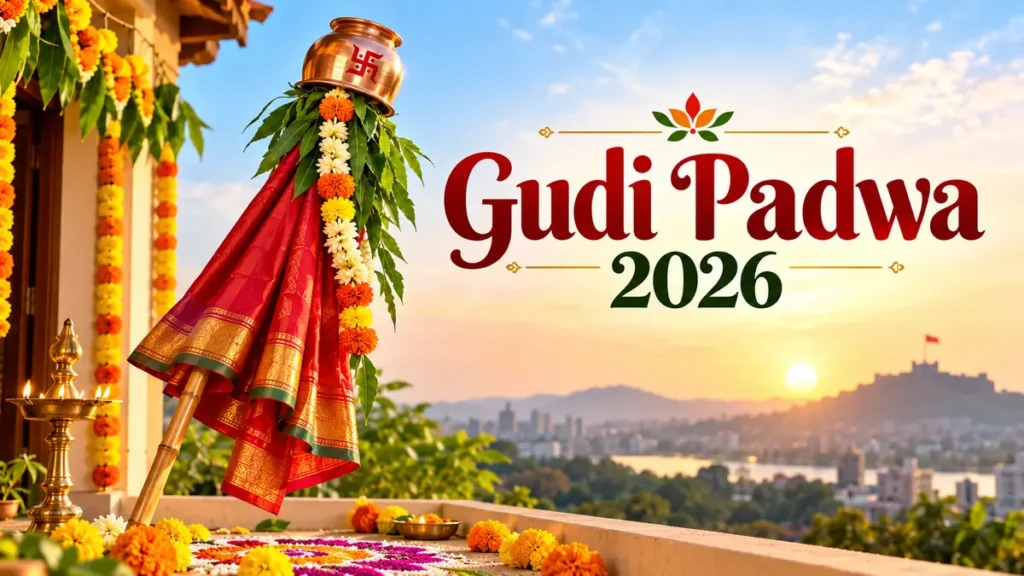
Gudi Padwa is one of Maharashtra’s most cherished festivals, marking the beginning of the Marathi New Year with colorful decorations, traditional prayers, delicious food, and family gatherings. The festival symbolizes prosperity, renewal, happiness, and the triumph of good over evil.
gudi padwa 2026 was celebrated on Thursday, March 19, 2026. The festival falls on Chaitra Shukla Pratipada, the first day of the waxing lunar fortnight in the Hindu month of Chaitra. Families celebrate by raising a decorated Gudi, performing prayers, preparing traditional Maharashtrian dishes, and welcoming the New Year with hope and gratitude. Drikpanchang+1
gudi padwa 2026 Date and Important Details
THURSDAY
19
MAR 2026
Marathi New Year
Chaitra Shukla Pratipada
Maharashtra, India
| Festival detail | Information |
|---|---|
| Festival name | Gudi Padwa or Gudhi Padva |
| Date | March 19, 2026 |
| Day | Thursday |
| Hindu month | Chaitra |
| Lunar tithi | Shukla Pratipada |
| Calendar | Marathi lunisolar calendar |
| New year | Marathi Shaka Samvat 1948 |
| Main ritual | Gudi Sthapana and Gudi Puja |
| Main region | Maharashtra and parts of the Konkan region |
| Related festival | Ugadi |
The date is confirmed by the Hindu festival calendar and Maharashtra’s official 2026 holiday listing. Drikpanchang+2
Why Does the Date of Gudi Padwa Change Every Year?
Gudi Padwa follows the Hindu lunisolar calendar rather than the Gregorian calendar. It is observed at the beginning of the bright fortnight of Chaitra, which generally falls in March or April.
Because lunar months do not align perfectly with Gregorian months, the festival shifts from year to year.
For comparison:
| Year | Date | Day |
|---|---|---|
| 2025 | March 30 | Sunday |
| 2026 | March 19 | Thursday |
| 2027 | April 7 | Wednesday |
| 2028 | March 27 | Monday |
Drikpanchang
gudi padwa 2026 Puja Muhurat and Tithi Timings
The auspicious timing for Gudi Padwa celebrations is connected to Chaitra Shukla Pratipada, the lunar day associated with the beginning of the New Year.
For Mumbai and Pune, the published 2026 Panchang calculations give the following approximate timings:
| Event | Date and time (IST) |
|---|---|
| Pratipada Tithi begins | March 19, 6:53 AM |
| Pratipada Tithi ends | March 20, 4:52 AM |
| Gudi Padwa observance | March 19, 2026 |
| Preferred worship period | Morning, according to local custom |
These tithi timings are supported by location-specific Panchang calculations for Mumbai and Pune. mypanchang.com+1
What Was the Best Time for Gudi Puja in 2026?
Traditionally, families raise the Gudi and perform worship in the morning. The festival is regarded as auspicious throughout the day, and there is no single universally required Gudi Puja muhurat.
The precise timing of sunrise and any preferred worship window depends on the location and family tradition.
For households following a particular Panchang or priest’s guidance, the local calendar remains the appropriate reference.
Is Gudi Padwa an Auspicious Day?
Yes. In Maharashtrian Hindu tradition, Gudi Padwa is considered an auspicious occasion for beginning positive activities.
Many families associate the day with moving into a new home, starting educational activities, opening financial accounts, or beginning a business venture.
However, religious beliefs about auspicious timing should be distinguished from practical decisions. Important financial or legal commitments still require appropriate planning.
What Is Gudi Padwa and Why Is It Celebrated?
Gudi Padwa is the traditional New Year festival celebrated primarily by Marathi-speaking Hindu communities in Maharashtra and the Konkan region.
The word Padwa comes from Pratipada, referring to the first lunar day of a fortnight. A Gudi is a decorated ceremonial arrangement raised outside homes to represent victory, prosperity, and good fortune.
The festival has religious, cultural, and seasonal significance.
The Beginning of the Marathi New Year
Gudi Padwa marks the beginning of a new year in the traditional Marathi calendar.
The occasion encourages people to welcome fresh opportunities, renew family relationships, express gratitude, and reflect on their goals.
It also connects the beginning of the year with the arrival of spring and seasonal changes in western India.
Connection With Lord Brahma
According to a Hindu religious tradition, Lord Brahma began creating the universe on Chaitra Shukla Pratipada.
This belief gives the day a special association with creation, renewal, and new beginnings.
The connection is part of Hindu religious tradition rather than a historical claim that can be independently verified.
Connection With Lord Rama
Another traditional interpretation associates Gudi Padwa with Lord Rama’s victory over Ravana and his return to Ayodhya.
The raised Gudi is sometimes understood as a victory banner, reflecting the triumph of righteousness over evil.
Different communities emphasize different legends, so no single interpretation represents every family’s observance.
Historical Associations With Shivaji Maharaj
Some popular accounts connect the tradition of raising a victory banner with Chhatrapati Shivaji Maharaj and the Maratha legacy of military success.
This association contributes to the festival’s cultural importance in Maharashtra.
However, the festival’s calendar origins and religious traditions are older than the Maratha Empire, and specific claims about its historical beginnings should not be treated as established without supporting evidence.
What Is a Gudi? Meaning and Symbolism
गुढीपाडवा — मराठी नववर्षाचा सण, महत्त्व आणि साजरा करण्याची पद्धत | marathi.community
Lokpriya – Celebrating Indian Heritage & Culture
11
The Gudi is the most recognizable symbol of the festival.
It usually consists of a long bamboo pole decorated with a bright cloth, leaves, flowers, and an inverted metal vessel.
The arrangement is displayed prominently outside a home, often near a window, balcony, entrance, or terrace.
Symbolism of Different Gudi Decorations
| Component | Traditional symbolism |
|---|---|
| Bamboo pole | Strength and stability |
| Bright silk or festive cloth | Joy, celebration, and prosperity |
| Inverted copper or silver vessel | Auspiciousness and abundance |
| Neem leaves | Renewal, purification, and seasonal tradition |
| Mango leaves | Freshness, fertility, and prosperity |
| Flower garland | Devotion and celebration |
| Sugar garland | Sweetness and happiness |
The meanings may vary among households, but the overall Gudi represents a hopeful beginning to the year.
Why Is the Kalash Placed Upside Down?
An inverted copper or silver vessel is placed at the top of the Gudi as part of its traditional design.
The vessel is considered auspicious and visually completes the raised ceremonial banner.
Although symbolic interpretations differ, the arrangement is widely associated with blessings and prosperity.
Which Direction Should a Gudi Face?
Families generally position the Gudi where it is visible from outside the house.
Some households prefer particular directions based on family customs or Vastu beliefs, but there is no single direction followed universally.
A secure, safe location is especially important when the Gudi is placed on an upper-floor balcony or terrace.
How to Celebrate Gudi Padwa at Home
Gudi Padwa celebrations combine home preparation, religious observance, family traditions, and festive meals.
The following sequence reflects common Maharashtrian practices.
1. Clean and Decorate the House
Families traditionally begin by cleaning their homes and preparing the entrance for the festival.
Decorations may include fresh flowers, mango-leaf torans, colorful fabrics, and decorative lamps.
The cleaning symbolizes leaving behind negativity and welcoming the New Year with a fresh outlook.
2. Take a Traditional Morning Bath
Many devotees wake early and bathe before beginning the day’s prayers.
People may wear new clothes or traditional Maharashtrian attire.
Women often wear Paithani or Nauvari sarees, while men may choose a kurta, dhoti, or traditional headwear.
3. Create a Rangoli
गुढीपाडवा — मराठी नववर्षाचा सण, महत्त्व आणि साजरा करण्याची पद्धत | marathi.community
Rangoli designs are commonly created near the entrance of the house.
Popular motifs include flowers, geometric patterns, lotus designs, and symbols of prosperity.
Some families use colored powders, while others decorate with flower petals or rice flour.
4. Prepare and Raise the Gudi
To prepare a traditional Gudi, families commonly use a bamboo pole, decorative cloth, mango or neem leaves, a flower garland, and a metal kalash.
The process generally involves:
- Cleaning and preparing the bamboo pole.
- Tying a bright cloth near its upper end.
- Adding a garland of flowers and leaves.
- Placing an inverted kalash at the top.
- Securing the completed arrangement upright in a visible location.
The Gudi should be firmly fastened to prevent it from falling, especially in windy conditions.
5. Perform Gudi Puja
Once the Gudi is installed, families offer prayers according to their customs.
Common offerings include flowers, turmeric, kumkum, incense, a lamp, and traditional food.
Some households recite prayers, listen to the annual Panchang reading, or seek blessings for health, peace, and prosperity.
6. Share Traditional Festive Foods
After worship, families prepare special Maharashtrian dishes and share meals.
Visiting relatives, exchanging greetings, and spending time with elders are important parts of the celebration.
Traditional Gudi Padwa Food and Its Cultural Meaning
Shrikhand, Puri, and Batata Bhaji – A Gudi Padwa Special Thali – Vishakha’s Kitchen
9
Food plays a central role in Gudi Padwa celebrations. Traditional dishes often combine sweet, savory, and occasionally bitter flavors.
Puran Poli
Puran Poli is one of Maharashtra’s best-known festive dishes.
It is a sweet flatbread filled with a mixture of cooked lentils, jaggery, and aromatic spices such as cardamom.
Families often serve it warm with ghee.
Shrikhand and Puri
Shrikhand is a sweet dish prepared using strained yogurt, sugar, and flavorings such as saffron or cardamom.
It is commonly served with puri, making it a popular festive combination.
Neem and Jaggery Mixture
Some families traditionally consume a small mixture containing neem leaves, jaggery, and other ingredients.
The bitter and sweet flavors symbolize the different experiences of life, including difficulties and happiness.
Although neem has a place in traditional practices, claims that consuming it prevents disease or medically purifies the body are not established. Neem should not be treated as a substitute for medical care, and concentrated preparations may be unsafe for some people.
Other Popular Maharashtrian Dishes
Festive menus may include batata bhaji, varan bhaat, koshimbir, masale bhaat, and different regional sweets.
Food choices vary by family, locality, and dietary preference.
Gudi Padwa and Ugadi: What Is the Difference?
Gudi Padwa and Ugadi are closely related New Year festivals celebrated on the same lunar calendar occasion.
Both mark Chaitra Shukla Pratipada, but their customs reflect different regional traditions.
| Feature | Gudi Padwa | Ugadi |
|---|---|---|
| Main regions | Maharashtra and Konkan | Karnataka, Andhra Pradesh, Telangana |
| Main significance | Traditional regional New Year | Traditional regional New Year |
| Distinctive custom | Raising a decorated Gudi | Preparing Ugadi Pachadi |
| Popular festive foods | Puran Poli, Shrikhand | Ugadi Pachadi, Holige and regional dishes |
| Calendar basis | Hindu lunisolar calendar | Hindu lunisolar calendar |
| 2026 date | March 19 | March 19 |
Both festivals emphasize renewal, prosperity, and gratitude.
What Is Ugadi Pachadi?
Ugadi Pachadi is a traditional preparation associated particularly with Telugu New Year celebrations.
It combines several flavors that symbolize the different emotional experiences people encounter throughout life.
Although Gudi Padwa and Ugadi share a calendar date, the Gudi-raising tradition is especially associated with Maharashtra.
Is Gudi Padwa the Same as Chaitra Navratri?
No. Gudi Padwa is the New Year festival, while Chaitra Navratri is a nine-night religious observance dedicated to the Divine Mother in Hindu traditions.
Both began on March 19 in 2026 because they are associated with Chaitra Shukla Pratipada. Drikpanchang
Chaitra Navratri involves devotional practices that may include fasting, prayer, and worship of Goddess Durga.
The celebrations are related through the Hindu calendar but have distinct religious meanings.
How Gudi Padwa Is Celebrated Across Maharashtra
Although the festival follows shared traditions, celebrations differ across cities and communities.
Mumbai
In Mumbai, Gudi Padwa celebrations combine household rituals with community events.
Some neighborhoods organize cultural performances, traditional attire processions, and festive gatherings.
Residential buildings may display decorated Gudis from balconies and windows.
Pune
Pune is known for its strong Maharashtrian cultural traditions.
Families celebrate with Gudi Puja, rangoli, festive meals, and traditional clothing.
Community celebrations may include music, cultural performances, and processions.
Nashik
In Nashik, celebrations often emphasize family rituals, religious observances, and visits to temples.
Traditional meals and home decorations are important parts of the occasion.
Konkan Region
In the Konkan region, Gudi Padwa reflects local Marathi and Konkani traditions.
Households may use locally available flowers and leaves, prepare regional foods, and observe customs passed down through generations.
Celebrations Outside India
Marathi communities living abroad also celebrate Gudi Padwa through family gatherings and cultural events.
Community associations may organize traditional music, dance, food festivals, and opportunities for younger generations to learn about Maharashtrian heritage.
Is Gudi Padwa a Public Holiday in 2026?
Yes. Gudi Padwa was an official public holiday in Maharashtra on Thursday, March 19, 2026.
The Brihanmumbai Municipal Corporation’s 2026 civic diary lists Gudhi Padwa among the year’s public holidays. MyBMC
Government offices and many institutions in Maharashtra observe the holiday, although arrangements vary by organization.
Gudi Padwa is not a uniform nationwide public holiday across every Indian state.
Schools, banks, private businesses, and public services may follow their applicable state or institutional holiday calendars.
Traditional Clothing and Decorations for Gudi Padwa
Clothing and home decoration are important ways families express cultural identity during the festival.
Traditional Maharashtrian Clothing
Women may wear Paithani sarees, Nauvari sarees, or other festive traditional outfits.
Common accessories include traditional necklaces, earrings, bangles, and the Maharashtrian nath, a distinctive nose ornament.
Men may wear kurtas, dhotis, waistcoats, or a traditional pheta.
The choice of clothing depends on personal preference and family customs.
Popular Home Decorations
Many families decorate their entrances with mango-leaf torans and marigold flowers.
Colorful rangoli designs complement the raised Gudi.
Bright yellow, green, orange, and red are frequently seen in festive decorations because they create a cheerful and celebratory atmosphere.
Gudi Padwa Wishes and Greetings for 2026
Sharing greetings is a simple but meaningful part of Marathi New Year celebrations.
Here are some English wishes suitable for family members, friends, and colleagues.
- Happy Gudi Padwa! May the New Year bring happiness, prosperity, and good health to your family.
- Wishing you a joyful Marathi New Year filled with peace, success, and beautiful memories.
- May this Gudi Padwa mark the beginning of new opportunities and lasting happiness.
- Sending warm wishes for a year of positivity, harmony, and prosperity.
- May the spirit of Gudi Padwa inspire fresh beginnings and strengthen family bonds.
- Wishing you and your loved ones a wonderful New Year filled with blessings and joyful celebrations.
A common Marathi greeting is Gudi Padwyachya Hardik Shubhechha, meaning heartfelt wishes for Gudi Padwa.
Common Questions About Gudi Padwa Traditions
Can Gudi Padwa Be Celebrated Without Raising a Gudi?
Yes. Although raising the Gudi is a central tradition, families may observe the occasion through prayer, festive meals, cultural activities, and New Year greetings.
People living in apartments or locations where a large Gudi cannot be installed may choose a smaller arrangement or focus on household worship.
Why Are Neem Leaves Used During Gudi Padwa?
Neem leaves are associated with seasonal renewal and traditional symbolism.
Their bitter taste is also used to represent life’s challenges when combined with sweet ingredients.
The practice is cultural and symbolic, and it should not be interpreted as proof of specific medical benefits.
Is Gudi Padwa Celebrated Only in Maharashtra?
No. The festival is strongly associated with Maharashtra, but Marathi and Konkani communities celebrate it in other parts of India and internationally.
Related New Year observances, including Ugadi, take place in other regions.
What Is the Marathi New Year Called?
The Marathi New Year is commonly called Gudi Padwa or Gudhi Padva.
The festival marks the beginning of a new year in the traditional Marathi lunisolar calendar.
In 2026, it marked the beginning of Marathi Shaka Samvat 1948. Drikpanchang
Is Gudi Padwa Related to Diwali?
Gudi Padwa and Diwali are different festivals.
Gudi Padwa marks the beginning of the traditional Marathi New Year in Chaitra, while Diwali is celebrated later in the year and has its own religious and cultural traditions.
Both involve auspicious rituals, family gatherings, festive foods, and home decorations.
Why Gudi Padwa Remains Important Today
Gudi Padwa continues to hold significance because it brings together religious belief, family tradition, regional identity, and the idea of renewal.
For many families, the festival is an opportunity to reconnect with their cultural heritage and teach younger generations about traditional customs.
The Gudi itself is a powerful visual symbol. Its bright cloth, flowers, leaves, and ceremonial vessel reflect the optimism associated with the beginning of a new year.
At the same time, the festival adapts to modern lifestyles. Families may celebrate in urban apartments, participate in community events, or connect with relatives through digital greetings.
The essential meaning remains centered on gratitude, hope, prosperity, and togetherness.
Final Thoughts on gudi padwa 2026
gudi padwa 2026 was observed on Thursday, March 19, marking the beginning of the Marathi New Year and Chaitra Shukla Pratipada.
From raising the traditional Gudi and performing morning prayers to preparing Puran Poli and sharing greetings, the festival reflects Maharashtra’s rich cultural heritage.
Its significance goes beyond a change in the calendar. Gudi Padwa encourages families to welcome new beginnings, preserve meaningful traditions, and approach the year ahead with optimism.
For future celebrations, checking a location-specific Hindu Panchang can help families determine the appropriate festival date and worship timings while honoring their own regional and household customs.