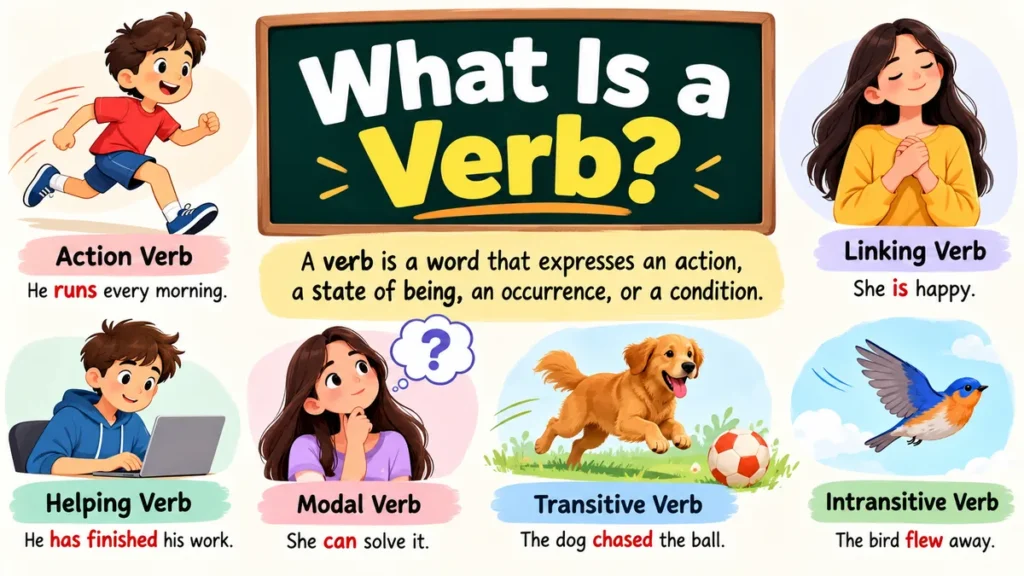
Every complete English sentence needs a verb, but verbs do much more than describe actions. They can express feelings, conditions, existence, changes, and events. Understanding verbs helps you write clearer sentences, use grammar correctly, and communicate more confidently.
A verb is a word that expresses an action, a state of being, an occurrence, or a condition. Verbs tell us what a subject does, what happens to it, or what it is like. Common examples include run, eat, write, think, become, have, and be. A verb is an essential part of a sentence’s predicate.
Consider these examples:
- Sarah runs every morning.
- The baby is asleep.
- They have finished their homework.
- The flowers bloom in spring.
- I believe your story.
Each sentence contains a verb that communicates an action, condition, or experience.
What Is a Verb in English Grammar?
In English grammar, a verb is one of the major parts of speech. It forms the foundation of a clause by expressing what the subject does, experiences, or is.
A verb can describe a physical activity, a mental process, a state, or an event.
| Sentence | Verb | What it expresses |
|---|---|---|
| John plays football. | plays | Physical action |
| Emma knows the answer. | knows | Mental state |
| The soup smells delicious. | smells | Sensory condition |
| The weather changed. | changed | Occurrence |
| He is a teacher. | is | State of being |
| They have arrived. | have arrived | Completed event |
Verbs can appear as single words or as verb phrases containing auxiliary verbs.
For example, in “She is reading a book,” the complete verb phrase is is reading. The word reading is the main verb, while is helps express the present progressive tense.
Why Are Verbs Important in Sentences?
Verbs connect the subject to information about an action, state, or event.
Compare these two expressions:
- The children in the garden.
- The children are playing in the garden.
The first is a phrase rather than a complete independent sentence. The second contains a subject and a finite verb phrase, making it a complete sentence.
Most standard English independent clauses require a finite verb, although commands and certain conversational expressions can have an implied subject or omitted words.
What Are the Main Types of Verbs?
English verbs can be classified according to their meaning, grammatical function, and relationship with other sentence elements.
1. Action Verbs
Action verbs describe something a person, animal, object, or other subject does. The action may be physical or mental.
Physical action examples:
- Walk
- Jump
- Dance
- Swim
- Cook
- Write
Mental action examples:
- Consider
- Imagine
- Decide
- Remember
- Analyze
Example sentences:
- The athlete jumps over the hurdle.
- My mother cooks dinner.
- We considered several solutions.
- She imagined a different ending.
An action verb does not always involve visible movement. Thinking, deciding, and remembering are also activities expressed through verbs.
2. Linking Verbs
Linking verbs connect the subject to a word or phrase that identifies or describes it. This information is called a subject complement.
Common linking verbs include be, seem, become, appear, remain, feel, look, smell, and taste.
Examples:
- The sky is blue.
- Michael became a doctor.
- The cake tastes sweet.
- She seems confident.
- The room remained quiet.
A linking verb does not express an action performed on an object.
Some verbs function as either linking verbs or action verbs depending on context.
Compare:
- The chef tasted the soup. (Action)
- The soup tasted salty. (Linking)
In the first sentence, the chef performs an action. In the second, the verb connects the soup to its quality.
3. Helping Verbs (Auxiliary Verbs)
Helping verbs work with main verbs to form different tenses, aspects, voices, questions, and negative constructions.
The three primary auxiliary verbs are:
- Be: am, is, are, was, were, being, been
- Have: have, has, had
- Do: do, does, did
Examples:
- She is studying mathematics.
- We have completed the assignment.
- Do you understand the question?
- They were invited to the ceremony.
- He does not like coffee.
In “They have finished their work,” have is an auxiliary verb and finished is the main verb.
The same word can function as a main verb in another sentence:
– They have a large house.
Here, have expresses possession rather than assisting another verb.
4. Modal Verbs
Modal verbs are a special category of auxiliary verbs used to express possibility, ability, permission, necessity, prediction, or obligation.
Common modal verbs include:
| Modal verb | Common meaning | Example |
|---|---|---|
| Can | Ability or permission | She can swim. |
| Could | Possibility or past ability | It could rain. |
| May | Permission or possibility | You may leave. |
| Might | Possibility | He might arrive late. |
| Must | Necessity or strong deduction | You must wear a helmet. |
| Should | Advice or expectation | You should rest. |
| Will | Prediction or willingness | I will help you. |
| Would | Hypothetical situation or politeness | I would prefer tea. |
| Shall | Formal suggestion or future reference | Shall we begin? |
Core modal verbs generally take the base form of the following verb without to.
Correct: She can drive.
Incorrect: She can drives.
Expressions such as have to, ought to, and be able to can also communicate modal meanings, although their grammatical structures differ from those of core modals.
5. Transitive Verbs
A transitive verb takes a direct object, which receives or is directly affected by the action.
Examples:
- Lisa opened the door.
- The teacher explained the lesson.
- He bought a bicycle.
- They built a bridge.
In “Lisa opened the door,” the door is the direct object of opened.
Some verbs can take two objects:
– She gave her brother a gift.
Here, her brother is the indirect object, while a gift is the direct object.
6. Intransitive Verbs
An intransitive verb does not take a direct object.
Examples:
- The baby slept.
- Everyone laughed.
- The guests arrived.
- The sun rose.
An intransitive verb can still be followed by an adverb or prepositional phrase.
For example:
- The children slept peacefully.
- The guests arrived at noon.
Neither peacefully nor at noon is a direct object.
Many English verbs can be transitive in one sentence and intransitive in another.
- She reads every evening. (Intransitive use)
- She reads novels. (Transitive use)
What Is a Verb? Understanding Verb Forms
English verbs change form to express grammatical information such as tense, agreement, and aspect.
Most lexical verbs have five commonly taught forms, although some forms may look identical.
| Verb form | Example: write | Example: play |
|---|---|---|
| Base form (V1) | write | play |
| Third-person singular | writes | plays |
| Past tense (V2) | wrote | played |
| Past participle (V3) | written | played |
| Present participle (-ing) | writing | playing |
These forms help construct different grammatical patterns.
Base Form
The base form is the simplest form of a verb.
Examples:
- I work from home.
- They play cricket.
- You should study regularly.
The base form is used after most modal auxiliary verbs and in many infinitive constructions.
Past Tense Form
The past tense commonly describes an action or situation located in the past.
Examples:
- She visited her grandmother.
- They went to school.
- He wrote a letter.
Regular verbs generally add -ed, while irregular verbs follow different patterns.
Past Participle
The past participle is used in perfect constructions and passive-voice constructions.
Examples:
- I have eaten breakfast.
- She has written three articles.
- The window was broken.
Present Participle
The present participle typically ends in -ing and can combine with forms of be to create progressive constructions.
Examples:
- He is running.
- They were playing.
- We have been waiting.
The -ing form can also function in other grammatical roles, including gerund constructions.
Regular and Irregular Verbs
Verbs are also categorized according to how they form their past tense and past participle.
Regular Verbs
Regular verbs usually form their past tense and past participle by adding -ed or -d.
| Base verb | Past tense | Past participle |
|---|---|---|
| Walk | walked | walked |
| Clean | cleaned | cleaned |
| Dance | danced | danced |
| Study | studied | studied |
| Stop | stopped | stopped |
| Watch | watched | watched |
Spelling rules may require changing y to i or doubling a final consonant.
For example, study becomes studied, while stop becomes stopped.
Irregular Verbs
Irregular verbs do not follow the standard -ed pattern.
| Base verb | Past tense | Past participle |
|---|---|---|
| Go | went | gone |
| Eat | ate | eaten |
| See | saw | seen |
| Take | took | taken |
| Speak | spoke | spoken |
| Write | wrote | written |
| Begin | began | begun |
| Buy | bought | bought |
| Cut | cut | cut |
| Be | was/were | been |
Some irregular verbs have identical forms, while others change completely.
Learning common irregular verbs is especially useful because many appear frequently in everyday conversation and writing.
Verb Tenses in English Grammar
Verb tense helps locate an action or situation in time. English commonly distinguishes past and present through verb forms, while future meaning is often expressed using will, be going to, or other constructions.
Traditional grammar lessons organize these patterns into 12 commonly taught tense-aspect combinations.
| Tense or construction | Example |
|---|---|
| Simple Present | She writes every day. |
| Present Continuous | She is writing now. |
| Present Perfect | She has written a letter. |
| Present Perfect Continuous | She has been writing for an hour. |
| Simple Past | She wrote yesterday. |
| Past Continuous | She was writing at noon. |
| Past Perfect | She had written before dinner. |
| Past Perfect Continuous | She had been writing for an hour. |
| Simple Future | She will write tomorrow. |
| Future Continuous | She will be writing at noon. |
| Future Perfect | She will have written by Friday. |
| Future Perfect Continuous | She will have been writing for two hours. |
These constructions combine time references with grammatical aspect, which indicates how an event unfolds or relates to another point in time.
Present Tense
The simple present describes habits, general truths, and certain current states.
- Water boils at 100°C under standard atmospheric pressure.
- She works at a hospital.
- They enjoy classical music.
The present continuous usually describes an activity happening now or around the present time.
- He is preparing dinner.
- We are learning English.
Past Tense
The simple past describes completed past events and previous situations.
- They visited London last year.
- I lost my keys yesterday.
The past continuous describes an activity that was in progress at a particular past time.
– She was studying when the phone rang.
Future Expressions
English frequently uses will and be going to to discuss future events.
- I will call you tomorrow.
- They are going to travel next month.
The present continuous can also describe planned future arrangements:
– We are meeting our teacher on Monday.
Stative Verbs vs. Dynamic Verbs
Another useful distinction is between stative and dynamic verbs.
A stative verb describes a state, condition, possession, perception, or mental relationship rather than an activity unfolding over time.
Common stative verbs include:
- Know
- Believe
- Understand
- Own
- Belong
- Prefer
- Need
- Love
Examples:
- I know the answer.
- She owns a car.
- They believe the explanation.
Stative verbs are generally less common in progressive constructions when they express stable states.
For example:
Correct: I understand the problem.
Usually incorrect for the intended meaning: I am understanding the problem.
A dynamic verb, by contrast, describes an activity, process, or event.
Examples:
- He is running.
- They are building a house.
- The temperature is rising.
Some verbs have both stative and dynamic meanings.
Compare:
- I think this is correct. (Opinion or state)
- I am thinking about the answer. (Mental activity)
Similarly:
- She has two dogs. (Possession)
- She is having lunch. (Activity)
The distinction depends on the meaning of the verb in context, not simply the word itself. Grammarly Blog+1
Finite and Non-Finite Verbs
Verbs can also be classified according to whether they express tense or participate in a clause’s grammatical agreement.
Finite Verbs
A finite verb is marked for tense or functions as the finite element of a verb phrase.
Examples:
- She works every day.
- They worked yesterday.
- He is sleeping.
- We can help.
In “He is sleeping,” is is finite, while sleeping is non-finite.
Non-Finite Verbs
Non-finite verb forms do not independently express tense or subject agreement.
They include infinitives, participles, and gerunds.
Infinitives
- I want to learn Spanish.
- She decided to leave early.
Gerunds
- Swimming improves endurance.
- He enjoys reading.
Participles
- The broken window needs repair.
- The smiling child waved.
A gerund is an -ing verb form functioning in a noun-like grammatical role. Participles can participate in verb phrases or modify nouns.
The same -ing form can serve different functions:
- Running is enjoyable. (Gerund)
- She is running. (Present participle in a verb phrase)
- The running water is cold. (Participial modifier)
Phrasal Verbs and Their Meanings
A phrasal verb combines a verb with one or more particles to create a particular meaning. The overall meaning is sometimes different from the meanings of the individual words.
Examples include:
| Phrasal verb | Meaning | Example |
|---|---|---|
| Give up | Stop trying | Never give up. |
| Turn off | Stop a device operating | Turn off the light. |
| Look after | Take care of | She looks after her brother. |
| Find out | Discover | We found out the truth. |
| Put off | Postpone | They put off the meeting. |
| Run into | Meet unexpectedly | I ran into an old friend. |
| Break down | Stop functioning | The car broke down. |
| Carry on | Continue | Please carry on working. |
| Pick up | Collect or lift | He picked up the package. |
| Look up | Search for information | Look up the word. |
Some phrasal verbs are separable.
- Turn off the television.
- Turn the television off.
- Turn it off.
Others are inseparable.
– She looks after her grandmother.
You cannot normally say “She looks her grandmother after.”
Learning phrasal verbs as complete expressions is often more effective than memorizing their individual components.
What Is a Verb Phrase?
A verb phrase contains a main verb and any auxiliary verbs that accompany it.
Examples:
- She sings.
- She is singing.
- She has been singing.
- She might have been singing.
The main verb contributes the central meaning, while auxiliaries provide additional grammatical information.
Consider:
“The students will have completed their assignments.”
The verb phrase contains:
- Will: modal auxiliary expressing future reference
- Have: perfect auxiliary
- Completed: main verb in the past participle form
In some grammar frameworks, the term verb phrase is defined more broadly to include complements and modifiers. In basic grammar instruction, it commonly refers to the main verb together with its auxiliaries. Grammarly+1
Subject-Verb Agreement Rules
Subject-verb agreement means that a finite verb must use the appropriate form for its subject.
This is especially noticeable with the simple present tense and forms of be.
Singular and Plural Subjects
In the simple present, most verbs take -s or -es with third-person singular subjects.
- He plays football.
- She teaches English.
- The dog barks loudly.
Other subjects generally use the base form:
- I play football.
- You play football.
- They play football.
Agreement With Be
| Subject | Present | Past |
|---|---|---|
| I | am | was |
| He/She/It | is | was |
| You | are | were |
| We | are | were |
| They | are | were |
Examples:
- I am ready.
- She is happy.
- We are students.
- They were tired.
Common Agreement Problems
A phrase between the subject and verb does not normally change the subject’s number.
Correct: The box of books is heavy.
Incorrect: The box of books are heavy.
The subject is box, not books.
With subjects joined by and, the verb is usually plural:
– Tom and Jerry are friends.
With either…or and neither…nor, agreement often follows the subject closest to the verb:
- Neither the teacher nor the students are absent.
- Neither the students nor the teacher is absent.
Active Voice and Passive Voice
Verbs also help distinguish active and passive voice.
In the active voice, the grammatical subject performs the action.
- The mechanic repaired the car.
- The chef prepared dinner.
In the passive voice, the grammatical subject receives the action or is affected by it.
- The car was repaired by the mechanic.
- Dinner was prepared by the chef.
The passive voice commonly uses a form of be followed by a past participle.
| Active voice | Passive voice |
|---|---|
| She writes a letter. | A letter is written by her. |
| They built a bridge. | A bridge was built by them. |
| He cleaned the room. | The room was cleaned by him. |
| Someone stole the bicycle. | The bicycle was stolen. |
Active voice often makes writing more direct, but passive voice is useful when the action or affected person is more important than the performer.
For example, “The results were published yesterday” is natural when the publisher’s identity is not relevant.
How to Identify a Verb in a Sentence
Finding verbs becomes easier when you understand their different functions.
Step 1: Find the Subject
Identify who or what the sentence is about.
Example:
“The little girl sings beautifully.”
Subject: The little girl
Step 2: Ask What the Subject Does or Is
Ask what action, state, or event is expressed.
“The little girl sings beautifully.”
Verb: sings
Step 3: Look for Helping Verbs
A sentence may contain several words working together as one verb phrase.
“The little girl has been singing all morning.”
Verb phrase: has been singing
Step 4: Check for Linking Verbs
Not every verb describes an action.
“The little girl seems tired.”
Verb: seems
It connects the subject with the adjective tired.
Step 5: Identify Verbs in Complex Sentences
A sentence may contain multiple clauses and therefore multiple verbs.
“After he finished dinner, John went outside because he wanted some fresh air.”
The verbs are finished, went, and wanted.
Each belongs to a different clause.
50 Common Verbs in English With Examples
The following table provides frequently used verbs and their meanings in context.
| Verb | Meaning | Example sentence |
|---|---|---|
| Be | Exist or have a state | She is happy. |
| Have | Possess | They have a car. |
| Do | Perform | I do my homework. |
| Go | Move or travel | We go to school. |
| Come | Move toward | Please come here. |
| Get | Receive or obtain | He got a gift. |
| Make | Create | She makes cakes. |
| Take | Carry or obtain | Take your bag. |
| Give | Provide | Give me the book. |
| See | Perceive visually | I see a bird. |
| Know | Understand or be aware | I know the answer. |
| Think | Consider | Think carefully. |
| Say | Speak words | She says hello. |
| Tell | Communicate | Tell me the story. |
| Ask | Request information | Ask a question. |
| Work | Perform a task | He works hard. |
| Play | Participate in an activity | They play tennis. |
| Run | Move quickly | The dog runs fast. |
| Walk | Move on foot | We walk daily. |
| Eat | Consume food | She eats rice. |
| Drink | Consume liquid | He drinks water. |
| Sleep | Rest | The baby sleeps. |
| Read | Understand written text | I read books. |
| Write | Form written words | She writes poems. |
| Speak | Communicate verbally | He speaks English. |
| Listen | Pay attention to sound | Listen carefully. |
| Learn | Gain knowledge | We learn grammar. |
| Teach | Help someone learn | She teaches science. |
| Buy | Purchase | I buy vegetables. |
| Sell | Exchange for money | They sell clothes. |
| Open | Make accessible | Open the door. |
| Close | Shut | Close the window. |
| Start | Begin | The class starts now. |
| Finish | Complete | Finish your work. |
| Help | Assist | Please help me. |
| Need | Require | I need water. |
| Want | Desire | She wants a bicycle. |
| Love | Feel affection | They love music. |
| Like | Enjoy or prefer | I like coffee. |
| Feel | Experience a sensation | He feels cold. |
| Become | Change into a state | She became famous. |
| Bring | Carry toward | Bring your notebook. |
| Build | Construct | They build houses. |
| Choose | Select | Choose an answer. |
| Find | Discover | I found my keys. |
| Keep | Retain | Keep the receipt. |
| Leave | Depart | We leave at eight. |
| Move | Change position | Move the chair. |
| Remember | Recall | Remember the rule. |
| Understand | Comprehend | I understand the lesson. |
Common Verb Mistakes and How to Avoid Them
Even experienced English learners occasionally make verb errors. Most involve tense, agreement, auxiliaries, or irregular forms.
Mistake 1: Using the Wrong Verb After Did
Incorrect: Did you went home?
Correct: Did you go home?
When did is used as an auxiliary, the main verb takes its base form.
Mistake 2: Incorrect Subject-Verb Agreement
Incorrect: She go to school.
Correct: She goes to school.
The third-person singular simple present normally requires an -s or -es ending.
Mistake 3: Confusing Past Tense and Past Participle
Incorrect: I have wrote the letter.
Correct: I have written the letter.
The perfect construction uses have followed by a past participle.
Mistake 4: Omitting an Auxiliary
Incorrect: They playing football.
Correct: They are playing football.
A standard present continuous construction requires am, is, or are followed by an -ing form.
Mistake 5: Using a Modal With an Inflected Main Verb
Incorrect: He can speaks French.
Correct: He can speak French.
Most modal auxiliaries are followed by the base form of the main verb.
Mistake 6: Using the Progressive With a Stative Meaning
Usually incorrect: I am knowing the answer.
Correct: I know the answer.
The stative meaning of know is normally expressed using a simple form.
Verb Examples in Different Sentence Types
Verbs appear in statements, questions, commands, and exclamations.
Declarative Sentences
Declarative sentences make statements.
- She works at a bank.
- The birds are flying south.
Interrogative Sentences
Interrogative sentences ask questions.
- Do you like music?
- Has she finished her homework?
- Are they coming tomorrow?
Imperative Sentences
Imperative sentences express instructions, requests, or commands.
- Close the door.
- Please sit down.
- Listen carefully.
The subject you is usually understood rather than explicitly stated.
Exclamatory Sentences
Exclamatory sentences express strong feelings.
- How beautifully she sings!
- What a wonderful job you have done!
The verb remains essential to the grammatical structure of these complete clauses.
Practice Exercises: Identify the Verbs
Test your understanding by identifying the verb or complete verb phrase in each sentence.
Verb identification quiz
5 questions
1. The children are playing in the park.childrenare playingpark
2. She became a successful scientist.successfulscientistbecame
3. We have finished our project.have finishedprojectour
4. He can solve difficult problems.difficultproblemscan solve
5. The flowers bloom every spring.flowersspringbloom
Check answers Reset
What Is the Difference Between a Verb, Noun, and Adjective?
Verbs, nouns, and adjectives perform different grammatical functions.
| Part of speech | Main function | Example |
|---|---|---|
| Noun | Names a person, place, thing, or concept | The runner is fast. |
| Verb | Expresses an action, state, or event | The runner moves quickly. |
| Adjective | Describes a noun or pronoun | The fast runner won. |
| Adverb | Modifies a verb, adjective, or another adverb | She runs quickly. |
A single English word may belong to different parts of speech depending on how it is used.
For example:
- I drink water. (Verb)
- I ordered a drink. (Noun)
Another example:
- They work every day. (Verb)
- Their work is impressive. (Noun)
The grammatical function of a word depends on its role in the sentence, not simply its spelling.
Conclusion: what is a verb?
A verb is a fundamental part of English grammar that expresses actions, states, conditions, and events. Verbs can function as main verbs, linking verbs, helping verbs, or modal verbs. They also change form to communicate tense, aspect, agreement, and voice.
Understanding the difference between regular and irregular verbs, transitive and intransitive verbs, and finite and non-finite forms makes sentence construction much easier.
The most effective way to recognize verbs is to examine real sentences. Identify the subject, locate the main verb, check for auxiliaries, and observe how the verb contributes meaning.
With regular practice, identifying and using verbs becomes a natural part of speaking and writing accurate English.