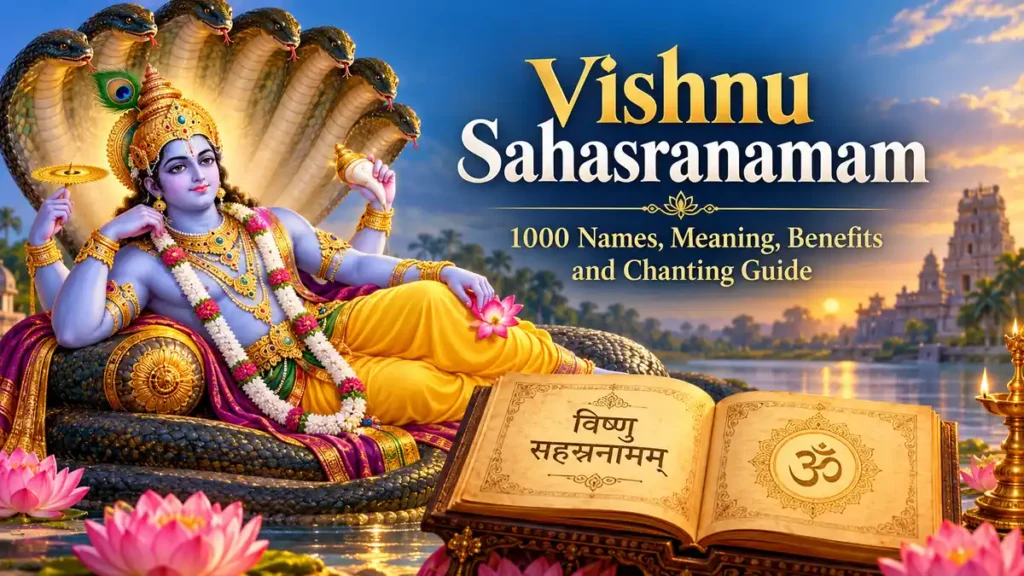
The Vishnu Sahasranamam is one of the most revered sacred hymns in Hinduism. For centuries, devotees have recited its thousand names of Lord Vishnu as an expression of devotion, a form of meditation, and a way to cultivate inner peace.
But what exactly do these thousand names mean? Where did the hymn originate, and how can someone unfamiliar with Sanskrit begin chanting it correctly?
Vishnu Sahasranamam is a Sanskrit hymn containing one thousand names of Lord Vishnu, the Hindu deity associated with preservation and cosmic order. Found in the Anushasana Parva of the Mahabharata, it is traditionally recited to honor Vishnu, reflect on divine qualities, and seek spiritual well-being. Each name expresses a particular attribute or aspect of the divine.
What Is Vishnu Sahasranamam?
The term Vishnu Sahasranamam comes from three Sanskrit words:
- Vishnu: The all-pervading deity associated with the preservation of the universe.
- Sahasra: One thousand.
- Nama: Name.
Together, they mean “the thousand names of Vishnu.”
The hymn is not simply a collection of names. It is a carefully composed devotional text that describes divine qualities such as compassion, wisdom, protection, truth, eternity, and the sustaining power of the universe.
In Hindu philosophy, a divine name can represent much more than an identifying word. It may express a theological principle, a spiritual quality, or a relationship between the divine and creation.
For example, the name Vishvam points toward the universe as a manifestation of the divine, while Bhutabhavyabhavatprabhuh describes the Lord as the master of past, present, and future.
Why Are There 1000 Names of Lord Vishnu?
The thousand names express the many dimensions of Vishnu’s nature.
Some describe his relationship with the universe, others emphasize his compassion toward living beings, and still others refer to his divine forms, knowledge, power, or eternal existence.
Several names appear more than once in traditional enumerations. Their repetition can carry different shades of meaning depending on context and interpretation.
The number one thousand also conveys spiritual abundance and completeness. The hymn presents a broad meditation on the divine rather than a list of one thousand entirely separate deities.
Origin and History of Vishnu Sahasranamam in the Mahabharata
The best-known Vishnu Sahasranamam appears in the Anushasana Parva, one of the major books of the Sanskrit epic Mahabharata.
Its setting is deeply significant.
After the devastating Kurukshetra War, the warrior Bhishma lies on a bed of arrows, awaiting the appropriate time to leave his mortal body. Yudhishthira, troubled by questions about duty, righteousness, and human suffering, approaches him for guidance.
During their conversation, Yudhishthira asks questions about the supreme deity, the highest refuge, and the means by which human beings may attain spiritual welfare.
Bhishma responds by praising Lord Vishnu and teaching the thousand names.
Who Composed Vishnu Sahasranamam?
Tradition attributes the Mahabharata to the sage Vyasa, also known as Krishna Dvaipayana.
Within the narrative, Bhishma is the person who recites the hymn to Yudhishthira. These are distinct roles: Vyasa is traditionally regarded as the compiler or author of the epic, while Bhishma is the speaker of the teaching in the story.
The hymn is commonly associated with the Anushasana Parva, Chapter 149, although chapter numbering varies among editions and recensions.
The Questions Asked by Yudhishthira
Yudhishthira’s questions provide the philosophical foundation of the hymn.
He wants to understand who is the supreme deity, who is the ultimate refuge, whom people should praise and worship, and which spiritual practice can help them transcend worldly suffering.
Bhishma’s answer places devotion to Vishnu at the center of his teaching.
The thousand names then become a practical way to remember and contemplate the divine attributes described in the text.
This narrative context helps explain why the hymn remains closely connected with bhakti, or devotional practice, and dharma, the principle of righteous living.
Meaning of Vishnu Sahasranamam and Its Important Names
Understanding the meaning of the names can transform recitation from a memorization exercise into a reflective spiritual practice.
The hymn describes Vishnu through attributes related to creation, preservation, knowledge, compassion, and liberation.
The First Verse of Vishnu Sahasranamam
The opening verse of the thousand-name sequence is:
Sanskrit:
विश्वं विष्णुर्वषट्कारो भूतभव्यभवत्प्रभुः।
भूतकृद्भूतभृद्भावो भूतात्मा भूतभावनः॥
Transliteration:
Vishvam Vishnur Vashatkaro Bhuta-bhavya-bhavat-prabhuh
Bhutakrid Bhutabhrid Bhavo Bhutatma Bhutabhavanah
Meaning:
This verse describes Vishnu as the universe, the all-pervading presence, the sacred principle invoked in Vedic sacrifice, and the Lord of past, present, and future. It also praises him as the creator, sustainer, inner self, and nurturer of all beings.
The opening establishes a central theological theme: the divine is not understood merely as a distant ruler but as the foundation and sustaining presence of existence.
Important Names of Lord Vishnu and Their Meanings
The following table introduces several prominent names appearing in the hymn.
| Name | Meaning or significance |
|---|---|
| Vishvam | The universe; all that exists |
| Vishnu | The all-pervading one |
| Narayana | The refuge or resting place of beings |
| Vasudeva | The indwelling divine presence |
| Madhava | A name associated with Lakshmi and divine knowledge |
| Govinda | Protector of cows; also interpreted as knower of the senses or Vedas |
| Keshava | A traditional name of Vishnu and Krishna |
| Madhusudana | Destroyer of the demon Madhu |
| Hrishikesha | Lord of the senses |
| Padmanabha | The one with a lotus arising from his navel |
| Damodara | The one whose waist was bound by a cord |
| Achyuta | The infallible or unchanging one |
| Ananta | The infinite or endless one |
| Janardana | Protector of people; a name with several traditional interpretations |
| Purushottama | The supreme person or supreme being |
These explanations are introductory. Sanskrit names frequently have multiple etymological interpretations, especially in traditional commentaries.
Why Do Some Names Have Multiple Meanings?
Sanskrit permits complex word formations and multiple interpretations based on roots, compounds, and philosophical context.
For instance, Govinda can be explained through associations with cows, the earth, the senses, or sacred knowledge.
Different schools of Vedanta may emphasize different meanings without necessarily changing the underlying Sanskrit text.
This interpretive richness is one reason the Vishnu Sahasranamam has inspired extensive commentary.
Spiritual Significance of Vishnu Sahasranamam
The hymn occupies an important place in Vaishnavism, the Hindu traditions centered on Vishnu and his manifestations, including Krishna and Rama.
Its significance extends beyond ceremonial worship.
Vishnu as the Preserver of the Universe
In the familiar Hindu Trimurti framework, Brahma is associated with creation, Vishnu with preservation, and Shiva with transformation or dissolution.
Vaishnava theology often presents Vishnu or Narayana more comprehensively as the supreme reality underlying creation, preservation, and dissolution.
The thousand names reflect this broader understanding.
Vishnu is praised not only as a protector but also as the source, inner presence, and ultimate refuge of existence.
Connection With Bhakti Yoga
Bhakti Yoga is the spiritual path of devotion.
In this tradition, repeating divine names is a way of directing attention toward God and cultivating qualities such as humility, gratitude, compassion, and surrender.
Vishnu Sahasranamam is a form of nama smarana, or remembrance of the divine through names.
It can also be practiced as nama japa, the repeated recitation of sacred names.
The goal is not necessarily to achieve a perfect vocal performance. For many practitioners, sincerity and sustained attention are equally meaningful.
Relationship With the Bhagavad Gita
The Bhagavad Gita and Vishnu Sahasranamam belong to the larger Mahabharata tradition.
In the Bhagavad Gita, Krishna teaches Arjuna about duty, devotion, knowledge, and liberation.
In the Vishnu Sahasranamam, Bhishma directs Yudhishthira toward remembrance and praise of the supreme divine.
Both texts emphasize devotion and the importance of aligning human conduct with spiritual understanding, although their literary forms and immediate teachings differ.
Vishnu Sahasranamam and Vedanta Philosophy
Traditional commentators have interpreted the thousand names through different philosophical perspectives.
Adi Shankaracharya, associated with Advaita Vedanta, wrote a celebrated commentary on the hymn. His interpretation explores the names in relation to the supreme reality, Brahman.
Parasara Bhattar, a major Sri Vaishnava scholar associated with Vishishtadvaita, also composed an influential interpretation emphasizing the divine qualities of Narayana.
These commentaries demonstrate how the same hymn can support detailed theological reflection within different Vedantic traditions.
Rare Book Society of India
+1
Benefits of Chanting Vishnu Sahasranamam
Traditional Hindu literature associates recitation of the thousand names with spiritual merit, protection, peace, and liberation.
The hymn includes a Phala Shruti, a section describing the fruits or benefits of recitation.
It is helpful to distinguish these religious teachings from scientifically established outcomes.
1. Encourages Mental Calmness
The rhythmic repetition of Sanskrit verses can provide a structured focus for attention.
For some people, recitation becomes a calming daily ritual, particularly when practiced in a quiet environment.
Slow breathing and sustained concentration may contribute to a subjective sense of relaxation. However, specific medical benefits from Vishnu Sahasranamam itself have not been firmly established through clinical research.
2. Strengthens Devotion and Spiritual Discipline
Regular recitation encourages a consistent relationship with devotional practice.
Setting aside time each day can reinforce patience, self-discipline, and mindful reflection.
For devotees, the names also serve as reminders of qualities they wish to cultivate in everyday life.
3. Supports Concentration and Memory Practice
Learning a long Sanskrit hymn involves listening, repetition, pronunciation, and memorization.
These activities require sustained attention and active recall.
A beginner who learns two verses each week, for example, gradually develops familiarity with Sanskrit sounds and the hymn’s structure.
This is an educational benefit of the learning process, not evidence that recitation directly treats memory disorders.
4. Inspires Courage During Difficult Times
Many devotees turn to Vishnu Sahasranamam during periods of uncertainty, grief, or emotional difficulty.
Names describing divine protection, permanence, and compassion can provide religious reassurance.
The practice may help someone approach difficulties with patience and perspective, although it cannot guarantee that external problems will disappear.
5. Encourages Ethical Reflection
Names associated with truth, compassion, wisdom, and righteousness can become subjects for personal contemplation.
For example, reflecting on the divine as the sustainer of all beings may encourage a practitioner to consider their responsibilities toward others.
This connects devotional practice with the broader Hindu concept of dharma.
6. Traditionally Associated With Spiritual Liberation
The Mahabharata presents remembrance and praise of Vishnu as spiritually meritorious.
Within Vaishnava traditions, devotion to Narayana is closely associated with freedom from the cycle of birth and death, known as samsara.
Liberation, or moksha, is a theological goal rather than a scientifically measurable result.
Are the Benefits of Vishnu Sahasranamam Guaranteed?
Traditional descriptions of spiritual benefits are expressions of religious belief.
Chanting does not guarantee wealth, physical healing, career success, or protection from every misfortune.
A balanced approach treats the hymn as a devotional and contemplative practice rather than a substitute for healthcare, responsible decision-making, or practical action.
How to Chant Vishnu Sahasranamam Correctly
Beginners can approach the hymn gradually without needing to memorize all one thousand names immediately.
The most helpful starting point is a reliable text, a clear recitation, and a manageable daily routine.
Step-by-Step Chanting Method
- Choose a quiet place. Sit comfortably in a location where you are unlikely to be interrupted.
- Prepare a reliable text. Use a Sanskrit edition with transliteration and, ideally, an English meaning.
- Begin with a short moment of attention. Some practitioners start with a prayer, an invocation to Ganesha, or a brief meditation on Vishnu.
- Listen to a traditional recitation. Pay attention to the pronunciation, rhythm, and pauses.
- Recite slowly. Follow the text carefully rather than trying to match a fast recording.
- Reflect on the meaning. Choose one or two names and consider their significance.
- Practice consistently. Begin with a few verses and gradually increase the length.
Traditional recitation often includes preliminary meditation verses, known as dhyana shlokas, and concluding prayers.
The exact arrangement may differ among devotional communities.
What Is the Best Time to Chant Vishnu Sahasranamam?
Morning is commonly preferred, especially during a quiet period before daily activities begin.
Evening recitation is also widespread.
Some devotees associate early morning spiritual practice with Brahma Muhurta, the traditionally auspicious period before sunrise.
However, there is no universal requirement that everyone must chant at one exact hour.
A practical daily schedule is often more sustainable than a demanding routine that is difficult to maintain.
Can Vishnu Sahasranamam Be Chanted at Night?
Yes. Many devotees recite or listen to the hymn in the evening or before sleeping.
Traditional customs concerning timing and ritual preparation may vary between families, temples, and religious lineages.
For ordinary devotional listening and personal reflection, evening practice is common.
How Long Does It Take to Recite the Full Hymn?
A complete recitation commonly takes approximately 20–40 minutes, depending on the pace and the inclusion of introductory and concluding verses.
A slower recitation with pauses for meaning may take longer.
There is no need to rush. Clear pronunciation and attentive recitation are generally more useful for learning than speed.
Can Beginners Chant Without Knowing Sanskrit?
Yes. Beginners often use English transliteration to learn the Sanskrit pronunciation.
Understanding the language can enrich the experience, but complete fluency is not a prerequisite for starting.
A useful approach is to learn the sound of a verse first, then study its meaning.
Vishnu Sahasranamam Lyrics, Structure and Pronunciation
The hymn is composed in Sanskrit and is traditionally transmitted through metrical verses called shlokas.
The main thousand-name sequence is commonly presented in 107 verses, followed by additional concluding material. Some published recitation versions use different verse counts because they include or exclude invocations, meditation verses, and supplementary prayers.
Main Parts of the Recitation
| Section | Purpose |
|---|---|
| Preliminary prayers | Prepare the mind for devotional recitation |
| Dhyana Shlokas | Describe the divine form for meditation |
| Yudhishthira’s questions | Introduce the central spiritual inquiry |
| Bhishma’s teaching | Explains the importance of praising Vishnu |
| Sahasranama Stotra | Presents the thousand names |
| Phala Shruti | Describes the traditional fruits of recitation |
| Concluding prayers | Express surrender, gratitude, or devotion |
Not every printed edition follows exactly the same arrangement.
The distinction between the core thousand-name hymn and supplementary recitation material is particularly important when comparing Sanskrit texts or English translations.
Sanatana
+2
Sanskrit Pronunciation Tips
Sanskrit includes sounds that do not always have exact equivalents in English.
A few distinctions are especially useful:
- Long vowels: The sounds represented by a and ā differ in length.
- Retroflex consonants: Sounds such as ṭ and ḍ involve a different tongue position from ordinary dental consonants.
- Aspirated consonants: Bh, dh, and th are not simply the English sounds suggested by their spelling.
- Anusvara: The nasal sound represented by ṃ changes according to phonetic context.
- Visarga: The sound represented by ḥ is a breath-like ending that requires attention during recitation.
A transliteration system using diacritical marks, such as IAST, provides greater precision than simplified English spellings.
Common Pronunciation Mistakes
A frequent mistake is reading Sanskrit transliteration exactly as ordinary English.
For example, the Sanskrit word Vishnu is more precisely transliterated as Viṣṇu. The mark beneath ṣ indicates a retroflex consonant.
Similarly, Narayana is more accurately written Nārāyaṇa in IAST.
Another mistake is separating words incorrectly. Sanskrit verses frequently use sandhi, the combination of sounds at word boundaries.
Listening to a knowledgeable reciter while following a correctly segmented text can make these patterns easier to understand.
How to Learn All 1000 Names of Vishnu
Memorizing the full Vishnu Sahasranamam may initially seem difficult, but learning becomes more manageable when divided into smaller sections.
A gradual approach allows pronunciation, rhythm, and meaning to develop together.
A Simple Four-Week Learning Plan
| Week | Learning goal | Daily practice |
|---|---|---|
| Week 1 | Learn the opening verses and basic pronunciation | 10–15 minutes |
| Week 2 | Add a few verses while reviewing earlier material | 15 minutes |
| Week 3 | Practice longer connected passages | 15–20 minutes |
| Week 4 | Consolidate what has been learned | 20 minutes |
This is a starting plan, not a promise of complete memorization in four weeks.
Learning the entire hymn usually requires a longer period, particularly for people unfamiliar with Sanskrit.
Listening Versus Chanting: Which Is Better?
Both practices can have devotional value.
Listening allows a beginner to become familiar with the sound, rhythm, and structure of the hymn.
Chanting introduces active participation and provides opportunities to improve pronunciation and memorization.
| Listening | Chanting |
|---|---|
| Useful for beginners | Encourages active learning |
| Can accompany quiet reflection | Requires greater attention to pronunciation |
| Helps develop familiarity with rhythm | Supports memorization through repetition |
| Accessible when vocal recitation is difficult | Allows deliberate pacing and pauses |
Many practitioners combine the two methods.
They listen to a verse, repeat it aloud, and then review its meaning.
Is It Necessary to Recite All 1000 Names Every Day?
No universal rule requires every devotee to complete the entire hymn daily.
Some people recite the complete text, while others practice selected verses or repeat particular divine names.
Devotional customs differ among households and spiritual traditions.
For a beginner, regular and attentive practice is generally more practical than attempting the full hymn without adequate preparation.
Traditional Rules and Common Beliefs About Recitation
Vishnu Sahasranamam is practiced in temples, homes, devotional gatherings, and individual spiritual routines.
Its observances vary according to religious tradition, family custom, and personal circumstances.
Can Women Chant Vishnu Sahasranamam?
Women participate in Vishnu Sahasranamam recitation in many contemporary Hindu communities.
Some families and lineages maintain particular ritual customs, but there is no single practice followed universally across all Hindu traditions.
Individuals who follow a specific sampradaya, or religious lineage, may consult their teachers about that tradition’s observances.
Can the Hymn Be Recited Without Taking a Bath?
Some traditional households prefer bathing and wearing clean clothes before formal worship.
These customs express ritual preparation and reverence.
However, personal remembrance of Vishnu and listening to devotional recitations are also practiced in ordinary daily circumstances.
The requirements of formal temple ritual should not automatically be treated as universal conditions for all personal devotional activity.
Is Vishnu Sahasranamam Only for Vaishnavas?
Although the hymn is especially important within Vaishnavism, it is also respected and recited by Hindus from a variety of devotional and philosophical backgrounds.
Its place within the Mahabharata contributes to its broad recognition.
People interested in Sanskrit literature, Indian philosophy, or comparative religion may also study the text academically without participating in its religious practice.
Can Children Learn Vishnu Sahasranamam?
Children can learn selected verses through age-appropriate repetition, listening, and explanations.
Short sessions are usually more manageable than long memorization exercises.
Introducing the meanings through stories from the Mahabharata, Bhagavata Purana, or traditions about Vishnu’s avatars may also help children understand the cultural context.
Learning should be encouraging rather than compulsory.
Vishnu Sahasranamam and Other Hindu Sacred Texts
Vishnu Sahasranamam belongs to a wider tradition of Sanskrit hymns, devotional poetry, and sacred-name recitation.
Understanding its relationship to other texts helps clarify its distinctive purpose.
Vishnu Sahasranamam vs Lalitha Sahasranamam
The Lalita Sahasranama is another prominent Sanskrit hymn containing one thousand divine names.
| Feature | Vishnu Sahasranamam | Lalitha Sahasranamam |
|---|---|---|
| Principal deity | Lord Vishnu | Goddess Lalita Tripurasundari |
| Major textual source | Mahabharata | Brahmanda Purana |
| Primary devotional tradition | Vaishnava, with wider Hindu use | Shakta, with wider Hindu use |
| Central emphasis | Divine preservation, supremacy, refuge, and spiritual liberation | Divine Mother, Shakti, wisdom, and liberation |
| Form | Thousand-name hymn | Thousand-name hymn |
Both are used for worship and contemplation, but their theological settings and traditional interpretations differ.
Vishnu Sahasranamam vs Vishnu Ashtottara Shatanamavali
Vishnu Ashtottara Shatanamavali is a devotional list of 108 names of Vishnu.
The main distinction is length and textual structure.
The Sahasranamam presents one thousand names within a metrical hymn, while an Ashtottara Shatanamavali typically presents 108 names in a format suited to individual offerings or repetition.
A shorter 108-name recitation may be convenient for daily worship, but it is not simply an identical abbreviated version of the Mahabharata hymn.
Relationship With Om Namo Narayanaya
Om Namo Narayanaya is a well-known Vaishnava mantra traditionally associated with surrender and reverence toward Narayana.
It is often called the Ashtakshara Mantra, the eight-syllabled mantra, under its traditional syllabic interpretation.
Vishnu Sahasranamam, by contrast, is a long hymn containing numerous divine names and descriptions.
Both involve remembrance of Vishnu, but they have different structures and roles in devotional practice.
Why Vishnu Sahasranamam Remains Relevant Today
Despite its ancient setting, Vishnu Sahasranamam continues to be practiced across generations.
Its appeal lies partly in its combination of religious devotion, poetic rhythm, philosophical depth, and personal reflection.
For some devotees, it is a daily act of worship. For others, it provides an opportunity to study Sanskrit or reflect on ideas such as permanence, duty, and compassion.
Digital recordings and transliterated editions have also made the hymn easier to approach for people who cannot read Devanagari.
Nevertheless, access to a recording is only the beginning. Understanding the meaning of the names helps prevent recitation from becoming purely mechanical.
A meaningful practice can be simple: read a few names, learn what they signify, recite them attentively, and consider how their associated qualities relate to everyday conduct.
Conclusion
Vishnu Sahasranamam is far more than a collection of one thousand sacred names. Rooted in the Mahabharata’s dialogue between Bhishma and Yudhishthira, it brings together devotion, Sanskrit poetry, and profound philosophical ideas about Lord Vishnu.
Its names describe the divine as the source, sustainer, protector, and ultimate refuge of existence. Traditional Hindu teachings associate its recitation with spiritual merit, inner peace, and progress toward liberation.
For anyone beginning to explore vishnu sahasranamam, the most practical approach is to start with a reliable Sanskrit text, learn the pronunciation gradually, and study the meaning alongside the recitation.
Even a few verses practiced with attention can become a valuable introduction to one of Hinduism’s most enduring devotional traditions.