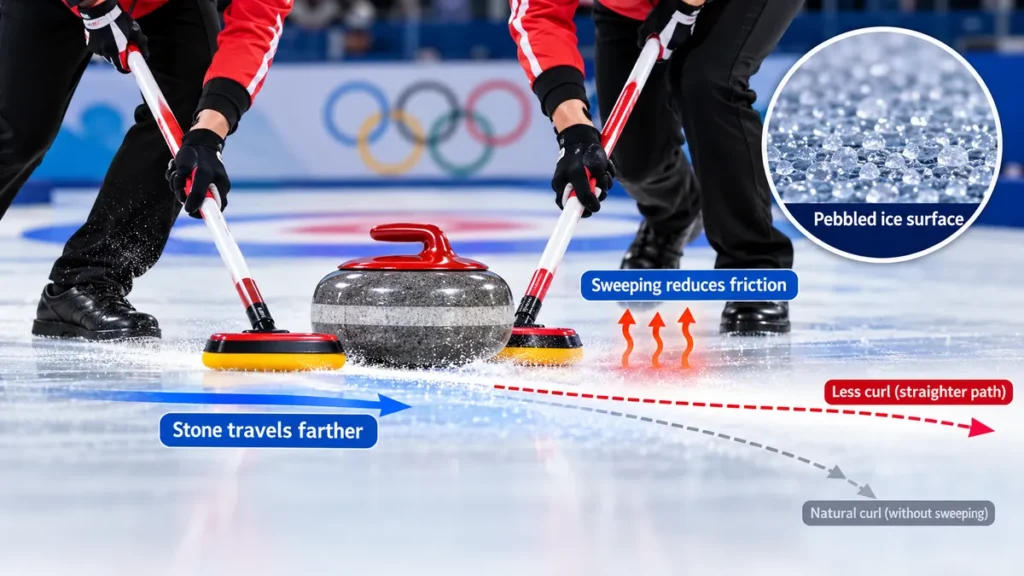
In Olympic curling, a stone can travel more than 40 meters across the ice, yet a few seconds of vigorous brushing can make the difference between a perfect shot and a missed target. The sweepers never touch the moving stone, but they can influence how far it travels and how much it curves.
So, how do brushes affect the stone’s path in olympic curling? Brushes change the interaction between the curling stone and the pebbled ice surface. Sweeping generates frictional heat and modifies the ice surface, generally reducing resistance, helping the stone travel farther, and changing its sideways curl. Skilled sweepers use timing, pressure, and brushing technique to guide the stone toward its intended destination.
Understanding this process reveals why sweeping is one of curling’s most important technical and tactical skills.
H2: How Do Curling Brushes Change the Stone’s Direction?
Curling brushes influence a stone’s movement by changing the ice conditions directly in front of it. The players cannot physically steer the stone like a vehicle, but they can alter the frictional forces acting on it.
A curling stone normally follows a curved trajectory because it rotates as it slides. This sideways movement is called curl.
When players sweep the ice ahead of the stone, they affect two important characteristics of its motion:
- Distance: Effective sweeping generally allows the stone to travel farther before stopping.
- Direction: Sweeping can reduce or otherwise influence the stone’s sideways movement, depending on technique, ice conditions, and the stone’s rotation.
In traditional sweeping, the most common effect is to keep the stone moving straighter for longer by delaying its curl.
For example, imagine a stone traveling toward the center of the house but beginning to curve too early. The sweepers can brush the ice in front of it to help maintain its intended line.
However, brushing does not give sweepers unlimited control. The stone’s initial speed, rotation, release angle, and ice conditions still determine much of its trajectory.
H3: Can Sweepers Make a Curling Stone Go Straight?
Sweeping can help a curling stone maintain a straighter path, but it cannot completely eliminate its natural tendency to curl.
The effect depends on the amount of rotation, the ice surface, the sweeping technique, and how much distance remains.
Once a stone has slowed significantly or started curling sharply, correcting its path becomes more difficult.
H3: Can Sweeping Make a Stone Curl More?
Under some conditions, specialized sweeping techniques can influence the amount or direction of curl more dramatically than conventional sweeping.
The relationship is complex. Brush-head materials, sweeping direction, pressure, and the characteristics of the ice can all affect the outcome.
This is one reason competitive curling organizations regulate sweeping equipment and techniques.
H2: The Science Behind Sweeping and Ice Friction
To understand why brushes work, it helps to examine the surface on which curling is played.
Unlike a perfectly smooth frozen surface, curling ice contains thousands of tiny frozen water droplets called pebbles.
These raised bumps create the surface texture over which the stone travels.


8
H3: How Pebbled Ice Affects Stone Movement
Curling stones do not glide across an entirely flat sheet of ice. Their narrow running bands interact with the tops of the frozen pebbles.
These contacts create resistance and contribute to the forces that affect the stone’s speed and direction.
Pebbled ice also makes curling more predictable and playable than it would be on an uncontrolled, flat frozen surface.
Ice technicians carefully prepare the playing surface to produce reasonably consistent conditions throughout a match.
H3: Does Sweeping Melt the Ice?
Sweeping creates frictional heat at the ice surface and can modify or slightly soften the upper portions of the pebbles.
A very thin layer of moisture may contribute to the sliding behavior under some conditions, but describing sweeping as simply melting ice into a lubricating puddle is misleading.
The physical mechanisms behind curling involve several interacting processes, including ice deformation, friction, surface texture, and the stone’s rotation.
The practical result is that sweeping can reduce the resistance encountered by the stone, allowing it to retain speed for longer.
H3: Why Does Reduced Friction Change the Stone’s Path?
Friction affects both the forward motion and the sideways movement of a rotating curling stone.
When sweeping modifies the frictional interaction between the running band and the ice, it can influence how quickly the stone slows and how its curl develops.
This matters especially near the end of a shot, when curling stones often exhibit more noticeable sideways movement.
A small change in trajectory can determine whether the stone reaches the button, stops short of the house, or makes contact with another stone.
H2: How Sweeping Affects Speed, Distance, and Curl
Sweeping is often described as making a curling stone travel farther, but its effect on a shot involves more than distance alone.
| Stone behavior | Without sweeping | With effective conventional sweeping |
|---|---|---|
| Speed | Decreases naturally | Speed is retained longer |
| Travel distance | Depends on initial delivery | Generally travels farther |
| Sideways curl | Follows natural curling path | Often curls less over the swept section |
| Directional control | Mostly determined by release and ice | Sweepers can influence the trajectory |
| Final stopping position | Based on original shot and conditions | Can be adjusted within limits |
Sweeping does not accelerate the stone in the sense of adding forward propulsion. Instead, it reduces some of the resistance that would otherwise slow the stone down.
H3: How Much Farther Can Sweeping Move a Stone?
There is no single distance that applies to every curling shot.
The effect depends on the original delivery speed, ice conditions, brush pressure, sweeping efficiency, and how long sweeping continues.
On a delicate draw shot, even a relatively small additional distance can be decisive.
On a fast takeout shot, the same sweeping effort may have a less obvious effect on the final position, although line control remains important.
H3: Why Is Sweeping Especially Important for Draw Shots?
A draw shot is intended to stop at a particular location, usually inside or near the house.
Because draw shots depend on precise weight and line, sweeping can help correct a stone that appears slightly short or is curling earlier than intended.
A well-timed sweep may carry the stone closer to the button or help it pass a guard.
However, if the stone has been delivered too strongly, sweepers cannot slow it down by brushing. Their best option may be to stop sweeping and allow the stone to lose speed naturally.
H2: How Curling Players Use Brushes During Olympic Matches
Sweeping requires physical strength, coordination, accurate judgment, and constant communication.
In traditional four-person curling, the player delivering the stone concentrates on release speed, rotation, and direction. Two teammates commonly sweep ahead of the moving stone while the skip or another designated player directs the shot.
The sweepers must assess how the stone is moving and respond quickly.
H3: Step-by-Step: How Olympic Curling Sweeping Works
- Stone delivery: The player releases the granite stone with a controlled amount of speed and rotation.
- Initial observation: Teammates judge the stone’s weight, speed, and expected trajectory.
- Sweeping decision: The team determines whether the stone needs additional distance, a straighter line, or another permitted adjustment.
- Active brushing: Sweepers move their brushes rapidly over the ice directly ahead of the stone while applying downward pressure.
- Continuous communication: The skip and sweepers exchange information about the stone’s speed and direction.
- Final adjustment: Sweeping continues or stops according to the intended finishing position.
The entire process takes place while the stone is moving, leaving little time for hesitation.
H3: Why Do Curlers Shout While Sweeping?
Curling players shout because their teammates need immediate instructions over a considerable distance.
Common commands include:
| Command | Meaning |
|---|---|
| Hurry! | Begin sweeping or increase effort |
| Hard! | Sweep with maximum appropriate intensity |
| Whoa! | Stop sweeping |
| Clean! | Lightly brush to remove debris |
| Line! | Focus on the stone’s intended direction |
| Weight! | Communicate or assess the stone’s travel distance |
The exact language varies among teams.
A loud command is not simply an expression of excitement. It often communicates a time-sensitive tactical decision.
H3: Why Do Sweepers Brush So Close to the Stone?
Sweeping is most effective when the stone passes over the recently brushed surface before the temporary changes to the ice diminish.
Brushing too far ahead may reduce the immediate benefit.
However, sweepers must avoid touching the moving stone or violating equipment and sweeping rules.
Maintaining a consistent position requires balance, quick footwork, and awareness of the stone’s trajectory.
H2: Curling Brush Techniques and Their Effects on the Stone
Not all sweeping techniques have identical effects.
Modern curling brushes typically use synthetic fabrics, engineered brush heads, and lightweight handles. Their performance depends on the interaction between the brush material, the athlete’s technique, and the ice.
H3: Traditional Sweeping
Traditional sweeping involves repeated back-and-forth movements across the ice ahead of the stone.
The aim is to modify the surface sufficiently to reduce resistance and help the stone maintain its intended travel.
The technique remains fundamental to competitive curling because it allows players to influence both distance and line.
H3: Directional Sweeping
Directional sweeping is a more specialized approach in which the sweeper’s positioning, brushing angle, and contact pattern are selected to influence the stone’s sideways motion.
For example, a sweeper may try to hold the stone straighter when it threatens to curl into a guard.
Other permitted techniques can modestly enhance the stone’s natural curling trajectory.
The outcome depends on whether the stone is rotating clockwise or counterclockwise, the ice conditions, and the sweeping technique.
Directional sweeping is not equivalent to physically pushing the stone sideways.
H3: Why Pressure and Brush Speed Matter
Effective sweeping requires a combination of downward force and brush-head movement.
Greater pressure can increase the interaction between the brush and the ice. Rapid strokes repeatedly work the surface immediately ahead of the moving stone.
However, applying maximum force at every moment is not necessarily the best strategy.
Sweepers must maintain balance, avoid fatigue, and adjust their effort to the shot.
A scientific review of curling performance identified downward force, brush speed, and sweeping position as important variables in sweeping effectiveness.
PubMed
+1
H2: Olympic Curling Sweeping Rules and Equipment Regulations
Because sweeping can significantly influence a curling stone’s path, international competition uses regulations designed to preserve fairness.
The governing organization, World Curling, maintains rules for sweeping and approved equipment.
H3: What Are the Rules for Sweeping in Olympic Curling?
Under World Curling’s sweeping rules, players must follow restrictions governing brush movement, debris, and contact with the stone.
Key requirements include keeping the brush head from being raised in front of a moving stone, avoiding depositing debris in its path, and finishing sweeping strokes to either side of the stone.
Players must also follow the applicable rules about who may sweep and where sweeping is permitted.
The precise restrictions depend on the stone’s position and the competition format.
World Curling
+1
H3: Why Were Some Curling Brushes Restricted?
The effectiveness of modern curling brushes created controversy when certain equipment combinations allowed athletes to influence stone trajectories more dramatically than expected.
The controversy, often associated with the term Broomgate, prompted tighter scrutiny of brush-head materials and sweeping techniques.
World Curling introduced elite brush specifications in 2016 and continued updating equipment requirements in subsequent seasons.
For the 2025–2026 Olympic season, the organization revised compliance requirements for several component-style brush constructions, including combinations associated with BalancePlus, Goldline, Hardline, and other manufacturers.
World Curling
+1
H3: What Changed in the 2026 Sweeping Technique Policy?
On January 6, 2026, World Curling introduced a sweeping technique policy clarifying acceptable and prohibited effects.
The policy recognizes that sweeping may help a stone travel farther, remain straighter, or experience some enhancement of its natural curl.
However, deliberately using sweeping techniques to increase the stone’s rate of deceleration is prohibited.
Certain single-stroke techniques intended to slow a stone are specifically restricted. Officials may issue warnings and impose further penalties for repeated violations.
World Curling
+1
This distinction matters: although sweeping techniques can influence friction in different ways, not every technically possible effect is permitted in Olympic-level competition.
H2: Why Sweeping Strategy Matters in Olympic Curling
Curling is sometimes described as chess on ice because teams must consider positioning, future shots, and their opponent’s options.
Sweeping adds another tactical dimension: the team can influence a stone after its release.
H3: Sweeping a Draw Toward the Button
The button is the small circle at the center of the house.
A draw toward the button requires accurate delivery weight and line.
If the stone appears likely to stop short, sweepers may brush vigorously to help it travel farther.
If the stone has enough weight but is curling too early, sweeping may help maintain a straighter trajectory.
The team must continually judge whether additional sweeping will improve or worsen the final position.
H3: Sweeping Around a Guard Stone
A guard is a stone positioned to protect another stone or block an opponent’s preferred route.
Players sometimes intentionally deliver a stone along a curved path around a guard.
If the incoming stone begins curling too early, sweeping may keep it from colliding with the guard.
Conversely, if the team needs the stone to finish its natural curl behind the guard, stopping the sweep at the right moment may be essential.
This combination of rotation, timing, and sweeping makes curling particularly strategic.
H3: Sweeping During a Takeout Shot
A takeout is designed to strike another stone and remove it from play or change its position.
Takeouts are often delivered with greater speed than draws.
Because the moving stone spends less time traveling across the ice, sweeping may have a smaller effect on its final distance than it would on a slower draw.
Nevertheless, line control can still be critical.
A slight change in the angle of impact can determine whether the delivered stone removes the intended target, misses it, or produces an unfavorable collision.
H3: How Sweeping Differs in Mixed Doubles Curling
Olympic mixed doubles curling involves two players per team rather than four.
That changes how athletes divide their responsibilities during delivery and sweeping.
Players must balance stone delivery, tactical decisions, and sweeping with fewer teammates available.
The same fundamental physics applies, but the demands on communication and positioning differ.
In wheelchair curling, sweeping is not used, making delivery accuracy and tactical positioning especially important.
H2: Common Misconceptions About Curling Brushes
Several popular explanations of curling sweeping are partly correct but leave out important details.
H3: Myth: Sweeping Makes the Stone Accelerate
Sweeping generally helps a stone maintain its speed by reducing resistance.
It does not provide the forward push required to accelerate the stone like a motor or another physical force applied directly to it.
The stone still loses kinetic energy as it travels.
H3: Myth: Sweepers Can Completely Control the Stone
Sweepers have meaningful influence, but they cannot freely redirect a stone toward any location.
The initial release, rotational direction, ice conditions, and remaining momentum impose limits.
Sweeping is a form of trajectory adjustment, not unrestricted steering.
H3: Myth: More Sweeping Is Always Better
Excessive sweeping can carry a stone beyond its intended stopping position.
It may also hold the stone too straight when the shot requires more curl.
Good sweeping is therefore selective rather than continuous.
H3: Myth: Curling Ice Is Completely Smooth
Curling ice is deliberately pebbled.
These frozen droplets help create the controlled interaction between the stone’s running band and the ice.
Without the carefully prepared surface, stone behavior would be substantially different.
H3: Myth: All Brushes Produce the Same Result
Brush-head construction, fabric, stiffness, pressure, and technique can influence performance.
This is precisely why World Curling maintains equipment specifications for elite competition.
H2: What Makes Olympic Curling Sweepers So Skilled?
Sweeping may appear simple to someone watching curling for the first time, but elite performance combines physical conditioning with sophisticated judgment.
Sweepers must understand how stones behave under different conditions and respond immediately to their teammates’ instructions.
The most important skills include:
- Ice reading: Recognizing changes in speed and curl across different paths.
- Weight judgment: Estimating how far a moving stone will travel.
- Brush control: Applying appropriate pressure and stroke speed.
- Directional awareness: Understanding how the stone’s rotation influences its trajectory.
- Communication: Coordinating with the skip and other teammates.
- Endurance: Maintaining effective sweeping during physically demanding matches.
Ice conditions can also evolve as a game progresses. Repeated stone movement, sweeping, and changes in surface conditions may affect the way later shots behave.
Experienced teams observe these changes and adjust their delivery and sweeping decisions accordingly.
The strongest sweepers are not simply the athletes who brush hardest. They are the ones who know when to sweep, how to sweep, and when to stop.
H2: Final Answer: how do brushes affect the stone’s path in olympic curling?
Curling brushes affect a stone’s path by changing the friction between its running band and the pebbled ice. Sweeping warms and modifies the surface, generally allowing the stone to retain speed, travel farther, and curl less. Certain permitted techniques can also enhance its natural curling trajectory.
World Curling explains that effective sweeping can sometimes extend a stone’s travel by approximately two or three meters, although the actual effect varies with the shot and ice conditions.
World Curling
The essential distinction is that sweepers influence the stone’s motion rather than physically steering or accelerating it.
When watching Olympic curling, pay attention to when players begin brushing, when they stop, and how the stone’s curve changes near the house. Those small adjustments demonstrate the combination of physics, teamwork, and tactical precision that makes sweeping so important to the sport.