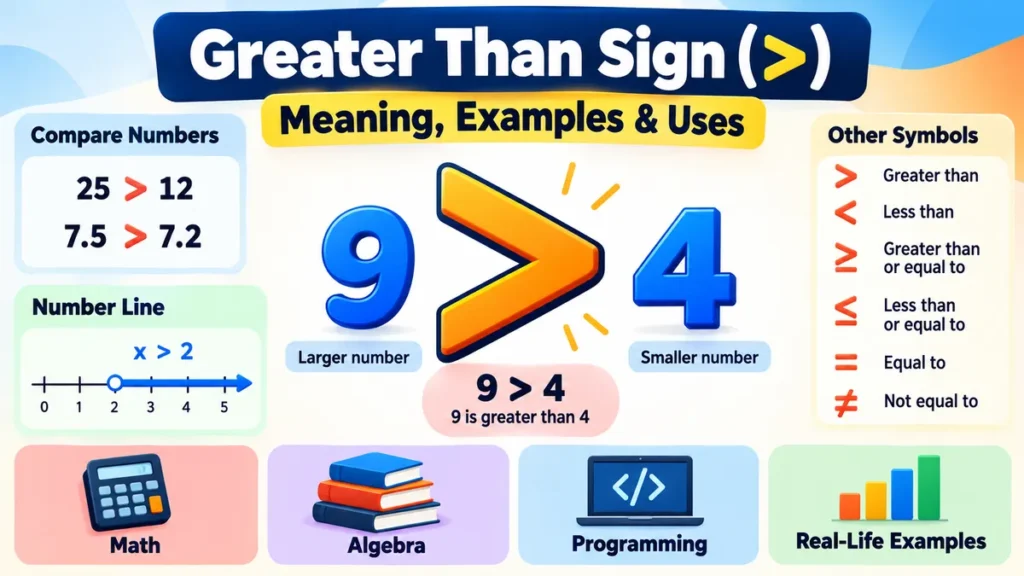
The greater than sign (>) is one of the most useful symbols in mathematics. It helps us compare numbers, understand inequalities, and determine which quantity is larger. You will encounter it in elementary math, algebra, programming, and everyday situations involving measurements, prices, and scores.
The greater than sign (>) is a mathematical comparison symbol indicating that the value on its left is larger than the value on its right. For example, 9 > 4 means nine is greater than four. The symbol’s wide opening faces the larger number, while its pointed end faces the smaller number.
What Is the Greater Than Sign in Mathematics?
The greater than sign is a mathematical relational symbol used to compare two numbers or expressions. It represents a strict inequality, meaning the value on the left must be larger than the value on the right.
For example:
- 10 > 5 means 10 is greater than 5.
- 25 > 12 means 25 is greater than 12.
- 100 > 99 means 100 is greater than 99.
- 7.5 > 7.2 means 7.5 is greater than 7.2.
The symbol is read from left to right as “is greater than.”
9 is greater than 4The wide opening faces 9, the larger number.
Why Is It Called the Greater Than Symbol?
The name describes its function: the symbol identifies which of two values is greater.
For example, suppose one student has 18 pencils and another has 11. We can express the comparison as:
18 > 11
This means the first student has more pencils than the second.
The sign can compare whole numbers, fractions, decimals, negative numbers, variables, and mathematical expressions.
Greater Than Sign vs. Less Than Sign
The greater than sign (>) and less than sign (<) look similar but point in opposite directions.
The greater than symbol indicates that the left value is larger. The less than symbol indicates that the left value is smaller.
| Symbol | Meaning | Example |
|---|---|---|
| > | Greater than | 8 > 3 |
| < | Less than | 3 < 8 |
| ≥ | Greater than or equal to | 8 ≥ 8 |
| ≤ | Less than or equal to | 3 ≤ 8 |
| = | Equal to | 5 = 5 |
| ≠ | Not equal to | 7 ≠ 4 |
The difference becomes easier to understand when you imagine the opening as a mouth that always faces the larger quantity.
Greater than8 is larger than 3
Less than3 is smaller than 8
An Easy Trick to Remember Greater Than and Less Than
A popular classroom method is the alligator trick.
Imagine the symbol represents an alligator’s open mouth. The alligator always wants to eat the larger number.
For example:
- 15 > 6: The mouth opens toward 15.
- 4 < 12: The mouth opens toward 12.
Another method is to focus on the pointed end. The narrow tip always points toward the smaller value.
Both techniques work with positive numbers, negative numbers, fractions, and decimals.
How to Use the Greater Than Sign With Numbers
To use the greater than sign correctly, first determine which value is larger. Then place that value on the left side of the symbol.
Comparing Whole Numbers
Whole numbers are among the easiest values to compare.
Consider:
45 > 32
Since 45 is larger than 32, the comparison is true.
When comparing large numbers, examine their place values. Start with the highest place value and move right until you find a difference.
For example:
8,542 > 8,495
Both numbers have 8 in the thousands place. However, 5 hundreds is greater than 4 hundreds, so 8,542 is larger.
Comparing Decimal Numbers
Decimal comparisons follow the same principle, but you must consider digits after the decimal point.
For example:
6.8 > 6.3
Both numbers have the same whole-number part, but 8 tenths is greater than 3 tenths.
Another example:
4.75 > 4.7
You can rewrite 4.7 as 4.70. Comparing 4.75 and 4.70 makes the relationship clearer.
Comparing Negative Numbers
Negative numbers sometimes confuse students because a number with a larger absolute value can actually be smaller.
For example:
-2 > -7
Although 7 is greater than 2 when both are positive, -2 is greater than -7 because it lies farther to the right on the number line.
Other examples include:
- -1 > -5
- -10 > -20
- 0 > -3
- 4 > -9
A useful rule is that, among two negative numbers, the one closer to zero is greater.
Comparing Fractions
Fractions can be compared by finding a common denominator or converting them to decimals.
Consider:
\[ \frac34 > \frac12 \]
Converting the fractions to decimals gives:
\[ 0.75 > 0.50 \]
You can also compare fractions through cross-multiplication when their denominators are positive.
For example:
\[ \frac58 > \frac37 \]
Cross-multiplying gives 5 × 7 = 35 and 3 × 8 = 24. Since 35 > 24, the first fraction is greater.
Understanding the Greater Than Sign on a Number Line
A number line provides a visual way to understand inequalities.
Numbers increase as you move to the right and decrease as you move to the left. Therefore, a number located farther to the right is greater than a number located to its left.
An open circle at 2 and a line extending right show all values greater than 2.
For the inequality x > 2, possible solutions include 3, 4, 5, 2.5, and infinitely many other numbers larger than 2.
The open circle indicates that 2 itself is not included.
If the inequality were x ≥ 2, the number line would use a filled circle because 2 would also satisfy the condition.
Greater Than Sign in Algebra and Inequalities
In algebra, the greater than sign often appears in inequalities containing variables.
An inequality compares two expressions rather than stating that they are equal.
For example:
\[ x > 10 \]
This means x can be any real number larger than 10.
Values such as 11, 15, and 20 satisfy the inequality, while 10 and 9 do not.
Solving a Simple Inequality
Consider:
\[ x+5>12 \]
Subtract 5 from both sides:
\[ x>7 \]
The solution includes every number greater than 7.
Solving Inequalities With Multiplication
Consider:
\[ 3x>18 \]
Divide both sides by 3:
\[ x>6 \]
Since 3 is positive, the direction of the inequality remains unchanged.
When Does the Greater Than Sign Flip?
The inequality symbol reverses direction when both sides are multiplied or divided by a negative number.
For example:
\[ -2x>8 \]
Divide both sides by -2:
\[ x<-4 \]
The greater than sign changes into a less than sign.
This happens because multiplying or dividing by a negative number reverses the order of values.
A common algebra mistake is forgetting to reverse the inequality when dividing by a negative coefficient.
Compound Inequalities
The greater than symbol also appears in compound inequalities.
For example:
\[ 2<x<8 \]
This means x is greater than 2 and less than 8.
Another example:
\[ x>5 \text{ and } x<12 \]
The solution contains values strictly between 5 and 12.
In interval notation, this is written as (5, 12). Parentheses indicate that the endpoints are excluded.
Greater Than or Equal To Sign (≥)
The greater than or equal to sign (≥) combines two mathematical relationships: greater than and equal to.
It means the value on the left can either be larger than or exactly equal to the value on the right.
For example:
\[ x\geq 5 \]
This means x can be 5, 6, 7, or any other number larger than 5.
The distinction is particularly useful when describing minimum requirements.
| Condition | Symbol | Is 10 included? |
|---|---|---|
| x > 10 | Greater than | No |
| x ≥ 10 | Greater than or equal to | Yes |
| x < 10 | Less than | No |
| x ≤ 10 | Less than or equal to | Yes |
For instance, if an examination requires a score of at least 60 points, the condition is score ≥ 60. A score of exactly 60 qualifies.
If the requirement is strictly more than 60 points, the condition becomes score > 60.
How to Type the Greater Than Sign on a Keyboard
Typing the greater than sign is straightforward on most computers and mobile devices.
On Windows and Mac
On a standard English-language keyboard, press:
Shift
.
>
Hold Shift and press the period (.) key.
This shortcut generally works on both Windows and macOS with a US keyboard layout.
On Android and iPhone
Open the keyboard’s numbers and symbols section, usually by tapping ?123 or a similar key. Depending on the keyboard, you may need to open an additional symbols panel to find >.
Copy the Greater Than Symbol
>
Copy symbol
The symbol has Unicode code point U+003E and is represented by decimal character code 62 in ASCII.
In HTML, the named character reference > can represent the greater than character.
Greater Than Sign in Computer Programming
The greater than sign is also a comparison operator in many programming languages.
It commonly evaluates whether one numerical value is larger than another and returns a Boolean result: true or false.
Python Example
age = 21print(age > 18)# TrueBecause 21 is greater than 18, the expression evaluates to True.
JavaScript Example
let score = 85;

if (score > 80) {
  console.log("Score is above 80");
}
The condition runs when the score exceeds 80.
Microsoft Excel and Google Sheets
Spreadsheet applications also use the greater than operator.
For example:
=A1>100This formula checks whether the number in cell A1 is greater than 100.
A conditional formula can be written as:
=IF(A1>100,"Above 100","100 or below")The result depends on the value entered in A1.
The greater than sign also has other roles in computing, such as separating parts of markup, representing redirection in some command-line shells, or appearing in arrow syntax. These meanings depend on the language or application.
Real-Life Examples of the Greater Than Sign
Mathematical comparisons appear frequently outside the classroom.
Comparing Prices
Suppose a notebook costs $12 and another costs $8.
\[ 12>8 \]
The first notebook is more expensive.
Comparing Temperatures
If one city has a temperature of 30°C and another has 22°C:
\[ 30>22 \]
The first city has the higher temperature.
Comparing Test Scores
A student scores 92 marks while another scores 87.
\[ 92>87 \]
The first score is higher.
Comparing Heights and Measurements
Suppose one building is 150 meters tall and another is 120 meters tall.
\[ 150>120 \]
The first building is taller.
These examples demonstrate how inequalities simplify comparisons involving quantities, measurements, and numerical data.
Common Mistakes When Using the Greater Than Sign
Although the symbol is simple, several errors occur frequently.
Confusing Greater Than With Less Than
Incorrect:
\[ 3>9 \]
Correct:
\[ 9>3 \]
The open side must face the larger value in a true comparison.
Thinking Negative Numbers Work Like Positive Numbers
Incorrect:
\[ -8>-3 \]
Correct:
\[ -3>-8 \]
On a number line, -3 lies to the right of -8.
Using Greater Than When Values Are Equal
The statement 5 > 5 is false because both values are equal.
The correct comparison is:
\[ 5=5 \]
If equality is permitted, use 5 ≥ 5.
Forgetting to Reverse an Inequality
When multiplying or dividing both sides of an inequality by a negative number, reverse its direction.
For example:
\[ -3x>12 \]
The correct solution is:
\[ x<-4 \]
Comparing Different Units Without Converting
A comparison such as 2 meters > 150 centimeters is mathematically meaningful only after recognizing the relationship between the units.
Since 2 meters equals 200 centimeters:
\[ 200\text{ cm}>150\text{ cm} \]
Always convert measurements to compatible units before comparing them.
Practice Greater Than Sign Questions
Test your understanding with these examples.
Choose the correct comparison symbol
0 of 5 answered
1. 12 ___ 7
>
<
=
2. -4 ___ -9
>
<
=
3. 0.65 ___ 0.8
>
<
=
4. 3/4 ___ 2/3
>
<
=
5. 15 ___ 15
>
<
=
Who Invented the Greater Than Sign?
The greater than and less than symbols are historically associated with the English mathematician Thomas Harriot, whose work helped establish the notation used in modern mathematics.
The symbols appeared in his mathematical treatise Artis Analyticae Praxis ad Aequationes Algebraicas Resolvendas, published posthumously in 1631.
Over time, these inequality symbols became standard mathematical notation and are now widely used in education, science, engineering, statistics, and computing.
Wikipedia
+1
Why the Greater Than Sign Matters
The greater than sign is more than a symbol for comparing two numbers. It provides a concise way to express mathematical relationships, solve inequalities, describe limits, and evaluate conditions.
Understanding the difference between >, <, ≥, and ≤ is essential for developing confidence in arithmetic and algebra.
The simplest rule to remember is that the wide opening of the greater than sign faces the larger value, and the pointed end faces the smaller value.
Once you understand this relationship, you can apply the greater than sign accurately to whole numbers, fractions, decimals, negative numbers, algebraic expressions, and everyday comparisons.