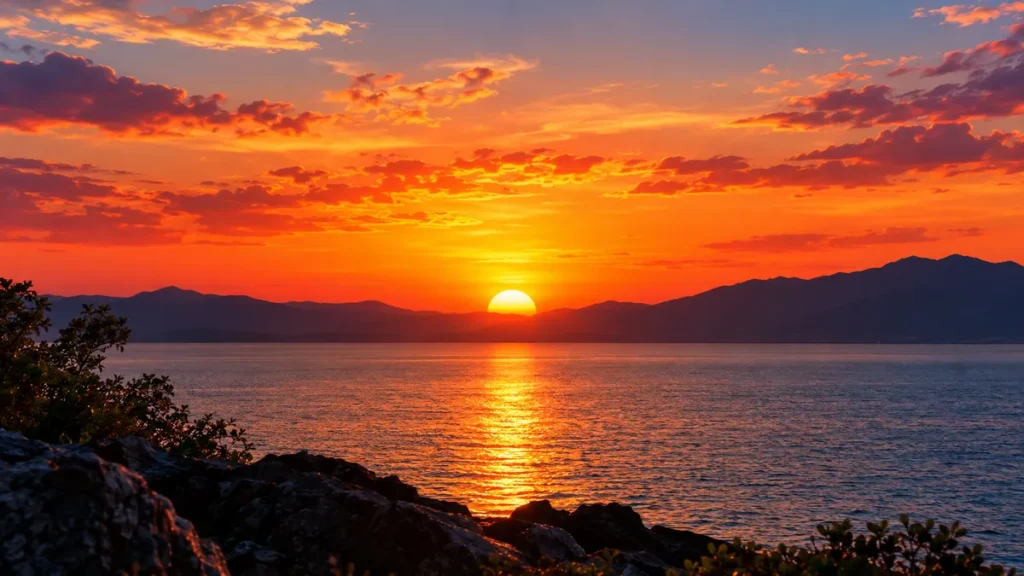
If you are searching for sunset today, the most important detail is your location. Sunset does not happen at one universal clock time. It changes according to your latitude, longitude, date, time zone, season, and local horizon.
Sunset today is the moment when the upper edge of the Sun disappears below the horizon at your location. To get the correct local time, use a sunrise-and-sunset calculator with your city or coordinates. The sky normally remains light afterward during civil, nautical, and astronomical twilight.
That distinction matters if you are planning an evening walk, outdoor event, prayer schedule, photography session, drive, hike, or simply want to watch the Sun go down.
What Time Is Sunset Today?
The exact sunset today time depends on where you are. Two cities can have noticeably different sunset times even when they use the same clock time or are located in the same country.
A reliable sunset calculator normally uses:
- Your latitude and longitude
- The current date
- Your local time zone
- The Sun’s position relative to Earth
- Standard assumptions about atmospheric refraction
- The apparent size of the solar disk
For example, a sunset calculator for a selected city can display today’s sunrise, sunset, day length, solar noon, Sun direction, and different stages of twilight.
If you search “sunset today near me” or “what time is sunset today?”, make sure the result is using your current city rather than a nearby major city.
Even a correct astronomical calculation may differ slightly from what you physically observe because buildings, mountains, trees, weather, elevation, and the shape of the local horizon can affect when the Sun actually disappears from view.
What Does Sunset Time Actually Mean?
People often think sunset is simply the moment the center of the Sun crosses the horizon. Astronomical calculations use a more specific convention.
The U.S. Naval Observatory defines sunrise and sunset around the apparent upper edge of the Sun’s disk reaching the horizon. For computational purposes, the center of the Sun is approximately 0.8333° below the geometric horizon at sunset.
That approximately 0.8333° adjustment accounts for two important effects:
| Factor | Approximate Amount |
|---|---|
| Sun’s apparent radius | 16 arcminutes |
| Atmospheric refraction | 34 arcminutes |
| Combined adjustment | 50 arcminutes (0.8333°) |
This is why the Sun can still appear to touch the horizon even though its geometric position is slightly below it.
NOAA uses the same 90.833° solar zenith value in its sunrise and sunset calculations.
Why atmospheric refraction matters
Earth’s atmosphere bends sunlight.
Near the horizon, this refraction makes the Sun appear slightly higher than its geometric position. As a result, apparent sunset occurs somewhat later than it would without Earth’s atmosphere.
The precise amount of refraction can vary with atmospheric pressure, humidity, temperature, and other conditions, so calculated sunset times should be understood as highly useful estimates rather than a guarantee of the exact visible second.
Why Does Sunset Today Change by Location?
Your position on Earth is one of the biggest factors controlling local sunset time.
Earth rotates from west to east, producing the Sun’s apparent daily movement across the sky. From an observer’s perspective, the Sun generally rises toward the eastern horizon, crosses the sky, and disappears toward the western horizon.
But the timing is not identical everywhere.
Latitude
Latitude describes how far north or south you are from the equator.
At higher latitudes, daylight length changes dramatically throughout the year. Summer days can become very long, while winter days become much shorter.
Near the equator, changes in daylight duration are generally less dramatic.
At very high latitudes, there can even be periods when the Sun does not set or does not rise during a particular day.
Longitude
Longitude describes your east-west position.
Locations farther east generally experience solar events earlier than locations farther west when other factors are similar. Clock time complicates this because time zones cover relatively large geographic regions rather than following solar longitude exactly.
This explains why two places using the same official time can have different sunrise and sunset times.
Time zone
The sunset displayed on your phone or weather service is converted into local civil time.
Time-zone boundaries are based partly on geography and partly on political decisions, so solar noon is rarely exactly 12:00 p.m. everywhere within a time zone.
Daylight Saving Time
In countries and regions that observe Daylight Saving Time, clocks move forward or backward seasonally.
The astronomical event itself has not suddenly shifted by an hour. The clock used to describe it has changed.
That is why sunset may appear to jump by about an hour when daylight-saving rules begin or end.
Why Does Sunset Time Change Every Day?
If you check sunset today and compare it with yesterday or tomorrow, you will usually notice a small difference.
The reason is Earth’s orbit around the Sun combined with Earth’s axial tilt.
Earth’s axis is tilted relative to its orbital plane. As Earth travels around the Sun, this changes the Sun’s apparent path through the sky and alters the length of daylight throughout the year.
Around the summer solstice
The hemisphere experiencing summer receives its longest days around its summer solstice.
Sunrise tends to be early and sunset late.
Around the winter solstice
The opposite happens near the winter solstice.
Daylight is shorter, sunrise occurs later, and sunset generally occurs earlier.
Around the equinoxes
Near the March and September equinoxes, the Sun’s apparent path produces roughly comparable periods of day and night across much of Earth.
The Sun also sets approximately toward the west around the equinoxes, although the exact observed direction depends on location and the date.
One detail that surprises many people is that the earliest sunset does not necessarily occur on the winter solstice, nor does the latest sunset necessarily occur on the summer solstice. Solar noon shifts slightly through the year, affecting the clock times of sunrise and sunset.
Sunset Today vs. Twilight: What’s the Difference?
One of the most common misunderstandings about sunset is assuming that sunset means immediate darkness.
It does not.
After the Sun disappears below the horizon, its light continues illuminating Earth’s atmosphere. This creates twilight.
Astronomers divide twilight into three stages:
| Stage | Sun’s Center Below Horizon | General Conditions |
|---|---|---|
| Civil twilight | 0° to 6° | Considerable natural light remains |
| Nautical twilight | 6° to 12° | Horizon becomes increasingly difficult to see |
| Astronomical twilight | 12° to 18° | Remaining sunlight gradually disappears |
| Night | More than 18° | Astronomical darkness under suitable conditions |
The U.S. Naval Observatory uses 6°, 12°, and 18° below the horizon to define the ends of civil, nautical, and astronomical twilight respectively.
Civil twilight
Civil twilight begins at sunset and continues until the Sun’s center reaches 6° below the horizon.
There is normally enough natural illumination for many ordinary outdoor activities, although actual visibility depends on weather, cloud cover, terrain, and surrounding artificial light.
For many people, this is the period they informally describe as “just after sunset.”
Nautical twilight
Nautical twilight follows civil twilight.
It continues until the Sun reaches 12° below the horizon. Historically, this stage has been important for navigation because the horizon can remain visible while brighter stars become easier to observe.
Astronomical twilight
Astronomical twilight lasts until the Sun reaches 18° below the horizon.
After that point, scattered sunlight contributes relatively little to the night sky, which is why astronomers commonly treat the end of astronomical twilight as the beginning of full astronomical darkness.
How Long After Sunset Does It Get Dark?
There is no single answer.
The time between sunset today and darkness depends heavily on latitude and season because the Sun crosses the horizon at different angles.
Near lower latitudes, the Sun often descends more steeply, so twilight can be relatively short.
At higher latitudes, the Sun may move below the horizon at a shallow angle, making twilight last much longer. During some seasons at extreme northern or southern latitudes, complete astronomical darkness may not occur at all.
Weather also affects how dark the environment appears.
Heavy clouds may make an evening seem dark much earlier, while clear skies can preserve visible twilight colors after the official sunset.
So if your activity requires actual darkness rather than simply the Sun being below the horizon, check astronomical twilight or night rather than relying on sunset time alone.
How to Find the Most Accurate Sunset Today Time
Finding today’s sunset is straightforward, but a few details improve accuracy.
1. Use your exact location
Enter your city or coordinates into a reputable solar calculator.
Location-specific calculations are much better than relying on a general sunset time for an entire state, province, or country.
2. Confirm the date
Sunset changes from one day to another.
Make sure the calculator is displaying today’s date, particularly when checking around midnight or researching sunset in another time zone.
3. Check the time zone
A correct astronomical calculation displayed in the wrong time zone can look completely incorrect.
If you are traveling, verify that your device or calculator has switched to the local time zone.
4. Check twilight if you need remaining daylight
For outdoor activities, sunset alone may not tell you everything you need.
Look at the end of civil twilight if you want to estimate how long useful natural evening light may remain.
5. Consider your actual horizon
Published sunset calculations generally assume a level horizon and standard atmospheric conditions. The U.S. Naval Observatory notes that local topography, observer height, and atmospheric conditions can alter the time at which sunset is physically observed.
If a mountain blocks your western horizon, for example, you may lose direct sunlight before the calculated astronomical sunset.
Why Can Two Sunset Websites Show Different Times?
Seeing two sources disagree by a minute or two does not necessarily mean either one is badly wrong.
Differences can result from:
- Coordinates selected for the city
- Rounding methods
- Elevation assumptions
- Atmospheric-refraction models
- Time-zone databases
- Calculation algorithms
- Treatment of the horizon
- Precision of displayed results
Atmospheric conditions themselves cannot be perfectly predicted. The U.S. Naval Observatory explains that even with a clear, unobstructed horizon, calculated rise and set times can differ from actual observations by a minute or more.
For everyday planning, a small difference usually does not matter. For professional, scientific, navigational, or legal applications, use an authoritative astronomical data source appropriate to that purpose.
What Direction Will the Sun Set Today?
People commonly say that the Sun rises in the east and sets in the west. That is broadly useful, but it is not the complete picture.
The exact sunset direction, known as the sunset azimuth, changes with your latitude and the season.
Around the equinoxes, the Sun sets approximately due west.
In the Northern Hemisphere, its sunset position generally shifts northward during the warmer part of the year and southward during the colder part. The pattern is reversed by season in the Southern Hemisphere.
This movement explains why the Sun may disappear behind a particular building, mountain, or landmark during one part of the year but set noticeably farther along the horizon several months later.
Sun calculators can display the Sun’s direction or azimuth in degrees for a selected location.
When Is the Best Time to Watch Sunset Today?
If you want to enjoy the sunset rather than simply know its clock time, arrive early.
A practical rule is to reach your viewing location 20 to 30 minutes before the listed sunset. That gives you time to find a clear view, settle in, and watch the light change as the Sun approaches the horizon.
Do not leave immediately after the Sun disappears.
Some of the most interesting evening colors can develop during civil twilight as sunlight continues to illuminate clouds and atmospheric particles from below the horizon.
A good viewing location usually has:
- A clear western horizon
- Minimal obstruction from buildings or trees
- A safe place to stand or sit
- Interesting foreground scenery
- Suitable weather and visibility
Be especially careful around beaches, cliffs, mountains, roads, and unfamiliar trails. Remaining daylight can disappear faster than expected once twilight progresses.
What Makes a Sunset Red, Orange, Pink, or Purple?
Sunset colors result from the interaction between sunlight and Earth’s atmosphere.
When the Sun is high overhead, sunlight takes a comparatively shorter path through the atmosphere. Near sunset, it travels through much more atmosphere before reaching your eyes.
Shorter wavelengths of visible light are scattered more strongly. As the sunlight’s path becomes longer, more blues and violets are scattered away from the direct beam, allowing reds, oranges, and yellows to become more prominent.
Clouds, aerosols, moisture, dust, smoke, and atmospheric conditions can influence the final appearance.
This is why sunset today may look dramatically different from yesterday’s sunset even when the official setting time has changed by only a minute or two.
When Is the Best Time to Photograph Sunset Today?
The listed sunset time is only one part of a successful photography plan.
Arrive before sunset and stay afterward.
Before sunset
The period leading up to sunset can produce warm directional light and long shadows. Photographers often use this softer evening illumination for landscapes, architecture, and outdoor portraits.
At sunset
When the Sun approaches the horizon, exposure differences between the bright sky and darker foreground can become significant.
If you are photographing with a phone, tapping the brightest part of the sky and slightly reducing exposure can often preserve more detail in the sunset.
After sunset
Do not pack your camera away as soon as the Sun disappears.
Civil twilight can produce intense color, especially when clouds are positioned to reflect the remaining sunlight.
Later, during nautical and astronomical twilight, the scene becomes cooler and darker, opening opportunities for cityscapes, silhouettes, stars, and long exposures.
Does Weather Change the Official Sunset Time?
Usually, weather does not substantially change the calculated astronomical sunset listed by a standard calculator.
The calculation is primarily based on the date, solar position, and geographical coordinates.
Weather does, however, change what you actually see.
Thick clouds can completely hide the Sun before it reaches the horizon. Haze may reduce visibility, while clear conditions can provide an unobstructed view.
Atmospheric refraction also varies somewhat with pressure, humidity, temperature, and related conditions, meaning the precise observed moment can differ slightly from the standard calculated value.
So there is an important difference between calculated sunset and visible sunset.
Does Elevation Affect Sunset Time?
Yes.
An observer at a higher elevation can see farther toward the horizon because Earth’s surface curves away below them.
From a sufficiently elevated position, such as a mountain or tall building, the visible horizon can be farther away and lower relative to the observer. This can allow the Sun to remain visible slightly longer than it would for someone near sea level.
Local terrain can have the opposite effect.
A mountain ridge immediately west of you may hide the Sun well before its standard calculated setting time.
This is one reason astronomical tables and real-world observations do not always match perfectly.
Sunrise, Solar Noon, Sunset, and Day Length
Sunset makes more sense when considered alongside the other major daily solar events.
Sunrise is when the Sun’s upper edge appears at the horizon in the morning under the standard astronomical convention.
Solar noon is when the Sun crosses the observer’s local meridian and normally reaches its highest position in the sky for that day.
Sunset is when the Sun’s upper edge disappears at the horizon in the evening.
Day length is the period between sunrise and sunset. Timeanddate, for example, defines daylight length as the span between those two events.
These times continually change through the year as Earth moves around the Sun.
Why Sunset Today Matters for Outdoor Planning
Sunset time is useful for far more than watching the evening sky.
Hikers can use it to estimate when direct daylight will end. Photographers use sunset and twilight times to plan lighting conditions. Drivers and cyclists may use the information to anticipate lower visibility.
Campers, travelers, event organizers, astronomers, fishermen, and people planning outdoor exercise can also benefit from knowing both sunset and twilight.
The key is to use the correct event for your purpose.
If you only need to know when the Sun disappears, use sunset.
If you need usable natural light, examine civil twilight.
If you need a genuinely dark sky for astronomy, check the end of astronomical twilight.
Common Mistakes When Checking Sunset Today
One common mistake is checking the sunset for the wrong city. A nearby city may be close enough for casual planning, but it will not necessarily have exactly the same time.
Another is confusing sunset with darkness. The Sun can be below the horizon while significant twilight remains.
Travelers sometimes forget time-zone or Daylight Saving Time changes, producing an apparent one-hour error.
People also assume the calculated sunset must match exactly what they see from their window. Buildings, hills, mountains, trees, observer elevation, and atmospheric conditions can all affect the visible event.
Finally, sunset should not be treated as a guaranteed safe-light cutoff for outdoor activities. If you are hiking, boating, driving, or navigating unfamiliar terrain, allow a comfortable margin before daylight disappears.
Sunset Today: The Key Takeaway
The exact sunset today time is specific to your location and date. For the most useful result, check a location-based solar calculator and confirm that it is using the correct city, date, and time zone.
Remember that sunset is not the same as complete darkness. Civil twilight follows sunset, followed by nautical and astronomical twilight as the Sun moves farther below the horizon.
For sunset watching or photography, arrive roughly 20–30 minutes early and remain after the Sun disappears. For activities where remaining daylight matters, check the end of civil twilight as well as the official sunset time.
That gives you a much clearer picture of not only when sunset happens today, but how much usable evening light remains afterward.