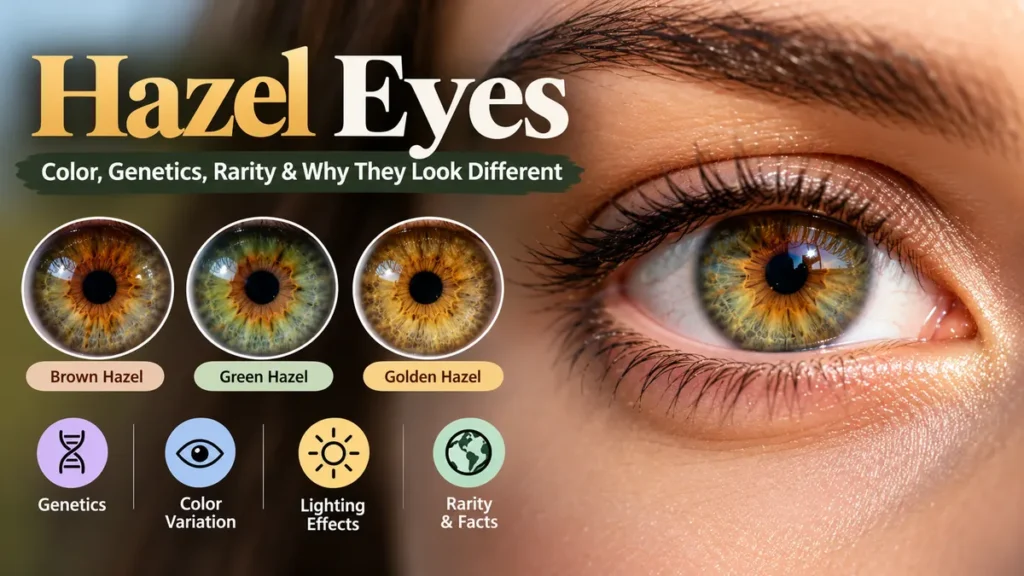
Hazel eyes are difficult to describe with a single color. Look closely and you may see brown around the pupil, green toward the outside, and streaks or flecks of gold in between. In different lighting, the same eyes may seem noticeably greener or browner.
That changing appearance has made hazel eyes one of the most recognizable—and frequently misunderstood—natural eye colors.
Hazel eyes are a mixed, multi-tonal eye color usually combining brown, green and gold. Their appearance results mainly from the amount and distribution of melanin in the iris together with the way light scatters through iris tissue. Genetics determines these characteristics, while lighting and surroundings can change which colors appear most prominent. MedlinePlus
What Color Are Hazel Eyes?
Hazel is generally described as a combination of brown, green and gold rather than one uniform shade. The proportions vary considerably between individuals.
One person might have a warm brown center surrounded by olive green. Another may appear mostly green with small brown or golden areas. Some hazel irises show all three colors clearly.
Cleveland Clinic describes hazel as various combinations of green, gold and brown and notes that the colors don’t necessarily appear in equal amounts. Cleveland Clinic
This variation means there isn’t one exact shade that qualifies as hazel.
Common appearances include:
- Green-hazel, where green is visually dominant
- Brown-hazel, where brown occupies more of the iris
- Golden hazel, with noticeable yellow-gold tones
- Brown or gold around the pupil with a greener outer iris
- Mixed green, brown and gold distributed throughout the iris
The transitions can be gradual or surprisingly distinct.
Why aren’t all hazel eyes identical?
Eye color exists along a continuum rather than as a handful of perfectly separated categories.
The amount of melanin matters, but so does where that pigment is distributed within the iris. The density and structure of iris tissue also affect how incoming light is absorbed, scattered and reflected.
That creates enormous individual variation.
Even two people who both describe their eyes as hazel may have visibly different colors and patterns. Cleveland Clinic notes that no two people have exactly the same eye coloration, with subtle differences possible even between identical twins. Cleveland Clinic
What Causes Hazel Eyes?
Three interconnected factors largely explain the characteristic appearance of hazel eyes:
- Melanin concentration
- Melanin distribution
- The interaction between light and iris structure
The iris is the colored circular structure surrounding the pupil. Its pigmentation comes primarily from melanin—the same broad class of pigment involved in skin and hair coloration.
According to MedlinePlus Genetics, eye color is directly related to the amount of melanin in the front layers of the iris. Brown eyes generally contain considerably more, while blue eyes contain much less. MedlinePlus
Hazel falls within the intermediate part of this spectrum.
The role of melanin
Melanin absorbs light.
When an iris contains a high concentration of melanin, more incoming light is absorbed and the eye generally appears darker. That is why heavily pigmented irises usually look brown.
With less melanin, more light can interact with and scatter through iris tissue.
Hazel eyes typically have less pigmentation than dark brown eyes, allowing greenish or golden effects to become visible alongside brown areas. All About Vision
The distribution may also be uneven. One part of the iris can therefore appear significantly browner than another.
There isn’t actually green pigment in green-looking areas
One of the more interesting facts about hazel eyes is that their green appearance doesn’t require a green pigment.
The visible color partly comes from the physical interaction between light and iris tissue.
Scientific research describes human eye color as being influenced by melanin abundance, the density and distribution of melanocytes, iris structure, and light scattering. PubMed Central (PMC)
Think of the color you see as the combined result of pigment plus optics, rather than pigment alone.
That distinction helps explain why lighter and mixed eye colors can look surprisingly different as environmental conditions change.
Why Do Hazel Eyes Seem to Change Color?
Hazel eyes don’t normally switch biological eye color throughout the day.
What changes is their appearance.
Because multiple tones are already visible within a hazel iris, different conditions can make one component stand out more strongly.
Bright daylight might emphasize green and gold. Under dim indoor lighting, the same iris might look predominantly brown.
Lighting makes the biggest difference
Different light sources have different intensities and color temperatures.
Natural sunlight, fluorescent office lighting, warm household bulbs and camera flashes illuminate the iris differently. The amount of light reaching and reflecting from the iris also changes.
That can dramatically alter how hazel eyes look in photographs.
All About Vision explains that melanin absorbs wavelengths of incoming light while light is also scattered and reflected by the iris. The combination contributes to the apparent colors of lighter and mixed irises. All About Vision
Clothing and surroundings affect perception
A person’s surroundings can influence perceived color too.
Green clothing can make green portions of a hazel iris seem more prominent. Earth tones may emphasize brown or gold. Makeup and nearby colors can create similar contrast effects.
The iris hasn’t suddenly produced a different pigment. Your visual system is simply interpreting the existing colors within a different environment.
Pupil size can affect appearance
The pupil naturally expands and contracts in response to light.
Because the iris surrounds the pupil, changes in pupil size alter how its patterns are displayed. This can subtly change which areas of a multicolored iris attract your attention.
So when someone says their hazel eyes “change color,” there may be a genuine visible difference—but usually not an actual rapid change in pigmentation.
Hazel Eyes Genetics: How Are They Inherited?
The genetics of hazel eyes is much more complicated than the classic classroom idea that brown eyes are dominant and blue eyes are recessive.
Eye color is polygenic, meaning numerous genes contribute to the final phenotype.
Two particularly important genes are OCA2 and HERC2, located close together on chromosome 15.
OCA2 influences processes involved in melanin production and storage. A regulatory region within HERC2 can influence the expression of OCA2, affecting pigmentation. MedlinePlus
Other genes associated with eye-color variation include:
- ASIP
- IRF4
- SLC24A4
- SLC24A5
- SLC45A2
- TPCN2
- TYR
- TYRP1
These genes can collectively influence pigmentation rather than producing a simple “hazel gene.” MedlinePlus
Eye color is even more genetically complex than once thought
A large genome-wide association study involving up to 192,986 European participants identified 124 independent associations across 61 genomic regions related to eye color, including 50 previously unidentified regions.
The researchers concluded that the genetic architecture of human eye color is substantially more complex than previously understood. PubMed Central (PMC)
That finding is especially relevant to intermediate colors such as hazel.
There isn’t a straightforward genetic switch where inheriting one “hazel allele” automatically produces hazel eyes.
Can two brown-eyed parents have a hazel-eyed child?
Yes.
Parents pass combinations of many genetic variants to their children. Two brown-eyed parents can carry variants associated with lighter pigmentation that combine differently in their child.
The reverse principle applies as well: knowing the parents’ visible eye colors does not allow you to predict a child’s exact eye color with certainty.
The traditional dominant-versus-recessive model is simply too limited for this purpose. MedlinePlus notes that eye-color inheritance can produce outcomes that would seem impossible under the older single-gene explanation. MedlinePlus
How Rare Are Hazel Eyes?
Hazel is less common than brown globally, but exact worldwide percentages should be treated cautiously.
Eye-color statistics vary considerably between sources because populations differ geographically and because categories such as hazel, green, amber and light brown aren’t always defined consistently.
A strong recent dataset provides a clearer picture for the United States.
A 2025 PLOS One study analyzed self-reported iris-color data from 235,423,085 driver’s license holders across 31 U.S. states. It reported:
| Eye color | Share in the dataset |
|---|---|
| Brown/black | 53.0% |
| Blue | 23.7% |
| Hazel | 10.3% |
| Green | 9.0% |
| Gray | 0.7% |
| Other | 3.3% |
Hazel therefore represented about one in ten people in this enormous U.S. dataset. PubMed Central (PMC)
There is an important limitation: the eye colors were self-reported, so some people may have classified similar-looking eyes differently. The researchers specifically acknowledged the possibility of misclassification bias. PubMed Central (PMC)
That is one reason older percentages and worldwide estimates shouldn’t be treated as universal constants.
Where are hazel eyes most common?
Eye-color frequencies vary strongly with ancestry and geographic population history.
The greatest diversity in iris coloration is generally observed among populations of European or partly European ancestry. Research also indicates that the genetics underlying pigmentation is complex across populations rather than belonging to a simple ethnic classification. PubMed Central (PMC)
Hazel eyes can occur across many backgrounds and regions. Eye color alone is therefore not a reliable way to determine someone’s ancestry or ethnicity.
Hazel Eyes vs. Green Eyes
Hazel and green are particularly easy to confuse.
Both can contain relatively low-to-moderate amounts of visible pigmentation compared with dark brown eyes, and both can change noticeably in appearance under different lighting.
The practical distinction is usually the mixture of colors.
| Feature | Hazel Eyes | Green Eyes |
|---|---|---|
| Main appearance | Brown, green and/or gold mixture | Predominantly green |
| Brown areas | Often obvious | Usually much less prominent |
| Gold tones | Common | Can occur |
| Color distribution | Frequently multicolored | Usually more consistently green |
| Lighting effect | Can shift strongly between brown/green | May vary in intensity |
A strongly green-dominant hazel iris can still be difficult to classify visually.
There is no universally perfect boundary separating every hazel eye from every green eye, and medical sources acknowledge that eye-color classification systems don’t always agree. Cleveland Clinic
Hazel Eyes vs. Brown Eyes
The difference becomes clearer when comparing typical hazel eyes with dark brown eyes.
Brown eyes contain greater amounts of melanin in the front layers of the iris. That additional pigment absorbs more light, creating a more consistently brown appearance. MedlinePlus
Hazel eyes usually reveal multiple colors.
In strong natural light, someone with light brown eyes may notice golden details, but that alone doesn’t necessarily make the eyes hazel. A visible green-brown combination is more characteristic.
Brown-hazel eyes occupy the difficult middle ground. They may look brown from across a room and distinctly green-gold-brown in a close photograph.
This is another reminder that eye color behaves more like a spectrum than a paint chart with rigid boundaries.
Hazel Eyes vs. Amber Eyes
Amber and hazel are also frequently confused because both can display striking golden tones.
The key distinction is generally uniformity versus mixture.
Hazel usually combines several colors, particularly brown and green with gold or amber-like areas.
Amber is generally described as a more consistently golden, yellowish or copper-toned iris.
So an iris that looks solid gold or copper without an obvious green component may be better described as amber. An iris combining golden-brown and green areas fits the conventional description of hazel more closely.
Classification remains imperfect, however. Studies and surveys don’t always use identical categories, and some datasets group unusual or intermediate colors differently. PubMed Central (PMC)
Are Hazel Eyes the Same as Central Heterochromia?
Not necessarily.
Heterochromia describes differences in iris coloration. Complete heterochromia means the two eyes have distinctly different colors, while other forms can involve differently colored portions within an iris.
MedlinePlus notes that heterochromia can result from genetic variation, differences during eye development, disease or injury. MedlinePlus
Central heterochromia typically produces a noticeably different ring of color surrounding the pupil.
Hazel eyes can naturally show a brown or golden center with a greener outer region, so the visual appearance can overlap. A multicolored iris therefore shouldn’t automatically be labeled central heterochromia simply because two colors are visible.
For ordinary identification, “hazel” describes the overall eye color, whereas heterochromia describes a pattern of color difference.
Can Hazel Eyes Develop or Change With Age?
Eye color can change during early childhood.
Babies don’t necessarily have their final iris pigmentation at birth. Melanin can accumulate as they develop, causing initially lighter eyes to become green, hazel or brown. All About Vision
Once eye color stabilizes, substantial spontaneous changes become less typical.
Minor differences from day to day are generally related to lighting, pupil size, surroundings or perception rather than actual pigment changes.
A genuine new change in iris color—especially one affecting only one eye—deserves more attention.
Cleveland Clinic notes that eye color can sometimes change during a person’s lifetime and that changes can occasionally provide clues to medical conditions. Cleveland Clinic
If an adult notices a significant unexplained change, particularly alongside pain, redness, blurred vision, injury or other eye symptoms, an eye-care professional should evaluate it.
Do Hazel Eyes Affect Vision?
Hazel eye color itself doesn’t determine how sharp your eyesight is.
Visual acuity depends on factors involving structures such as the cornea, lens, retina and optic nerve rather than whether an iris is categorized as hazel, brown or blue.
Pigmentation does influence how light interacts with the iris, but having hazel eyes does not mean someone inherently sees better or worse.
Regular eye care remains the same basic priority regardless of eye color:
- Protect your eyes from ultraviolet radiation with appropriate sunglasses.
- Have routine eye examinations at intervals recommended for your age and risk factors.
- Seek professional assessment for persistent pain, redness or visual changes.
- Don’t ignore a sudden change in the color or appearance of one iris.
Eye color is visually interesting, but it isn’t a substitute for information about eye health.
Can Hazel Eyes Become Greener Naturally?
You can’t reliably or safely change your natural iris pigmentation through foods, exercises, supplements or other internet “hacks.”
What you can change is how existing colors are perceived.
Natural daylight may make green tones more visible. Clothing or makeup that contrasts with brown and green can emphasize particular portions of the iris. Photography settings can produce an even stronger effect.
None of those methods changes the underlying genetics or permanently redistributes melanin.
If hazel eyes look green in one photograph and brown in another, the simplest explanation is usually lighting and perception—not a biological transformation.
What Makes Hazel Eyes Unique?
The most distinctive characteristic of hazel eyes isn’t simply their rarity. It’s their variation.
A hazel iris can contain enough pigmentation to display rich brown and gold areas while simultaneously allowing structural light effects to produce greenish regions. Differences in pigment distribution then create patterns that vary across the iris.
Genetically, this appearance reflects a complex system involving OCA2, HERC2 and numerous additional pigmentation-associated genes rather than a single inheritance rule. MedlinePlus
Optically, the balance between pigment absorption and light scattering helps explain why the colors can look different depending on illumination. All About Vision
And statistically, hazel isn’t merely an extremely rare curiosity: the largest recent U.S. iris-color study classified 10.3% of more than 235 million records as hazel. PLOS
The best way to understand hazel eyes, then, is not as one precise shade but as a naturally variable eye-color pattern shaped by genetics, melanin distribution, iris structure and light. Brown, green and gold may compete for attention from one moment to the next, while the underlying iris remains the same.