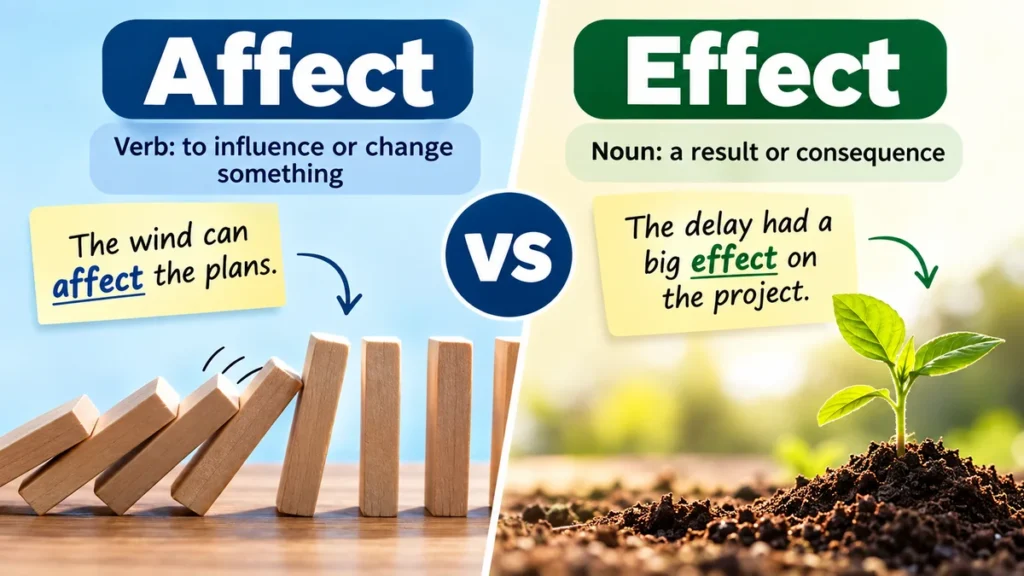
Few pairs of English words cause as much confusion as affect vs effect. They look similar, sound similar in ordinary speech, and both relate to change. Yet in most sentences, they perform different grammatical jobs.
Here is the simplest rule: affect is usually a verb meaning “to influence or cause a change,” while effect is usually a noun meaning “a result or consequence.” For example, lack of sleep can affect your concentration, and poor concentration can be an effect of lack of sleep. This distinction is also reflected in major grammar references.
That rule solves most affect-or-effect questions. There are exceptions, though: effect can sometimes be a verb, and affect can sometimes be a noun. Understanding those less common uses will help you choose confidently even in academic, professional, and technical writing.
Affect vs Effect: What Is the Main Difference?
The basic difference between affect vs effect is grammatical:
| Word | Most Common Role | Meaning | Example |
|---|---|---|---|
| Affect | Verb | To influence or change something | Stress can affect your sleep. |
| Effect | Noun | A result or consequence | Stress can have an effect on sleep. |
Think about cause and result.
If one thing is influencing another, you probably need affect.
If you are describing the result of that influence, you probably need effect.
Consider these two sentences:
The weather affected our travel plans.
Here, affected describes what the weather did. It changed or influenced the plans.
The weather had an unexpected effect on our travel plans.
Here, effect names the result or consequence produced by the weather.
Cambridge Grammar makes essentially the same distinction: affect generally means to influence or cause something to change, whereas effect as a noun describes the result of an influence.
A Quick Substitution Test
When you are unsure which word belongs in a sentence, replace it temporarily.
For affect, try:
- influence
- change
- alter
For effect, try:
- result
- consequence
- outcome
For example:
The temperature can ___ the experiment.
“The temperature can influence the experiment” makes sense.
Therefore:
The temperature can affect the experiment.
Now consider:
The temperature had a noticeable ___ on the experiment.
“The temperature had a noticeable result” points toward the noun:
The temperature had a noticeable effect on the experiment.
This substitution method is particularly useful because it focuses on meaning rather than spelling.
When to Use Affect
In everyday English, affect is most commonly a transitive verb. It means to influence, alter, or produce a change in someone or something.
Examples:
- Rain may affect attendance at the event.
- Your diet can affect your energy levels.
- The new schedule affected everyone in the office.
- Temperature affects the speed of some chemical reactions.
- Her teacher’s encouragement positively affected her confidence.
- Rising costs could affect the project’s budget.
Notice that something receives the influence in each example.
Rain affects attendance.
Rain is doing the affecting, while attendance is being affected.
Affect Usually Needs an Object
Because the common form of affect is a transitive verb, it normally acts on someone or something.
Consider:
The decision affected employees.
Decision is the subject, affected is the verb, and employees is the object receiving the action.
That grammatical pattern can help when the meaning alone does not immediately make the answer obvious.
Affects vs Affect
Use affects when the subject is third-person singular in the present tense:
- Exercise affects mood.
- Weather affects traffic.
- Screen brightness affects battery life.
Use affect with plural subjects and with words such as I, you, we, and they:
- These changes affect students.
- They affect everyone differently.
- Long working hours can affect productivity.
The underlying meaning remains “influence” or “cause a change.”
When to Use Effect
Effect is most commonly a noun meaning a result, outcome, or consequence produced by something.
Examples:
- The medicine had an immediate effect.
- Exercise can have a positive effect on mood.
- The storm had little effect on the building.
- Researchers studied the effects of sleep deprivation.
- The lighting created a dramatic effect.
- The changes had an unexpected effect on productivity.
One useful clue is the word appearing before effect. Because effect is commonly a noun, it frequently follows articles and adjectives:
- an effect
- the effect
- a positive effect
- a negative effect
- a significant effect
- an unintended effect
If you can naturally place the, an, or an adjective before the missing word, effect is often the right choice.
Effect vs Effects
Effect is singular:
The treatment had one noticeable effect.
Effects is plural:
Researchers examined several effects of the treatment.
This distinction becomes useful with phrases such as:
- side effect
- side effects
- long-term effects
- harmful effects
- positive effects
- environmental effects
Affect vs Effect Examples in Sentences
Seeing both words used in similar contexts makes the distinction easier to recognize.
| Affect | Effect |
|---|---|
| Noise can affect concentration. | Noise can have an effect on concentration. |
| The weather affected our plans. | The weather had an effect on our plans. |
| Sleep affects memory. | Lack of sleep can have negative effects on memory. |
| The decision affected the entire team. | The decision had an unexpected effect on the team. |
| Inflation affects household spending. | Inflation has several effects on household spending. |
| Lighting can affect the appearance of a room. | The lighting created a pleasant effect. |
The relationship becomes clearer when both words appear in one sentence:
The new schedule affected employees, but its overall effect on productivity was small.
Affect describes an action. Effect names the result.
How to Remember Affect vs Effect
One of the best-known memory devices is RAVEN:
Remember
Affect =
Verb
Effect =
Noun
Purdue OWL specifically gives RAVEN as a memory aid for distinguishing the common uses of the two words.
Another easy trick is:
A = Action = Affect
If the word describes the action of influencing something, think of the A in affect and action.
For effect, think:
E = End result = Effect
These tricks are not complete grammatical definitions because both words have exceptions. They are nevertheless reliable for the vast majority of everyday sentences.
Cause, Affect, Effect
You can also picture the relationship as a sequence:
Cause → affects something → produces an effect
For example:
Heavy rain → affects traffic → produces delays as an effect
This connects the two words conceptually instead of requiring you to memorize isolated definitions.
Affect vs Effect: The Important Exceptions
The usual verb-versus-noun rule works most of the time, but English has two important exceptions:
Effect can be a verb.
Affect can be a noun.
These uses are much less common than the standard meanings.
Effect as a Verb
As a verb, effect means to bring about, accomplish, or cause something to happen.
For example:
The organization hopes to effect change.
This does not mean the organization hopes to influence change. It means the organization hopes to bring the change about.
Other examples include:
- The reforms were designed to effect lasting change.
- The negotiations effected a peaceful transition.
- Management introduced several measures to effect improvements.
The phrase effect change is one of the most common places where you will encounter effect as a verb. Purdue OWL likewise identifies the verb effect as meaning “to bring about” or “to accomplish.”
Compare:
The campaign affected policy.
The campaign influenced policy.
The campaign effected a policy change.
The campaign brought the change about.
That difference is subtle but meaningful.
Affect as a Noun
As a noun, affect is primarily a specialized psychology and psychiatry term relating to observable or expressed emotion. Cambridge, for example, identifies the noun form as a specialized psychology usage referring to emotion, mood, or an observable reaction showing feeling.
You might encounter phrases such as:
- flat affect
- restricted affect
- emotional affect
This use is uncommon in everyday conversation and should not replace effect when you simply mean “result.”
For most general writing:
effect = result
remains the safer rule.
Affected vs Effected: What’s the Difference?
The confusion continues when the words move into the past tense.
Affected usually means influenced or changed.
Effected means brought about or accomplished.
Examples:
The power outage affected several neighborhoods.
The neighborhoods experienced the influence or consequences of the outage.
The new director effected major changes in the department.
The director caused those changes to happen.
Dictionary.com similarly distinguishes affected as the past tense of the common verb affect from effected, the past tense of effect meaning to make something happen.
Affected as an Adjective
Affected can also describe people or things influenced by an event:
- affected residents
- affected customers
- affected areas
- affected systems
For example:
Emergency supplies were delivered to the affected areas.
Here, affected describes the areas that experienced the consequences of an event.
Affecting vs Effecting
The same distinction applies to the -ing forms.
Affecting usually means influencing:
The noise is affecting my concentration.
Effecting means bringing something about:
The committee is responsible for effecting organizational change.
There is another meaning of affecting as an adjective: something emotionally moving can be described as affecting. Dictionary.com notes both this adjective use and the verb distinction.
For example:
It was an affecting performance.
In this sentence, affecting means emotionally moving.
Common Expressions With Effect
Several established English expressions use effect, not affect. Learning them as complete phrases can prevent mistakes.
Take Effect
Take effect means to begin operating or producing a result.
The new rules take effect next month.
In Effect
In effect can mean currently operating or, depending on context, essentially or practically.
The restrictions remain in effect.
Have an Effect
Use have an effect on when discussing a result or influence as a noun.
Exercise can have an effect on your mood.
Side Effect
A side effect is an additional consequence or result, especially a secondary effect associated with a treatment or action.
Drowsiness can be a side effect of some medicines.
These expressions use the noun effect, which is why replacing it with affect would normally be incorrect.
Is It “Affect Change” or “Effect Change”?
Both constructions can be grammatically possible, but they communicate different ideas.
Affect change means influence a change.
Effect change means cause or bring about a change.
In practice, when someone intends to say “make change happen,” effect change is the expression they want.
Compare:
Economic conditions can affect changes in consumer behavior.
Economic conditions can influence those changes.
Community organizations can effect change through coordinated action.
The organizations can bring change about.
The distinction illustrates why the simple “affect is always a verb, effect is always a noun” rule should be treated as a shortcut rather than an absolute law.
Is It “Affect Me” or “Effect Me”?
In normal usage, affect me is usually correct when you mean “influence me.”
The criticism didn’t affect me.
Using effect me would normally be incorrect because the verb effect means to bring something into existence, not simply to influence someone.
Similarly:
How will this affect me?
is normally correct.
But:
What effect will this have on me?
is also correct because effect is now being used as a noun meaning “result.”
The grammatical structure has changed even though the overall ideas are closely related.
Common Affect vs Effect Mistakes
Many errors occur because writers rely only on pronunciation. The two words sound similar enough that hearing the sentence may not reveal which spelling is required.
A common error is:
Incorrect: The weather had a negative affect on attendance.
Because the sentence refers to a result, write:
Correct: The weather had a negative effect on attendance.
Another common error is:
Incorrect: The weather effected attendance.
If the intended meaning is “influenced attendance,” write:
Correct: The weather affected attendance.
The verb effected would suggest that the weather actually brought attendance into existence, which is probably not the intended meaning.
Another useful clue is sentence structure:
___ something → often affect
an/the ___ → often effect
For example:
This could affect sales.
This could have an effect on sales.
Affect vs Effect in Academic and Professional Writing
The distinction matters particularly in academic, scientific, business, and technical writing because the two words can change the precise meaning of a statement.
Consider a research sentence:
Temperature affected the reaction rate.
This states that temperature influenced the rate.
Now compare:
The effect of temperature on the reaction rate was measured.
Here, effect refers to the observed result or influence as a thing being measured.
Scribbr gives a similar academic distinction, noting that affect functions as a transitive verb in its common sense while effect commonly functions as the noun describing the resulting change.
When editing formal writing, ask two questions:
Am I describing an action or influence?
Use affect.
Am I naming a result or consequence?
Use effect.
Then check whether the sentence uses one of the less common exceptions.
Affect vs Effect: A Final Quick Check
Before choosing between these words, use this simple decision process:
- Ask whether you mean influence or change.
- If yes and you need a verb, choose affect.
- Ask whether you mean result, outcome, or consequence.
- If yes and you need a noun, choose effect.
- If you mean bring about or accomplish, the verb effect may be correct.
- If you are discussing observable emotional expression in a psychological context, the noun affect may be correct.
For everyday writing, however, the core affect vs effect rule remains simple: affect is usually the action of influencing something, while effect is usually the result of that influence.
Remember A for action: affect and E for end result: effect. Once you identify whether your sentence needs an action or a result, choosing the correct word becomes much easier.