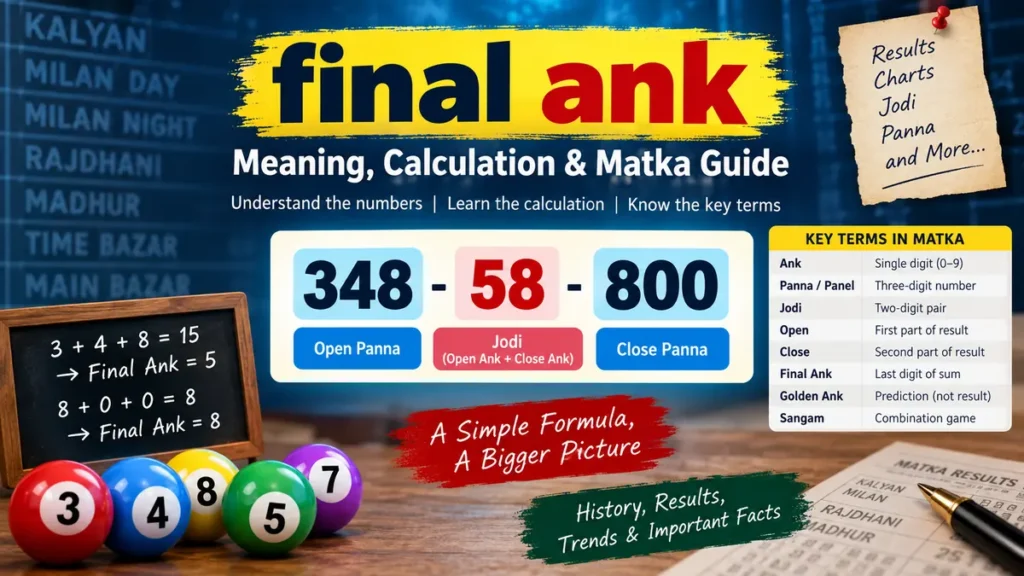
If you have come across the term final ank while reading about Satta Matka, Kalyan, Milan Day, Rajdhani, or Main Bazar, the number-heavy result tables can be confusing at first. The terminology looks complicated, but the basic mathematical idea behind an ank is relatively simple.
final ank generally refers to a single digit from 0 to 9 derived from a Matka result. In a three-digit panel or panna, the digits are added together and the last digit of that total becomes the ank. Matka markets commonly organize results around Open and Close rounds, producing related Panna, Ank, and Jodi values.
This guide explains the terminology, calculation method, result format, popular market names, historical charts, and an important point that result and prediction websites often blur: historical number patterns do not make future random outcomes reliably predictable.
What Is final ank?
In Satta Matka terminology, ank means a single digit, normally from 0 through 9. A final ank is the single-digit value associated with a completed result.
Current Matka information sites use the term alongside markets such as Kalyan, Milan Day, Rajdhani Day, Milan Night, Rajdhani Night, Madhur Day, Madhur Night, Time Bazar, and Main Bazar. Live-result pages frequently display the complete three-digit panel together with a two-digit Jodi and individual ank values.
The easiest way to understand the terminology is to separate the common result components:
| Term | Basic meaning | Typical format |
|---|---|---|
| Ank | Single digit | 0–9 |
| Panna/Panel/Patti | Three-digit combination | 348 |
| Jodi | Pair of digits | 58 |
| Open | First part of a result | Single digit/panel |
| Close | Second part | Single digit/panel |
| Final result | Completed market result | 348-58-800 |
Different websites sometimes use slightly different labels, particularly Panna, Panel, and Patti, so readers should check how a particular result table defines its columns.
How Is final ank Calculated?
The basic ank calculation uses the sum of the digits in a three-digit panel.
For example, suppose a panel is:
3 + 7 + 9 = 19
Only the final digit of 19 is retained:
Ank = 9
Another example:
4 + 8 + 8 = 20
The last digit is zero:
Ank = 0
This same principle is described by current Matka reference pages: add the three panel digits and use the last digit of the resulting sum.
Simple Calculation Examples
| Panna | Calculation | Ank |
|---|---|---|
| 123 | 1 + 2 + 3 = 6 | 6 |
| 137 | 1 + 3 + 7 = 11 | 1 |
| 348 | 3 + 4 + 8 = 15 | 5 |
| 560 | 5 + 6 + 0 = 11 | 1 |
| 800 | 8 + 0 + 0 = 8 | 8 |
| 889 | 8 + 8 + 9 = 25 | 5 |
The important rule is that the result remains a single digit from 0 to 9. When the total has two digits, only its final digit is used.
Quick Takeaway: A three-digit panna and an ank are not the same thing. The panna contains three digits; the ank is obtained from the last digit of their sum.
final ank, Open Ank, Close Ank, and Jodi
Understanding Open and Close makes Matka result notation considerably easier to read.
A completed market result can contain an Open Panna, an Open Ank, a Close Ank, and a Close Panna. The two single-digit ank values together form the Jodi.
Consider this purely mathematical example:
348-58-800
The first panel is 348:
3 + 4 + 8 = 15
So the Open Ank is 5.
The second panel is 800:
8 + 0 + 0 = 8
So the Close Ank is 8.
Together:
Open Ank 5 + Close Ank 8 = Jodi 58
The result can therefore be represented as:
348 – 58 – 800
Current Kalyan/Matka result pages use this three-part presentation for many markets.
Why This Format Matters
Someone seeing a string such as 348-58-800 for the first time might assume that all three numbers are separate results.
They are connected.
The first and third groups are three-digit panels, while the middle pair represents the ank values associated with the two sides of the result.
This distinction also explains why searching for a Kalyan final ank may produce a single digit on one page but a complete panel-Jodi-panel result on another.
final ank and Kalyan Matka
Kalyan is one of the market names most frequently associated with final ank searches. Search results for the term currently contain pages covering Kalyan alongside several other Matka markets rather than treating final ank as a separate standalone game.
The terminology commonly encountered includes:
- Kalyan final ank
- Kalyan result
- Kalyan chart
- Kalyan Jodi
- Open Ank
- Close Ank
- Panna or Panel
- Matka final
- Historical result chart
Other market names frequently displayed alongside Kalyan include Milan Day, Milan Night, Rajdhani Day, Rajdhani Night, Madhur Day, Madhur Night, Time Bazar, and Main Bazar.
These are market labels rather than alternative mathematical definitions of an ank.
What Is a final ank Chart?
A final ank chart is essentially a historical record. Depending on the website, it may show dates, markets, Open and Close results, Panna values, Jodi numbers, or a single final digit.
For example, historical tables may be organized like this:
| Date | Market | Open Panna | Jodi | Close Panna |
|---|---|---|---|---|
| Example date | Market A | 123 | 67 | 458 |
| Example date | Market B | 348 | 58 | 800 |
These examples demonstrate the format only; they are not current results or forecasts.
Historical Final Ank records are a major feature of several currently indexed sites, with tables covering previous dates and multiple markets.
What Historical Charts Can Actually Tell You
A chart can accurately answer historical questions such as:
- What number was previously reported?
- Which Jodi appeared on a particular date?
- What Open or Close Panna was recorded?
- How frequently did a digit appear within the recorded dataset?
- Did two websites publish the same historical result?
Those are descriptive uses of data.
A historical chart cannot, by itself, demonstrate that a particular digit must occur next.
That distinction matters because many Final Ank websites mix historical records with terms such as guessing, golden ank, passing records, weekly numbers, trends, or predictions.
Can Past final ank Results Predict the Next Number?
Past results can be counted and analyzed, but that is different from reliably predicting the next outcome.
Suppose the digit 7 has appeared much more frequently than 3 in a short historical dataset. It is tempting to conclude that either:
7 is “hot” and will continue appearing, or
3 is “due” because it has appeared less often.
Neither conclusion follows automatically from the historical counts.
If outcomes are genuinely random and independent, earlier results do not create a dependable rule for the next result. A streak may look meaningful after it happens without providing predictive power beforehand.
This is why terms such as Golden Ank, “fix” numbers, “sure” numbers, “expert guessing,” and similar prediction labels should not be confused with mathematically guaranteed outcomes. Some current sites explicitly publish Golden Ank or expert-guessing sections alongside official-looking result tables.
Quick Takeaway: Historical frequency is evidence of what happened in the recorded data. It is not proof of what will happen next.
What Is Golden Ank Compared With final ank?
The distinction between Golden Ank and final ank is especially important because search results frequently place both terms on the same page.
A final ank describes a result-related digit after the relevant outcome has been established.
Golden Ank, by contrast, is generally used by Matka sites for suggested or predicted numbers published before a result. One current Final Ank site explicitly distinguishes the declared Final Ank from Golden Ank numbers described as guesses.
That gives readers a useful rule:
| Term | What it represents |
|---|---|
| Final Ank | Result-related single digit |
| Open Ank | Digit associated with the Open panel |
| Close Ank | Digit associated with the Close panel |
| Jodi | Open and Close digits together |
| Panna/Panel | Three-digit combination |
| Golden Ank | Prediction/guessing terminology used by some sites |
A prediction should never be treated as a confirmed result simply because it appears beside historical result data.
Understanding Panna, Patti, Single, Jodi, and Sangam
Matka terminology extends beyond the final digit. Anyone researching final ank will regularly encounter several related terms.
Single or Ank
A Single refers to one digit from 0 through 9.
Examples include:
0, 1, 2, 3, 4, 5, 6, 7, 8, 9
It is the simplest numerical category in the terminology.
Jodi
A Jodi is a two-digit pair.
Examples could include:
15, 28, 42, 58, 83
In a complete Open-Close representation, the first digit corresponds to the Open Ank and the second to the Close Ank.
Panna, Panel, or Patti
These terms refer to a three-digit combination.
Examples include:
123, 348, 560, 800
The terminology varies between websites. Some prefer Panna, others Panel or Patti.
Half Sangam
Half Sangam combines an ank from one side with a three-digit panna from another part of the result.
Full Sangam
Full Sangam relates the Open Panna and Close Panna together.
These categories are commonly listed alongside Single, Jodi, and Panna in explanations of Matka terminology.
They describe different result combinations; they do not create a method for guaranteeing a future outcome.
How to Read a final ank Result Page
Modern Final Ank pages can be extremely dense. A single screen may contain live results, historical charts, Golden Ank predictions, weekly tables, passing records, Jodi data, and multiple market schedules.
A clearer way to interpret such a page is to separate confirmed information from predictions.
1. Check the Market Name
First identify which market the row represents.
It might be Kalyan, Milan Day, Rajdhani Day, Madhur Day, Milan Night, Rajdhani Night, Time Bazar, or Main Bazar.
Do not assume that a number displayed prominently at the top belongs to every market.
2. Check the Date
Result sites frequently retain historical data while also displaying today’s information.
A number from yesterday’s chart is not today’s result.
3. Identify the Result Format
A complete result might look like:
Panna – Jodi – Panna
A partially completed market might display only the first panel or Open value until the remaining information is available.
4. Separate Results From Predictions
Look carefully for labels such as:
Result, Live Result, Golden Ank, Guessing, Weekly, Prediction, Dhamaka, Passing Record, or Record.
These labels do not necessarily refer to the same type of information.
5. Cross-Check Time-Sensitive Information
Live pages can update at different speeds, and search-engine snippets may contain cached information rather than the latest page state.
This is particularly relevant because current Final Ank sites publish market schedules and rapidly changing result tables throughout the day.
What Does DPBoss final ank Mean?
Another phrase commonly encountered in this search space is DPBoss final ank.
DPBoss-related terminology is used across Matka result and chart pages as a reference associated with result information, charts, and number updates. Some Final Ank pages explicitly use “Dpboss” in descriptions of their result or Golden Ank content.
For someone researching the terminology, the important distinction remains unchanged: identify whether the displayed number is a historical result, a currently declared result, or merely a prediction.
A familiar site or label does not change the mathematical nature of the numbers.
Why Do Different final ank Websites Show Different Information?
This is one of the most useful questions to ask when comparing Matka pages.
Different sites can show different values because they may be displaying information from different markets, dates, stages of a result, update times, or prediction sections.
A page may also contain cached content.
For example, one section may show a completed historical Kalyan result while another displays an upcoming market’s prediction. Without checking the headings, the numbers can easily be mistaken for comparable results.
There is another issue: terminology is not perfectly standardized.
One website may use Panna, another Panel, and another Patti. Likewise, “Final Ank” can be presented as the relevant single digit or used more broadly in the branding of an entire Matka results service.
When comparing pages, therefore, match:
market + date + Open/Close status + result type
rather than comparing isolated digits.
Are final ank and Matka Final the Same Thing?
They are closely related terms, but they can be presented differently.
final ank usually emphasizes the single-digit component of the outcome.
Matka Final may be used more broadly for the completed result.
This is visible in search results where pages use titles combining “Final Ank,” “Kalyan Final Ank,” and “Matka Final” while displaying complete result strings and market tables.
So when a person says “final,” context matters.
They might mean:
the single ank,
the Close result,
the final Jodi,
or the entire completed panel-Jodi-panel sequence.
Checking the format removes most ambiguity.
Is Satta Matka Legal?
Legal status deserves attention because informational pages often discuss Matka mechanics without clearly separating them from gambling law.
Satta Matka is a form of gambling. One prominent Final Ank result page itself states that Satta is not legal in India while describing online and offline participation.
The broader legal position can depend on jurisdiction, the exact activity involved, and applicable central and state-level laws. Online gambling regulation can also differ from traditional physical gambling rules.
For that reason, a website being accessible online should not be taken as evidence that participating through it is lawful in a particular location.
Anyone researching the subject should distinguish between learning what Matka terminology means and participating in gambling involving real money.
Common Misunderstandings About final ank
Several misconceptions repeatedly arise around these numbers.
“A number that has not appeared recently is due.”
Not necessarily. This is a classic form of the gambler’s fallacy when applied to independent random events.
“A frequently appearing ank is guaranteed to remain hot.”
Past frequency alone cannot establish that.
“Golden Ank means confirmed result.”
No. On current Matka sites, Golden Ank is commonly associated with guessing or prediction information rather than a declared result.
“Jodi and Ank mean the same thing.”
They do not. Ank is a single digit, whereas Jodi contains two digits.
“Panna is the final digit.”
No. Panna or Panel is a three-digit combination from which an ank can be calculated.
“A prediction becomes reliable if several websites publish it.”
Repetition is not independent evidence. Websites and social channels can reproduce information from one another.
A Simple Way to Understand the Entire Structure
The terminology becomes much easier once you think of it as a hierarchy:
Three digits → sum → single Ank
Then:
Open Ank + Close Ank → Jodi
And the complete result may be represented as:
Open Panna → Jodi → Close Panna
For example:
348 → 58 → 800
Mathematically:
3 + 4 + 8 = 15 → 5
8 + 0 + 0 = 8 → 8
Therefore:
5 + 8 → 58
Once this relationship is understood, charts containing Kalyan, Milan, Rajdhani, Madhur, Time Bazar, and Main Bazar results become much easier to read.
final ank: The Key Points to Remember
final ank is best understood as part of the terminology used around Satta Matka results. An ank is a single digit between 0 and 9, commonly obtained by adding the digits of a three-digit Panna or Panel and retaining the final digit of the sum. Open and Close ank values can then appear together as a Jodi.
Terms such as Kalyan final ank, Matka Final, Jodi, Panna, Patti, Open, Close, Golden Ank, DPBoss, Milan Day, Rajdhani, Madhur, and Main Bazar appear together because they belong to the same broader result ecosystem.
The most useful next step when reading any chart is to identify the date, market, result type, and Open/Close status before interpreting the displayed numbers. Historical charts can explain what happened previously, but prediction labels and apparent number patterns should not be mistaken for guaranteed future results.