Getting piped gas at a new home in Pakistan is possible again, but the process has changed. New domestic connections are currently being processed on an RLNG (Re-Gasified Liquefied Natural Gas) tariff, rather than the traditional indigenous or “system gas” arrangement used for many older connections.
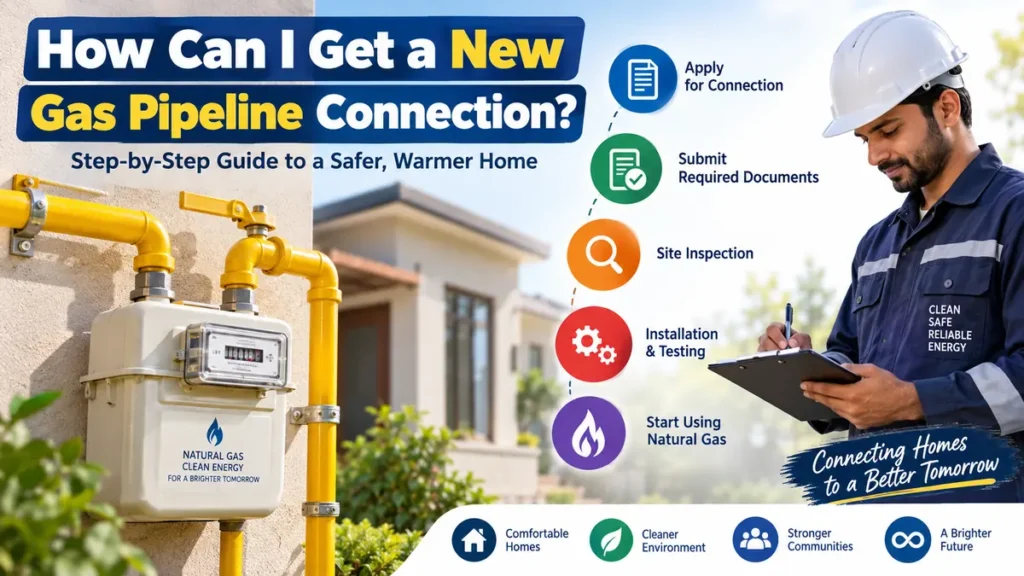
If you are wondering how can i get a new gas pipeline connection, first confirm that an operational gas distribution line reaches your premises. Then apply to the gas utility serving your area, submit your CNIC and property documents, complete the site survey and internal houseline requirements, pay the official demand notice, and wait for the service line and gas meter to be installed.
The exact procedure depends mainly on whether your property is served by Sui Northern Gas Pipelines Limited (SNGPL) or Sui Southern Gas Company Limited (SSGC).
Can You Get a New Gas Pipeline Connection in Pakistan?
Yes. New gas connections are currently being provided in Pakistan on an RLNG basis.
In a recent National Assembly response, the Ministry of Energy’s Petroleum Division stated that new RLNG connections are being provided to domestic, commercial and industrial categories. The government relaxed the moratorium for domestic connections on an RLNG basis, while the moratorium on new indigenous-gas connections remains in place because of limited local gas supplies.
This distinction matters.
System or indigenous gas comes primarily from Pakistan’s domestic natural-gas resources. RLNG is liquefied natural gas that is imported, converted back into gaseous form and supplied through the gas network.
For a new household connection, therefore, you should not assume that you will receive the same tariff structure as an older neighboring property.
Both SNGPL and SSGC currently identify their new domestic connection routes as RLNG-based. SNGPL explicitly states that domestic applications are being processed on imported RLNG tariff, while SSGC’s current application form says new domestic connections are available only under the RLNG tariff under government directives.
The first thing to check
Before preparing paperwork, determine whether a gas distribution pipeline actually exists and is operational in front of or close to your property.
This is one of the most overlooked requirements.
SNGPL’s procedure says applications can proceed where its gas network is operational in front of the premises. SSGC’s current RLNG application requires applicants to affirm that an SSGC gas pipeline exists in front of the premises.
A house being located in a gas-served city does not automatically mean the individual property is technically feasible for a new connection.
Which Gas Company Should You Apply To?
You must apply to the distribution company responsible for your area.
For most residential applicants, the relevant company will be either:
| Gas utility | Main service region | New domestic connection type |
|---|---|---|
| SNGPL | Primarily northern Pakistan, including Punjab and Khyber Pakhtunkhwa | RLNG |
| SSGC | Sindh and Balochistan | RLNG |
Do not submit applications to both companies. Your property’s location and the existing distribution network determine which utility handles the connection.
Both utilities provide dedicated new-connection services. SNGPL’s official website includes an online domestic RLNG application and application-tracking service, while SSGC provides an online RLNG domestic application and new-connection status facility.
how can i get a new gas pipeline connection Step by Step?
For a normal residential property, the overall process follows a fairly predictable sequence even though individual requirements differ between SNGPL and SSGC.
1. Check whether a gas pipeline serves your property
Start with the physical network.
Look for existing gas meters at neighboring houses and determine whether the main distribution line runs in front of your premises.
A neighbor’s gas bill can be useful because it contains the consumer or customer number associated with the local network. SNGPL specifically says the nearest consumer number is mandatory for an online application. SSGC’s online application asks for both the nearest customer number and nearest meter number.
Do not assume that having a neighbor with gas guarantees approval. The utility still has to determine technical feasibility.
2. Gather your documents
Prepare your documents before opening the online application. Missing, unclear or inconsistent paperwork is an avoidable cause of delays.
For an SNGPL domestic RLNG application, essential documents include:
- A valid CNIC of the applicant
- Property title documents, such as registry, transfer certificate or Fard Patwar
- Owner’s NOC where the applicant does not own the property
SNGPL also identifies a neighbor’s gas bill, an electricity bill for the applicant’s premises and other documents confirming the address or plot size as useful supporting documents.
For online or mobile applications, SNGPL requires applicants to upload an image or PDF of the valid CNIC and property documents.
SSGC’s current checklist is somewhat more extensive. Depending on the property, it can include:
- Completed application form
- Valid CNIC
- Neighbor’s gas bill or nearest customer/meter number
- Property or ownership documents
- Tenancy agreement and landlord NOC for tenants
- Approved plan, completion plan, drawing or approval letter where applicable
- Society or relevant-authority NOC where applicable
- Undertaking or affidavit
- Completed RLNG contract form
SSGC currently specifies an undertaking on Rs. 100 stamp paper in its checklist.
Requirements can vary with the property, society and connection circumstances, so use the current utility checklist rather than relying on an old photocopied form.
How to Apply for an SNGPL New Gas Connection
SNGPL provides both physical and digital application routes.
If its network is operational in front of the premises, you can submit the prescribed application at a regional office, sub-office or Customer Services Center. Applications can also be submitted online through the SNGPL website or its ConnectOn mobile application.
Normal Merit vs Fast Track
SNGPL allows a domestic RLNG applicant to choose between Normal Merit and Fast Track on the same application form.
The documentation is the same for both options. The difference is that Fast Track carries an additional urgent fee.
SNGPL currently lists that urgent fee as Rs. 25,000, subject to revision. This amount is in addition to applicable security, service-line and other charges.
Fast Track should not be confused with guaranteed immediate installation. Technical feasibility and other prerequisites still apply.
How to Apply for an SSGC New Gas Connection
SSGC also provides a dedicated online application for new domestic RLNG connections.
Its online form requests details including:
- Zone
- Nearest customer number
- Nearest meter number
- Existing meters at the premises
- Number of floors
- Number of units or kitchens
- Premises type
- Plot size
- Number of connections required
- Applicant’s name
- Complete property address
- Mobile number
- CNIC
- Details of outstanding dues, if applicable
- Supporting documents
SSGC accepts specified electronic document formats through its online application.
The company also operates Customer Facilitation Centers (CFCs). Its documented connection process includes application submission, customer registration, document scrutiny, a physical site survey, technical approval, issuance of connection charges, payment and finally service-line or meter installation.
What Happens After You Submit the Application?
Submitting the form is only the beginning. A new gas meter is not normally installed simply because an application has been registered.
Application verification
The gas company reviews the applicant’s personal, property and connection information.
Incorrect CNIC details, incomplete ownership documents, mismatched addresses or missing NOCs can interrupt processing.
Keep your application acknowledgment or reference number. You may need it to track the case or resolve a problem later.
Physical site survey
A company representative then assesses the premises.
For SNGPL, the representative visits the property according to turn or merit and prepares a feasibility report. If supplying gas is technically and operationally feasible, the houseline plan is designed during the site visit.
SSGC likewise requires physical surveying of applications to confirm the address and houseline route before technical approval.
The survey can determine whether:
- A usable distribution main exists
- The premises can safely be connected
- The proposed service-line route is feasible
- The address matches the application
- The internal houseline arrangement is acceptable
- Additional permissions or infrastructure are required
This is why a successful online submission should not be interpreted as approval.
What Is a Demand Notice for a Gas Connection?
Once the application passes the required technical stages, the utility can issue a demand notice or proposal letter showing the charges that must be paid.
For SNGPL, the Demand Notice/Proposal Letter is issued with the houseline plan and information about registered houseline contractors.
After the required internal houseline work is completed, the applicant signs the RLNG supply contract and completes the required payment formalities.
The payment receipt matters. Keep the original or a secure digital copy until the connection has been installed and your account is fully operational.
How Much Does a New Gas Connection Cost?
There is no single universal figure that should be quoted for every applicant.
Charges differ between SNGPL and SSGC, can depend on plot size and location, and may change through regulatory or company revisions. Additional work or internal houseline installation can also add to the total.
Current SNGPL domestic RLNG connection charges
SNGPL currently publishes the following standard security and service-line amounts:
| Plot size | Service-line charge | Security | Total |
|---|---|---|---|
| Up to 10 marlas | Rs. 1,500 | Rs. 20,000 | Rs. 21,500 |
| Above 10 marlas | Rs. 3,000 | Rs. 20,000 | Rs. 23,000 |
The company states that these amounts are subject to change by OGRA.
If Fast Track is selected, the currently published Rs. 25,000 urgent fee is additional.
SNGPL identifies the Rs. 20,000 security as refundable.
Current SSGC domestic RLNG connection charges
SSGC publishes separate figures according to plot size and province.
For a property up to 10 marlas or 300 square yards, its current published total is Rs. 22,725 in Sindh and Rs. 21,725 in Balochistan.
For a property over 10 marlas or 300 square yards, the published total is Rs. 24,450 in Sindh and Rs. 23,450 in Balochistan. SSGC explicitly labels these as prevailing charges that are subject to change.
These figures do not mean every property will have exactly the same total project cost.
SSGC states that the cost of the internal houseline, pipe fitting and labor is borne by the customer.
Never pay an unofficial agent
This is one area where the official instructions are especially clear.
SNGPL says demand notices and connection charges must be paid through banks or authorized online channels and that no company representative is authorized to collect the money personally in cash. It also warns applicants not to pay agents or touts to accelerate a connection.
Treat requests for unofficial “speed money” as a warning sign.
What Is an Internal Gas Houseline?
The service line and internal houseline are not the same thing.
The service line connects the distribution network to the consumer’s connection or meter arrangement. The internal houseline carries gas from the meter side through the premises to approved appliances or burner points.
Under SNGPL’s procedure, internal houseline installation is the consumer’s responsibility and is performed at the consumer’s cost and risk. SNGPL maintains enlisted contractors and requires the necessary installation/testing certificate before completing subsequent formalities.
SSGC similarly requires customers to arrange their internal houseline according to approved specifications. Its distribution department checks the houseline before commissioning the connection and will not commission an installation that fails the applicable specifications.
Do not treat this work as ordinary plumbing. Gas pipe installation, testing and appliance connections have direct safety implications.
What Is RLNG and Why Does It Matter?
RLNG stands for Re-Gasified Liquefied Natural Gas.
Natural gas is cooled into LNG for transport. Imported LNG is then converted back into gaseous form and supplied through the gas system.
For a new domestic applicant in Pakistan, the practical issue is not simply what RLNG means technically. It is how the tariff differs from older domestic system-gas arrangements.
The government has retained restrictions on new indigenous-gas connections while permitting new connections on an RLNG basis.
SNGPL currently states that domestic RLNG is billed at a flat rate rather than the slab-wise pricing used for system gas, and the bill is issued monthly.
RLNG prices can change. The Oil and Gas Regulatory Authority (OGRA) is therefore an important entity for applicants because official tariffs and regulatory changes can affect what consumers ultimately pay.
A sensible approach is to check the latest applicable tariff before accepting a new RLNG connection rather than estimating future bills from what an older system-gas customer next door pays.
What If I Submitted an Old Gas Application Before the Ban?
Do not automatically assume an old application is still being processed under its original terms.
SNGPL’s current FAQ distinguishes between applicants who had already paid a demand notice before the ban and those whose previous system-gas applications were not processed.
Applicants who had already paid may be able to move to an RLNG connection after signing the RLNG contract, providing the required undertaking and paying the applicable security difference. SNGPL currently states that applicants whose system-gas applications were not processed may submit new applications for RLNG-based connections.
If you have an old application number or paid demand notice, verify that specific case with the utility before submitting duplicate paperwork.
What If There Is No Gas Pipeline in Front of Your House?
This is a different situation from requesting a meter on an existing network.
A normal domestic connection assumes the distribution infrastructure can technically serve the premises. If there is no operational main in front of your property, the case may involve extension of the gas main, network development or infrastructure work rather than a straightforward meter installation.
Do not pay a private person who claims they can “extend” the official distribution line without utility approval.
Ask the relevant gas company whether:
- A distribution main exists nearby.
- Your property is considered on-network.
- A network extension is technically possible.
- Additional approvals or costs apply.
- A housing society must submit the infrastructure request collectively.
The answer can depend on network capacity, road-crossing requirements, distance, permissions and utility policy.
Can a Tenant Apply for a New Gas Connection?
Potentially, yes, but additional documentation is normally required because the applicant is not the property owner.
For example, SSGC’s current checklist requires a tenancy agreement together with the landlord’s NOC where the applicant is a tenant.
SNGPL similarly requires an owner’s no-objection certificate where ownership of the property does not rest with the applicant.
Get the NOC before submitting the application. Trying to obtain it after the case has already entered document scrutiny can create unnecessary delays.
Can You Apply for a Second Gas Meter?
A second meter is not automatically prohibited simply because one connection already exists at the property.
For example, SNGPL says an additional RLNG connection may be provided for a separate upper or other portion even where the lower portion already has a system-gas connection, subject to the prevailing policy, merit and required documentation.
The physical layout of the property matters. Separate units, floors, kitchens and ownership arrangements may be reviewed during the application and survey.
SSGC’s current online application specifically asks applicants how many meters are already installed, the number of floors, the number of units or kitchens, and how many connections are requested.
How Long Does a New Gas Connection Take?
There is no reliable universal waiting period for every new application.
The total time depends on factors such as:
- Application completeness
- Technical feasibility
- Network availability
- Survey scheduling
- Merit or queue position
- Houseline completion
- Demand-notice payment
- Required NOCs
- Service-line work
- Meter availability
- Whether civil or road permissions are necessary
SNGPL states that after the required prerequisites are fulfilled, connections are installed on a first-come, first-served basis, with the payment date generally serving as the trigger for determining turn.
SSGC’s published complaint-resolution information lists new service connection and meter installation as 45 days after Distribution receives the relevant instruction from Sales for a domestic new connection. That is a specific downstream installation stage, however, and should not be interpreted as a guarantee that the entire application—from initial submission to live supply—will always finish within 45 days.
How Can You Track Your Gas Connection Application?
Save every identifier you receive when submitting the application.
SNGPL’s website includes a dedicated Track Your Application service as part of its online customer services.
SSGC also provides a new-connection status facility and sends application progress updates through SMS or its Customer Connect app. Its current application instructions advise applicants who do not receive an SMS update within one week to contact the designated sales email.
Keep these records together:
- Application/reference number
- CNIC copy
- Submitted property documents
- Application acknowledgment
- Survey-related correspondence
- Demand notice
- Payment receipt
- RLNG contract
- Houseline certificate
- Relevant NOCs
A simple folder containing these documents can save considerable time if the application stalls.
Common Reasons a New Gas Connection Gets Delayed
Many problems occur before meter installation.
The pipeline is not actually available
Seeing gas service elsewhere in the neighborhood does not prove that the required distribution line is operational directly in front of your premises.
Check network availability first.
The property documents do not match
Names, addresses and plot details should be consistent across the CNIC, registry or transfer documents and supporting utility bills.
If the applicant is not the owner, obtain the appropriate NOC.
The nearest consumer information is missing
A neighboring gas bill or customer number helps identify the correct network and location.
For SNGPL online applications, the nearest consumer number is mandatory. SSGC also asks for nearest customer and meter numbers on its current online form.
The applicant pays the wrong person
Official payments should go through approved banking or online payment channels.
Do not hand connection charges to someone claiming to be an intermediary.
The houseline does not meet specifications
A technically unsuitable internal installation can prevent commissioning even after other stages have been completed.
Use the applicable approved specifications and qualified/enlisted personnel where required.
The applicant expects an indigenous-gas tariff
This is one of the biggest sources of confusion in the current system.
New domestic applications are being processed on an RLNG basis. The tariff can therefore differ significantly from the arrangement applying to an older system-gas connection.
A Practical Checklist Before You Apply
A few minutes of preparation can prevent weeks of unnecessary back-and-forth.
Before submitting the application, confirm that:
- You know whether SNGPL or SSGC serves the property.
- A gas pipeline/network is operational at the premises.
- Your CNIC is valid.
- Your ownership documents are complete.
- You have the landlord’s NOC if required.
- You have a nearby consumer/customer or meter number where required.
- Your address is identical and complete across the application documents.
- Any society or authority NOC has been obtained.
- You understand that the new domestic connection is RLNG-based.
- You have reviewed the current connection charges and tariff.
- You have saved your application/reference number.
- You will make payments only through official channels.
What Happens When Everything Is Approved?
Once the application is technically feasible, the necessary houseline requirements have been satisfied, the RLNG contract has been completed and official charges have been paid, the case proceeds toward service-line and meter installation.
SNGPL describes the final stage as installation on a first-come, first-served basis after completion of the prerequisites.
SSGC’s documented workflow similarly moves from approval to the connection-charge bill, customer payment, field activity and finally installation of the service connection and/or gas meter.
Once commissioned, the meter becomes the basis for measuring consumption and generating the household’s gas bill.
Final Takeaway
The practical answer to how can i get a new gas pipeline connection in Pakistan is to first verify that an operational gas network reaches your property and identify whether SNGPL or SSGC serves the area. You then submit a new domestic RLNG application with your CNIC, ownership or tenancy documents and other required records.
After document verification, the gas company conducts a site survey. If the connection is technically feasible, you complete the approved houseline work, receive and pay the demand notice through official channels, sign the required RLNG documentation and wait for the service line and meter to be installed.
The most important current change is that new domestic connections are being provided on an RLNG basis rather than as new indigenous system-gas connections.
Because connection charges and RLNG tariffs can change, check the latest figures directly with SNGPL, SSGC and OGRA at the time you apply rather than relying on an older fee schedule.